Continental Forces Clash at the Battle of White Plains
General George Washington mounts a fighting defense at Chatterton Hill against advancing British and Hessian regiments.
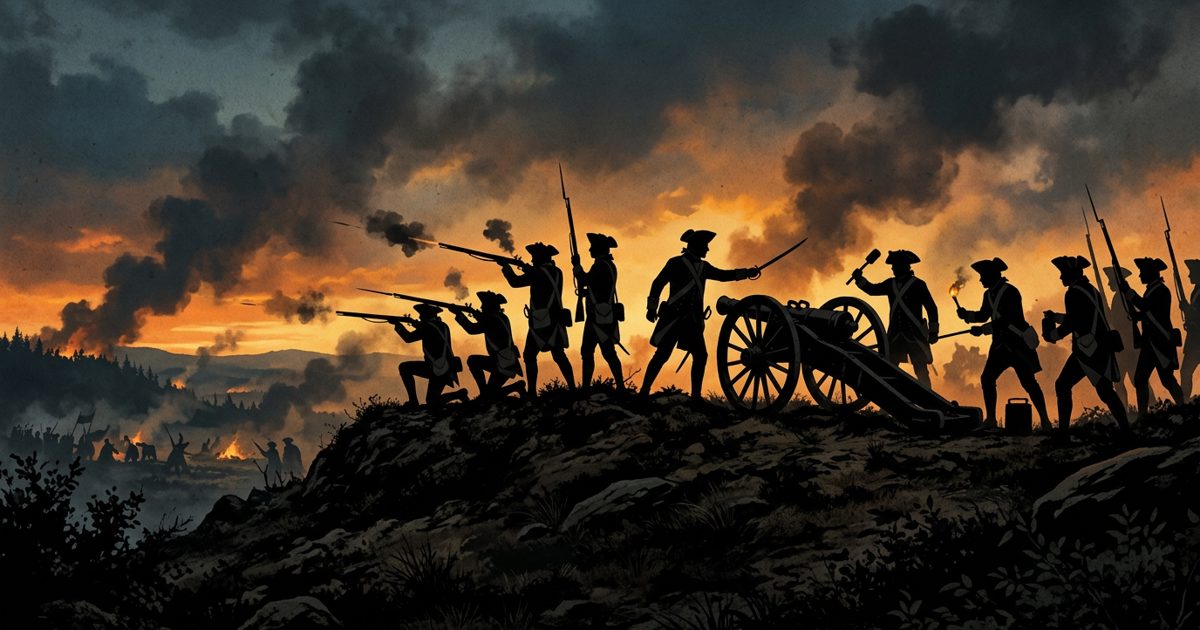
General George Washington deployed thirteen thousand Continental soldiers across the rolling ridges of White Plains to block British forces advancing through Westchester County. General William Howe directed fourteen thousand British regulars and Hessian mercenaries north in two columns to crush the American army after weeks of maneuvers across Manhattan. Continental outposts took up position on Chatterton Hill, a critical elevation rising above the Bronx River on the American right flank. Brigadier General Alexander McDougall commanded the hill with sixteen hundred troops, supported by Colonel John Haslet's Delaware regiment and Captain Alexander Hamilton's artillery battery.
British and Hessian columns slammed into the American defensive lines around mid-morning after crossing the Bronx River under intense canister fire. Captain Hamilton directed his fieldpieces with deadly precision from the crest of Chatterton Hill, repeatedly breaking up enemy attempts to ford the swollen stream. Hessian grenadiers under Colonel Johann Rall eventually secured a crossing downstream, flanking the American position while British light dragoons charged the slope. Militia units on the American right broke under the combined cavalry and bayonet assault, exposing the veteran Continental regulars to intense enfilading musketry.
Colonel Haslet conducted an orderly fighting retreat with his Delaware and Maryland Continentals, preventing the collapse of the entire flank into a rout. General Washington utilized this fighting withdrawal to reposition his main forces into fortified entrenchments on the commanding heights of North Castle. General Howe halted his advance instead of launching an immediate assault against the primary American entrenchments, awaiting reinforcements while torrential autumn rains soaked the battlefield. American casualties totaled roughly one hundred and seventy-five men killed and wounded, while British and Hessian casualties exceeded two hundred and thirty. Continental forces safely evacuated the area on November 1, preserving the army intact for the subsequent New Jersey campaign.