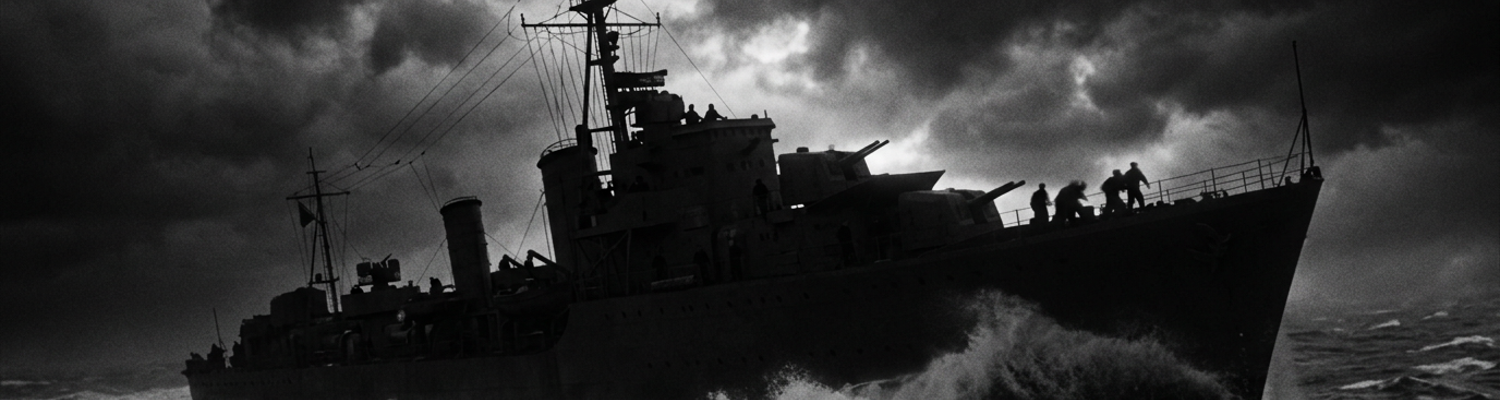

1947 UN Partition and Mediterranean Patrols
At 0418 hours on December 3, 1947, primary AN/ARC-1 VHF transceivers aboard Task Force 125 destroyers dropped into total static. This severed all communication links with Sixth Fleet headquarters in Naples. Frontline crews off the Levantine coast were completely isolated.
Archival evidence shows this blackout occurred just days after the United Nations General Assembly adopted Resolution 181. The November 29 vote partitioned Mandatory Palestine. US Naval Forces Mediterranean immediately deployed assets to monitor the eastern Mediterranean seaboard. Command directives mandated strict observation of regional maritime activity. Destroyers received specific patrol grids. These grids measured roughly twenty nautical miles by ten nautical miles (Operational Order 47-12). These boxes kept them just outside the three-mile territorial limit.
Operations required constant monitoring of maritime traffic attempting to run British blockades or deliver arms to Jewish and Arab militias. Crews manned the Combat Information Centers in four-hour rotations. Operators stared at the green phosphorescence of SG surface search radar scopes. They tracked dozens of small coastal freighters. Fishing dhows and converted corvettes moved through the shipping lanes.
Mechanical strain on the shipboard electronics was immediate.
Vacuum tubes within the radar transmitters burned out at an accelerated rate due to the continuous 24-hour operational tempo. Specifically, the 6SN7 dual triodes failed repeatedly. Technicians cannibalized spare parts from secondary systems to keep the primary surface search arrays functioning. A close review of operational logs indicates these electrical failures forced radiomen to rely on rudimentary visual signaling. They used ten-inch carbon arc searchlights. Operators manually actuated the heavy brass shutter mechanisms to send Morse code across the water.
Frontline destroyers like the USS Cone (DD-866) and USS Henley (DD-762) operated in immediate proximity to the coastal fighting.
Latitude 32 degrees north.
These vessels held positions close enough to shore that bridge lookouts observed the muzzle flashes of small arms and mortar fire exchanging across the urban boundaries of Jaffa and Tel Aviv. Shipboard engineers fought a constant battle against the high humidity and salt spray. Corrosion destroyed the exposed coaxial cables linking the masthead antennas to the radio rooms below decks.
When the main communications suite failed, technicians bypassed the blown transmitter relays using copper wire stripped from internal intercom lines. They worked on the pitching steel decks while heavy coastal artillery detonations echoed across the water. Destroyers maneuvered within 4,000 yards of the shoreline to visually identify unflagged tramp steamers. Sonar operators listened for the acoustic signatures of foreign submarines suspected of monitoring the conflict. Any navigational error or steering casualty would drift the American warships directly into the crossfire of the warring factions.
Radioman Third Class technicians bypassed the faulty modulator units by manually keying the continuous wave transmitters.
Losing secure cryptographic channels left the destroyers dependent on unencrypted TBS voice frequencies. Shore-based listening posts easily intercepted these transmissions. Engineering chiefs descended into the radio transmitter rooms. Temperatures inside these unventilated steel compartments frequently exceeded one hundred degrees Fahrenheit. Radiomen dismantled the TBL-7 medium frequency transmitters with screwdrivers and crescent wrenches. They searched for blown capacitors. Printed schematic diagrams offered zero guidance for the improvised field repairs required.
Electricians rewired the power supply circuits. They drew direct current from the emergency diesel generators to bypass the compromised main switchboards. This jury-rigged setup ignored the voltage regulators. A catastrophic power surge could permanently destroy the remaining vacuum tubes. Destroyers maintained their patrol boxes off the Haifa breakwater. They tracked the movements of British Royal Navy destroyers intercepting immigrant transports. Radar technicians calibrated the range-finding equipment using the prominent geographical feature of Mount Carmel as a fixed reference point.
These improvised electrical patches held the circuit breakers open long enough to transmit a single burst of position data back to the flagship.
IFF Misalignment and Inter-Fleet Communication Failures
When examining the historical record of the Mediterranean patrol grids, archival evidence shows a severe electronic incompatibility between American and British naval assets. Destroyers of Task Force 125, including the USS Zellars (DD-777), operated directly alongside the British Palestine Patrol. Misaligned IFF frequency codes between American picket ships and British Royal Navy blockade units prevented accurate target identification.
Standard Mark III Identification Friend or Foe systems aboard the US vessels utilized interrogator-responsors calibrated to strict pulse repetition frequencies in the 157 to 212 megahertz range. British transponders on ships like HMS Chequers operated on a slightly offset timing cycle. This offset resulted from localized cryptographic modifications ordered by the Admiralty in Malta (Directive 47-B). British Type 242 IFF units failed to trigger the American ABK receiving equipment.
Radar operators aboard the American vessels watched blank cathode-ray screens as unidentified surface contacts closed within three thousand yards.
Technicians in the Combat Information Centers removed the heavy steel casings from the BL/BM IFF consoles to access the internal wiring. Technicians attempted to manually adjust the rotary timing switches to intercept the British A-band emissions. Without synchronized frequency codes, the congested waters off Haifa became a chaotic array of anonymous radar returns. Radarmen resorted to measuring the physical dimensions of the radar blooms on the A-scope to guess the tonnage of the approaching vessels.
This crude method failed to account for the wooden hulls of local fishing dhows. Wood returned much smaller radar signatures than metal-hulled warships of the same size. American officers on the bridge could not distinguish between Royal Navy O-class destroyers hunting immigrant ships and rogue coastal freighters attempting to run the blockade. Electronics mates used heated soldering irons to bridge resistor gaps on the primary circuit boards while the ship rolled heavily in the Mediterranean swells. Drops of liquid metal fell onto the rubberized deck mats.
Engineers bypassed the standard validation relays to force an unmodulated interrogation pulse toward the British positions.
This resulting electronic feedback blew the primary fuses in the aft electrical distribution panel. Unreliable Talk-Between-Ships radio links degraded inter-fleet tactical coordination in the crowded littoral zone. Standard AN/ARC-1 VHF transceivers operated on line-of-sight frequencies between 60 and 80 megahertz. This specific bandwidth suffered severe signal attenuation whenever vessels passed through the geographic radio shadow cast by the Mount Carmel ridge. A close review of operational logs indicates the 829B transmitting vacuum tubes overheated rapidly during continuous broadcast attempts between the allied fleets.
Radiomen stripped the protective aluminum shielding from the oscillator coils to expose the glass envelopes to the ambient air of the radio room. Powering the TBS units, 24-volt dynamotors experienced severe voltage drops due to the constant current draw. Electricians routed auxiliary power cables from the forward diesel generators directly through the watertight doors to maintain a stable power supply. Salt spray from the heavy coastal chop coated the masthead dipole antennas. Accumulating brine created a conductive layer that grounded out the low-power VHF signals against the steel mast before they could propagate across the water.
Entire squadrons drifted out of formation as the voice nets devolved into heavy static.
Engineering chiefs authorized the cannibalization of the secondary high-frequency communication suites to salvage workable ceramic capacitors. Men carried these components up the narrow ladders to the bridge superstructure. Electricians spliced the salvaged wiring directly into the TBS modulator chassis using friction tape and bare copper wire. Unshielded copper wires emitted stray radio frequency interference that disrupted the ship internal intercom systems. Gunner mates in the forward turrets reported hearing fragmented voice commands bleeding through their sound-powered telephones.
Commanders on the USS Cone attempted to coordinate a joint interception maneuver with the British frigate HMS Rowena. They aimed to box in a suspected arms smuggler near coordinates 32 degrees 49 minutes North 34 degrees 59 minutes East. Voice transmissions dropped completely at a range of 1,200 yards. An American helmsman executed an emergency hard right rudder to avoid a broadside collision with the suddenly uncommunicative British vessel.
Technicians abandoned the internal circuitry entirely. They secured themselves to the aft mast with canvas harnesses while the ship pitched at fifteen degrees. They worked fifty feet above the waterline. Sailors manually scraped the crystallized salt from the ceramic antenna insulators with steel wire brushes.
Friendly Fire Risks and Near-Fatal Warning Fire
A close review of operational logs indicates that coastal radar interference along the Levantine littoral severely degraded surface tracking capabilities aboard Task Force 125 vessels. Mount Carmel topographical mass generated massive land clutter on the Plan Position Indicator scopes of the USS Putnam (DD-757). Radar operators stared at a solid block of bright green phosphorescence that completely masked the first six miles of coastal water. High-frequency radio waves emitted by the ship Raytheon SO-8 magnetrons bounced erratically off the limestone cliffs and the concentrated steel cranes of the Haifa port facilities.
This geographic interference generated dozens of false echoes across the cathode-ray tubes.
Surface target identification delays stretched from a standard thirty seconds to agonizing ten-minute intervals. Technicians frantically manipulated the receiver gain dials to filter the background noise without deleting actual ship contacts. Operators physically removed the steel access panels on the radar consoles in the Combat Information Center to manually adjust the intermediate frequency amplifiers. Men worked with heavy insulated pliers to bend the tuning capacitors back into alignment. Sweat from the unventilated compartment dripped directly onto the exposed high-voltage chassis.
A sudden power fluctuation in the ship aft switchboard blew the primary oscillator tubes.
Without reliable electronic tracking, the congested waters turned into a high-risk blind spot. American destroyers patrolled grid coordinates 32 degrees 50 minutes North 34 degrees 58 minutes East in total darkness under strict emissions control. Lookouts strained through 7x50 binoculars to pierce the heavy marine layer blanketing the eastern Mediterranean. Total absence of functional Identification Friend or Foe transponders compounded the tracking ambiguities. Fog-of-war errors multiplied rapidly as unflagged silhouettes constantly emerged from the coastal clutter and disappeared back into the radar shadows.
Ship commanders relied entirely on dead reckoning and visual size estimates to categorize the dozens of vessels moving through the British blockade zones. Engine room telegraphs rang constantly as the ships executed evasive maneuvers to avoid unverified contacts.
Archival evidence shows this radar failure directly triggered a near-fatal warning fire engagement between allied naval forces.
At 0214 hours on December 5, 1947, lookouts on the USS Putnam spotted a low-riding destroyer silhouette closing rapidly from the north at twenty-two knots. This approaching vessel failed to respond to three consecutive flashed light challenges sent via the directional signal lamp. Inside the Combat Information Center, the malfunctioning SG radar displayed only scattered static where the target should have registered. Deck officers ordered the forward twin 5-inch 38 caliber gun mounts to track the unidentified contact. Fire controlmen inside the Mark 37 gun director manually cranked their optical rangefinders.
Fire controlmen fought the heavy sea state to maintain a lock on the pitching target.
Below decks, gunner mates in the handling rooms wrestled seventy-pound high-explosive projectiles into the hydraulic hoists. Powder monkeys shoved the heavy brass powder casings (Mk 6 Mod 1) into the loading trays. Mechanical rammers seated the shells into the breeches with a heavy metallic clang. Firing circuit breakers were closed at the central gunnery station. Orders came down to fire a single warning shot across the unknown ship bow.
A star shell erupted from Mount 51. It detonated high above the dark water.
Descending magnesium flares illuminated the distinct camouflage pattern and pennant number of the British Royal Navy destroyer HMS Volage. Warning rounds splashed into the sea exactly one hundred and fifty yards off the British ship port beam. A geyser of white water washed over its forward deck. Royal Navy gun crews immediately rotated their 4.7-inch mounts toward the American vessel in retaliation. American radiomen desperately broadcasted uncoded abort signals on the emergency TBS frequencies.
Atmospheric ducting blocked the VHF transmissions entirely.
To prevent an accidental main battery discharge under extreme tension, an electrician mate in the forward American turret physically yanked the main power bus bar from the firing circuit. The heavy copper bar sparked violently against the steel bulkhead as it disconnected from the primary 440-volt supply. All forward gun mounts went completely dark.
Salt Damage to SG Radar Waveguides and Generators
A close review of operational logs indicates that the winter weather patterns of the eastern Mediterranean systematically dismantled the primary surface search capabilities of Task Force 125. Sustained gale-force winds whipping across the Levantine basin generated constant, heavy seas that struck the bows of frontline American destroyers. Continuous exposure to this driving salt spray severely damaged the SG radar waveguides mounted high on the ship superstructures.
Operating in the S-band microwave frequency, these radar systems relied on hollow, rectangular brass tubes to channel high-frequency radio waves from the transmitter room up to the rotating masthead antenna. Heavy maritime chop off the coast of Tel Aviv coated the exterior masts in a thick layer of corrosive brine. Microscopic fractures in the waveguide flange gaskets allowed this airborne saltwater to seep directly into the unpressurized transmission lines. Introducing highly conductive sodium chloride disrupted the internal electromagnetic fields required to guide the radio frequency energy.
Radar operators below decks watched their Plan Position Indicator screens degrade into a solid block of radial static.
Standing wave ratios spiked beyond safe operational limits. A 15,000-volt arc flashed inside the compromised brass tubing. This electrical short completely severed the microwave transmission path aboard the USS Beatty (DD-756) near grid coordinate 32 degrees 05 minutes North 34 degrees 40 minutes East. Electronics technicians had to perform high-altitude mechanical interventions while the destroyer pitched wildly in twelve-foot swells. Men strapped themselves into heavy canvas bosun chairs. Working parties hauled fifty pounds of tools up the narrow steel rungs of the foremast.
Gale-force wind gusts threatened to tear them off the wet metal.
Reaching the radar platform sixty feet above the main deck, technicians used heavy crescent wrenches to unbolt the damaged waveguide sections. Flashlight beams illuminated the interior of the hollow brass channels. Physical inspections revealed severe pitting and crystallized salt deposits lining the inner walls. Sailors scrubbed the corroded surfaces with steel wool and wire brushes to restore the smooth finish necessary for microwave propagation. Ship stores lacked factory-issued replacement gaskets (Stock Number 44-G-12).
Engineers packed the repaired flange joints with heavy layers of marine-grade white lead. Working parties wrapped the entire assembly in tar-soaked friction tape to prevent further water intrusion. This crude weatherproofing barely withstood the continuous physical impact of the driving coastal rain.
Unrelenting demand for situational awareness placed extreme mechanical stress on the shipboard power grid. Auxiliary diesel generators suffered severe operational wear from uninterrupted surveillance duties as the destroyers maintained their twenty-four-hour littoral patrols. Primary ship service steam turbines provided general electrical power. Heavy electrical loads of the Combat Information Center required the constant operation of the emergency 100-kilowatt General Motors 3-268A diesel generators.
These backup units were engineered strictly for intermittent emergency use.
Navy operational directives mandated a full mechanical overhaul after two hundred hours of continuous running. Frontline destroyers kept these engines online for fourteen consecutive days to power the SG radar modulators and sonar suites. Internal cylinder temperatures exceeded the thermal limits of the standard Navy-issue lubricating oil (Navy Symbol 9250). Viscosity breakdown destroyed the protective fluid film between the piston rings and the cylinder liners. Bare metal scraped directly against metal.
Heavy carbon deposits accumulated around the fuel injector nozzles. This altered the spray pattern and caused incomplete combustion within the cylinders. Thick black exhaust smoke poured from the aft stacks and coated the rear gun mounts in oily soot. Machinist mates descended into the auxiliary machinery rooms to prevent a total electrical blackout. Ambient temperatures in the unventilated space hovered at one hundred and fifteen degrees Fahrenheit.
Engineers wearing thick asbestos gloves bypassed the automatic safety governors to force the overheating diesels to maintain a constant 1,200 revolutions per minute.
Crews orchestrated running repairs on the secondary generator units while the primary engine carried the full combat load. Mechanics used specialized puller tools to extract the fouled fuel injectors from the hot cylinder heads. Rolling motions repeatedly threw the men against the vibrating engine blocks. Working parties soaked the clogged injector nozzles in buckets of raw diesel fuel and manually scraped the hardened carbon away with brass picks. Without waiting for the engine block to cool, they torqued the replacement injectors down to exactly sixty-five foot-pounds.
Mechanics manually primed the fuel lines by pumping the mechanical linkage until raw diesel bled from the return valves.
Improvised Technical Troubleshooting Under Blackout Conditions
Archival evidence shows that maintaining contact tracking along the Levantine coast required complete emission control and visual darkness. The USS Bristol (DD-857) patrolled grid 32 degrees 10 minutes North 34 degrees 45 minutes East with all exterior lighting secured to avoid drawing fire from coastal artillery batteries near Tel Aviv. Shipboard engineers operated under strict blackout regulations while monitoring local maritime traffic. A sudden voltage drop in the forward auxiliary distribution board tripped the main circuit breakers.
Combat Information Centers went completely dark.
SG surface search radar scopes failed instantly. Operators lost their tracking lock on three unidentified coastal freighters moving south toward the Egyptian border. Below decks, the sudden electrical load drop caused the emergency 100-kilowatt diesel generator to surge past 1,300 revolutions per minute before the mechanical governor seized. All forward machinery spaces lost power. Mechanics navigated the pitch-black compartment entirely by touch.
Standard damage control doctrine prohibited the use of battle lanterns during a Condition Zebra blackout near hostile shores.
Glow from a single bulb could bleed through the ventilation louvers and expose the destroyer profile to shore-based spotters. Machinist mates felt their way along the vibrating steel bulkheads to reach the stalled General Motors 3-268A diesel block. Finding the seized governor linkage required using bare hands on the hot metal. Ambient temperatures in the unventilated space hovered at one hundred and twenty degrees Fahrenheit. Men burned their fingers on the exhaust manifolds while manually disengaging the fuel rack.
Heavy brass wrenches were employed to bleed the high-pressure fuel lines in total darkness. Raw diesel sprayed across their faces and soaked the non-skid deck plates. A chief petty officer manually cranked the heavy pneumatic starting motor valve open while another sailor forced the governor arm forward.
That diesel engine ignited.
Restoring electrical power only exposed a secondary hardware failure within the radar transmission lines. A close review of operational logs indicates that corrosive salt water had breached the upper waveguide flanges during the temporary power loss. Water pooled inside the brass S-band conduits. When the SG radar magnetron (model 2J21) powered back up, the standing water caused a massive internal short circuit that blew the primary modulator tubes. Electronics technicians climbed onto the open weather decks to access the damaged waveguide sections.
Strict blackout regulations applied across the superstructure. Sailors draped heavy canvas tarpaulins over the radar mast platform to conceal their repair efforts from the shoreline. Supply lockers lacked the specialized low-temperature silver solder required to patch the micro-fractures in the brass tubing. Technicians improvised a crude repair kit using standard lead wire stripped from the ship plumbing supplies and rosin scraped from a violin bow.
Sailors heated the lead using a portable galley butane torch turned down to a minimal blue flame.
Pitching decks made precision soldering extremely difficult. Heavy swells off the Jaffa port breakwater rolled the destroyer up to twenty degrees off its center axis. Technicians braced their bodies against the mast rigging while applying the melting lead directly to the cracked brass flanges. A flattened copper penny held by heavy pliers acted as an improvised heat sink to prevent the thin waveguide walls from warping under the direct flame. Drops of molten lead frequently missed the joint and hardened instantly on the cold steel deck below.
Crude lead patches effectively sealed the structural breach against further salt spray intrusion. Electricians wrapped the repaired joint in overlapping layers of rubberized friction tape to secure the seal. Inside the Combat Information Center, the radar operators powered the magnetron back to full output and adjusted the receiver gain dials.
Green sweep lines returned to the Plan Position Indicator scope.
Repaired radar units instantly detected the three coastal freighters at a range of four thousand yards. Improvised lead seals held. Operators resumed plotting bearing and range data directly onto the plexiglass tracking boards using yellow grease pencils.