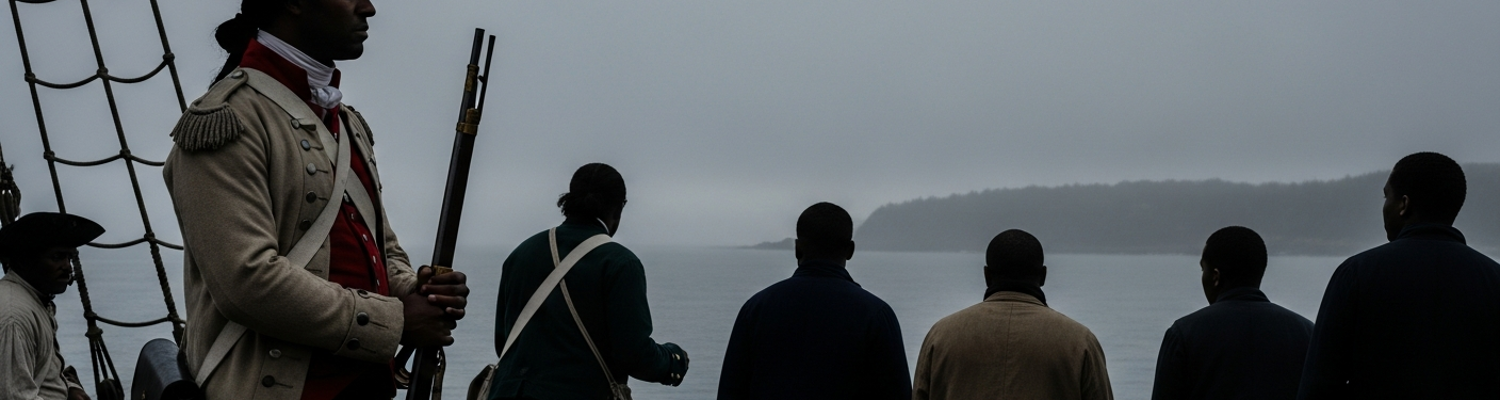

Dunmore's Desperate Proclamation
The intersection of British military strategy and Black aspirations for freedom began in the volatile autumn of 1775. John Murray, the 4th Earl of Dunmore and Virginia's last Royal Governor, found his authority collapsing. Driven from the capital at Williamsburg by escalating revolutionary fervor, he established a floating command post within a flotilla of Royal Navy vessels off the coast. From this isolated position, facing a growing Patriot militia on land, Dunmore made a calculated decision intended to shatter the rebellion's logistical and social spine.
On November 7, 1775, from the warship HMS William, he issued a proclamation that declared martial law. Its most explosive provision offered freedom to "all indentured Servants, Negroes, or others, (appertaining to Rebels,) free that are able and willing to bear Arms." This was not an act of abolitionist sentiment. It was a pragmatic, even desperate, military maneuver. Dunmore sought to bolster his own thin ranks while simultaneously depriving the planter class, which formed the rebellion's leadership, of its primary labor source. The proclamation aimed to turn the Patriots' greatest economic asset into a direct military threat against them.
The response was immediate and overwhelming. Hundreds of enslaved men risked capture and brutal punishment to reach Dunmore's floating sanctuary. Within weeks, an estimated 800 had successfully made the perilous journey, with perhaps 2,000 attempting it. From these first volunteers, Dunmore organized the Royal Ethiopian Regiment. The name was a deliberate choice, employing a contemporary term for Africans that was considered dignified. The regiment's uniforms bore the incendiary motto "Liberty to Slaves," a direct challenge to the Patriot cause.
This unit, commanded by white officers but composed entirely of Black soldiers, was armed, drilled, and prepared for immediate combat. The formation of a uniformed, armed Black regiment sent a wave of panic through the southern colonies.
The Ethiopians saw action almost at once. A week after the proclamation, they participated in a British victory at Kemp's Landing, routing a Patriot militia force. The tactical and psychological impact was significant. Their most defining engagement, however, occurred on December 9, 1775, at the Battle of Great Bridge. In a poorly conceived attempt to dislodge an entrenched Patriot force blocking the land route to Norfolk, Dunmore ordered a frontal assault across a narrow causeway. The Ethiopian Regiment participated in the attack alongside British regulars.
The assault was a tactical disaster, resulting in a decisive British defeat and heavy casualties. The battle itself was a minor part of the regiment's operational reality. The true enemy was disease. Crowded onto naval vessels with poor sanitation and inadequate provisions, the soldiers and the hundreds of other refugees with them fell victim to a smallpox epidemic. The virus swept through the flotilla, incapacitating and killing far more men than Patriot muskets ever could.
By the summer of 1776, Dunmore's position became untenable. He abandoned Virginia, sailing for New York with his remaining forces. This included about 300 survivors of the Ethiopian Regiment. The unit was formally disbanded, and its remaining soldiers were absorbed into other British formations.
Though the regiment's existence was brief and tragic, Dunmore's decision established a powerful precedent. It proved to British commanders that enslaved people represented a vast, motivated pool of potential manpower, introducing a potent new variable into the war's strategic calculus.
The Philipsburg Proclamation and the Pioneers
As the war expanded, British leadership refined and broadened Dunmore's initial policy. In 1779, the Commander in Chief of British forces in North America, General Sir Henry Clinton, issued the Philipsburg Proclamation from his headquarters in Westchester County, New York. This decree significantly expanded the offer of freedom. Unlike Dunmore's proclamation, which was limited geographically and required military service, Clinton's offered liberty to any enslaved person owned by a Patriot who escaped to British lines. This offer was unconditional, requiring no promise to bear arms.
The decision signaled a major strategic shift towards economic warfare. Clinton aimed to destabilize the entire rebel economy by systematically draining it of its labor force. The proclamation triggered a mass exodus, particularly during the British Southern Campaign led by General Lord Cornwallis from 1780 to 1781. Thousands of men, women, and children fled plantations and sought refuge with the British columns, creating a large, mobile contingent of liberated people.
While a few would serve in combat roles, the British army organized the vast majority into noncombatant auxiliary units. The most prominent of these were the Black Pioneers. In 18th century military terminology, a pioneer was a soldier tasked with engineering, construction, and logistical support. The Black Pioneers became an indispensable component of the British war machine, performing the grueling labor that sustained the army on the march.
These units, typically organized into companies of 50 to 100 men under the command of white engineering officers, handled a wide array of mission critical tasks. They cleared forests to create roads for artillery and supply wagons. They built fortifications, digging trenches and erecting redoubts, often under enemy fire. They constructed barracks, repaired bridges, and managed the vast supply trains that were the lifeblood of any campaign.
In occupied cities like Charleston and Philadelphia, their duties extended to sanitation and public works, keeping the cities functional for the occupying army.
Their labor was not safe. Pioneers often operated at the front, repairing damaged defenses or clearing obstructions during active engagements. They were issued tools, not always weapons, and received minimal military training. Yet their work was vital to the army's logistical tail and operational mobility.
Commanders like Clinton and his chief engineer, Major James Moncrief, depended heavily on this mobile workforce. The Black Pioneers provided the muscle that allowed regular British and Hessian soldiers to focus on combat duties. Their knowledge of local terrain also made them effective guides through the swamps and forests of the South.
Sergeant Thomas Peters, a former slave from North Carolina who escaped to British lines, served in the Black Pioneers and rose to a position of leadership, a testament to the meritocratic possibilities within the corps.
By integrating thousands of self emancipated people into these structured support roles, British commanders executed a policy that simultaneously hobbled the Patriot war effort and provided a pathway to freedom. The price of that freedom was hard labor, exposure to disease, and the constant dangers of a military campaign. It was a price thousands willingly paid.
The Book of Negroes and an Uncertain Freedom
The British surrender at Yorktown in October 1781 did not conclude the story for the thousands of Black Loyalists who had gambled their futures on a Crown victory. The provisional peace agreement, the Treaty of Paris signed in 1783, contained a clause that created a final, tense confrontation. Article 7 of the treaty stipulated that the British were to withdraw all their forces from the United States without "carrying away any Negroes or other Property of the American Inhabitants."
This language placed the final British Commander in Chief, Sir Guy Carleton, in a moral and legal bind. He was obligated to honor the treaty, but he was also bound by the explicit promises of freedom made by his predecessors, Dunmore and Clinton.
In a series of tense meetings with General George Washington in the spring of 1783, Carleton was resolute. He argued that any person who had reached British lines under the promise of the proclamations was now free. To return them to their former owners would be a dishonorable breach of public faith. He refused to do it.
As a pragmatic compromise, Carleton proposed a meticulous accounting of every Black person evacuating with the British from their last stronghold in New York City. This registry would create a detailed record, allowing American owners to seek financial compensation from the British government for their lost "property" at a later date.
This ledger became known as the "Book of Negroes." Compiled under the direction of Brigadier General Samuel Birch, it remains a remarkable historical document. For several months in 1783, at inspection points like Fraunces Tavern in Manhattan, a joint British American commission reviewed the Black passengers boarding the evacuation ships. Clerks recorded the names of approximately 3,000 men, women, and children. They noted their ages, physical descriptions, and whether they were born free or had escaped. The ledger often includes the name and location of their former owner and the year they joined the British.
For each person deemed eligible, the commission issued a certificate of freedom signed by General Birch, a document that served as their passport to a new life.
The primary destination for these evacuees was Nova Scotia. Over 3,500 Black Loyalists ultimately settled in the British colony, founding communities like Birchtown, which briefly became the largest settlement of free Blacks in North America. The promise of "Freedom and a Farm," however, proved largely illusory. They arrived late in the year to a harsh climate, received inadequate provisions, and were granted smaller, less desirable plots of land than their white Loyalist counterparts. Many faced systemic prejudice, economic exploitation, and outright violence, culminating in the 1784 Shelburne Riot, where white soldiers and settlers attacked the Black community.
The hardships in Nova Scotia prompted a further chapter in the diaspora. Dissatisfied with broken promises, nearly 1,200 Black Loyalists, organized by leaders like Sergeant Thomas Peters, accepted an offer from the British abolitionist Sierra Leone Company. In 1792, a fleet of 15 ships sailed from Halifax, carrying them to West Africa to found a new colony named Freetown.
Carleton's decision to honor the Crown's promise, meticulously documented in the Book of Negroes, had profound consequences. It secured the physical liberty of thousands and led directly to the creation of foundational Black communities in Canada and Sierra Leone, a lasting legacy of resilience forged in the crucible of war.