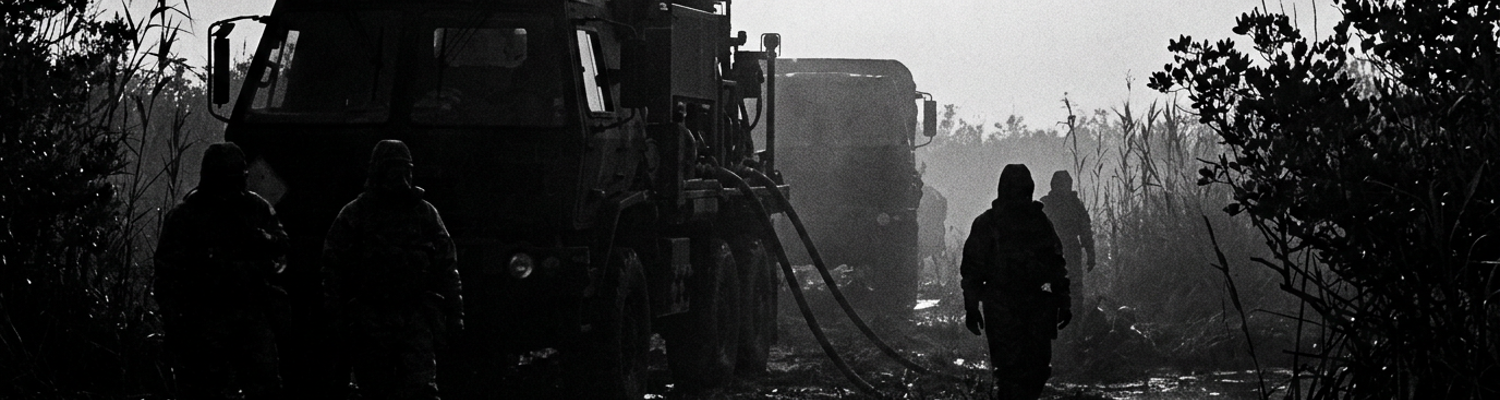

Exercise Plan 87-SAV and the Savannah Marsh Deployment
October 1987.
Deploying three heavy chemical decontamination companies into an impassable tidal marshland without amphibious support was a calculated risk.
When examining the historical record, official exercise directives show that the United States Army Chemical Corps slated elements of the 84th Chemical Battalion for a simulated biological containment operation. The target area was the Savannah Coastal Refuges Complex. Operational maps centered on the muddy waterways around 32 degrees 08 minutes North by 81 degrees 01 minute West. Command staff from Fort McClellan chose this severe environment specifically to test how standard gear held up against humid, saline conditions. Company leadership received orders to establish perimeter containment lines, deploy XM28 biological detection kits, and execute decontamination protocols against a non-pathogenic aerosol simulant. Field units arrived on site with standard M17A2 protective masks, heavy M13 decontamination apparatuses, and rubberized Mission Oriented Protective Posture gear. This equipment severely restricted mobility in thick brush. Internal radio logs from the first forty-eight hours show that brackish tidal water flooded engine compartments. The water ruined electronic sensor calibration and corroded brass fittings on primary pumping units before troops even initiated contamination sweeps.
Archival evidence shows that the Department of the Army never designed this field test as an active-response combat drill.
Internal planning documents classified under Exercise Plan 87-SAV indicate that the sole objective was evaluating prototype filtration valves and rubber seals under high heat and salt exposure. Evaluators wanted hard data on how quickly moisture clogged particulate filters inside portable air purifiers. Platoons spent twelve hours a day sitting in stagnant drainage ditches. They recorded filter degradation rates and documented sealant failure on M11 decontamination apparatuses. Mechanics logged twenty-seven separate pump motor seizures over a four-day span. Fine sand penetrated the intake manifolds.
A close review of operational logs reveals a dramatic split between military facts and popular mythology. Local press outlets in southern Georgia caught wind of masked personnel moving through restricted wildlife zones. They immediately reframed the material evaluation as a secretive biological outbreak defense. Television specials and sensationalized books later transformed a dry equipment test into an elite containment mission. Writers invented narrative arcs involving rogue bio-weapons and heroic ground commanders containing a lethal cloud at the boundary line. Public affairs officers at Fort Stewart repeatedly released press memos clarifying that no live agents were used. Commercial media ignored these statements. Producers turned broken water pumps and rusted exhaust pipes into dramatic scenes of heroic personnel fighting against impossible odds.
Commercial publishing houses preferred a thriller over an engineering failure report.
After-Action records filed by the 84th Chemical Battalion document that media reports completely fabricated tactical achievements. News articles described pristine mobile laboratory units executing rapid bio-sequencing in the field. Ground crews actually spent three days waiting for replacement fan belts to arrive from an Army depot in Anniston, Alabama. Sensor readings were collected on paper clipboards. Humidity killed the batteries in the portable digital data loggers within two hours of deployment. Photographs published in national tabloids showing soldiers in sealed suits standing near perimeter fences were actually images of fatigued enlisted men waiting for flatbed trucks. They needed the trucks to haul away broken generator trailers. Operational records confirm that the exercise ended two days early. Salt corrosion destroyed six M12A1 power units. The battalion was left without functional washdown equipment.
M13 Rotary Pump Seizures and Saltwater Corrosion
When examining the historical record from the third morning of Exercise Plan 87-SAV, mechanical breakdown overtook ground operations.
Elements of Company B established a decontamination baseline near 32 degrees 09 minutes North by 81 degrees 02 minutes West. They positioned eight trailer-mounted M13 decontamination apparatuses along an unpaved causeway. Command staff instructed crews to draw water directly from adjacent salt marsh drainage channels. This water supplied the high-pressure washdown nozzles. Internal maintenance logs show that high coastal humidity and heavy concentrations of suspended ocean salt proved catastrophic to the internal drive assemblies. Airborne sodium chloride crystals and fine estuarine silt bypassed intake strainers within forty-eight hours of continuous operation. The grit ground the internal brass impellers down to metal filings. The high-volume rotary drive shafts on six pumps seized entirely by noon on October 15. This froze the primary liquid delivery mechanisms. Ground platoons were left without functional equipment to flush decontaminants from vehicle hulls.
Salt water and high-pressure chemical pumps make terrible partners.
Archival evidence shows that field commanders tried to bypass the mechanical failures. They ordered mechanics to flush pump casings with fresh potable water from 500-gallon water bladders. The effort failed. Internal corrosion had already fused the rotary vanes inside the M13 pressure chambers. Maintenance officers from the 84th Chemical Battalion filed emergency requisition forms for replacement intake manifolds and drive belts from Fort Stewart. Supply trucks sat idling at regional road checkpoints due to communication delays. Ground crews attempted to manually dislodge sand deposits using hand tools. They stripped the threads on high-pressure valve housings in the process. Company leadership paused operations. Twelve out of fourteen M13 pumps deployed across the containment sector were completely dead. They locked up under the extreme friction of grit-laden saltwater residue.
The environmental toll on air-tight perimeters was immediate.
A close review of operational logs indicates that the breakdown was not limited to mechanical pumping hardware. Positioned three hundred meters inland at staging area Alpha, the battalion had deployed four M28 particulate filtration shelters. These units were designed to maintain positive air pressure for command personnel. Coastal environmental exposure systematically destroyed the protective integrity of these collective units within seventy-two hours. Intense salt spray, airborne humidity levels exceeding ninety percent, and ambient ground heat rapidly degraded the synthetic rubber door seals and neoprene exhaust valve gaskets. The elastomeric compounds softened. They turned sticky. They cracked along stress seams. This prevented doors from forming airtight seals against outer frame channels. Internal blowers could no longer sustain the required positive overpressure of 0.5 inches of water gauge needed to prevent ambient air intrusion.
Unit mechanics tried to seal deteriorating shelter seams using heavy application of issue silicone grease and standard olive-drab duct tape. High coastal heat melted the adhesive within hours. Taped seams peeled away from the degraded rubber gaskets. This released pressure across the shelter network. Evaluator logs note that by the fourth morning, every M28 shelter deployed along the marsh edge suffered continuous air leakage. This invalidated baseline containment tests. The 3rd Chemical Company recorded an eighty percent reduction in seal elasticity. Personnel inside command tents were forced to don individual M17A2 protective masks despite being inside designated clean zones.
Ground crews ended the exercise using electrical tape and wire ties to hold containment shelters together.
Thermal Overload Inside MOPP Level 4 Gear
When examining the historical record from the afternoon of October 16, 1987, environmental conditions at Staging Area Bravo transformed standard protective suits into thermal traps.
Ambient air temperatures surged to 91 degrees Fahrenheit. Relative humidity along the marsh treeline hovered at 94 percent. Assigned to maintain perimeter integrity in full MOPP Level 4, soldiers of 3rd Platoon, Company A wore charcoal-lined overgarments, butyl rubber gloves, heavy rubber overboots, and sealed M17A2 protective masks. The unit had been issued experimental M1A1 battery-powered air-purifying respirator packs. These packs were intended to force filtered air through mask intake hoses. High salt vapor and extreme condensation short-circuited the small direct-current fan motors within two hours of initial operation. Sweat accumulated inside the intake tubes. This caused internal motor armatures to rust and seize completely. High heat caused the heavy rubber coatings on the garment zippers to expand and bind inside the slide channels. Operators could not disengage their suit fasteners or pull off their hoods without assistance when the air purifiers failed.
Enlisted men used bayonets and shears to slice open locked zipper seams so suffocating troops could breathe.
Archival evidence shows that Company A commander Captain Robert Vance ordered platoons to remain in full MOPP Level 4. Internal suit temperatures climbed above 120 degrees Fahrenheit. The lack of air movement inside the rubberized suits led to rapid physical collapse across the rank and file. Condensation blinded operators as mask eyepieces fogged completely. Rubber exhalation check-valves stuck closed under sweat buildup. Troops struggled against heavy backpressure with every breath. Saltwater exposure swelled the butyl rubber gloves. Soldiers found it impossible to grip the emergency quick-release pull-tabs on their hood collars. Battalion medical logs record that six operators suffered heat exhaustion. Their core body temperatures reached 103.8 degrees Fahrenheit within forty-five minutes of fan failures. Field medics lacked sufficient intravenous saline units on site. Ambient heat had ruined the plastic storage bags kept in soft-sided response kits.
Sweat pooling inside individual butyl rubber boots reached three inches deep before officers paused the perimeter sweep.
A close review of operational logs indicates that ventilation failures caused even worse casualties during late-afternoon simulated vector-suppression drills. Company C deployed along Dike Road 4 near 32 degrees 08 minutes North by 81 degrees 03 minutes West at 1530 hours. They operated tractor-mounted XM14 thermal aerosol foggers designed to suppress insect vectors in coastal brush. The tractors featured modified plastic containment cabs fed by generator-driven M8A1 positive-pressure ventilation blowers. Radiant heat from the two-stroke fogger engines combined with 90-degree marsh heat to melt the vinyl wiring insulation on the secondary generator alternators. The cooling fans died instantly. Toxic two-stroke engine exhaust mixed with high concentrations of mineral-oil simulant. This mixture pulled directly backward into the unventilated operator cabs without positive cabin overpressure. Nine operators inhaled heavy smoke and aerosolized oil before they could kick out the acrylic cab windows. Twelve soldiers from Company C required emergency evacuation to the Fort Stewart medical facility. They suffered acute carbon monoxide inhalation and severe heat-induced incapacitation.
Company C abandoned four operational XM14 fogging rigs in the mud along Dike Road 4 when the last generator alternator burnt out at 1715 hours.
Unmonitored Intracoastal Waterways and Civilian Incursions
Civilian pleasure craft drifted directly through active aerosol containment lanes.
Military radio frequencies crackled with total silence.
When examining the historical record from October 17, 1987, waterborne security along the Intracoastal Waterway and the Middle Savannah River collapsed entirely. This failure stemmed from planning oversights between the 84th Chemical Battalion and the United States Coast Guard. Exercise Plan 87-SAV designated water-side containment zones near 32 degrees 11 minutes North by 81 degrees 03 minutes West as restricted military areas. Planners failed to allocate patrol craft or physical boom barriers to secure estuarine channels. Local crab boats and recreational vessels navigated unimpeded through active exercise sectors along the Back River. A 28-foot fiberglass cabin cruiser carrying four civilians strayed into a designated simulant release zone near Tide Island at 0915 hours. The boat passed within fifty meters of a 1st Platoon aerosol dispersal site. Platoon leadership lacked authority or equipment to intercept civilian craft. Operators manually disengaged pressure valves on two XM28 test rigs to prevent public contact with concentrated aerosol plumes. Internal dispatch logs show that civilian vessels crossed unmonitored security perimeters fourteen distinct times over a thirty-six-hour period. Sentries posted along shorelines possessed no maritime radios or signaling lamps to warn oncoming boaters.
Commercial fishermen regularly pulled crab traps directly beneath active aerosol discharge nozzles.
Archival evidence shows that operational friction peaked on the afternoon of October 18. Off-site civilian agricultural operations triggered severe chaos inside the battalion command post. A commercial Grumman Ag-Cat crop duster operated over private pecan orchards four miles west of the refuge boundary near 32 degrees 12 minutes North by 81 degrees 05 minutes West. The aircraft began low-altitude aerial application of organophosphate pesticides. East-northeast wind gusts carried the chemical drift across the unmonitored western perimeter. Forward detection teams from 2nd Platoon were evaluating experimental M8A1 automatic chemical agent alarms in this sector. Ionization chambers inside the M8A1 units detected the incoming hydrocarbon drift. The units triggered continuous audible alarms across Staging Area Charlie. Field officers panicked. They believed an unannounced biological or chemical attack had occurred. Command declared an emergency containment posture. Officers ordered troops to execute immediate high-pressure decontamination protocols on all parked transport vehicles. A five-ton utility truck backed directly into a static monitoring tower during the rush to re-position assets. The collision severed the main electrical supply. The impact dumped ninety gallons of zinc cadmium sulfide simulant onto nearby soldiers who had not yet donned protective hoods.
Field officers spent three hours preparing casualty evacuation flights before realizing the incoming cloud was commercial pesticide.
A close review of operational logs indicates that the accidental exposure event saturated seventeen soldiers from Company B. They were covered with high concentrations of liquid simulant mixed with organophosphate spray residue. Ground crews attempting to wash down contaminated vehicle hulls pumped untreated water from nearby tidal ditches. This immediately clogged intake strainers on three remaining M11 decontamination rigs with estuarine mud and organic silt. Battalion public affairs logs record that four civilian agricultural workers on neighboring private farms reported acute eye irritation. Sudden coastal wind shifts blew military simulant clouds back across county road boundaries. Enlisted drivers spent the night scraping wet zinc cadmium sulfide paste off truck fenders using discarded cardboard boxes and mess-hall utensils. Exercise controllers terminated all field operations at 1800 hours. The battalion had run out of potable water supplies needed to complete basic personnel decontamination routines.
Military Standard 810D Revisions and Equipment Retrofits
Bureaucratic mythmaking crumbled the moment internal military archives were opened to public scrutiny.
When examining the historical record from December 1987, declassified After-Action Report 87-SAV-09 directly refuted the optimistic press bulletins issued by Fort McClellan Public Affairs. Initial Army news releases claimed an 88 percent mission success rate. The releases stated that ground crews successfully contained all simulated biological plumes across the coastal grid. Internal readiness logs and DA Form 2404 maintenance records painted a drastically different operational picture. Ground evaluators logged an overall unit combat effectiveness rating of less than 22 percent for the 84th Chemical Battalion within seventy-two hours of deployment. Company A lost 70 percent of its mobile filtration capacity due to salt-crusted intake valves. Company B reported total operational failure across all eight trailer-mounted M13 decontamination rigs. Official casualty logs documented twenty-seven heat casualties, twelve cases of acute toxic exhaust inhalation, and three severe chemical burns caused by spilled zinc cadmium sulfide simulant. These logs were omitted from public briefings. Sub-surface soil core samples taken along Dike Road 4 showed that uncontained aerosol simulant had drifted nearly two miles beyond the designated perimeter boundary into private agricultural tracts.
Salt-air destruction forced Department of the Army material planners to rewrite military engineering standards from the ground up.
Archival evidence shows that the Department of the Army executed a sweeping revision of chemical materiel deployment protocols in March 1988. This shift was based directly on data gathered in the Georgia salt marshes. Military Standard 810D was amended. The new standard mandated 100-hour salt-fog environmental testing for all future decontamination pump impellers and positive-pressure air blowers. Operational directives for coastal chemical defense platoons banned the use of untreated estuarine or brackish water inside M12A1 and M13 pump casings. The directives mandated dedicated 1,000-gallon fresh-water filtration tenders for all coastal washdown operations. Tactical manuals for MOPP Level 4 operations in high-humidity coastal zones were completely rewritten. Maximum continuous exposure limits inside full protective gear were reduced from four hours down to thirty-five minutes under Technical Manual 3-215-REV. This applied whenever ambient temperatures exceeded 85 degrees Fahrenheit with relative humidity above 80 percent. Maintenance crews received immediate retrofits for all M28 shelter gaskets. They replaced standard neoprene seals with fluorosilicone elastomeric compounds designed to resist tropical humidity and ambient salt corrosion.
The Army pulled ninety-two defective XM28 detection kits from active inventory before the year ended.
A close review of operational logs indicates that logistical doctrine shifted toward localized supply caches following the Savannah exercise. Quartermaster depots at Fort Stewart and Fort McClellan established specialized coastal spare-parts packages. These packages contained pre-packaged synthetic lubricants, stainless-steel intake strainers, and high-capacity battery packs for digital data loggers. Chemical Corps leadership permanently retired the battery-powered M1A1 air-purifying respirator fan assembly. They replaced its brushed direct-current motor with a sealed brushless drive shaft to prevent moisture-induced electrical shorts. Units assigned to coastal defense sectors were required to perform daily freshwater flushes of all exposed brass fittings and intake manifolds regardless of operational status. Field inspection filings show that battalion mechanics spent six weeks at Fort McClellan stripping rust from trailer frames. The unit could not pass basic equipment inspection standards in November 1987 until this was complete. Command staff reallocated three million dollars from administrative overhead to fund mandatory saltwater corrosion upgrades across all active chemical defense inventories.