
The Treasury's Accidental Navy
The United States exited the War of 1812 with a renewed, aggressive sense of national purpose. This energy drove westward expansion and ignited a boom in coastal and Great Lakes maritime trade. The safety of this burgeoning commerce depended completely on a fragile, often neglected network of aids to navigation. The U.S. Lighthouse Establishment, created in 1789, was the federal body responsible for these aids, but it existed under the tight fiscal leash of the Treasury Department. From 1820 until 1852, the entire system fell under the singular, suffocating authority of Stephen Pleasonton, the Fifth Auditor of the Treasury.
Pleasonton was a man defined by bureaucratic parsimony. He earned his reputation for clerical diligence by saving government records during the 1814 burning of Washington, but he was no mariner, engineer, or innovator. His administration of the Lighthouse Establishment was a masterclass in extreme frugality, frequently at the direct expense of operational effectiveness and safety at sea. He championed a decentralized system where local customs collectors, men with political connections but rarely any maritime or engineering qualifications, oversaw lighthouse site selection and construction. This arrangement produced predictable, often disastrous results. Worse, a core structural weakness crippled the entire system. The Lighthouse Establishment owned no vessels. It possessed no dedicated means to build, inspect, or supply its own remote outposts. Lighthouses, by their very nature, occupied the most exposed, violent, and inaccessible points of the American coastline, turning basic logistics into a constant, pressing crisis.
This logistical void was filled, not by design, but by departmental convenience. Another Treasury entity, the Revenue Cutter Service, stepped into the breach. Established in 1790 by Alexander Hamilton, the primary mission of the RCS was enforcing tariffs and suppressing smuggling. Its cutters, mostly nimble schooner-rigged vessels designed for speed and shallow-water pursuit, were strategically positioned at major American ports along the Atlantic and, after the war, on the Great Lakes. This existing distribution made them the only federal maritime assets consistently available to reach the isolated lighthouses. No act of Congress directed the cutters to perform this duty. The logic was brutally simple and bureaucratic. An auditor in the Treasury Department needed to get supplies to a lighthouse run by the Treasury Department, so he used the Treasury Department’s ships. This practical, ad hoc arrangement became the essential logistical spine of the nation’s aids to navigation system for more than three decades.
Barrels, Blocks, and Breaking Seas
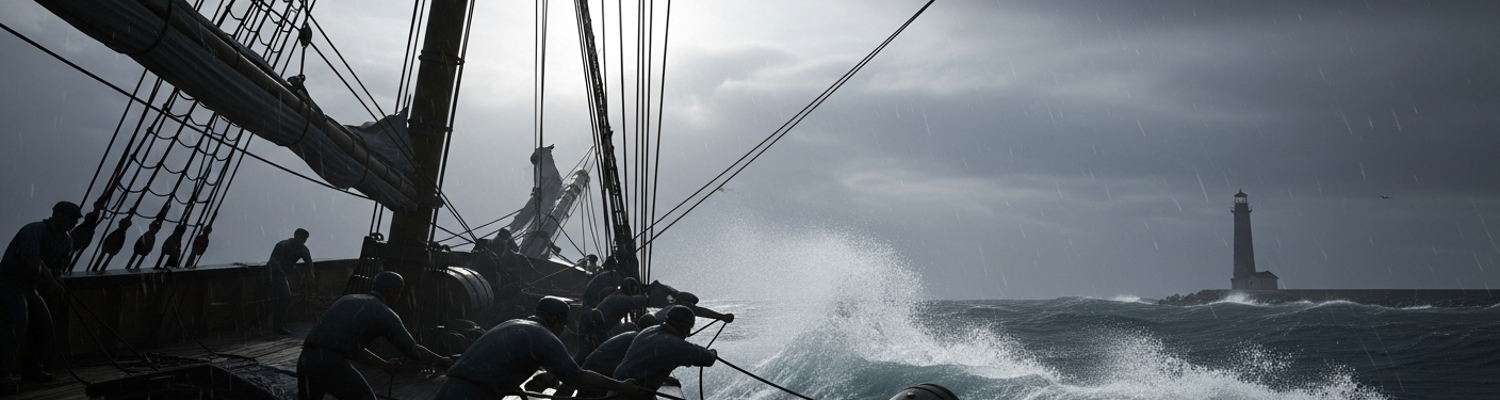
The duties performed by the cutters were far more complex than simple delivery runs. These vessels and their crews became the de facto logistical operators for the entire Lighthouse Establishment. A single mission profile for a cutter like the USRC Morris might see its hold packed with an impossible variety of cargo. Barrels of whale oil, replacement wicks, polishing compound, and new glass panes were stowed alongside massive granite blocks for a new tower on the coast of Maine or lumber for a keeper's dwelling on a remote island. They transported skilled masons and carpenters for construction and repair. They ferried new keepers to their lonely stations and retrieved those whose terms had ended, or whose sanity had frayed.
For many lighthouse keepers and their families, the sight of a Revenue Cutter’s sails on the horizon was a momentous event, their only physical link to the nation they served. The cutters brought salt pork, flour, mail, medicine, and news from a distant world. Operations along the Atlantic seaboard were a continuous battle against the sea. A cutter tasked with resupplying the lights along North Carolina’s Outer Banks had to navigate the Graveyard of the Atlantic. The shifting sands and violent, unpredictable storms near Cape Hatteras and Ocracoke Inlet could ground or wreck a vessel in minutes. Further north, cutters operating off New England contended with persistent, thick fog and a coastline littered with submerged rocks and ledges. A routine supply trip to a station like the Boon Island Light was an extreme test of seamanship, local knowledge, and raw nerve. Transferring a 400-pound barrel of oil from a rolling cutter deck to a longboat, rowing it through the surf, and hauling it up a rocky shore was back-breaking, dangerous work that defined the service.
The push onto the Great Lakes after 1818 opened a new theater of operations with its own brutal challenges. The first cutters stationed on the lakes, such as the USRC Erie, found themselves supporting a rapidly growing string of lighthouses as commerce surged westward. Their work was frantic, compressed into a short shipping season bracketed by thick winter ice. They had to deliver a full year’s worth of supplies to lights on Lake Erie, Lake Huron, and Lake Michigan before the freeze. They performed this duty while facing the notoriously violent and sudden storms that can boil up over the freshwater seas with little warning. The cutters not only supplied existing stations but also acted as survey platforms, helping to chart the waters and identify locations for new lights as ships pushed toward the resource-rich upper lakes.
By the 1830s, the cutter’s support role began to gain some official notice. An 1837 act of Congress formally charged the Revenue Cutter Service with assisting mariners in distress, a duty its crews had always performed but was now codified in law. The following year, Congress, tired of complaints from the maritime industry, directed a comprehensive inspection of the entire lighthouse system. The task was assigned to naval officers, who were transported from light to light aboard revenue cutters. The resulting reports were a damning indictment of Pleasonton’s management, detailing poorly placed lights, shoddy construction, and obsolete technology like the ineffective spider lamps he favored over modern parabolic reflectors. The reports also served as an unintentional affirmation of the Revenue Cutter Service’s capability. They were the only vessels able to execute such a wide-ranging logistical and inspection mission.
Doctrine Forged in Salt Spray
The decades of hands-on, practical support for the Lighthouse Establishment built a deep well of institutional knowledge within the Revenue Cutter Service. This was not a doctrine developed in a classroom or written in a manual. It was a capability forged through the relentless repetition of difficult tasks in unforgiving environments. Cutter captains and their crews became experts in coastal logistics, shallow-water navigation, and complex maritime support. This slow, organic evolution of operational capacity laid the direct groundwork for the modern U.S. Coast Guard’s mission to maintain the nation’s aids to navigation.
The professionalization of the service gained momentum in 1843 with the creation of the Revenue Marine Bureau, led by its first chief, Captain Alexander V. Fraser. An officer with a clear vision for the service’s future, Fraser regularized the lighthouse inspection tours conducted by his cutters. He understood the powerful synergy between the two Treasury branches and advocated for their formal merger, a proposal that was nearly a century ahead of its time. His efforts, while unsuccessful, signaled a critical shift from an ad-hoc arrangement to a more integrated, though still unofficial, partnership.
The end of Stephen Pleasonton’s penny-wise, pound-foolish tenure came in 1852 with the formation of the U.S. Lighthouse Board. This new body, composed of Army engineers, Navy officers, and civilian scientists, brought a much-needed scientific and engineering discipline to the system. Yet even this highly professionalized board still depended completely on the Revenue Cutter Service. The board had the engineers to design a screw-pile lighthouse and the scientists to perfect the Fresnel lens, but it had no ships and no sailors. The cutters remained the primary means of transportation for inspection tours and for delivering men and materials to the most challenging offshore construction sites. The cutters’ role had become so integral to the functioning of the system that it was simply taken for granted.
This long, shared history made the eventual consolidation of the services a matter of administrative logic. When the Revenue Cutter Service and the U.S. Life-Saving Service were combined in 1915 to create the U.S. Coast Guard, the new service inherited this century-old expertise in maritime support and logistics. The final, formal transfer of the U.S. Lighthouse Service to the Coast Guard in 1939 was not the creation of a new mission. It was the official recognition of a reality that had existed since the early 19th century. The doctrine of safeguarding maritime commerce by building, supplying, and maintaining aids to navigation was not invented in a Washington office in 1939. It was forged in the holds of small wooden cutters, beating their way through storms to keep the lights burning along an ever-expanding American coast.