
The Sahel in 2021 was a vortex of compounding crises. Porous borders across vast, ungoverned territories had created a superhighway for arms, drugs, and human trafficking. This illicit economy financed a growing collection of extremist organizations. Groups like Al-Qaeda in the Islamic Maghreb (AQIM) and the Islamic State in the Greater Sahara (ISGS) did not just exist in this space; they thrived, exploiting local grievances and the absence of state authority. Environmental factors provided a grim backdrop. Increasing desertification and unpredictable rainfall fueled intercommunal violence, particularly between herders and farmers competing for dwindling resources. This created a fertile recruiting ground for armed groups who could offer what governments could not.
France’s military presence, Operation Barkhane, was conceived as a direct response to this deteriorating security environment. Launched on August 1, 2014, it evolved from the preceding Operation Serval, which had halted the southward advance of jihadist groups in Mali in 2013. The stated objective of Barkhane was explicitly counter-terrorism. French military planners aimed to prevent the Sahel from becoming a permanent safe haven. The operational design involved a force of approximately 3,000 soldiers, headquartered in N'Djamena, Chad, with a mandate to operate across the G5 Sahel countries: Burkina Faso, Chad, Mali, Mauritania, and Niger. A key component of the strategy was partnership. French forces were intended to support the G5 Sahel Joint Force, providing advanced training, intelligence, and rapid intervention capabilities. The core mission was to neutralize extremist leaders while empowering local armies to eventually take control of their own security.
The internal fragility of the Malian state itself, however, presented a catastrophic obstacle. By 2021, the government in Bamako was a source of perpetual crisis. The country was under military rule following two coups in rapid succession. In August 2020, President Ibrahim Boubacar Keïta was overthrown by a military junta, the National Committee for the Salvation of the People (CNSP), led by Colonel Assimi Goïta. A transitional government was established, with Bah N'Daw as interim president, but the military retained ultimate control. This arrangement collapsed on May 24, 2021, when Goïta initiated a second coup, arresting President N'Daw and Prime Minister Moctar Ouane. Goïta accused them of a cabinet reshuffle that sidelined key military figures. He was formally declared the transitional president. This “coup within a coup” laid bare the profound weakness within Mali's governing institutions. The government had little effective control over large swaths of its own territory, particularly in the north and central regions. The constant political upheaval in the capital crippled any coherent national security strategy.
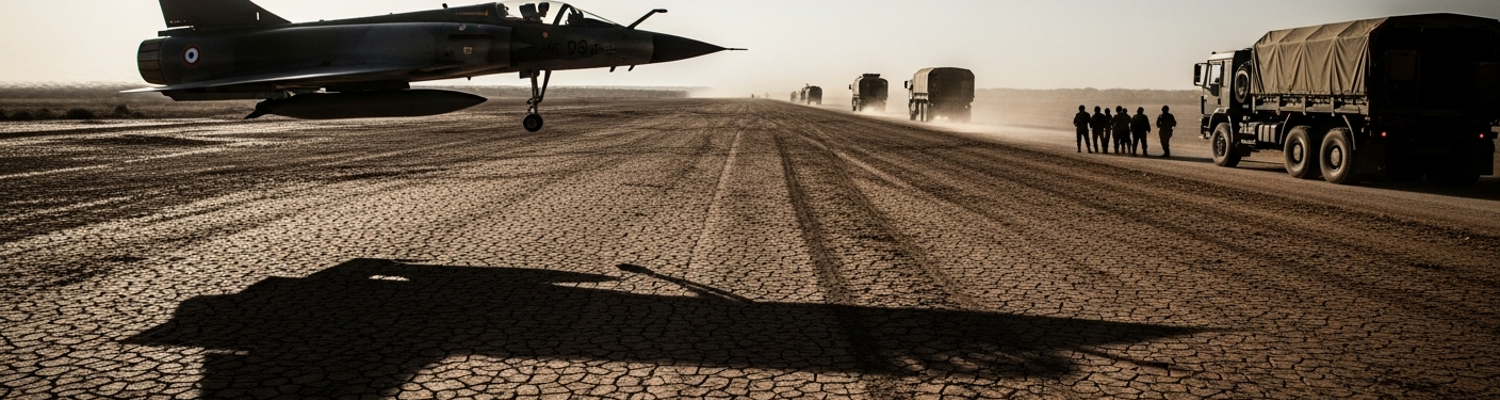
On January 3, 2021, as part of Operation Éclipse, a French counter-terrorism sweep in central Mali, a patrol of two Mirage 2000 fighter jets was directed toward a target near the village of Bounti. Archival evidence shows the decision to strike was based on intelligence gathered over several days, culminating in real-time surveillance from an MQ-9 Reaper drone. French military command identified a gathering of approximately 40 adult males in a semi-desert area as an armed terrorist group. Drone observation, according to official French statements, confirmed the absence of women and children, a key step in the targeting protocol. Satisfied that the group met the criteria for a military target, the command authorized the engagement. The Mirage 2000 patrol delivered three bombs. Based on the initial battle damage assessment, the strike was designated a success with an estimated 30 enemy fighters neutralized.
The official French military communiqué stood in absolute opposition to the first accounts emerging from the Bounti area. Local sources, including the Fula association Tabital Pulaaku, began circulating reports of a catastrophic error. This version of events asserted the strike had hit a wedding party. Witnesses from the village described a scene where approximately 100 men had gathered under trees for the celebration. According to these civilian reports, there were no visible weapons, and the group consisted of men of all ages. The local accounts claimed the airstrike killed around 20 civilians. This narrative directly contradicted every piece of information released by Operation Barkhane, which firmly denied the existence of a wedding and maintained that only jihadists were killed.
The immediate humanitarian impact on the ground was severe. Médecins Sans Frontières (MSF) later confirmed taking in injured individuals from the Bounti area, noting they were almost all men, with a significant number being elderly. The attack sowed terror. Villagers collected the dismembered bodies of the dead for rapid burial, a process that French officials would later argue prevented independent verification. The conflicting accounts compelled the United Nations Multidimensional Integrated Stabilization Mission in Mali (MINUSMA) to dispatch a special fact-finding mission. Over several weeks, a team composed of 15 human rights officers, supported by UN forensics experts, conducted over 100 individual interviews and analyzed photographic evidence. Its report, published on March 30, 2021, concluded that the gathering was indeed a wedding with about 100 civilians present. The investigation determined the strike killed 22 people. Of those, 19 were civilians, with the other three being confirmed members of the Katiba Serma armed group. The civilian victims were all men aged between 23 and 71.
The formal decision to launch a full, independent fact-finding mission by MINUSMA was a direct consequence of the irreconcilable narratives. The chasm between Operation Barkhane’s assertion of a successful strike and the local accounts of a wedding party massacre demanded impartial adjudication. Archival records show the investigation was formally initiated by MINUSMA's Human Rights and Protection Division (HRPD). A specialized team was deployed, comprising 15 human rights officers, supported by UN forensics and public information specialists. Their mandate was to proceed to the Bounti area and conduct a thorough inquiry. The logistical and security challenges were substantial. The area was a known locus of activity for armed groups, and the investigation team required robust security protocols. The mission's methodology was meticulous, involving over 115 individual, in-person interviews alongside roughly 100 telephonic interviews with survivors, witnesses, and local officials.
Published on March 30, 2021, the 36-page United Nations report systematically dismantled the official French version of events. The investigation concluded that the gathering near Bounti was a wedding celebration with approximately 100 civilians in attendance. The report confirmed the strike killed 22 people. Nineteen were unequivocally civilians, with the other three identified as suspected members of the Katiba Serma armed group. The civilian victims were all men, aged between 23 and 71. The UN team’s conclusions were based on witness testimony, interviews, and forensic examination of the strike location. The report noted that the group affected was overwhelmingly composed of civilians protected under international humanitarian law. It raised significant concerns about respect for the principles of the conduct of hostilities. The French Ministry of Armed Forces immediately and forcefully rejected the report’s conclusions. Paris expressed reservations about the methodology, stating it was based on unverifiable local testimonies and unsubstantiated hypotheses. French officials, including Defense Minister Florence Parly, maintained that their forces had targeted an armed group identified through a robust intelligence process. This created a direct institutional conflict. The UN, based on its ground investigation, had declared a grave breach of international law, while a key Security Council member completely repudiated the findings.
The political shockwave of the UN report was immediate. It catalyzed a sharp escalation in local animosity against foreign forces. The report’s conclusions provided official validation for the civilian accounts, transforming local anger into a wider, national grievance. For many Malians, the Bounti strike and the subsequent French denial became a symbol of foreign military impunity. This sentiment was expertly exploited by jihadist organizations, particularly Al-Qaeda affiliate Jama'at Nasr al-Islam wal Muslimin (JNIM), which incorporated the Bounti incident into its propaganda. Their messaging framed the strike as proof that Operation Barkhane was not a partner in security but an occupying force killing innocent Malians. A review of operational logs from the period following the report's release indicates a tangible breakdown in cooperation. The flow of human intelligence began to dry up as trust evaporated. The environment became significantly more hazardous for international troops, with the population’s resentment hampering the freedom of movement necessary for effective operations.
The political schism triggered by the Bounti airstrike manifested almost immediately in the cessation of intelligence sharing from the Malian Armed Forces (FAMa). Archival evidence shows this was a deliberate, top-down directive. Following France’s public repudiation of the UN’s findings, the junta in Bamako ordered its regional commands to halt all intelligence liaisons with Operation Barkhane. This severed the flow of ground-level information. French intelligence capabilities, while technologically advanced with satellite imagery and signals intelligence (SIGINT), lacked the granular human intelligence (HUMINT) that only FAMa could provide. Malian liaison officers were withdrawn from French forward operating bases, ending the joint analysis of drone feeds and target packages. The informal networks of informants cultivated by FAMa went silent to the French. A review of operational logs from Barkhane’s Groupement Tactique Désert (GTD) units in the Mopti region shows an immediate drop in actionable intelligence reports. The result was a sudden operational blindness. French patrols were now moving through areas without any atmospheric understanding, unable to distinguish a hostile village from a neutral one.
This paralysis was not just electronic.
The breakdown swiftly translated into physical blockades, weaponizing bureaucracy to grind French military logistics to a halt. Convoys that once had free passage through FAMa-controlled territory were now systematically obstructed. On key supply arteries, such as Route Nationale 16 connecting Gao and Mopti, French logistics columns found themselves held at Malian army checkpoints for hours, sometimes days. Soldiers who had previously waved them through now demanded new, often non-existent, transit permits, citing sovereign authority. This was a centrally coordinated effort to apply pressure. Fuel tankers, ammunition trucks, and vehicles carrying rations and medical supplies were all targeted. The operational tempo of counter-terrorism missions slowed dramatically. Planned sweeps were postponed or canceled as armored columns found themselves unable to secure the fuel and materiel required to project force. The impasse effectively grounded French units.
The cumulative effect was a catastrophic erosion of trust that broke the counter-insurgency model. The Bounti incident, validated in the public’s mind by the UN report, made French forces appear to be indiscriminate aggressors. This sentiment permeated the ranks of the FAMa. Joint patrols became exercises in mutual suspicion. French soldiers were forced to view their supposed partners as a potential green-on-blue threat, while FAMa soldiers resented the perceived arrogance of the foreign force. Consequently, the number of joint operations plummeted. French forces began to operate more unilaterally, becoming increasingly isolated within their bases. This isolation created a permissive environment for insurgent groups, who could now move more freely between communities without fear of being reported. For the local population, any cooperation with Barkhane became toxic. Villagers who might have once warned a French patrol of an impending ambush now remained silent. The human intelligence network, the bedrock of any successful counter-insurgency, had completely disintegrated.
Operational logs for Operation Eclipse - Part IV, intended as the decisive phase to clear insurgent cells from the Gourma-Serma corridor, expose a campaign strangled by political sabotage. The operation, scheduled for June 7th, 2021, depended on the pre-positioning of supplies at forward operating bases south of the Niger River bend. Archival evidence shows the French Groupement Tactique Désert (GTD) “Lamy” was tasked with executing the main thrust. Its combat power was predicated on a logistics chain running down Route Nationale 15 and 16 from the primary hub in Gao. On May 28th, just days after the second coup consolidated Colonel Goïta’s power, the system froze. A logistics convoy designated “Altair 7,” consisting of 42 vehicles including fuel tankers and refrigerated containers, was halted by Malian Armed Forces at a checkpoint outside Sévaré. The FAMa commander cited a new directive from Bamako requiring a “sovereign customs inspection” for all foreign military assets, a bureaucratic maneuver for which no protocol existed. For 72 hours, the convoy remained static, a vulnerable target on an exposed highway, before being ordered back to Gao. This single act of administrative obstruction nullified weeks of planning. Eclipse Part IV was dead on arrival.
The logistical chokehold had an immediate and debilitating effect on base services, most notably field kitchen operations. French forward operating bases, like the one at Gossi, relied on a steady stream of Class I supplies to operate their modular field kitchens, the Cuisine Roulante Modèle F1. These kitchens were the heart of camp morale. The blockade of convoys like Altair 7 severed this artery. Refrigerated trucks carrying perishable goods were turned back or left to spoil. Propane canisters needed for the burners were depleted without replacement. Within a week, the Gossi garrison’s kitchen fell silent. Post-action reports from the base command detail a rapid decline in sanitation and morale as cooks were reassigned to guard duty. The sophisticated kitchen equipment became a useless monument to a supply line that no longer existed.
The collapse of centralized messing created acute troop sustenance issues, with a disproportionate impact on non-French international contingents attached to Task Force Takuba. While French soldiers were issued their standard Ration de Combat Individuelle Réchauffable (RCIR), these were designed for short-term field use. Forcing troops to subsist on these pre-packaged meals for weeks led to documented nutritional deficiencies and a drop in combat effectiveness. The problem was magnified for allied units. A review of communications from the Estonian ESTPLA-34 reconnaissance platoon shows urgent requests for resupply going unanswered. Their own national combat rations had been exhausted, and they were forced to rely on the French RCIRs, which many found unpalatable. Records from a Czech special forces detachment highlight even greater friction, as their logistical requests were routed through the now-unresponsive French command structure. These elite soldiers, dependent on a high-calorie intake, were reduced to the same basic ration packets. The shared hardship did not build camaraderie; it bred resentment.
Malian state media archives from late 2021 reveal a deliberate rhetorical offensive against the French presence. Following Colonel Assimi Goïta’s consolidation of power, the junta in Bamako began to weaponize anti-colonial sentiment to create political cover for its strategic realignment away from Paris. Statements read by government spokesmen on the state broadcaster ORTM transformed in tone. Operation Barkhane was no longer framed as a partner but as an occupying force. Prime Minister Choguel Maïga became a prominent voice in this campaign, publicly accusing France of having a neo-colonial and paternalistic attitude. This narrative was highly effective. It tapped into popular frustration over the lack of security progress and skillfully deflected blame for the country’s instability onto the foreign troops. The Bounti airstrike and France’s denial of the UN’s findings were repeatedly cited as proof of French malevolence, fueling large-scale, government-sanctioned protests in Bamako where French flags were burned. This officially cultivated hostility was the precursor to the rupture to come.
The operational paralysis and public hostility left Paris with an untenable position. In June 2021, French President Emmanuel Macron announced a major transformation of France’s military presence, signaling the end of Operation Barkhane in its current form. This strategic pivot was massively accelerated by the deepening political crisis. The final turning point was the confirmed arrival of Russian mercenaries from the Wagner Group in Bamako in December 2021, a development France and its allies had explicitly warned against.
On January 31, 2022, the Malian government formally expelled the French ambassador, Joël Meyer, giving him 72 hours to leave the country. This action was triggered by remarks from French Foreign Minister Jean-Yves Le Drian, who had described the junta as illegitimate and out of control. The expulsion was the most severe diplomatic rupture possible short of war. It severed the primary high-level communication channel between the two governments. With no ambassador, the military attaché’s office was rendered impotent, and the direct line of communication between the Barkhane commander and the Malian Ministry of Defense was cut.
This diplomatic collapse immediately precipitated a chaotic military withdrawal. On February 17, 2022, President Macron formally announced the full withdrawal of all French and Takuba Task Force troops from Mali. He outlined a four-to-six-month timeline for an orderly departure. The Bamako government immediately rejected this. The following day, a government spokesman appeared on television to demand France withdraw its forces without delay, declaring the proposed timeline a violation of Malian sovereignty. This turned the French redeployment into a high-risk logistical operation under quasi-hostile conditions. The withdrawal from key forward operating bases in Gossi, Ménaka, and Gao had to be conducted without the cooperation of the host nation’s armed forces. The complete French withdrawal was finalized on August 15, 2022, when the last soldier from Operation Barkhane crossed the border out of Mali.
Declassified intelligence assessments from Washington paint a grim picture of the diplomatic fallout. U.S. Africa Command (AFRICOM) had registered high concern after the May 2021 coup, but the subsequent invitation of Russian Wagner Group mercenaries was viewed as a catastrophic failure of Western policy. Intelligence summaries circulated within the State Department and Pentagon noted that the Malian junta’s pivot to Moscow was a geopolitical realignment with continent-wide implications. AFRICOM’s commander, General Stephen Townsend, gave a stark public assessment confirming the presence of several hundred Wagner operatives, delivered by Russian military aircraft. The American intelligence perspective was that the junta had willingly made its population vulnerable to an organization known for human rights abuses simply to secure its own power. This move nullified years of Western counter-terrorism partnerships.
The degradation of the G5 Sahel Joint Force was immediate. Conceived in 2017, the force, comprising units from Mauritania, Chad, Burkina Faso, Niger, and Mali, was fundamentally dependent on Operation Barkhane for its effectiveness. French support provided logistical coordination, intelligence feeds from Reaper drones, and rapid-response air support from Mirage fighters. With the political rupture, this support evaporated. Joint command centers were dismantled. The viability of the force was already in question after Mali’s 2022 withdrawal, but the departure of its primary enabler rendered it completely ineffective. The institution became a framework without a function, unable to conduct the large-scale cross-border operations for which it was designed.
The operational vacuum was swiftly filled by insurgent groups. Analysis of conflict data shows a dramatic escalation in violence and territorial expansion by both JNIM and ISGS following the French departure. Data from 2022 showed that fatalities linked to militant violence were projected to increase by nearly 150 percent from 2021. Groups that had been tactically disrupted by French operations were now free to maneuver. JNIM, in particular, capitalized on the chaos, launching an aggressive push south and west, bringing attacks to within 150 kilometers of the capital, Bamako. ISGS reasserted itself with ferocity in the Gao and Ménaka regions, killing over 1,000 people in 2022 as it sought to reestablish control. The withdrawal of international forces gave these groups the time and space to regroup, recruit, and launch more ambitious attacks.
Flight tracking data and intelligence summaries from late 2021 confirm the arrival of the Russian Wagner Group in Mali as the definitive catalyst for a complete strategic realignment. The political rupture with Paris created a security vacuum the Malian junta moved to fill immediately. The first contingents of Wagner mercenaries began arriving in December 2021 aboard Russian Air Force transport aircraft, such as a TU-154 registered to the Russian Ministry of Defense’s 223rd Flight Detachment. It was a state-directed deployment. Upon arrival, Wagner operatives immediately began constructing a new camp at Bamako’s Modibo Keïta International Airport and quickly took over former French outposts in central Mali. Their mission profile was twofold: first, to provide a close protection detail for Colonel Goïta and the ruling junta, effectively “coup-proofing” the regime; second, to conduct offensive operations alongside the FAMa. This operational model, financed at a reported cost of $10 million per month and supplemented by mining concessions, replaced a counter-insurgency strategy with one of regime security and resource extraction.
The confirmed arrival of state-backed Russian mercenaries made the European military presence in Mali politically and operationally unsustainable. On February 17, 2022, President Macron announced the complete withdrawal of all forces associated with Operation Barkhane and the European-led Takuba Task Force from Malian territory. This initiated a complex logistical undertaking to repatriate thousands of soldiers and thousands of tons of equipment under a compressed timeline. The withdrawal was completed on August 15, 2022. This did not mark the end of the European presence in the region but rather a strategic displacement. Niger became the new center of gravity for counter-terrorism efforts, with France and its allies redeploying approximately 1,500 troops and critical air assets to Niamey. The smaller, multinational special forces units that comprised the Takuba Task Force, including contingents from the Czech Republic, Estonia, and Sweden, were also withdrawn from Mali by June 30, 2022. The entire European security architecture in the Sahel, built over nearly a decade, was forced to retract and reconfigure around Niger. On May 15, 2022, Mali withdrew from the G5 Sahel, the institutional framework for regional security cooperation, rendering the joint force completely ineffective.