
Immediate Riverine Aid Station Operations
A radio transmission logged by the 3rd Medical Battalion’s Direct Support Unit at Dong Tam marked the start. River Rat Six-Actual was taking heavy fire at grid XT 254 918. An RPG had struck ATC 112-5, causing catastrophic damage. An urgent MEDEVAC was required.
In the minutes following a riverine ambush, the first medical response occurred not in a sterile room but on the muddy banks of the Mekong Delta. A review of operational logs from the 3rd Marine Division and the Army's 2nd Brigade, 9th Infantry Division, shows that company and platoon corpsmen had moments to establish casualty collection points (CCPs) under fire. These were not stations. They were improvisations.
Corpsmen identified shallow depressions or thick mangrove roots offering minimal cover. Their first action was returning fire while directing the walking wounded toward this point. The riverbanks, particularly along the Cua Viet or Ham Luong rivers, were composed of slick, unstable silt. Litter teams, often just two infantrymen, would slip and fall, jarring the wounded. After-action reports mention that anchoring a poncho against the rotor wash of incoming helicopters became a multi-man effort. Medical equipment, pre-staged in aid bags, was quickly fouled by mud. Applying a dressing was complicated by grime that coated everything, increasing infection risk. These riverbank CCPs were transient, existing only long enough to consolidate casualties for movement to the next level of care.
That next level was often a converted barge.
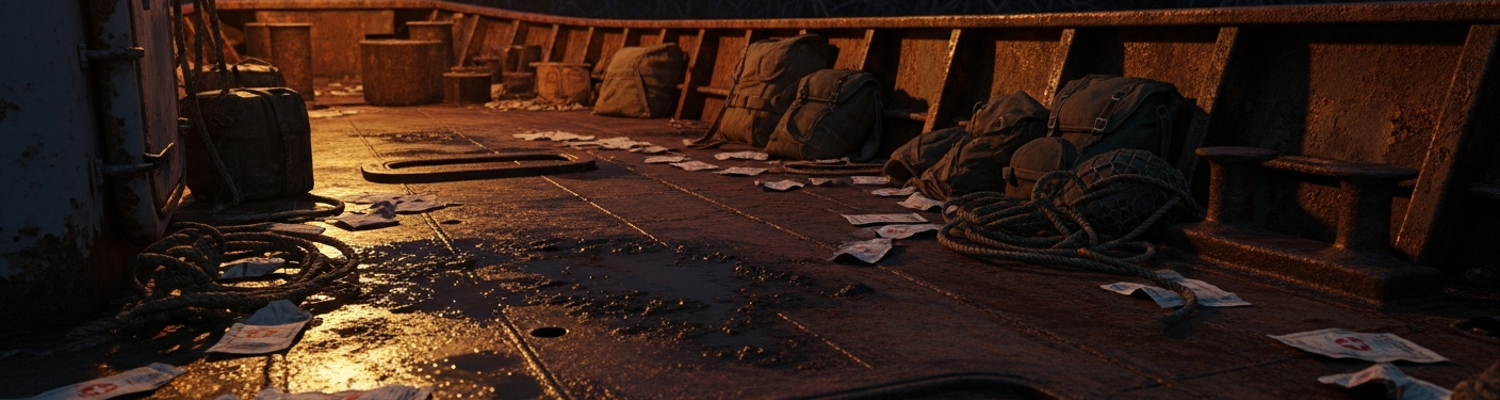
The Mobile Riverine Force could not rely on fixed hospitals. The solution was the Armored Troop Carrier (ATC), specifically the ATC(H) variant, with its cargo well converted into a floating aid station. One such vessel supporting Task Force 117 was a reconstructed Mechanized Landing Craft (LCM-6), heavily modified. Archival evidence shows these medical aid boats were up-armored with steel plating against small arms and rocket fragments. Inside the cramped, open-topped well deck, medical personnel from units like D Company, 9th Medical Battalion, secured litter stands to the deck plates. The space was limited, allowing for maybe five litter cases at a time. Power for surgical lights came from portable generators whose exhaust mixed with diesel and blood. The boat's constant rocking made delicate procedures a challenge. An electric winch was often rigged to hoist casualties directly from smaller patrol boats, a necessary innovation to avoid navigating narrow internal passageways.
Initial casualty assessment was a brutal calculation. The methodical triage of a rear-area hospital was a luxury that did not exist. Corpsmen and surgeons relied on a rapid, tactical sorting protocol. A review of Marine Corps and Army medical procedures from the period indicates a system based on immediate survivability. Using grease pencils, a letter was scrawled on a casualty’s forehead. 'M' for Minimal, 'D' for Delayed, 'I' for Immediate, and 'E' for Expectant. This assessment was made in seconds by a senior corpsman or junior medical officer with little more than a stethoscope.
The 'Immediate' category was for life-threatening but survivable injuries like airway obstructions or severe hemorrhaging. These men were moved first. 'Delayed' included serious injuries like major fractures that were not immediately life-threatening. 'Expectant' was reserved for casualties with such catastrophic wounds they were unlikely to survive. This was a harsh calculation to conserve limited medical resources for those with a greater chance of survival.
Brown-Water Transport Mechanical Failures
The effectiveness of any medical evacuation chain depends on the reliability of its transport. In the riverine environment, where dedicated medical vehicles were rare, combat boats were MEDEVAC boats. When they broke, the system collapsed. A review of operational logs from Task Force 116 and the 3rd Medical Battalion reveals a pattern of mechanical failures. These were systemic breakdowns rooted in using equipment in an environment for which it was not entirely designed.
The Swift Boat, or Patrol Craft Fast (PCF), was a key example. Built with aluminum hulls for speed, these vessels used diesel engines with many conventional steel components. Maintenance records show a constant battle against the corrosive mix of saltwater, freshwater, and humidity. This created galvanic corrosion between the hull and engine mounts. More critically, it attacked the engines. Starter motors, relays, and fuel injector housings would freeze with rust. For a boat on patrol, this was a maintenance issue. For a boat ordered to start its engines for an urgent MEDEVAC, it was a disaster. There are documented cases from Coastal Division 11 where a Swift Boat, the primary extraction vessel for a unit in contact, could not start its General Motors 12V71N engines. The crew could hear the radio calls for evacuation while they tried to break rusted components free.
The Patrol Boat, River (PBR) had its own vulnerability. Its Jacuzzi water jet propulsion allowed it to operate in shallow, debris-filled canals. This design, however, introduced a new point of failure. The water jets sucked in massive volumes of river water, along with everything else. Operational reports from River Section 531 are filled with instances of PBRs losing all power. The culprit was a fouled intake. Dense mats of water hyacinth, fishing nets, and delta silt would be pulled against the intake grate, starving the pump. Crews had a back-flushing procedure, but it took time and often failed. For a PBR crew extracting a wounded SEAL team, a loss of propulsion was catastrophic. The boat went from a 25-knot asset to a drifting target.
At the most improvised level of evacuation, even moving a wounded man created a mechanical crisis. In mass casualty situations, any vessel became an ambulance, including local sampans. These small wooden boats were not intended to carry the weight of multiple soldiers in full gear. The standard-issue Army pole litter and the Stokes litter were too long and wide to fit inside a sampan's curved hull. After-action reports from 3rd Medical Battalion corpsmen describe laying stretchers across the gunwales, making the boat dangerously top-heavy. The transfer of a patient from the sampan to a larger ATC(H) was a point of failure. A stretcher handle could become wedged against the sampan’s frame, trapping the critically wounded patient. This created a frantic delay, with soldiers wrestling the jammed litter while exposed to enemy fire.
Saline Corrosion of Medical Instruments
A review of 3rd Medical Battalion after-action reports and Navy Bureau of Medicine and Surgery equipment logs from the Mekong Delta reveals an insidious enemy to surgical readiness: saltwater. The brackish water was catastrophically corrosive to standard-issue surgical instruments. Tools like hemostats, forceps, and retractors, made from 300-series stainless steel, were designed for sterility, not prolonged chloride exposure. Onboard ATC(H) aid stations, where casualties arrived wet and caked in river mud, instruments were in constant contact with saline. This initiated rapid pitting corrosion, creating microscopic cavities in the steel. The effect was most pronounced in mechanically critical areas. The box locks of hemostats would seize. The fine serrations on grasping forceps were eaten away. The ratcheted locking mechanisms would fail. A surgeon clamping a bleeding vessel might find their Kelly clamp refusing to lock.
This created a second crisis by compromising sterilization. Field sterilization was often limited to boiling or soaking in chemical solutions like Zephiran. These methods relied on a smooth, non-porous surface. Archival analysis shows that microscopic pits created by saline corrosion became sanctuaries for blood, tissue, and bacteria. Even after boiling, shielded contaminants could survive, turning a sterile instrument into a vector for infection. The delta mud, laden with bacteria like Clostridium perfringens, became embedded in these corroded surfaces. Medical personnel from D Company, 9th Medical Battalion, noted that instruments emerging from a sterilizing bath might appear clean but were microscopically seeded with pathogens.
The direct impact on patient outcomes was severe. The combination of failing tools and compromised sterility created a cascade of negative effects. A surgeon working on a casualty inside the rocking well-deck of an aid boat contended with instruments that did not function. A corroded scalpel, its edge dulled by pitting, required more pressure, causing greater tissue trauma. A hemostat that failed to lock could lead to increased blood loss. Procedure times were extended. A review of medical records from facilities like the 6th Convalescent Center at Cam Ranh Bay points to a notable rate of post-operative infections in combat wounds, with Staphylococcus aureus being a frequent culprit. Medical officers frequently cited the poor condition of surgical instruments as a significant variable, leading to higher rates of wound dehiscence and sepsis.
Corpsman Physical and Mental Strain
For the Navy corpsman on the rivers, there was no true rear area. Personnel exhaustion was the result of a continuous operational tempo. A corpsman assigned to a PBR section might return to a support barge after a 72-hour patrol, but this was not a period of rest. It was a period of resupply, maintenance, and casualty processing. Unit logs detail how corpsmen would immediately begin decontaminating their mud-fouled medical equipment for the next patrol, often beginning in less than twelve hours. Sleep was taken in short bursts on the steel deck of a rocking boat next to a loud diesel generator. The cumulative effect was a deep fatigue. Studies show such prolonged sleep deprivation degrades complex mental functions first. This physical depletion was worsened by the environment. Constant exposure to heat, humidity, and dampness led to low-level physical ailments that sapped a corpsman’s endurance.
The psychological burden was distinct. Riverine combat was intimate and inescapable. When an ambush erupted, it happened within the confines of a small boat. A corpsman transitioned from a combatant to a medic treating devastating wounds on men who were part of his tiny crew. The aid station was the blood-slicked deck. Psychiatric reports from the period reveal the weight associated with triage under these conditions. The decision to label a friend as 'Expectant' was a psychological burden carried long after the engagement. The enclosed space of the boat meant there was no turning away. The sights, sounds, and smells of trauma were concentrated.
This constant stress created a condition of hyper-awareness that was impossible to turn off. A corpsman was always on duty. This inability to mentally disengage was a significant contributor to combat fatigue. The enemy’s tactics, sudden violence from a concealed position, fostered perpetual anxiety. Every shaded riverbank held a potential threat.
The intersection of extreme fatigue and high stress directly impacted medical precision. The fine motor skills required for starting an IV or suturing a wound degrade significantly under sleep deprivation. Archival medical records show patterns that suggest its influence. An increase in logged instances of 'difficult' intravenous access or notations of multiple attempts to place a chest tube correlate with units in continuous operations. A corpsman with hands trembling from exhaustion and adrenaline, working on a rocking boat with corroded instruments, was set up for failure. The cognitive effects were more dangerous. A miscalculation of a morphine dose was a potentially lethal error. It could also lead to a fatal hesitation in a triage decision, wasting seconds that could have saved a life. The lack of standardized crew rest policies for medical personnel meant the corpsman's own state became one of the most unpredictable variables in casualty care.
Post-Ambush Psychological Trauma Logging
3rd Medical Battalion after-action memoranda and informal corpsman logs reveal the immediate psychological fallout from a riverine ambush was as significant as the physical wounds. The documentation of acute psychological symptoms was an inconsistent process conducted in the carnage of a boat’s well deck. There were no standardized forms for psychiatric field assessment. Corpsmen made hurried notes on casualty tags or in waterproof notebooks, describing behaviors outside the recognized scope of combat shock. Entries describe men who became entirely mute and unresponsive, staring blankly as their own shrapnel wounds were dressed. Others exhibited uncontrollable weeping or violent, convulsive shivering unrelated to blood loss.
They were symptoms of a complete psychic break.
The enclosed nature of riverine combat produced a unique set of immediate psychological reactions. Medical notations from Task Force 117 support craft detail widespread, acute tremors in survivors, their hands shaking so violently they could not hold a canteen. More disturbing was the sudden onset of temporary catatonia. Multiple reports describe Marines and sailors who would freeze in place, completely unresponsive to commands for minutes or even an hour. This paralysis posed a tactical problem, as these men were incapable of returning fire or helping to navigate the boat out of the kill zone. At the other extreme was a surge of aggressive paranoia. Survivors would perceive threats everywhere, aiming weapons at the far riverbank or incoming MEDEVAC helicopters. This hyper-reactivity created severe risks of friendly fire incidents. Unit leaders were forced to make split-second decisions to disarm their own men.
The prevalence of these stress reactions was exceptionally high among the brown-water sailors of Task Force 116 and the Marines they supported. Sailors on a PBR or an ATC were trapped inside a small, exposed metal container during an attack. The violence was intimate, lasting for a few terrifying minutes before receding into silence, leaving survivors adrift in a space filled with their dead and wounded crewmates. This experience was a direct pathway to psychological collapse. Records show a higher incidence of these acute breakdowns among men on the smallest craft, like PBRs, where the entire crew fought in a space the size of a small room. The constant stress of patrolling, combined with the explosive nature of combat, created a condition where a man’s nervous system was perpetually overloaded.
Inadequate Field Diagnostic Capabilities
A review of 3rd Medical Battalion equipment manifests from riverine support units reveals a lethal technology gap. When a casualty arrived with penetrating wounds from a B-40 RPG, the corpsman had no tools to see inside the body. No portable X-ray machines, no ultrasound, no ability to run blood tests. The diagnostic toolkit was limited to what a medic could carry: stethoscopes, dressings, and morphine syrettes. The jagged fragments from an RPG did not travel in straight lines. They tumbled and deflected off bone, carving chaotic paths. A small entry wound on the abdomen could hide a fragment that had lacerated the spleen, perforated the intestine, and lodged near the spinal column. The exact path of the shrapnel was guesswork.
This forced a reliance on primitive diagnostic methods: visual and tactile assessment. A surgeon or senior corpsman, working under a single swaying bulb, would have to probe a wound track with a finger. This was a dangerous attempt to gauge depth or feel for a fractured bone. After-action reports detail surgeons using a sterile hemostat to gently explore a wound cavity, listening for the metallic click of the instrument striking a fragment. Visual inspection was just as crude. Medical personnel assessed the color and flow of blood, distinguishing a venous bleed from an arterial hemorrhage. They watched the abdomen for the rigidity that signaled internal bleeding. It was an imprecise science, conducted in seconds.
The most significant challenge was the inability to detect invisible, time-delayed threats. Internal injuries and brewing infections were silent killers. A tiny metal fragment could puncture the bowel, initiating a slow leak of septic contents into the abdominal cavity. With no field laboratories, a rising white blood cell count, the first sign of major infection, was impossible to detect. The bacteria-laden mud of the Mekong, containing organisms like Pseudomonas and Clostridium perfringens, would be driven deep into wound tissue. While a wound might be irrigated on the surface, the bacteria were already multiplying in the oxygen-deprived environment of deep muscle. Medical records from Naval Support Activity Hospitals show a recurring pattern. Casualties would arrive from the river in stable condition only to crash hours or days later from overwhelming sepsis or organ failure that went undiagnosed at the point of injury.
Land-Centric Logistical Inflexibility
An examination of 3rd Medical Battalion and III Marine Expeditionary Force logistical doctrine reveals a system structured for ground combat in Europe, not a dispersed, riverine fight. The supply chain was built on the assumption of secure, land-based depots and predictable consumption. This model failed when applied to the fluid environment of the Mekong Delta, where small boat units operated in isolation. The system treated a four-man PBR crew the same as a 150-man rifle company, a failure of imagination that created critical shortages.
The most immediate failure was in specialized medical equipment. A review of after-action reports from medical personnel with Task Force 116 and 117 shows a consistent pattern of requests for equipment the land-based supply system would not provide. Standard-issue field litters were too long to maneuver within the confines of a PBR. Corpsmen were forced to improvise, using ponchos as makeshift stretchers. There was a desperate need for smaller, compact rescue skeds or folding litters, but these were not standard inventory items. Requisitions were denied or lost. Electronic equipment, like the few portable vital sign monitors available, was designed for dry conditions, not the humidity and salt spray of the delta. They failed constantly. The supply chain was optimized to deliver pallets of battle dressings, not the niche, environmentally-hardened gear needed on the boats.
A second deficiency was the lack of potable water for forward medical units. Land-based infantry units were supported by large, trailer-mounted water purification systems. This structure was absent on the waterways. Individual PBRs and ATCs were not equipped with effective onboard purification systems. A 1968 report from the 3rd Medical Battalion noted that the opening of its new hospital at Quang Tri was delayed specifically because of problems with securing potable water. For small boat crews, the only source of clean water was what they could carry in canteens from their shore base. On extended patrols, this supply was quickly exhausted. Dehydration and heat casualties became a constant problem. For corpsmen, the lack of sterile water created an impossible dilemma. They were often forced to clean wounds with non-potable river water, increasing the risk of severe infection.
This logistical oversight extended to psychological well-being. The system for providing mental health support was entirely land-based, centered on psychiatrists at large rear-area hospitals. There was no mechanism to project these resources forward onto the isolated river craft. A corpsman on a PBR could identify a crewmate suffering from acute combat stress, but he had no one to turn to. There was no one to evacuate the sailor to, short of a full MEDEVAC for a complete breakdown. The supply system that could deliver ammunition had no equivalent for delivering psychological first aid. After-action reports make no mention of combat stress teams visiting riverine units. The concept did not fit a logistical framework designed for large troop concentrations on solid ground.
Improvised Riverine Medical Planning
Formal medical planning was a luxury rarely afforded to the brown-water navy. The concept of pre-staged support collapsed in an environment defined by small, isolated units and sudden violence. Tactical medicine became a discipline of constant improvisation driven by systemic supply failures. A corpsman on a PBR heading into the Vam Co River system knew his medical kit was unsuited for the mission. Standard-issue pole litters were too long to maneuver inside the boat. This forced corpsmen to use ponchos, a technique that risked aggravating spinal injuries.
Medical personnel learned to pre-stage intravenous bags by puncturing the plastic and inserting the spike sets ahead of time, knowing the fine motor skills to do so under fire would be impossible. They cannibalized webbing to create custom slings for securing wounded men to bulkheads. This culture of improvisation was a direct response to a logistical chain that was fundamentally land-centric. Requisitions for smaller, folding litters or waterproof medical packs were consistently denied or lost within a bureaucracy designed to supply infantry divisions.
A series of internal reports filed by the 3rd Medical Battalion throughout 1969 cataloged these problems. One recurring annex, often attached to the battalion’s monthly command chronology (a document designated NARA Record Group 127), detailed the persistent failure of field medical equipment. The reports noted that sophisticated gear, such as the limited number of portable electrocardiographs, had a near-total failure rate. More critically, they documented how basic instruments were being destroyed. Stainless steel hemostats and needle drivers were rendered useless by pitting corrosion. The reports specified that the box locks, the simple hinge of the instrument, would seize, or the serrated tips would be eaten away, making it impossible to clamp a bleeding vessel.
These were dry, technical accountings of failure. The documents methodically listed the stock numbers of the failing equipment and the operational impact. A February 1969 report noted that standard field sterilization procedures were insufficient to remove bacterial contaminants from the microscopic pits created by corrosion. The authors, typically junior medical service corps officers, recommended immediate procurement of higher-grade stainless steel or disposable instruments.
These detailed assessments were almost always buried. A review of III Marine Amphibious Force command chronologies shows the 3rd Medical Battalion’s monthly submission was a small component of a massive data call. The urgent annex detailing the systemic failure of surgical tools would be physically filed behind hundreds of pages covering ammunition expenditures, fuel consumption, and personnel transfers. A division-level staff officer reviewing the submission would see only the top-line summary of casualty statistics, not the granular detail of a corpsman’s failing equipment. The problem was not a conspiracy, but a failure of bureaucratic structure. The critical data was present in the archives, but it was functionally invisible, lost in a mountain of unrelated logistical data.