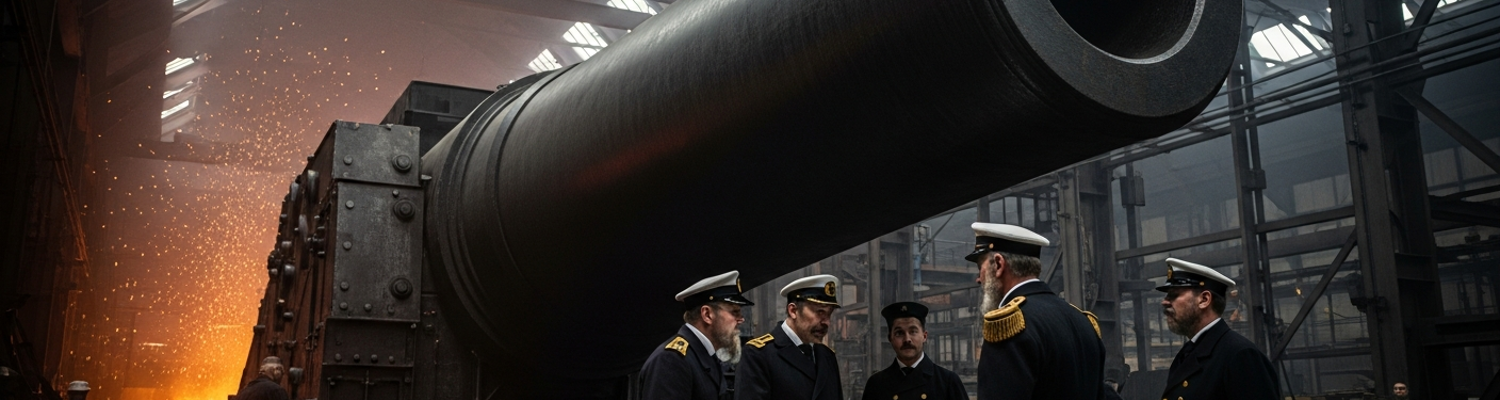

The United States Navy emerged from the War of 1812 with a reputation for ferocity in single-ship actions, yet the conflict exposed a deep, systemic vulnerability. Its ordnance supply was a chaotic patchwork. American warships went to sea armed with a mix of British-made long guns, domestically produced copies of varied quality, and short-range carronades that proved inadequate against the Royal Navy's standoff tactics. The reliance on inconsistent private foundries and captured British cannon created a logistical nightmare. Guns from different makers required unique implements, non-interchangeable parts, and often possessed dangerous metallurgical flaws. Post-war, a faction of forward-thinking officers understood that true naval independence required a sovereign capability to design, manufacture, and test its own weapons. This realization sparked a deliberate, multi-decade effort centered on solving complex logistical and engineering problems, forging a uniquely American path in naval gunnery.
Standardizing Cannon Production at Washington
The Washington Navy Yard, established in 1799 under Commodore Thomas Tingey, was initially a shipbuilding and fitting-out facility. After its partial destruction by the British in 1814, it was rebuilt with a new strategic purpose. Its location up the shallow Anacostia River made it less suitable for servicing the larger ships-of-the-line entering the fleet, but its position and existing infrastructure made it ideal for industrial production. The decision to centralize ordnance manufacturing there was a direct response to the failures of the existing system. Private foundries scattered across the nation produced guns with little to no standardized inspection, leading to inconsistent performance and catastrophic failures. The Navy needed absolute control over its supply chain.
In 1820, the first ordnance laboratory was established at the yard, the seed that would grow into the Naval Gun Factory. This move was a direct assault on the procurement problem. By bringing production in-house, the Navy could dictate every step of the process. This began with sourcing raw materials. Government agents could enforce stringent quality standards on iron suppliers, rejecting entire lots of pig iron that failed to meet specifications, a level of control impossible when dealing with a dozen different private contractors. The Navy Board specified charcoal-smelted iron for its purity and strength, a costly but necessary requirement. The factory also became a national center for training artisans and engineers in the demanding craft of gunfounding, creating a permanent, institutional knowledge base that did not exist before.
The logistical challenges were substantial. A dedicated internal railway system had to be constructed to move multi-ton castings and finished guns between the foundry, the massive steam-powered lathes in the machine shops, and the proofing range. New buildings were erected, including a large foundry and boring mill. The yard became a hub of industrial technology, centralizing the manufacture of not just cannons but also anchors, chain, and steam engines for the new generation of warships. This concentration of effort systematically reduced the Navy’s dependence on outside contractors and foreign designs. It ensured that a gun cast in Washington met a defined, repeatable standard of quality, safety, and performance, a foundational step toward ordnance self-sufficiency.
The Push for Scientific Gunnery
While the Washington Navy Yard provided the industrial muscle, Captain Thomas ap Catesby Jones supplied the intellectual and doctrinal impetus for change. A combat veteran of the War of 1812, he was a key figure who advocated for transforming naval gunnery from a craft based on tradition to a science grounded in empirical data. He recognized that simply standardizing production was not enough; the guns themselves had to be fundamentally better and safer. Gun crews operated under the constant threat of a cannon bursting, a catastrophic failure common with the brittle cast-iron pieces of the era.
Jones championed the adoption of scientific metallurgy and rigorous testing protocols. Instead of relying on the 'rules of thumb' of foundry foremen, he pushed for a methodical understanding of materials. This involved destructive testing of iron samples to understand their tensile strength and fatigue properties. At the Washington Navy Yard, an experimental gun battery was constructed, allowing cannons to be fired down a cleared range along the Anacostia River. This facility permitted precise observation of projectile trajectories, the effects of different powder charges, and the terminal performance of new types of ammunition. It transformed gunnery from guesswork into a quantifiable science.
His reforms also extended to ammunition. Influenced by the French Paixhans gun, Jones was an early advocate for explosive shell designs, recognizing their devastating effect on wooden hulls. This created new technical problems, such as developing reliable fuzes and casting shells that would not detonate prematurely inside the barrel, a common and deadly accident. The introduction of these powerful new weapons demanded a parallel evolution in safety and doctrine, which Jones’s rigorous proofing methods provided. As an inspector and superintendent of ordnance, his work created a critical feedback loop. Data from the proofing range, where each gun was fired with an overpressure 'proof' charge, directly informed manufacturing processes and new designs. This tangibly improved the safety, reliability, and power of American naval guns.
The Dahlgren Gun A New Standard
Decades of institutional progress culminated in the 1850s with the work of Lieutenant John A. Dahlgren. Assigned to ordnance duty at the Washington Navy Yard in 1847, Dahlgren inherited the industrial capacity and scientific methodology his predecessors had built. His work was driven by a personal understanding of the dangers of existing ordnance. In 1849, he witnessed a 32-pounder burst during a proofing demonstration, killing a gunner and narrowly missing him. This event solidified his determination to design a safer, more powerful naval cannon based on scientific principles.
Dahlgren’s design was a direct result of empirical analysis. He conducted extensive experiments to map the pressure curve inside a firing cannon, confirming that the pressure was greatest at the breech and diminished rapidly as the projectile traveled down the barrel. He found that traditional cannons, with their relatively uniform thickness, were needlessly heavy at the muzzle and dangerously weak at the breech. Dahlgren’s solution was to design a gun with its weight distributed precisely according to the pressure curve. This resulted in a distinctive shape with smooth, flowing curves and a massively reinforced breech, earning it the nickname 'soda bottle'. The absence of sharp angles, which created stress concentrators in older designs, was a key element of its strength.
The Dahlgren gun represented a significant engineering and metallurgical achievement. Its optimized shape allowed it to handle a much larger powder charge relative to its bore size, firing heavier shot and powerful explosive shells without the risk of bursting that plagued earlier designs. The standard IX-inch Dahlgren, for example, weighed about 9,000 pounds and could fire a 73-pound explosive shell with authority. Its 32-pounder predecessors weighed nearly as much but fired a much lighter, solid projectile with less range and power. Production of these guns, centered at government-contracted foundries like the West Point Foundry and the Fort Pitt Foundry under strict naval supervision, required precise casting techniques. Many were cast hollow and cooled from the inside out, a method that created tension in the metal and further strengthened the breech.
Dahlgren’s work set a new, quantifiable standard for smoothbore ordnance. His guns were not just more powerful; they were dramatically safer, with no IX-inch or XI-inch Dahlgrens recorded as bursting in combat during the Civil War. This reliability had a profound impact on sailor morale and naval doctrine, allowing for sustained fire in the heat of battle. It also influenced shipbuilding, as new steam frigates like the USS Merrimac class and the iconic ironclad monitors were designed specifically to carry batteries of the heavy, powerful Dahlgren guns. The XI-inch Dahlgren carried by the USS Monitor in its famous duel with the CSS Virginia was a testament to this new capability. The American way of ordnance had fully matured, moving from a state of dependent imitation to one of self-sufficient, scientific innovation.