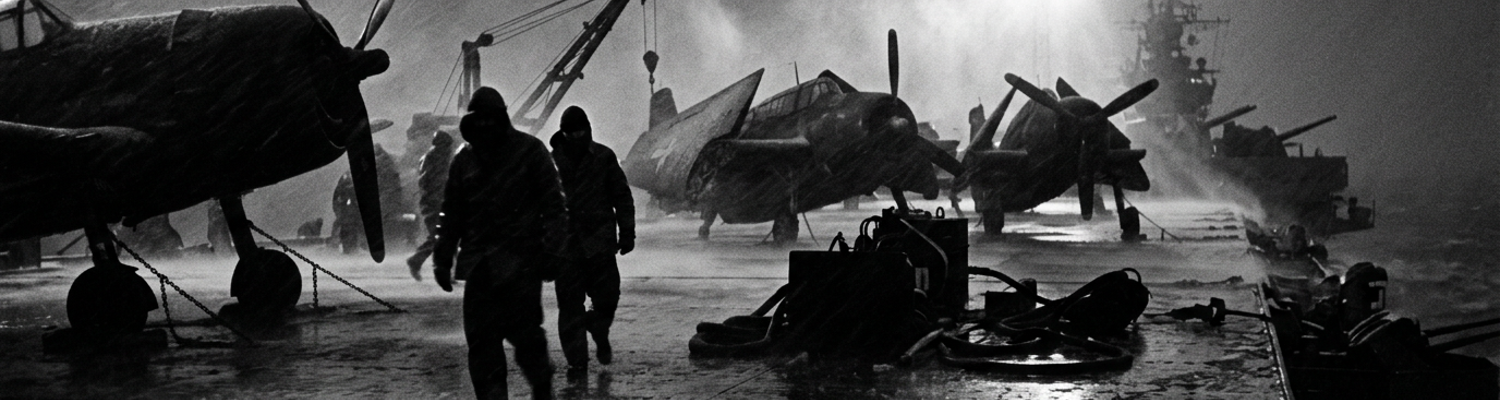

Task Force 58 Air Operations Over Honshu
Vice Admiral Marc Mitscher operated under a rigid seventy-two-hour countdown dictated by Pacific Fleet command.
Archival evidence shows that Task Force 58 had to approach within 125 nautical miles of the Honshu coast. They needed to launch carrier aircraft against Japanese industrial targets and break contact by the evening of February 17. The amphibious transports of Task Force 51 were already converging on Iwo Jima. Any operational delay off Honshu risked leaving those troopships without carrier air cover on D-Day.
Orders forbade all electronic transmissions.
Every carrier division had to reach pre-assigned launch coordinates off the Tokyo plains at precisely 0600 on February 16. The navigation relied entirely on dead reckoning and silent radio reception. The timeline offered zero allowance for weather disruptions or mechanical error.
A close review of operational logs indicates that Task Force 58 sailed directly into a Siberian gale moving southeast across the Kanto Plain. Flight deck crews on USS Hornet (CV-12), USS Lexington (CV-16), and USS Essex (CV-9) worked through sleet squalls. Heavy sea spray froze into thick crusts over the wooden flight decks. Freezing water locked arresting gear cables. Green water washed over carrier bows in sea state five conditions. At 0545 on February 16, the first wave of over one thousand aircraft launched into the freezing overcast.
Their primary targets were industrial.
The objective list included the Nakajima Aircraft Company assembly complex at Ota, the Musashino engine works, and army air bases at Atsugi and Tachikawa. The mission required eliminating Japanese fighter production and clearing forty airfields of defensive air wings before the invasion fleet reached the Volcano Islands. Grumman F6F Hellcats skidded across icy flight decks during deck-run launches.
When examining the historical record of Carrier Air Group 11 and Air Group 80, striking these facilities demanded exact time-on-target synchronization. Dozens of separate squadrons had to reach designated coordinate intersections within sixty seconds of one another. Curtiss SB2C Helldivers diving at steep angles, Grumman TBF Avengers flying low-level glide bomb runs, and Hellcats providing high cover operated on strict schedules. Failing that window meant unescorted bombers would face concentrated anti-aircraft artillery and Nakajima Ki-84 fighters without escort.
Strike groups ascended through driving sleet into clear air above 20,000 feet over the Chiba Peninsula.
Ambient air temperatures at that altitude dropped below minus forty-five degrees Fahrenheit. Strict radio silence prevented pilots from calling out timing corrections over the target. Each flight leader depended entirely on the calibrated balance of mechanical cockpit clocks to judge their approach runs. At high altitude, that mechanical timekeeping fell apart.
Sub-zero air rushing through unsealed instrument panels caused standard animal and petroleum lubricants inside Elgin and Waltham eight-day aircraft clocks to solidify. Escapements slowed down. Balance wheels lost momentum. Second hands dragged or seized entirely. Bombing formations arrived three to six minutes out of phase. This timing error scattered the carefully staged strike corridors and jammed recovery patterns back over the fleet.
Lubricant Failure in Type A-11 Navigation Watches
When examining the historical record of Carrier Air Group 83 aboard USS Essex, the mechanical breakdown began the moment flight leaders crossed 18,000 feet.
Naval aviators relied on wrist-worn Type A-11 navigation timepieces built by Elgin, Waltham, and Bulova. These were supplemented by bulkhead-mounted Mark II navigation chronometers. Factory specifications required these instruments to run on refined porpoise-jaw oil blended with light mineral distillates. Chemical petroleum products in 1945 were not formulated for high-altitude combat environments. As cockpits climbed through freezing cloud banks above the Pacific approach routes, temperatures plunged past minus forty degrees Fahrenheit.
At that threshold, organic animal fats separated from mineral bases.
Capillary action pulled the congealing fats directly into the jewel holes. The lubricant turned into a sticky sludge. Cap jewels around the escape wheel pivots gummed shut. Pinions lost rotational clearance. Inside the unpressurized cockpits of Grumman F6F-5 Hellcats, pilots noticed the sweep-second hands twitching erratically before freezing against the dials. Porpoise-jaw oil hardened into cold grease across five carrier task groups.
Archival evidence shows that this viscous drag hit the balance wheel assemblies hardest. The balance wheel in a Type A-11 oscillated at 18,000 beats per hour. It swung through an arc of 270 degrees to drive the pallet fork and escapement. Cold-thickened lubricant on the balance staff pivots degraded this oscillation instantly. Rotational amplitude dropped from normal operating tolerances down to sixty degrees. Hairsprings could no longer overcome the hydraulic drag of the congealed grease on the impulse pin.
Many balance wheels stopped oscillating altogether.
Others ran thirty to forty percent slow within twenty minutes of reaching altitude. In the Mark II chronometers carried by navigation officers in Grumman TBM Avengers, similar mechanical drag distorted dead-reckoning logs. Navigators calculated groundspeed by matching timed ground points against paper charts. When the balance wheels dragged, those speed calculations produced wild discrepancies. A five-minute approach run over Chiba turned into an uncalibrated eight-minute drift toward Japanese flak corridors.
Dead-reckoning calculations failed across every quadrant of the Kanto Plain.
A close review of operational logs indicates that these mechanical timing errors disrupted the entire coordinated strike schedule on February 16. Strike groups launched from USS Bunker Hill and USS Hornet were scheduled to meet at pre-selected rally coordinates south of Tokyo Bay at 35 degrees 15 minutes North, 139 degrees 45 minutes East. Helldivers from VB-80 and Avengers from VT-80 arrived seven minutes ahead of their escorting Hellcats due to divergent clock rates between cockpits. The dive-bombers orbited unprotected over coastal radar installations at Tateyama. They drew heavy anti-aircraft fire while burning reserve fuel.
Striking the Nakajima aircraft plant at Ota required exact synchronization to suppress airfield defenses before bombers entered their terminal dives. Individual squadrons arrived piecemeal over the targets between 0715 and 0740. Japanese Army Ki-84 fighters from the 47th Sentai exploited the gaps. They attacked isolated elements of Air Group 11 before fighter cover arrived.
Strict Strike Timetables and Operational Doctrine
Archival evidence shows that Task Force 58 operated under complete radio silence across all tactical frequencies from the moment ships departed Ulithi Atoll until aircraft crossed the coastline of Honshu.
Fleet doctrine classified all voice transmitters under absolute emission control. This specifically included the high-frequency SCR-522 and ARC-5 command radios inside Grumman F6F Hellcats and Curtiss SB2C Helldivers. The intent was direct. Planners needed to deny the Japanese Navy 1st Air Fleet and land-based radar networks on Hachijo-jima and Oshima any electronic signature of approaching carrier divisions. Shore installations along the Boso Peninsula operated Type 13 air-search radars and direction-finding stations. These stations were capable of triangulating radio transmissions within seconds of a carrier transmission.
Admiral Mitscher issued operational orders mandating that no pilot, flight leader, or shipboard radar operator could transmit a single tone.
This ban applied even to reports of engine trouble, navigational drift, or water ditchings in the freezing winter sea. Aircrews flew blind through dense stratus clouds across hundreds of miles of open ocean. They verified their approach routes using paper dead-reckoning charts taped to knee-boards alongside elapsed-time chronograph watches. A single broadcast over the radio net would strip five carrier task groups of tactical surprise.
A close review of operational logs indicates that the strike plans drawn up by air officers depended entirely on micro-synchronized time-on-target strikes across Japanese airfields and engine factories. Carrier Air Group 11 aboard USS Hornet and Air Group 83 aboard USS Essex planned three-phase strikes designed to overwhelm air defenses through split-second layering.
At T-minus ninety seconds, Grumman F6F-5 Hellcats swept in at fifty feet above ground level.
They fired five-inch high-velocity aircraft rockets and six .50-caliber machine guns directly into the sandbagged revetments of Imperial Japanese Army twenty-five-millimeter Type 96 anti-aircraft guns. At T-zero, Curtiss SB2C-4 Helldivers pushed over from twelve thousand feet into sixty-degree dives. They released one-thousand-pound high-explosive bombs onto runway intersections and maintenance hangars. At T-plus sixty seconds, Grumman TBM-3 Avengers followed at eight hundred feet, dropping fragmentation clusters across aircraft dispersal revetments.
Every phase of that three-minute assault relied on mechanical watch movements ticking at exactly the same speed.
If the strikes hit out of order, the dive-bombers plunged through the blast fragments of their own escort rockets, or arrived after Japanese gunners had recovered from the strafing runs. When examining the historical record of Task Group 58.2, timing errors broke the operational doctrine across multiple flight corridors over Tokyo Bay. Strike planners had established the approach axis along precise geographical waypoints. Aircraft crossed the southern cape of the Miura Peninsula, turned northwest toward the naval arsenal at Yokosuka, and broke out over the Musashino plain.
Each leg had been measured in knots, magnetic headings, and minutes on stopwatch elapsed-time bezels. Without radio channels to adjust for sudden wind shifts or cloud-bank deviations, flight leaders had only their bulkhead clocks and cockpit timepieces to confirm when to deploy into tactical attack columns. Sub-zero temperatures inside unheated cockpits slowed down balance wheels. Hellcat escorts flew through their assigned suppression corridors four minutes before the Helldiver strike divisions reached their initial points.
Japanese gunners at Tachikawa and Atsugi had time to reload their automatic cannons.
They spotted the unescorted dive-bombers breaking through the cloud ceiling and directed coordinated fire against the lead elements of Air Group 80. VF-80 expended its entire ammunition load over empty runway strips six minutes before the bombers arrived at coordinates 35 degrees 43 minutes North, 139 degrees 24 minutes East.
Improvised Solvents and Graphite Field Washes
Hangar deck repair shops smelled of leaded fuel, solder fumes, and frozen sea brine.
When examining the historical record of USS Bunker Hill and USS Hornet, instrument technicians operated inside cramped repair spaces two decks below the flight line. Flight quarter sirens sounded repeatedly throughout the predawn hours of February 16. Operational countdowns gave technicians less than forty minutes between strike briefings and engine run-ups to service dozens of non-functioning Type A-11 wristwatches and panel-mounted chronographs. Hull plating moved heavily against thirty-foot waves off the Japanese coast. This motion caused bench vises, brass tweezers, and magnifying loupes to rattle violently across steel workbenches.
Technicians worked by the dim beam of hooded desk lamps.
They unseated balance cocks, hairsprings, and escape wheels with fine-tipped screwdrivers while flight deck officers pounded on watertight doors demanding calibrated timepieces for Air Group 84. A dropped balance staff or stripped jewel screw meant an unrecoverable failure. Replacement inventory from replenishment ships at Ulithi was days away. Specialists secured their watchmaker trays with friction tape against the roll of the ship. They stripped down sixteen-jewel movements piece by piece to expose the seized drive trains before pilots manned their Grumman F6F Hellcats.
Two decks above, flight deck handlers spotted fifty strike aircraft in darkness.
Archival evidence shows that standard issue Elgin and Waltham chronometers could not function with the grease approved by Navy supply catalogs. Technicians in Carrier Air Group 4 aboard USS Essex drained glass jars of 100/130-octane aviation gasoline directly from the wing sumps of parked Avengers. They blended the volatile fuel with industrial trichloroethylene degreasers from the catapult maintenance lockers. Watch plates, escape wheels, and pallet arbors were dropped straight into open glass watch-glasses filled with the solvent mix. This dissolved hardened porpoise-jaw fats and mineral waxes.
Swirling the components with camel-hair brushes stripped away every trace of factory lubricant within thirty seconds.
The process left the polished steel pinions completely bare. Liquid oils inevitably froze solid when aircraft reached twenty-two thousand feet over the Kanto Plain. The mechanics discarded traditional lubricants entirely. Technicians crushed dry carbon blocks into ultra-fine powdered graphite. They dusted the microscopic particles across jewel holes, balance pivots, and pallet stones with cut-down brass styling pins. The dry graphite formed a frictionless coating that could not solidify, evaporate, or gum up when exposed to minus-fifty-degree atmospheric temperatures.
Graphite dust settled into technicians skin and across the green felt of the repair trays.
A close review of operational logs indicates that instrument shops verified these field modifications through rapid thermal stress testing before clearing the watches for flight. Maintenance men on USS Yorktown rushed the graphite-treated Elgin 539 movements down into the forward meat-storage lockers. They left them exposed to sub-zero temperatures next to frozen beef rations for twenty-minute evaluation cycles. Technicians checked the balance wheel swing with handheld stopwatches. They confirmed that the graphite-treated balance staffs sustained an operating amplitude above two hundred degrees without stalling in the cold.
Watch cases were resealed with improvised rubber gaskets punched out of inner-tube scrap.
Technicians wrapped them with friction tape to block driving sleet and handed them up through the hangar hatches directly to strike leaders as Wright R-2600 engines turned over on the flight deck. Forty-four reconditioned watches were distributed to VT-84 flight crews fifteen minutes before the first launch wave accelerated down the deck at 35 degrees 20 minutes North, 140 degrees 15 minutes East.
Underway Replenishment Challenges Off the Bonin Islands
Heavy steel cables snapped under tension when the swells pitched ship hulls forty feet apart.
When examining the historical record of Service Squadron 6, Rear Admiral Donald B. Beary received emergency orders to maintain continuous replenishment stations northeast of the Bonin Islands at 26 degrees 30 minutes North, 143 degrees 50 minutes East. Gale-force winds battered the outer island chain. Task Force 58 steamed south from Honshu on February 17, running dangerously low on aviation fuel, ordnance, and functional timekeeping instruments. Winter currents collided with cold northern frontal systems. This generated twenty-five-foot swells that caused fleet oilers and repair tenders to roll thirty degrees through horizontal planes.
Deck crews wrestled with three-inch manila messenger lines and heavy steel trolley wires across churning green water.
Hydraulic winches shrieked as automatic tensioning gear struggled to compensate for rapid distance shifts between escorting destroyers, supply tenders, and Essex-class fleet carriers. A single parted cable meant unguided steel cables sweeping across flight decks. The cables swept crewmen into sea spray that froze against catwalk stanchions. Rig captains timed every heave by eye, waiting for momentary lulls between crests to feed highline traveler blocks across rolling hull gaps. Fuel hoses tore free twice during the morning watch of February 18.
Archival evidence shows that dry-cargo vessels assigned to Service Squadron 6 carried priority crates packed specifically for carrier air wing instrument shops. Aboard the repair ship USS Piedmont (AD-17) and accompanying supply tenders, deck officers rigged highline cargo nets. These nets contained double-walled wooden chests lined with vulcanized rubber dampeners, horsehair blankets, and excelsior packing. Inside these shock-insulated containers rested zeroed Hamilton Model 21 marine chronometers, replacement Elgin 539 movements, and hundreds of four-ounce glass vials holding experimental low-temperature synthetic lubricants.
Naval Research Laboratory chemists had expedited these synthetic diester compounds.
The new fluids were designed to replace the failed porpoise-jaw oils and standard mineral distillates that had frozen solid over Tokyo. The synthetic fluids retained low viscosity down to minus sixty-five degrees Fahrenheit without forming paraffin crystals. Transferring these fragile consignments demanded extreme winch control. As carrier hangar decks rose and plummeted alongside the pitching tenders, winch drivers eased traveler blocks down directly onto padded mattresses laid across the open elevator wells of USS Lexington and USS Hornet. Saltwater soaked the cargo platforms whenever traveler blocks dipped into cresting wave peaks.
A close review of operational logs indicates that Navy instrument specialists on USS Bunker Hill received forty-eight shock-crated chronometers and thirty gallons of experimental synthetic instrument fluid while maintaining twelve knots into the wind.
Machinist mates immediately ferried the sealed jars down to the aft avionics shop to flush out the field-applied kerosene and graphite residues.
Each balance pivot was stripped with alcohol, dried with forced compressed air, and treated with micro-droplets of the synthetic diester oil before being locked back into anti-vibration bulkhead mounts. Technicians verified the escapement tolerances against cold-chamber benches set up inside the forward meat lockers. They confirmed that balance wheel amplitudes remained stable at two hundred and seventy degrees under freezing conditions. Flight technicians completed calibration runs on seventy-six replacement pocket stopwatches and cockpit timers at 1400 on February 18. This occurred five hours before Task Group 58.3 repositioned south to launch initial support sweeps over the sulfur ridges of Iwo Jima.
Fleet Standardization of Low-Temperature Synthetic Lubricants
Paperwork from carrier ready rooms sparked an overhaul of naval horology within forty-eight hours of the Honshu strikes.
When examining the historical record of the Bureau of Aeronautics, action reports submitted by Carrier Division 5 and Carrier Division 6 exposed how chemical failure had compromised high-altitude combat doctrine. Technical officers at the Bureau collaborated with metallurgists at the Naval Research Laboratory in Anacostia. They dissected frozen Elgin 539 and Waltham 6/0-B movements pulled directly from carrier repair lockers. Cold-chamber evaluations replicated the atmospheric conditions over the Kanto Plain. Engineers exposed test units to temperatures of minus fifty-five degrees Fahrenheit inside hypobaric chill vats.
Laboratory engineers discovered that standard-issue porpoise-jaw oil experienced catastrophic phase changes below minus thirty degrees.
This oil was sourced from the melon fats of Atlantic bottle-nosed dolphins. Triglycerides and free fatty acids precipitated out of solution. They formed microcrystalline wax grids across the balance staff jewels, pallet arbors, and escape wheel teeth. Kinematic viscosity spiked from twenty centistokes at room temperature to over twelve thousand centistokes in sub-zero flight conditions. The mainspring barrel generated insufficient torque to push the gear train through this frozen emulsion. Balance wheel oscillations collapsed from three hundred degrees of rotational sweep down to zero within forty minutes of exposure.
Natural dolphin fats could not survive modern stratospheric combat.
Archival evidence shows that the Navy acted swiftly, bypassing peacetime procurement cycles to accelerate the adoption of synthetic low-temperature instrument oils across every fleet air wing. Naval Research Laboratory chemical teams directed by organic chemists rushed formulations based on synthetic branched-chain aliphatic diesters. They specifically utilized di-2-ethylhexyl sebacate blended with phenolic oxidation inhibitors and anti-wear tricresyl phosphate additives. This synthetic lubricant remained fluid down to minus sixty-five degrees Fahrenheit. It resisted evaporation in low-pressure cockpit environments up to thirty-five thousand feet.
Rear Admiral Dewitt C. Ramsey ordered procurement branches to coordinate emergency production runs with commercial chemical manufacturers in Delaware and New Jersey.
Industrial blending facilities packaged the synthetic fluid into sealed four-ounce amber glass bottles fitted with precision eyedroppers for distribution to naval aviation depots. Forward air depots on Guam and repair tenders at Ulithi received urgent directives to purge all porpoise-jaw and mineral lubricants from fleet horological inventories. They replaced them entirely with the new synthetic diester specification. Supply officers condemned thousands of gallons of traditional watch lubricants to scrap drums across Pacific supply depots.
A close review of operational logs indicates that this accelerated standardization directly altered carrier maintenance protocol prior to Operation Iceberg off the Ryukyu Islands in late March 1945.
Field directives required carrier instrument technicians aboard USS Essex, USS Yorktown, and USS Intrepid to completely strip, solvent-clean, and re-oil all cockpit clocks, Mark II navigation chronometers, and wrist chronographs before launching combat air patrols.
Waltham, Elgin, and Hamilton factory production lines in Massachusetts, Illinois, and Pennsylvania simultaneously converted their final assembly lubrications to the synthetic diester compound under direct naval inspection oversight. Technicians checked torque thresholds on balance wheel jewels using specialized microscopic capillary wire. They ensured that escape wheel teeth received less than one-tenth of a milligram of synthetic fluid to avoid hydraulic drag during high-g pullouts. Carrier Air Group 83 flight leaders flying Grumman F6F-5 Hellcats against kamikaze strike formations off Okinawa reported zero watch stoppages during forty-two continuous days of sub-zero, high-altitude fighter sweeps. The Bureau of Aeronautics recorded no high-altitude horological seizure incidents during naval air strikes conducted between coordinates 26 degrees 12 minutes North, 127 degrees 40 minutes East and the Japanese home islands through August 1945.