
Subterranean Bunker Networks at the Punchbowl
Department of the Army Field Manual 5-15 dictated standard procedures for neutralizing defensive positions. The doctrine required a systematic advance utilizing floodlights and standard block-and-tackle extraction rigs. It assumed the existence of linear triage corridors. The Haean-myon basin in December 1951 offered entirely different conditions. The terrain consisted of a lightless network of collapsing dirt tunnels. Soldiers dragged bleeding casualties upward by their load-bearing suspenders. Archival evidence shows that the task of pacifying these North Korean and Chinese fortifications fell to an improvised coalition. Joint Army Military Police security detachments and combat engineer teams took the assignment. Standard infantry units bypassed the deepest redoubts to maintain momentum along the surface ridges. This left the 2nd Engineer Combat Battalion and attached 2nd Military Police Company units to conduct the subterranean clearing operations.
The clearing teams operated entirely without standard supply lines.
A close review of operational logs from Hill 1042 and Hill 902 indicates severe mechanical bottlenecks (NARA Record Group 338). The engineers carried M2A1 flamethrowers and thirty-pound composition C-3 satchel charges. They used these explosives to collapse the deepest bunkers. Military Police detachments followed immediately behind them. Their orders required them to secure prisoners and establish underground casualty collection points. This doctrine assumed the tunnel floors were flat. The North Korean engineers had instead constructed multi-tiered defensive complexes. Steep connecting galleries dropped thirty to forty feet directly into the granite. When an engineer took shrapnel in a lower gallery, the MPs had to abandon their security protocols. They acted as stretcher-bearers. They attempted to maneuver standard canvas litters through tunnels measuring only four feet in diameter. The rigid poles of the stretchers jammed against the timber shoring at every sharp turn.
Engineers dismantled the stretchers.
They physically carried wounded men over their shoulders while scaling fifty-degree inclines. The division of labor between the Military Police and the combat engineers broke down completely under these conditions. Security detachments were originally tasked with establishing holding pens for enemy combatants near the tunnel entrances. The sheer volume of rock and debris dislodged by the C-3 charges blocked the designated exit routes. MPs found themselves trapped alongside the engineers in the lower levels. They discarded their standard issue handcuffs and riot batons. They dug through the collapsed dirt with their bare hands. Joint teams spent up to six hours clearing a single ten-foot section of collapsed gallery just to extract one injured soldier.
Evacuation times stretched from minutes to hours.
Sub-zero winter weather created ice-choked shafts. These blockages severely obstructed vertical access and natural ventilation throughout the Punchbowl basin. Temperatures at the ridgetops regularly dropped to negative twenty degrees Fahrenheit during the second week of December. Moisture from human breath and groundwater seepage froze instantly upon contact with the vertical tunnel walls. The primary access shafts became coated in thick layers of smooth ice. Block-and-tackle pulleys brought in by the engineers froze solid within twenty minutes of exposure. Manila ropes turned rigid. They snapped under the weight of a single casualty. Medical personnel waiting at the surface could not access the wounded below. The ice buildup completely sealed off the primitive ventilation grates carved into the hillsides.
Carbon monoxide pooled in the lowest chambers.
Detonating satchel charges consumed the remaining oxygen. The blasts flooded the enclosed spaces with toxic fumes. The blocked ventilation shafts trapped the explosive gases underground alongside the clearing teams and the casualties. Engineers attempting to hack through the ice blockages with standard M-1943 entrenching tools found the steel blades chipped against the frozen earth. Airflow stagnation meant that triage stations established at the base of the access shafts became immediate suffocation hazards. MPs tied frozen ropes around the waists of wounded soldiers. They attempted to hoist them up the iced-over vertical chutes by sheer physical force. The friction of heavy winter parkas dragging against the jagged ice tore the fabric. Open wounds were exposed directly to the freezing temperatures. Medical corpsmen recorded instances where blood plasma froze inside the glass administration bottles before it could reach the patients waiting at the bottom of the shafts.
Cordite Smoke Hazards and Subsurface Obstacles
Archival evidence from the 2nd Engineer Combat Battalion logs during the second week of December reveals a severe atmospheric degradation. Chemical byproducts dictated the pace of subterranean advances. Detonating thirty-pound Composition C-3 satchel charges within the enclosed granite chambers of Hill 1042 generated thick clouds of vaporized explosive compounds. Close-quarters exchanges of small arms fire compounded this issue. M1 Garand rifles and enemy PPSh-41 submachine guns discharged massive volumes of raw cordite directly into the stagnant air.
The smoke stayed trapped.
Clearing teams composed of joint engineer and Military Police detachments stepped directly into these heavy concentrations immediately after a breach. Standard infantry doctrine assumed natural air currents would pull fumes through the tunnel network. The multi-tiered North Korean complexes completely lacked cross-ventilation. Trapped cordite smoke settled heavily in the lowest cleared bunker chambers. Visibility dropped to less than six inches. Soldiers pushing into the captured rooms inhaled concentrated clouds of unburned propellant. They breathed in sulfur and carbon monoxide. The resulting acute respiratory distress incapacitated entire squads within minutes. Men experienced violent coughing fits. They suffered uncontrollable vomiting and severe hypoxia while attempting to secure combatants in the dark.
Standard M3 lightweight gas masks failed almost immediately.
A close review of medical evacuation manifests indicates a specific mechanical failure. The internal charcoal filters of the standard issue masks saturated with cordite particulate after only twelve to fifteen minutes of exposure. Men tore them off. This action exposed their lungs directly to the toxic gas retention pooling in the dead-end galleries. The heavy winter air pressing down from the surface access shafts created a severe temperature inversion. This locked the noxious fumes deep underground. Command elements from the 2nd Infantry Division ordered clearing teams to implement strict ten-minute rotational shifts. The goal was to prevent mass asphyxiation. This administrative directive broke down completely when structural collapses blocked the primary egress corridors. Men designated for surface rotation could not physically climb past the incoming relief squads carrying heavy extraction block-and-tackle gear. The narrow physical geometry of the connecting tunnels forced soldiers to crawl on their stomachs through the densest layers of the settling gas.
Toxic vapor gathered thickest directly against the dirt floors.
Engineers struggled to clear these subsurface structures because the physical clearance points restricted all forward movement. The tight spaces completely eliminated the use of standard extraction rigging. The North Korean defenders constructed entryway doglegs measuring exactly three feet wide by three feet high. These were heavily reinforced with interlocking red pine logs and hardened clay. Detonating satchel charges near these chokepoints fractured the timber shoring. The wood shattered. The blasts splintered the thick logs inward and reduced the clearance aperture to less than twenty inches of passable space. Engineers had to wedge their shoulders through these jagged gaps. They dragged unexploded ordnance and heavy M2A1 flamethrower fuel tanks. They pulled injured personnel through the splintered openings. The collapsed entryways formed solid physical barricades. These blockages trapped the toxic gases inside the newly captured rooms. Men trapped on the wrong side of the breach inhaled the accumulated fumes while waiting for the bottleneck to clear. Attempts to widen the restricted structural clearance points using short-handled M-1943 entrenching tools only dislodged more loose earth from the ceiling. This further sealed the rudimentary vents. Sapper teams spent up to four hours hacking at a single splintered pine beam in total darkness. They breathed air composed heavily of vaporized cordite. The physical exertion required to break through the debris accelerated their heart rates. This forced deeper inhalation of the contaminated air. Medical corpsmen operating the surface casualty collection stations recorded thirty-four separate instances on Hill 902 where combat engineers required emergency vertical extraction solely due to severe chemical inhalation.
Freezing Temperatures and Medical Supply Failures
Army Medical Department directives specified exact pain management protocols in forward areas. The standard relied on the immediate subcutaneous injection of half-grain morphine tartrate via disposable Squibb Syrettes. Archival evidence from the 2nd Medical Battalion operating along the northern ridgelines of the Haean-myon basin in December 1951 reveals a complete breakdown of this protocol. Ambient temperatures near Hill 1042 dropped to negative twenty-six degrees Fahrenheit during the first week of the operation. The standard medical kit issued to frontline corpsmen stored these single-use tin tubes in uninsulated canvas webbing. The kits were exposed directly to the wind chill.
The morphine tartrate solution inside the tubes froze solid within forty-five minutes of a patrol leaving the warming tents.
Water expands by roughly nine percent when it transitions to ice. This physical expansion exerted outward pressure against the pliable tin walls of the Syrette. The crimped metal seams at the base of the tubes split open under the strain. The medication leaked out and crystallized across the canvas belts. Medics reaching casualties deep inside the granite bunkers found their entire supply of pain relief mechanically destroyed. A close review of operational logs from the 38th Infantry Regiment indicates a desperate improvisation. Surviving Syrettes required intense bodily heat to thaw the frozen needle shafts. Corpsmen placed the intact metal tubes inside their own mouths. They wedged them deep into their armpits beneath layers of wool uniforms. Thawing a single dose took up to fifteen minutes of continuous body contact. The blind wire loop used to puncture the internal seal frequently snapped off in the medic's fingers. The metal became highly brittle in the extreme cold. Casualties with traumatic amputations from Chinese concussion grenades lay screaming on the frozen dirt floors. Medics waited for the body heat to turn the ice block back into a liquid. Command elements from the 2nd Infantry Division ordered medics to tape the Syrettes directly to their chests before stepping off the line of departure.
Sweat from physical exertion caused the surgical tape to lose adhesion and drop the tubes into the snow.
Intravenous volume replacement encountered identical thermal failures across the subterranean triage corridors. Standard medical protocols relied on dried blood plasma. Corpsmen reconstituted this in the field by mixing it with sterile distilled water inside rigid glass administration bottles. Temperatures on the ridges around coordinate 38°16'N 128°07'E caused the reconstituted liquid to drop below thirty-five degrees Fahrenheit within ten minutes of mixing. The suspended proteins inside the plasma precipitated out of the solution. The fluid turned into a thick gelatinous sludge. This high-viscosity gel refused to flow through the narrow lumens of the standard issue latex IV tubing. Medics attempting to treat hemorrhagic shock at the subterranean collection points found that the cold constricted the rubber hoses until they clamped shut completely. Inserting the eighteen-gauge steel needle into a collapsed vein became impossible when the delivery system failed to generate any hydrostatic pressure.
The plasma froze solid directly inside the glass bottles.
Field commanders from the 2nd Engineer Combat Battalion directed aid stations to establish continuous heating operations. They used M-1950 gasoline squad stoves. Corpsmen filled M-1 steel helmets with snow and melted it over the open flames. They submerged the frozen plasma bottles into the hot water baths to restore liquid flow. This thermal shock caused the cold glass containers to shatter. Shards of glass and liquid plasma spilled directly into the boiling water. Adjusting the heat required medics to constantly monitor the water temperature using their bare hands to prevent the containers from cracking. Reheating a single 500cc bottle of plasma took twenty-five minutes of uninterrupted attention from a dedicated corpsman. Men bleeding out from shrapnel wounds waited on canvas litters. Medical personnel focused entirely on operating the improvised water baths. The heated plasma cooled rapidly as it traveled down the thirty-six inches of exposed latex tubing. The liquid gelled again just before entering the patient's arm.
Improvised Underground Heated Triage Alcoves
Army Medical Department Field Manual 8-10 guaranteed medics a standardized battalion aid station. This was supposed to be housed within a sprawling climate-controlled General Purpose Medium tent positioned three miles behind the line of departure. The 2nd Medical Battalion operating at coordinate 38°16'N 128°07'E instead inherited a lightless maze of collapsing granite walls and frozen mud. Frontline Army medics attached to the 38th Infantry Regiment abandoned surface evacuation protocols entirely during the second week of December 1951. Enemy mortar barrages along the Haean-myon basin ridgelines forced these corpsmen into the newly captured North Korean tunnel networks to escape the fragmentation patterns.
A close review of 2nd Infantry Division tactical logs reveals a direct order from the division surgeon.
The mandate required the establishment of forward triage facilities directly inside the subterranean complexes. Medical teams identified secondary ammunition storage alcoves carved deep into the bedrock of Hill 902. Frontline Army medics modified subterranean bunker alcoves into protected underground casualty collecting points. These storage cavities measured exactly six feet wide by eight feet deep. Converting the tiny subterranean chambers required intense physical labor from exhausted medical personnel. Corpsmen dragged shattered red pine logs from the main entry corridors to shore up the structurally compromised ceilings. They shoveled out hundreds of pounds of loose shale and spent brass casings using short-handled entrenching tools. This created a flat surface for the wounded. Ambient temperatures inside the granite alcoves hovered around zero degrees Fahrenheit. Medics laid down overlapping layers of empty canvas sandbags and discarded enemy winter coats over the frozen dirt floor. This insulated the casualties from the rock. Space restrictions meant that a maximum of three canvas litters could fit inside an alcove simultaneously. Medical personnel had to crawl on their hands and knees over the wounded soldiers to administer blood plasma and pack bandages into open chest wounds.
Total darkness compounded the medical emergencies.
Archival evidence from the 2nd Engineer Combat Battalion details the mechanical integration of power systems to solve the temperature and visibility deficits. Command elements ordered sapper teams to transport standard 1.5-kilowatt Homelite portable diesel generators down the iced-over access shafts. Portable diesel generators were installed to power improvised heating units and sustain medical lighting in low-oxygen alcoves. Transporting a single 115-pound generator unit required four engineers using heavy canvas straps. They lowered the machinery down forty-foot vertical drops. Sapper units bolted the machines directly to the bedrock floor of adjacent tunnel junctions. They ran thick rubber-coated electrical cables through the dirt corridors to connect standard 100-watt incandescent drop lights inside the triage alcoves. These power lines also supplied electricity to salvaged Herman Nelson aircraft heaters.
The heating units forced warm air through flexible canvas ducts directly onto the shivering casualties.
Internal combustion engines require a continuous intake of atmospheric oxygen to maintain the ignition cycle. The deepest complexes of Hill 1042 lacked any natural cross-ventilation. Running the Homelite generators inside the sealed granite corridors rapidly consumed the limited breathable air. Diesel engines sputtered and experienced heavy RPM drops as the ambient oxygen levels plummeted within twenty minutes of activation. Unburned fuel pooled in the exhaust manifolds. Generators discharged thick black clouds of carbon monoxide and particulate matter directly into the stagnant tunnel air. Medics operating the triage alcoves thirty feet away noticed the incandescent drop lights flickering violently as the power systems choked. Heavy exhaust fumes drifted down the connecting galleries and flooded the casualty collection points. Corpsmen treating shrapnel lacerations suddenly found themselves gasping for air alongside their patients.
Engineers had to manually shut down the power systems to prevent mass asphyxiation.
Cutting the engines instantly plunged the subterranean triage centers back into absolute darkness. Herman Nelson heaters stopped forcing warm air through the canvas ducts. Temperatures inside the alcoves plummeted back below freezing within ten minutes. Medics resorted to utilizing standard M2 pocket flashlights held between their teeth to illuminate surgical fields while clamping severed arteries. D-cell batteries inside the flashlights drained rapidly in the extreme cold. Engineers attempted to route standard corrugated metal exhaust pipes from the generator manifolds up through the collapsed ceiling vents. Jagged debris blocking the vertical shafts crushed the thin aluminum piping. Exhaust gas backed up into the engine blocks and caused the diesel generators to stall permanently. Medical teams sat in total darkness listening to the breathing of the casualties.
Diesel Ambulance Fuel Waxing on Trench Routes
Archival evidence from the 2nd Medical Battalion motor pool logs details the collapse of surface evacuation protocols during the third week of December 1951. Temperatures along the Haean-myon basin ridgetops plummeted to negative twenty-eight degrees Fahrenheit. The unit operated a fleet of modified M39 series utility vehicles equipped with diesel powerplants. These were specifically allocated to navigate the steep mud-rutted trench routes connecting Hill 902 to the rear clearing stations. Standard petroleum diesel contains naturally occurring paraffin wax molecules. This chemical composition dictates a specific cloud point where the liquid hydrocarbons begin to solidify.
The extreme ambient cold forced the fuel inside the exposed steel tanks of the ambulances past this thermal threshold.
Wax crystals precipitated out of the liquid diesel. The microscopic solids clumped together instantly. A close review of maintenance manifests from the 38th Infantry Regiment reveals the mechanical destruction that followed. The crystallized paraffin suspended in the fuel traveled directly from the primary tanks into the narrow copper delivery lines. Diesel engines rely on high-pressure mechanical injection to force atomized fuel into the combustion chambers. The wax slurry hit the primary inline paper fuel filters and completely coated the porous cellulose membranes. The thick paste blocked all liquid flow. Fuel starvation occurred within three minutes of engine ignition. Drivers attempting to idle their vehicles outside the subterranean casualty collection points watched their RPM gauges drop to zero. The heavy engines violently shuddered and died. Mechanics working in the open air removed the heavy steel filter housings and found the internal elements encased in a solid block of white wax. They attempted to bypass the primary filters entirely by running rubber hoses directly from the tanks to the injection pumps. This field modification allowed the wax slurry to enter the high-pressure fuel pumps. The abrasive paraffin crystals scored the internal steel cylinders and destroyed the tight mechanical tolerances.
Injector nozzles shattered under the dry mechanical pressure.
Mechanized transport failure left battalion medical personnel unable to move casualties via standard motor routes. Main Supply Route 7 consisted of a graded dirt path carved directly into the eastern slope of the Punchbowl. Standard operating procedures dictated that the diesel ambulances would traverse this route to transport stabilized patients from the trench lines to the Mobile Army Surgical Hospital located seven miles south. The fuel-waxing epidemic paralyzed the entire motor pool. Paramedics found themselves stranded at coordinate 38°16'N 128°07'E with dozens of bleeding soldiers and zero operational vehicles. Casualties suffering from penetrating abdominal trauma lay on frozen canvas litters beside the dead engines. Command elements from the 2nd Infantry Division ordered motor pool mechanics to thaw the frozen fuel lines using open-flame M-60 gasoline blowtorches. Mechanics crawled underneath the stalled ambulances and directed the blue flames against the frozen undercarriage. Applying direct fire to the thin copper tubing caused the trapped diesel to boil and rupture the metal seams.
Liquid fuel spilled directly into the snow.
Casualty evacuation collapsed along frozen trench routes when diesel ambulances suffered severe fuel-waxing in extreme cold. Medics abandoned the stalled vehicles. They attempted to manually carry canvas litters down the steep connecting trenches. The narrow physical dimensions of these defensive earthworks forced the stretcher-bearers to walk single file while supporting two hundred pounds of dead weight. Standard canvas litters featured rigid wooden poles that scraped against the frozen mud walls at every bend in the trench line. Groundwater seepage had turned the trench floors into solid sheets of smooth ice. Corpsmen wearing standard rubber-soled pac boots lost their footing on the fifty-degree inclines and dropped the litters. Patients spilled onto the frozen ground. Medical personnel resorted to wrapping steel communication wire around their boots to generate traction while dragging wounded men over the frozen earth. The physical exertion of moving casualties through the winding earthworks depleted the medical teams within two hours. Evacuation times to the rear aid stations increased from forty-five minutes by ambulance to nine hours by foot. Platoon leaders recorded fourteen instances where severely wounded patients froze to death on the stretchers before reaching the bottom of the hill.
Manual Sled Relays and Improvised Cableways
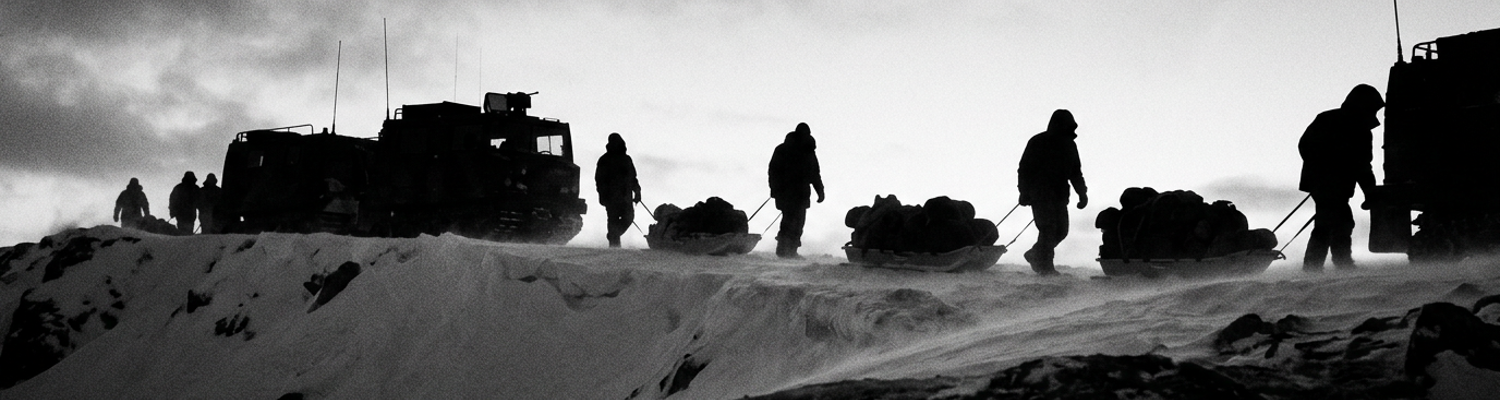
Archival evidence from the 2nd Medical Battalion supply manifests reveals a complete abandonment of wheeled evacuation by December 18, 1951. Supply officers shifted medical transport onto hand-drawn manual sled relays over frozen terrain. They raided quartermaster depots near coordinate 38°15'N 128°06'E for M-1942 Ahkio snow sleds. Quartermasters originally designed these units to carry two-hundred-pound arctic canvas tents. Medical corpsmen repurposed the shallow fiberglass hulls to transport wounded soldiers down the eastern slopes of the Haean-myon basin. Loading a casualty required medics to wrap the patient in heavy wool blankets and lash them tightly to the internal cargo rings using standard parachute cord. The steep descent from Hill 902 featured forty-degree inclines completely covered in packed snow and hidden sheets of black ice. Four-man teams attached thick manila tow ropes to the front of the Ahkio hulls. They attempted to control the downward momentum by digging the heels of their rubber-soled pac boots directly into the frozen hillside.
The two-hundred-pound human payload caused the sleds to accelerate uncontrollably down the slick gradients.
A close review of operational logs from the 38th Infantry Regiment indicates that continuous manual transport proved physically impossible. Supply officers organized a rigid relay system spaced at exact fifty-yard intervals down the ridgeline. Stretcher-bearers dragged the sleds to a designated wooden marker, unclipped their canvas harnesses, and handed the ropes to a fresh four-man team waiting in the snow. Men operating the ropes experienced severe muscle fatigue within ten minutes of pulling. The heavy canvas straps cut directly into their collarbones through three layers of winter clothing. Sweat generated by the intense physical exertion soaked their cotton thermal undershirts. This moisture froze instantly against their skin when they stopped moving at the exchange points. Jagged granite outcroppings hidden beneath the snowpack tore deep gouges into the fiberglass sled runners.
Medical personnel recorded twenty-three separate incidents where the damaged hulls fractured completely and dumped casualties into the freezing mud.
Surface evacuation routes stopped entirely at the deep topographical fissures separating the primary ridge from the rear aid stations. A tectonic fault line created a sheer two-hundred-foot vertical drop between the base of Hill 1042 and the adjacent extraction zone. Engineers constructed improvised overhead cableways to haul litter casualties across unpassable mountain gaps. Sapper teams from the 2nd Engineer Combat Battalion felled thick red pine trees using two-man crosscut saws. They used these logs to build heavy wooden A-frame support towers on both sides of the chasm. Sledgehammer operators anchored three-eighths-inch braided steel wire rope directly into the frozen bedrock using heavy steel pitons. Mechanics salvaged hand-cranked winch assemblies from destroyed M39 utility vehicles and bolted them to the timber frames. Medics secured standard canvas litters to the suspended steel cables using heavy steel carabiners and load-bearing D-rings.
Two engineers manually turned the heavy iron winch handles to pull the suspended stretcher across the void.
Sub-zero weather immediately degraded the mechanical reliability of the aerial transport system. Wind chill dropping to negative thirty degrees Fahrenheit caused ambient moisture from the ravine to flash-freeze directly onto the exposed steel cables. Thick layers of rime ice coated the braided wire rope. The heavily greased steel pulleys attached to the litters slammed into these solid ice blockages and jammed tight against the metal. Forward momentum ceased entirely. Casualties lay suspended in mid-air one hundred feet above the rocky ravine floor while engineers attempted to clear the ice. Men operating the hand cranks applied maximum physical force to break the pulleys loose. This intense torque caused the braided steel wire to stretch and fray against the iced-over winch gears.
A frayed wire strand snapped under tension and whipped backward across the face of a winch operator.