
15 December 1941. 19:40 Local Time, 16°45′N 169°31′W. A squall provides cover for the Japanese submarine I-22 as it surfaces 5,500 yards from Johnston Atoll. Its 140mm deck gun opens fire. The first shells bracket the tiny island. The third strikes an oil storage tank, which erupts in flame and illuminates the nearby power station for the submarine's gunners. For ten minutes, shells walk across the outpost. One lands just astern of the transport USS William Ward Burrows anchored in the lagoon. The U.S. Marine garrison returns fire with 5-inch guns. The shots are inaccurate. The I-22 withdraws unscathed.
The attack was a tactical failure for the Japanese. But it confirmed a deep-seated strategic fear for American war planners.
These remote atolls were not fortresses. They were stepping stones. Archival evidence shows their primary purpose was to form an air ferry route connecting Hawaii to Australia via Canton Island, Christmas Island, and Fiji. This southern corridor was essential for moving aircraft, personnel, and high-priority supplies outside the range of Japanese land-based aviation. The initial deployment to these specks of coral and sand was a frantic race against time. There were no deep-water ports, no established infrastructure, and no local resources. Everything, from bulldozers to bullets, had to be transported thousands of miles across open ocean. Coral reefs had to be blasted to create channels for supply ships. Airstrips were scraped out of the unforgiving coral, creating surfaces that shredded tires and ingested abrasive dust into sensitive aircraft engines. The very act of building these outposts was an immense operational lift, undertaken with the constant knowledge that an enemy cruiser could appear over the horizon at any moment.
A close review of operational logs indicates the response to these early raids centered on heavy artillery.
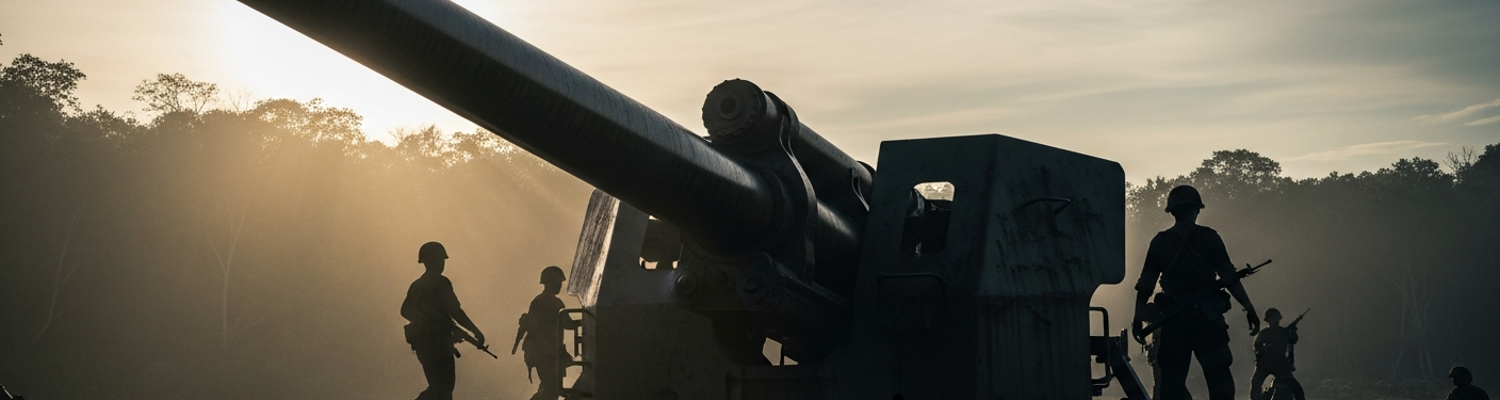
The defense of Johnston Atoll fell to units like Battery C of the 15th Coast Artillery Battalion. Their primary armament was the 155mm GPF (Grande Puissance Filloux), a French-designed gun from the First World War. Weighing nearly 13 tons in its traveling configuration, moving the weapon from a ship, across a shallow lagoon, and into a firing position on a sand-and-coral islet was a monumental task. Emplacing the guns required digging massive pits for the split trails to anchor into the unstable ground, a necessity to absorb the recoil and allow the gun its full 60 degrees of traverse. The fine, corrosive sand and salt spray infiltrated every mechanical tolerance. The hydro-pneumatic recoil systems, which relied on a precise balance of oil and nitrogen, were particularly susceptible to contamination that could lead to catastrophic failure upon firing. The gunners of Battery C fought a constant battle against the environment before they could ever fight the enemy. Their tactical mission was simple: deny the lagoon to enemy surface vessels and protect the vital airfield from naval bombardment. Every day involved a grinding routine of maintenance, cleaning cosmoline and corrosion from breech blocks and traversing gears, all performed under a punishing tropical sun.
The initial survey and construction phases on the Pacific atolls subjected Army engineers and Navy Seabees to an unceasing environmental assault. It was as debilitating to morale as it was destructive to machinery. The moment bulldozers broke the thin topsoil and tore into the dense jungle, they unleashed a miasma of decay. For millennia, the cycle of growth and decomposition had been contained within the island’s ecosystem. Now, it was violently disrupted. The resulting stench of rot was a physical presence, a thick, sweet, and nauseating odor that clung to uniforms and tents, and permeated the C-rations. It was the smell of disturbed earth, shredded vegetation, and stagnant water, all baking under a sun that drove temperatures inside metal equipment sheds to well over 120 degrees Fahrenheit. This was compounded by an inescapable humidity that often hovered near 100 percent. Sweat would not evaporate. Every uniform became a sodden, chafing second skin. Fungal infections and skin diseases were a constant affliction. For every two men lost to combat in some sectors of the Southwest Pacific, five were incapacitated by disease, a statistic directly influenced by these hellish atmospheric conditions.
The environment was a relentless corrosive agent.
Naval Construction Battalion logs (CBMU 501, entry for 4.11.43) reveal a daily, losing battle against rust. The combination of high humidity and aerosolized salt from the ocean spray created an electrolytic process that attacked every piece of metal. It was not a slow process. Bright steel tools left out overnight would have a visible layer of orange rust by morning. The delicate tolerances of machinery were the first to suffer. Carburetor jets on jeeps and generators became clogged with crystalline salt deposits. The paper-and-wax insulation on electrical wiring and radio components would absorb moisture, swell, and short-out entire communications systems. The hydro-pneumatic recoil mechanisms of artillery pieces required a constant state of vigilance, as microscopic pitting on the recoil rods could shred the seals, causing a failure upon firing. Maintenance crews worked around the clock, not just repairing but attempting to prevent this decay. They coated metal surfaces in thick layers of cosmoline grease, wrapped ignition systems in oiled cloth, and instituted mandatory daily cleaning rituals for all personal weapons, where soldiers would field-strip their rifles just to scrape the creeping rust from bolts and receivers.
The duty of documenting this struggle fell to small, often overlooked, teams of combat photographers from the Army Signal Corps. Dispatched from units like the 165th Signal Photo Company, these men were soldiers first and photographers second. Their task was creating a visual record for intelligence, engineering analysis, and public dissemination. They moved alongside the Seabees and engineers, capturing the initial landings, the brute force of the bulldozers, and the methodical work of airfield construction. Their own equipment was as vulnerable as any other piece of complex machinery. The standard-issue Speed Graphic PH-47 camera, while robust, had leather bellows susceptible to dry-rot and fungus in the damp conditions. Lenses would develop their own fungal blooms, a creeping web across the glass that softened images. Film stock was a perishable commodity. Heat and moisture could fog unexposed film or cause the emulsion to separate from the acetate base, rendering entire batches useless. Photographers improvised. Film was stored in sealed ammunition cans with desiccant packets. Lenses were cleaned with captured high-proof Japanese sake when proper solvents ran out. Their work provided a critical, unfiltered window for commanders in the rear, cutting through sanitized reports to show the ground-truth of building a war from sand and coral.
The submarine bombardments of December 1941 were a prelude to a protracted period of nerve-wracking skirmishes. Japanese naval strategy in the Central Pacific evolved into a persistent war of harassment against these isolated American outposts. For the men of Battery C, 15th Coast Artillery, this translated into a grueling cycle of alerts and stand-downs. Unidentified radar contacts or distant sightings of periscopes sent crews scrambling to their gun pits at all hours. After-action reports from the Harbor Defenses of Pearl Harbor, which had oversight of Johnston, reveal a pattern of recurring submarine probes throughout 1942. These were not full-scale assaults. They were cautious, probing attacks designed to test defenses, disrupt airfield operations, and chip away at the garrison’s morale. An attack could consist of a few shells fired from extreme range before the submarine crash-dived, leaving the gunners to scan an empty sea. The tactical problem for Battery C was immense. Their World War I-vintage 155mm GPF guns, while powerful, were designed for static defense against surface ships, not for hunting submerged submarines. Firing was often a matter of educated guesswork, lobbing 95-pound shells at a last known position or a fleeting glimpse of a shadow on the water.
Each call to action was a violent intrusion into the humid monotony of garrison life.
The shriek of the alarm was followed by the thud of boots on coral as gun crews raced to their emplacements. The air would quickly become thick with an acrid cocktail of smells. From the island’s power station, which kept searchlights and communications gear running, came the constant, throat-catching fug of diesel fumes. This smell defined the outpost’s existence, the mechanical heartbeat of the garrison. During an engagement, it was overwhelmed by the sharp, metallic tang of cordite. The process of firing the 155mm gun was a feat of mechanical and human effort; an eight-man crew had to manhandle the massive shell and separate powder charge into the breech, slam the heavy block shut, and stand clear. The ensuing blast was a physical blow. The cloud of gray-white smoke that billowed from the muzzle carried the unmistakable scent of the propellant, a smell that clung to uniforms and filled the lungs. It was the smell of industrial warfare being waged from a tiny speck of sand.
This was the raw, confined world that photographers from the Army Signal Corps were tasked with documenting. Working in two- or three-man teams, often attached from a larger unit like the 165th Signal Photo Company, their mission was to capture the operational life of the outpost, including combat. During a night skirmish, their job was perilous. The flash from a press photographer’s bulb could provide a perfect aiming point for an enemy gunner. They worked in near-total darkness or coordinated their shots with the firing of the main guns. Analysis of Signal Corps photographic logs from the period shows a focus on capturing specific evidentiary details: the muzzle flash of the 155mm guns, the splash of return fire in the lagoon, and damage to island infrastructure. Capturing a usable image of a distant submarine at night was nearly impossible. They focused their lenses on the human element instead. The strained faces of the gun crews, illuminated for a split second by the violent light of the breech opening to receive the next round. These images, shot on cumbersome Speed Graphic cameras whose delicate bellows were rotting in the tropical humidity, were not for public consumption. They were an intelligence tool, a grainy view for commanders in the Headquarters Bubble at Pearl Harbor and Washington, cutting through dry reports to show the physical and psychological reality of holding a lonely outpost under fire.
Archival Signal Corps photographic plates from the Pacific theater reveal a consistent narrative of profound resource strain. Photographers from units like the 165th Signal Photo Company, armed with bulky Speed Graphic PH-47 cameras, captured a visual truth that rarely aligned with the upbeat summaries cabled to command echelons. One series of 4x5 inch negatives from Funafuti in 1943 documents the daily battle for mechanical survival. An image shows the cracked cylinder head of a vital water distillation unit, not replaced, but patched with metal sheeting and sealed with a dark, tar-like substance. Another plate captures two exhausted engineers from an Army aviation battalion stripping parts from a wrecked jeep to keep a single generator running, their faces grim under the tropical sun. These were not images of glorious combat. They depicted a war of attrition against the environment itself, a story told through images of cannibalized machinery, frayed wiring, and tires worn down to the canvas.
The psychological toll was a constant, if subtle, subject. Photographers documented the human cost not in overt breakdowns, but in the physical details of exhaustion. A high-angle shot shows a line of soldiers outside a mess tent, their postures slumped, uniforms sweat-stained and tattered. They are not interacting. Each man is isolated in his own world of fatigue. Another image, intended for an engineering report, focuses on a makeshift shelter built against the rain, but the truly telling detail is the soldier inside, staring blankly past the camera, his eyes hollow. These large-format negatives captured immense detail, showing the fungal blooms on canvas tents, the rust-pocked helmets, and the gaunt features of men pushed to their physical and mental limits by heat, disease, and isolation. Each click of the shutter documented a reality of scarcity and decay.
Photographic evidence provided a stark, factual record of environmental destruction that went beyond simple wear and tear. The plates served as a time-lapse of decay, showing how the man-made tools of war were being systematically unmade by the Pacific environment. A sequence of photos taken for an ordnance maintenance log (NARA Record Group 111-SC) shows a 155mm coastal gun emplacement over a period of six months. The first image shows the gun freshly emplaced, its metal gleaming. The final plate shows the same weapon, its barrel streaked with rust, a creeping tide of corrosion consuming the breech mechanism, and its wooden ammunition crates swollen and beginning to rot in the perpetual damp. Signal Corps photographers captured close-ups of carburetor jets clogged with a crystalline mix of salt and coral dust, and the delicate wiring of a command post radio set rendered useless by a web of green-white fungus growing over the contacts. Their own equipment was not immune; photographers constantly fought fungus on their lenses and the dry-rot of their camera bellows, a struggle that made their mission of documentation a technical challenge in itself. These images were a direct visual report on the losing battle against a corrosive atmosphere that attacked everything from massive artillery pieces to the smallest electrical components.
This granular, visual truth stood in sharp contrast to the operational summaries that flowed up the chain of command to Pearl Harbor and Washington. A weekly logistics cable from an outpost might list Airfield anti-aircraft batteries: 90% operational, a statistic that projected strength and readiness. That same week, a Signal Corps photographer’s plates would arrive in a different pouch, showing that operational meant a gun crew had to bypass a corroded firing solenoid with a jury-rigged connection of bare wire, a fix that was both dangerous and unreliable. An engineering summary might report Motor pool vehicle readiness: 85%, yet the photographic record would reveal that this percentage was achieved only by welding cracked truck frames and keeping half the fleet immobile as designated parts donors. This disconnect fostered a dangerous perception of control within the headquarters bubble. While commanders saw reassuring percentages and concise reports, the photographic plates screamed a different story. One of improvisation, impending failure, and a logistical chain stretched to its breaking point. The photos were not strategic analyses, but they were undeniable data points that complicated and often directly contradicted the simplified picture upon which high-level decisions were being made.