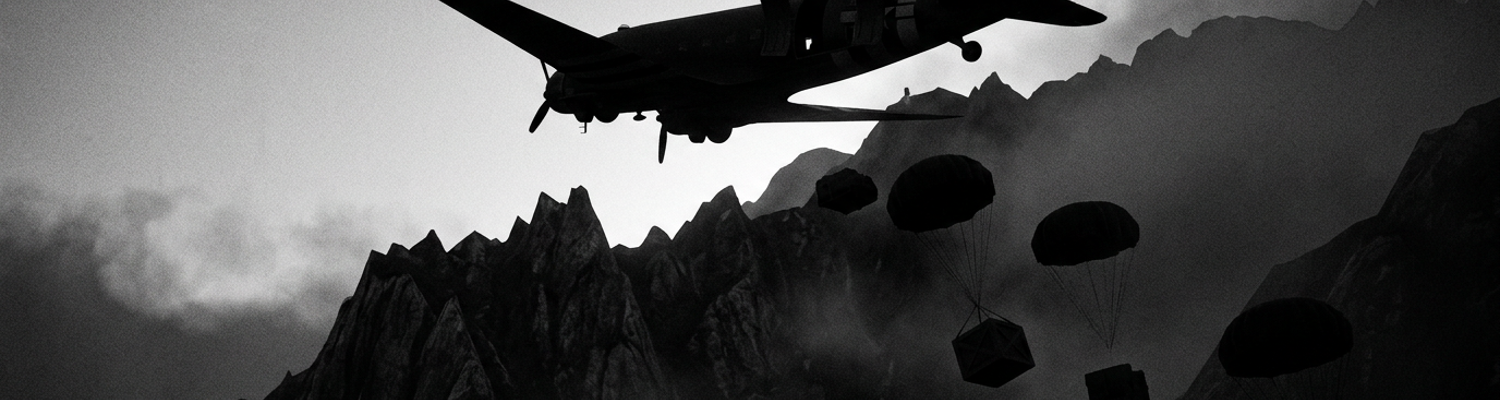

Strategic Objectives of Operation Avalanche at Avellino
The men of the 509th Parachute Infantry Battalion spent the forty-eight hours prior to September 14, 1943, breathing the abrasive dust of North African staging fields. Sleep deprivation was a quantifiable physical barrier before the engines of the C-47 transport planes even turned over. Combat rations consisted of hardtack and minimal water. This left the paratroopers severely dehydrated while marching across the tarmac at Kairouan under a punishing sun. Archival evidence shows that many of these men had not slept for two straight days due to last-minute manifest changes forced by arguing ground commanders and Army Air Forces planning staff. These troops carried eighty pounds of gear, weapons, and ammunition strapped to their fatigued bodies.
The invasion of mainland Italy demanded a high price in human endurance.
Operation Avalanche aimed to secure the Allied foothold at the Salerno beachhead. Lieutenant General Mark Clark commanded the U.S. Fifth Army to land along a twenty-mile stretch of the Gulf of Salerno starting on September 9. The geography heavily favored the defenders. A steep amphitheater of mountains ringed the narrow coastal plain. This terrain gave the German 16th Panzer Division clear lines of sight to direct 88mm artillery fire down on the landing craft of the U.S. VI Corps and British X Corps. Securing this foothold required capturing the high ground and the inland road networks to prevent enemy armor from pushing the invasion force back into the Mediterranean Sea. By September 13, a massive German counterattack threatened to force a separation between the American and British sectors along the Sele River. The situation deteriorated rapidly. Clark instructed his staff to prepare contingency plans for a total evacuation of the beachhead.
Ground force commanders desperately needed interdiction operations behind the German lines to protect their vulnerable perimeter.
Senior Army Air Forces officers resisted these requests. They viewed airborne drops deep in mountainous terrain at night as a reckless misuse of their troop carrier squadrons. Arguments erupted in the planning tents over flight paths, altitude requirements, and the lack of pathfinder transponders on the ground. General Clark forced the issue. He required an immediate airborne operation designated Giant III to cut off the specific routes feeding the German counterattack.
Planners targeted a small mountain town twenty miles inland.
The 509th Parachute Infantry Battalion was tasked with blocking German reinforcements moving through the mountain passes of Avellino. A close review of operational logs indicates that Avellino operated as the primary transit hub for the German Hermann Göring Division and the 15th Panzergrenadier Division moving south toward Salerno. Route 18 intersected with several narrow mountain defiles right at the town center. Lieutenant Colonel Doyle Yardley commanded the 509th and received orders to drop his 640 men directly into this heavily defended junction. The tactical directive required the battalion to destroy bridges, mine the roads, and hold the passes for a minimum of five days until the Fifth Army could break out of the beachhead.
Army Air Forces commanders protested the drop zone selection.
They cited the 4,000-foot peaks surrounding the Avellino valley. Troop carrier pilots from the 51st Troop Carrier Wing lacked the necessary terrain-following radar to navigate the Apennine Mountains in total darkness. The navigational plan required the aircraft to fly hundreds of miles over the open Mediterranean, make a sharp turn at a poorly defined coastal landmark near Agropoli, and fly blindly into the mountains. Navigators did not possess Eureka-Rebecca radar tracking systems to locate the drop zone electronically. Ground commanders ignored these aviation constraints. They prioritized the immediate need to stop German tanks from reaching the Salerno perimeter. Yardley and his men were assigned a drop zone designated only by a set of grid coordinates in a rocky valley they had never seen in daylight. Aviation staff failed to provide aerial reconnaissance photographs of the specific jump sectors.
The paratroopers were ordered to rely on dead reckoning and makeshift maps drawn from outdated Italian civilian surveys.
Inter-Service Friction and Beacon Allocation Disputes
When examining the historical record of September 1943, the dysfunction between U.S. ground forces and aviation branches dictated the tactical conditions at Avellino. Lieutenant General Mark Clark and the U.S. Fifth Army staff demanded immediate airborne reinforcement to prevent the Salerno beachhead from collapsing under German armor assaults. USAAF Troop Carrier Command officers, specifically within the 51st Troop Carrier Wing under Brigadier General Paul Williams, flatly refused the initial operational timelines. Ground commanders viewed the C-47 squadrons entirely as cargo transports expected to deliver infantry on demand. Aviation staff understood the mechanical limitations of flying unarmored, overloaded Douglas transports through the heavily defended Apennine mountain passes at night. The C-47 engines struggled to maintain altitude over 4,000-foot peaks while carrying twenty fully equipped paratroopers and parapacks loaded with explosives.
This clash of doctrine completely halted the deployment of specialized pathfinder units.
Airborne pathfinder teams had just been conceptualized following the disastrous friendly fire incidents during the invasion of Sicily. These specialized squads required dedicated aircraft, specific low-altitude flight training, and three days of advance infiltration to mark drop zones with halogen lamps. Fifth Army command overrode the USAAF requests for this preparation window. They ordered the 509th Parachute Infantry Battalion to jump within twenty-four hours of the initial briefing. Command disputes between Allied ground commanders and USAAF Troop Carrier Command delayed pathfinder equipment deployment indefinitely. Troop Carrier Command retaliated by withholding the few trained pathfinder crews available in North Africa. They cited the unacceptable risk of losing highly technical personnel on a rushed, unreconnoitered mission.
The airborne infantrymen were forced to jump entirely blind.
Disagreements over the allocation of Rebecca and Eureka radar transponders left the drop zone without navigation signals. The Eureka was a sixty-pound ground-based transmitter designed to emit a specific radio frequency between 214 and 234 megahertz. Operating as the corresponding airborne receiver, the Rebecca mounted directly inside the cockpit of a transport plane. It functioned by broadcasting an interrogation pulse that triggered the Eureka to reply. This exchange displayed the ground signal as a blip on a cathode-ray tube to guide pilots directly to the target from up to fifty miles away. British engineers developed the system. Inventory in the Mediterranean theater was severely restricted in late 1943. A close review of operational logs indicates that the Allied supply board in Algiers controlled the distribution of these radar sets.
Airborne planners requested twelve Eureka units for the Avellino drop to establish a hard electronic perimeter.
Logistics officers denied the requisition entirely. High-ranking USAAF generals prioritized the Rebecca-Eureka systems for heavy bomber squadrons conducting long-range strikes into Germany and for established aerial resupply routes in less hostile sectors. They argued that dropping classified radar technology into a heavily contested zone like Avellino risked immediate capture by the German 16th Panzer Division. Ground force commanders furiously contested this decision. They pointed out that traversing the jagged peaks surrounding the drop zone at night was mathematically impossible without electronic guidance.
The allocation board refused to budge.
No transponders were loaded onto the aircraft at Kairouan.
The absence of these radar systems stripped the 51st Troop Carrier Wing of its only reliable navigation method. Pilots flying the Avellino route had to rely on basic dead reckoning over 200 miles of open ocean before making a sharp inland turn near the Agropoli coastline. Navigators sat in the unpressurized cabins trying to read outdated Italian civilian maps with flashlights. Cloud cover obscured the moon, removing the ability to identify terrain features visually. The C-47s entered dense fog immediately after crossing the shoreline. Without a Eureka signal to track, flight formations broke apart to avoid mid-air collisions in the zero-visibility conditions. Aircraft scattered across a thousand square miles of hostile Italian airspace. Individual pilots guessed their locations based on flight time and airspeed calculations.
Jumpmasters stood by the open doors staring into pure blackness.
The lead aircraft crossed the estimated coordinates for Avellino and toggled the green jump lights.
Night Navigation Errors Over the Apennines
On September 14, 1943, 640 paratroopers of the 509th Parachute Infantry Battalion launched aboard C-47 transport aircraft. A close review of operational logs indicates that the 51st Troop Carrier Wing provided thirty-nine Douglas transports for the Giant III mission. These aircraft departed from the remote Kairouan airfields in Tunisia. The mechanical demands on these aircraft pushed their operational limits. Each unarmored plane carried a heavy payload of airborne infantrymen. Every individual soldier was strapped into eighty pounds of M1 Garand rifles, Thompson submachine guns, composition C-2 demolition charges, and extra .30 caliber ammunition. Aviation mechanics loaded six external parapacks under the belly of each fuselage. They packed them with folding-stock bazookas and medical supplies.
Pratt and Whitney R-1830 Twin Wasp engines strained at maximum manifold pressure to generate enough lift to clear the North African coastline.
Lieutenant Colonel Doyle Yardley rode in the lead aircraft (serial number 41-18492). He commanded a battalion tasked with securing a heavily defended valley they had only studied on outdated civilian survey maps. The flight plan dictated a 200-mile low-level transit across the Mediterranean Sea at an altitude of just 500 feet. This low altitude was required to evade Luftwaffe radar sweeps originating from Sicily and southern Italy. Inside the unpressurized cabins, the air temperature plummeted as the formation approached the European landmass.
The pilots flew entirely blind into the hostile airspace of the Italian mainland.
Archival evidence shows that the designated flight path demanded a sharp turn inland at the Agropoli coastline. This maneuver required precise timing. Navigators relied strictly on dead reckoning. They calculated distance by measuring airspeed against a stopwatch while factoring in estimated wind drift. These calculations became highly inaccurate the moment the aircraft encountered the turbulent weather fronts off the coast of Campania. Heavy cloud cover completely obscured the moonlight over the Tyrrhenian Sea. As the C-47 squadrons crossed over the shoreline, a thick maritime fog blanketed the lower coastal elevations. This fog erased all visual reference points.
Formations instantly broke apart to avoid mid-air collisions.
Pilots pulled back on their yokes, forcing the overloaded transports into steep climbs to keep from slamming into the unseen peaks of the Apennine mountain range. Altimeters provided useless altitude readings over the rapidly changing elevation. The terrain surrounding Avellino featured jagged limestone ridges rising abruptly to 4,000 feet, specifically around Mount Terminio and the steep walls of the Sabato River valley. Updrafts violently battered the wings of the scattered aircraft. Severe night navigation errors over the rugged Apennine terrain scattered paratroopers across a 100-square-mile area. Without electronic Eureka transponders to guide them, flight crews lost their bearings within minutes of entering the mountain passes. Troop carrier pilots flashed the green jump lights whenever their stopwatches suggested they had reached the Avellino crossroads.
Jumpmasters shoved their sticks out of the aircraft doors at wildly varying altitudes.
Some men exited as low as 400 feet above the rocky slopes. Others dropped from 2,000 feet into freezing crosswinds. High winds and zero visibility resulted in a catastrophic dispersion of the battalion. Operational debriefings reveal that some sticks landed less than ten miles from the Salerno beachhead. They dropped right back into the main line of resistance. Other squads dropped thirty miles deep into the high mountains, landing near the villages of Montella and Lioni. They were entirely separated from their chain of command. Equipment bundles containing heavy machine guns, 60mm mortars, and anti-tank mines fell through the sky. They crashed into deep ravines where the troops could not recover them.
The 509th broke into dozens of isolated, heavily armed micro-units operating independently behind the lines of the German 16th Panzer Division.
Unlit Drop Zones and Immediate Equipment Loss
A close review of operational logs indicates that Allied planners originally scheduled local Italian partisans to ignite a geometric pattern of brush fires across the Avellino drop zone. These ground signals were designed to guide the 51st Troop Carrier Wing down into the Sabato River valley. Command friction between the Fifth Army and the Army Air Forces resulted in the cancellation of this advance coordination. Ground generals refused to delay the Giant III mission to allow Office of Strategic Services agents enough time to infiltrate the region and organize the partisan networks (NARA Record Group 338). The C-47 pilots crossed over the Apennine ridges expecting to see a designated T-shaped fire illuminating the Route 18 intersection. They looked down into an unbroken expanse of black terrain. German 16th Panzer Division anti-aircraft batteries enforced a strict regional blackout. They extinguished all civilian lights in the towns below. Flight crews stared through their plexiglass windshields searching for any visual reference point against the dark limestone mountains.
The pilots flew blind at 150 miles per hour over 4,000-foot peaks.
Without Eureka radar transponders or ground signal fires, the troop carriers lost all orientation over the target area. Navigators checked their stopwatches to estimate when they had crossed the twenty miles from the Agropoli coastline to the drop zone. The lead aircraft flipped the green toggle switches based entirely on these unverified time-distance calculations while flying through thick maritime cloud cover. Jumpmasters pushed their sticks of paratroopers out the side doors into the freezing slipstream. The men of the 509th Parachute Infantry Battalion plummeted into the pitch-black void of the Campania region. High winds dragged the descending canopies away from the intended valley floor and toward the steep, heavily forested slopes of Mount Terminio and the adjacent Sabato riverbanks.
Troopers fell through the night sky without any visual horizon to brace their legs for the impending ground contact.
Gravity accelerated the heavily burdened infantrymen into the rocky terrain at twenty-two feet per second.
Archival evidence shows that these high-velocity impacts on the jagged Apennine limestone instantly destroyed the battalion communications network. Radiomen jumped with the SCR-300 backpack transceivers strapped to their webbing. These thirty-five-pound units relied on highly fragile glass vacuum tubes to broadcast frequency-modulated signals back to Fifth Army headquarters at the Salerno beachhead. The violent landings smashed the internal circuitry of almost every set in the drop wave. Company commanders carried the smaller SCR-536 handie-talkies to coordinate local squad movements. The die-cast aluminum chassis of these handheld radios cracked open against the rocks. This severed the battery connections and snapped the telescoping antennas.
Platoon leaders found themselves standing in hostile territory with completely dead communication equipment.
Aviation mechanics back at Kairouan had packed the heavier battalion gear into six external A-4 parapacks strapped under the belly of each C-47. The navigators released these bundles miles away from the scattered paratroopers. Faulty release mechanisms dropped over half the equipment parapacks into inaccessible mountain gorges. Small clusters of three to five men consolidated in the darkness without any link to higher headquarters. These isolated squads lacked the heavy .30 caliber water-cooled machine guns, 60mm mortars, and anti-tank mines required to block the German armor columns moving down Route 18.
Paratroopers crept through unfamiliar vineyards and terraced farms.
They were armed only with M1 Garand rifles, Thompson submachine guns, and the composition C-2 demolition blocks they carried in their musette bags. Lieutenant Colonel Doyle Yardley could not broadcast assembly coordinates or call for aerial resupply to replace the lost heavy weapons. The 509th separated into dozens of disconnected micro-units operating without knowledge of the broader tactical situation. Individual riflemen engaged passing German patrols based strictly on line-of-sight encounters in the dark.
A platoon sergeant near the village of Lioni spent four hours dismantling three broken SCR-300 sets in a ditch to salvage a single working transmitter.
Tactical Encounters with the Sixteenth Panzer Division
Archival evidence shows that scattered elements of the 509th Parachute Infantry Battalion encountered the mechanized columns of the German 16th Panzer Division during the predawn hours of September 15. Generalmajor Paul Sievers had ordered his armored reserve units to reposition through the Avellino transit hub to reinforce the counterattack against the Salerno beachhead. Convoys of Panzerkampfwagen IV Ausf. H medium tanks and Sd.Kfz. 251 half-tracks rumbled south along Route 18 with their blackout drive lights engaged. Paratroopers moving in groups of three or four stumbled into these armored formations while attempting to orient themselves in the unfamiliar Sabato River valley.
The infantrymen expected to find a lightly defended rear area.
They instead found themselves standing in the primary staging lanes of a fully mobilized panzer grenadier regiment. German vehicle commanders standing in open cupolas spotted the American silhouettes crossing the mountain roads. Coaxial MG34 machine guns immediately opened fire on the isolated airborne squads. The deafening roar of Maybach HL120 engines echoed off the narrow limestone canyon walls.
A close review of operational logs indicates that the scattered American units lacked the ordnance required to destroy armored vehicles.
The catastrophic drop scattered the external A-4 parapacks across miles of inaccessible ravines. Platoon leaders realized their folding-stock M1A1 bazookas and heavy M1 anti-tank mines were completely lost in the darkness. The paratroopers carried only M1 Garand rifles, .45 caliber Thompson submachine guns, and composition C-2 demolition blocks in their canvas musette bags. Standard ball ammunition deflected harmlessly off the eighty-millimeter frontal armor plates of the advancing Panzer IVs. Infantrymen crouched in the roadside ditches while seventy-five-millimeter high-explosive shells destroyed the trees directly above their positions.
Squad leaders ordered their men into the dense brush to avoid total annihilation.
German tank treads crushed the asphalt just feet from where the airborne troops lay hidden in the mud.
When examining the historical record of these early morning firefights, survival depended entirely on the immediate exploitation of the Apennine geography. Isolated micro-units utilized the steep terrain features flanking Route 18 to avoid direct destruction by the panzer columns. The narrow mountain defiles restricted the German tanks to a single file formation. Turret gunners could not elevate their main guns high enough to target the jagged limestone outcroppings overhanging the roadway. Paratroopers climbed the terraced vineyards and positioned themselves in these mechanical blind spots. Groups of three or four men waited for the armored vehicles to pass through deep culverts before dropping improvised explosive charges onto the vulnerable engine deck grilles.
Other squads used the thick maritime fog settling in the Sabato riverbed to mask their movements between stone farmhouses.
The deep irrigation ditches running parallel to the highway provided exact defilade protection against coaxial machine-gun fire. If a tank halted to investigate a noise, the Americans crawled backward up the steep inclines. They used the heavy timber of the Mount Terminio foothills to break the line of sight. A corporal near the town of Serino wedged a two-pound block of C-2 into the suspension bogies of an idling half-track and sprinted blindly into a ravine before the fuse detonated.
German panzergrenadiers dismounted from their Sd.Kfz. 251 half-tracks to conduct aggressive infantry sweeps of the roadside embankments.
Command staff from the 16th Panzer Division quickly recognized that heavily armed enemy units were operating inside their primary transit corridor. Officers directed their troops to deploy MG42 machine gun teams along the ridgelines to encircle the scattered Americans. Airborne riflemen countered these maneuvers by retreating higher into the adjacent mountain peaks. Conventional defensive lines were abandoned immediately. The tactical profile shifted from a coordinated battalion blockade to decentralized guerrilla warfare. Troopers navigated the treacherous rock faces in total darkness to bypass the German cordons. Small teams observed the armored columns from elevations exceeding two thousand feet. They mapped the traffic flow for later sabotage attempts.
One isolated squad spent six hours buried under a pile of dead olive branches while a German repair crew replaced a thrown track just ten yards away.
Guerrilla Ambushes Against German Supply Lines
The complete collapse of the battalion command structure occurred within three hours of the initial jump.
When examining the historical record of the September 14 drop, the rapid capture of senior officers forced a total abandonment of standard airborne doctrine. Lieutenant Colonel Doyle Yardley dropped directly into a German sentry post near San Michele. He sustained combat injuries before being taken prisoner by a motorized patrol. This initiated a sixteen-month internment at Oflag 64 in Poland. His immediate capture broke the battalion chain of command right as the scattered sticks hit the ground. Standard tactical doctrine dictated that the battalion mass its six hundred men at the southern edge of the Avellino crossroads to form a rigid, sustained defensive perimeter blocking Route 18.
This centralized strategy was completely nullified by the catastrophic dispersion of the jump and the widespread destruction of the fragile SCR-300 backpack radios.
Cut off from central command, paratroopers abandoned the planned chokepoint blockade in favor of decentralized, small-unit guerrilla tactics. Executive officer Major William R. Dudley and dispersed non-commissioned officers gathered isolated pockets of three to five men in the darkness. These micro-units possessed no 60mm mortars or heavy water-cooled machine guns. They relied entirely on M1 Garand rifles, Thompson submachine guns, and canvas musette bags loaded with composition C-2 explosives. Platoon leaders recognized that a conventional stand against the mechanized formations of the 16th Panzer Division would result in immediate mass casualties. The men retreated into the rugged Apennine foothills. They used the jagged limestone ridges, thick chestnut forests, and dense maritime fog to mask their movements from searching enemy patrols.
Survival required immediate tactical improvisation.
Archival evidence shows that these isolated teams initiated a relentless series of ambushes against German communication lines and supply trucks along the critical mountain passes. Operating deep behind enemy lines without the possibility of aerial resupply, the paratroopers targeted the narrow defiles of Route 18 near the high-altitude villages of Montella and Lioni. Infantry squads utilized the steep terraced vineyards and stone farmhouses overhanging the highway to establish elevated, concealed firing positions. Convoys of soft-skinned Opel Blitz supply trucks and Sd.Kfz. 251 half-tracks slowed to navigate the tight, ascending switchbacks. Airborne riflemen initiated contact at extremely close range.
Troopers hurled high-explosive Gammon grenades directly into the open cargo beds of the passing vehicles.
These detonations ignited the volatile 88mm artillery ammunition being transported south to the Salerno beachhead. Other micro-units prioritized the physical severing of German field telephone networks. Paratroopers scaled wooden utility poles along the Sabato River valley under the cover of darkness to cut the heavy Feldfernkabel wires. This actively disabled the communication grid of the 15th Panzergrenadier Division. German repair crews arrived in lightly armored scout cars to splice the severed lines. American squads triggered improvised tripwire explosives fabricated from salvaged M1 anti-personnel mines and C-2 demolition blocks. The continuous, unpredictable destruction of cargo trucks and communication infrastructure severely degraded the flow of Axis reinforcements moving toward the vulnerable U.S. Fifth Army perimeter.
A close review of operational logs indicates that the sheer frequency of these scattered attacks caused German commanders to grossly miscalculate the size of the American force operating in their rear echelons.
Axis intelligence reports forwarded to Field Marshal Albert Kesselring concluded that an entire airborne regiment had landed in the Campania region. Generalmajor Paul Sievers diverted a full reserve infantry regiment away from the primary armored counterattack at Salerno to conduct exhaustive anti-parachute sweeps through the Avellino hills. The 509th kept these seasoned panzergrenadiers occupied for over two weeks. They constantly displaced higher into the Mount Terminio elevations after every roadside ambush. American troops seized an abandoned Italian Army supply depot near the town of Serino to replenish their dwindling medical provisions. They distributed the excess rations to local civilian partisans who provided exact intelligence on German patrol routes.
The scattered squads lived entirely off the land.
They drank from mountain streams and slept in hidden limestone caves during daylight hours. Battalion surgeon Captain Carlos Alden evaded capture for forty-eight hours. He ambushed a German scout car with a salvaged Thompson submachine gun before running out of ammunition in a terraced vineyard.
Operational Relief of the Salerno Beachhead
A close review of operational logs indicates that the decentralized sabotage campaign executed by the 509th Parachute Infantry Battalion directly degraded the German Tenth Army counteroffensive at Salerno. Generaloberst Heinrich von Vietinghoff commanded the Axis forces attempting to push the U.S. VI Corps into the Mediterranean. His operational plan required the rapid transit of the 15th Panzergrenadier Division and elements of the Hermann Göring Division south through the Avellino crossroads. Scattered American micro-units blocked the narrow Route 18 defiles with improvised explosives. Airborne riflemen dropped high-explosive Gammon grenades onto convoy lead vehicles from elevated limestone ridges. They targeted the unarmored engine blocks of the transport vehicles.
Burning Opel Blitz cargo trucks created physical bottlenecks.
These wrecks trapped trailing Panzer IV tanks in narrow mountain switchbacks. German recovery vehicles attempting to clear the wreckage hit M1 anti-tank mines hastily buried in the dirt shoulders by retreating American squads. The mechanized columns of the 16th Panzer Division came to a complete halt just fifteen miles north of the American beachhead.
Archival evidence shows that this constant rear-echelon harassment forced German command staff into a severe tactical miscalculation.
Field Marshal Albert Kesselring received frantic reports of ambushed supply trains and severed Feldfernkabel communication lines across the Campania region. Axis intelligence officers evaluated the high frequency of these attacks. They concluded that a full Allied airborne regiment occupied the high ground. Generalmajor Paul Sievers reacted by diverting heavily armed panzergrenadier battalions away from the primary assault on the Salerno perimeter. He ordered these veteran combat assets to conduct exhaustive, time-consuming sweeps through the dense chestnut forests of Mount Terminio. This diversion of manpower removed the infantry support from the German counterattack required to overrun the U.S. Fifth Army artillery positions near the Sele River.
Lieutenant General Mark Clark utilized this exact window of reduced enemy pressure.
He landed the 82nd Airborne Division directly inside his defensive perimeter and offloaded heavy Sherman tanks from LSTs at the shoreline. American artillery batteries received 105mm ammunition resupplies while German infantry searched empty caves twenty miles inland. The Avellino insertion demonstrated the tactical resilience of airborne infantry operating completely outside standard military doctrine. The catastrophic drop failures of September 14 had stripped the battalion of its heavy weapons, central command structure, and electronic communication. Dispersed non-commissioned officers assumed immediate command of isolated squads consisting of men they had never met in the staging areas.
These ad hoc units survived by exploiting the extreme topography of the Apennine Mountains to avoid direct engagements with mechanized patrols.
Troopers abandoned heavy, damaged equipment like the shattered SCR-300 radios to increase their mobility across the steep terraced vineyards and deep ravines. They sustained themselves entirely on scavenged supplies. They stole raw potatoes from local farms and drank rainwater pooled in limestone crevices along the Mount Terminio ridgeline. When composition C-2 demolition blocks ran out, paratroopers rewired captured German Tellermines and unexploded 88mm artillery shells to initiate ambushes against passing scout cars. A staff sergeant near the village of Lioni armed his five-man squad entirely with captured MP40 submachine guns stripped from a disabled half-track.
When examining the historical record of the breakout phase, the survival rate of these isolated units heavily depended on their aggressive evasion tactics.
The U.S. Fifth Army finally broke the German containment lines on September 28 and advanced north toward Naples along Highway 18. Disconnected elements of the 509th began emerging from the mountain passes to link up with the advancing 3rd Infantry Division. These paratroopers had operated behind enemy lines for two weeks with zero aerial resupply, artillery support, or medical evacuation capabilities. Infantrymen walked into Allied checkpoints suffering from severe dysentery, malaria, and untreated shrapnel wounds sustained during the initial highway ambushes. Out of the 640 men who boarded the C-47 transports at Kairouan, approximately 400 successfully infiltrated back to American lines over the following month. The remaining personnel were listed as killed in action or captured by German regional patrols and transported to POW camps in northern Europe.
A squad of six paratroopers walked into a forward command post near San Severino carrying a wounded corporal on a door torn from an Italian farmhouse.