
The Doctrinal Rift and Unseen Threats
The United States Army of the Cold War was an institution fixated on a single point on the map. The Fulda Gap. Its doctrine, budget, and identity were forged in anticipation of a massive Warsaw Pact armored assault across the plains of West Germany. Divisions were heavy, equipment was designed for open-field maneuver, and strategic thought was consumed by a potential World War III fought with tanks and tactical nuclear weapons. This singular focus created a deep institutional blindness. Threats that did not fit the European conventional warfare model were often ignored, under-resourced, or addressed with dangerously ill-suited ad-hoc solutions.
The discovery of vast enemy tunnel networks in Southeast Asia presented just such a problem. It was a form of warfare for which the Army had no answer, a subterranean dimension that negated American airpower and mechanized superiority. The initial response was defined by improvisation, sending individual soldiers, the so-called tunnel rats, into the dark with little more than a flashlight and a sidearm. This was not a sustainable or scalable doctrine. High command recognized the need for a mechanized solution, a way to project power underground. The problem was that no dedicated vehicle for this role existed, and the bureaucracy was too slow and too focused on the Fulda Gap to initiate a proper development program.
So they turned to what they had.
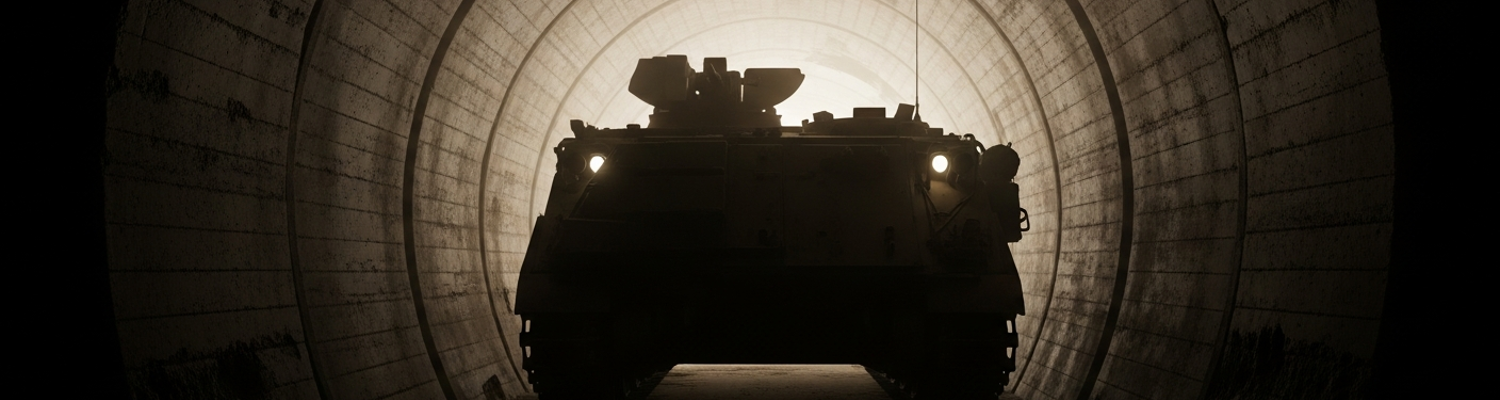
The M113 Armored Personnel Carrier. A ubiquitous aluminum box on tracks, it was the workhorse of the mechanized infantry. Planners, desperate for a solution, initiated a series of classified studies in 1968 under the umbrella designation ‘Project Mole.’ The concept was to adapt the M113 for urban subterranean combat, not in the narrow earthen tunnels of Vietnam, but in the larger, man-made utility and subway tunnels anticipated in a European conflict. It was a program born of doctrinal desperation, an attempt to force a square-peg vehicle into a round-hole mission.
Project Mole: An Ill-Conceived Subterranean Solution
Project Mole was never a single, unified program. It was a collection of disparate, often competing, field-expedient measures and classified studies. The core idea was to transform the M113 from a simple battle taxi into a mobile support base for operations in large subterranean complexes. The vehicle was envisioned as a rolling command post, a source of breathable air, and a firebase to secure tunnel junctions. The initiative immediately ran into the unforgiving laws of physics and engineering.
First was the problem of life support. An M113 is designed to operate with its large top hatch open, relying on the outside atmosphere. Sealing it for underground use required a closed-loop life support system its designers never conceived of. Archival evidence from Aberdeen Proving Ground, under a 1971 study designated XM769, details these attempts. Engineers bolted experimental CO2 scrubbers and oxygen tanks, many adapted from submarine technology, into the troop compartment. These systems were bulky, inefficient, and generated a tremendous amount of heat that the vehicle, now sealed in a tunnel, had no way to dissipate.
Test reports document repeated, catastrophic failures. During a simulation in March 1972, the combined respiration of the four-man crew and the diesel engine’s own oxygen consumption overwhelmed the makeshift system. Internal carbon dioxide levels reached critical concentrations in just 48 minutes, forcing an emergency evacuation. The engine’s own exhaust, improperly vented, posed a constant threat of being drawn back into the crew compartment. The project was attempting to solve a complex environmental engineering problem with off-the-shelf parts and a vehicle fundamentally unsuited for the task.
M113 Adaptation: A Cascade of Engineering Failures
The vehicle’s mobility proved to be an equal disaster. The M113’s excellent cross-country performance was a product of its wide T130E1 tracks, designed to distribute its twelve-ton weight over soft ground like mud and sand. On the hard, uneven surfaces of concrete and rock-hewn test tunnels, this design became a critical liability. A close review of operational logs from the Nevada Test Site shows the tracks offered almost no traction on smooth, debris-strewn concrete. The vehicle’s skid-steering, which relied on braking one track to turn, was too abrupt for the narrow confines. The hull repeatedly scraped and slammed against the tunnel walls.
One simulation in May 1973 ended in total failure. An XM769 prototype, attempting to climb a mild 15-degree incline inside a mock subterranean passage, lost traction. The driver’s attempt to regain a grip caused the vehicle to slide sideways. The immense lateral force threw the right-side track, shearing the steel connecting pins. The M113 was left completely immobilized. It was a metal plug wedged deep inside the test tunnel.
These systemic flaws culminated in a tragic, final test in early 1975. The objective was a long-duration, sealed-hull endurance run with a four-man crew from the 1st Cavalry Division. A faulty sensor in the ventilation system’s monitoring equipment failed to alert the crew to a slow, steady buildup of carbon monoxide. The engine’s exhaust, vented through a temporary external port, was being drawn back into the vehicle through a compromised seal around the commander’s cupola. In the noisy, cramped compartment, the crew’s gradual descent into hypoxia went unnoticed. When the crew failed to respond to scheduled radio checks, a rescue team was sent in. They forced the rear ramp and found all four crewmen unconscious. Medical reports (declassified under file NARA RG 338.5) confirmed two were dead from CO poisoning. The other two died from complications within days. The incident led to the immediate and permanent cancellation of the XM769 program. The Army’s attempt to create a subterranean fighting vehicle had failed, at the cost of four lives.
Operation Underpass: A Manufactured Humanitarian Crisis
Two years before the final, fatal test of the XM769, the Army’s flawed subterranean doctrine was put on full display during a NATO exercise. Operation Underpass, part of the larger AUTUMN FORGE series in 1972, was designed to test the Army’s ability to clear and secure a large, enemy-held subterranean complex in a European setting. The scenario involved Warsaw Pact forces seizing a multi-level slate mine in West Germany. But planners, seeking to add complexity, introduced a fatal variable. A simulated civilian population, role-played by West German reservists, was sheltering in the mine. The U.S. Army was tasked with not only clearing the enemy but also evacuating the civilians.
This created an immediate conflict of directives. The tactical force, drawn from the 11th Armored Cavalry Regiment, was focused on assault. Their job was speed, aggression, and destruction. The evacuation element, a mix of U.S. Army military police and liaisons from the State Department, operated on a completely different set of priorities centered on orderly processing and humanitarian care. The two elements could not even speak to each other. The 11th ACR used VHF radios on one frequency range, while the MP units used another. Direct communication was impossible without routing messages through a distant command post, a process that could take minutes. The exercise was a recipe for chaos.
It did not take long to arrive.
The evacuation quickly devolved. The armored cavalry troopers, moving with combat speed, used smoke and concussion grenades to clear passages, creating panic among the role-players. The plan called for the civilians to be guided out through a single, designated safe corridor. The logistical bottleneck formed almost immediately. An M113 attached to the MP platoon, intended to serve as a mobile command post, was ordered deeper into the mine to provide lighting for a secondary route. Its driver, struggling in the narrow, dark passage, misjudged the clearance. The vehicle’s track rode up on a pile of loose rock, causing the hull to lurch and wedge itself diagonally across the main tunnel. The engine stalled. The primary exit was completely blocked.
Conflicting Mandates and Logistical Paralysis
The M113 was now a twelve-ton cork. When the crew tried to restart the stalled engine, the electrical system, already strained by powering external floodlights, shorted out. This plunged the tunnel into absolute darkness and filled the air with acrid smoke. Panic among the role-players became genuine fear. The exercise was immediately terminated, but the problem was now real. Hundreds of people were trapped underground behind a disabled armored vehicle.
This was the direct result of conflicting directives. The Army Civil Affairs officers and the State Department liaisons on site had a mandate to process the refugees according to specific protocols, a task made impossible by the tactical unit's aggressive posture and the subsequent blockage. Their directives for handling refugees, which involved screening and documentation, were in direct opposition to the immediate need to simply get people out of a dangerous environment. The State Department liaison, operating under a different set of rules regarding the handling of non-combatants, refused to authorize a more hazardous secondary exit route without proper vetting procedures, a bureaucratic absurdity in the face of a physical crisis.
The conflicting directives between the tactical military units and the civil-political elements created total paralysis. The military police could not clear the passage without heavy recovery equipment. The tactical units could not assist without violating the established civilian safe zone. The State Department representative insisted on following refugee processing protocols that were irrelevant to the immediate emergency. Each agency and branch operated within its own silo, unable to adapt to the rapidly deteriorating situation. Extracting the vehicle and the trapped personnel took over eight hours. The official report cited driver error, but the real cause was institutional. It was the result of a bureaucracy forcing a vehicle into a role it was not designed for, governed by conflicting rules that made failure inevitable.
Deep Strike: The Failure of Joint Subterranean Doctrine
By 1975, the Army’s subterranean warfare concept was a collection of failures and hard-learned lessons. The field exercise codenamed ‘Deep Strike’ was meant to be a validation, a joint effort to prove the concept could work. The objective was to neutralize a simulated Warsaw Pact command bunker buried deep within the Baumholder training area. The plan required a complex, sequential operation. Army armored tunnel teams, using M113s as stand-ins for the cancelled XM769, would secure the entrance. Then, a specialized Marine Corps demolition unit from the 2nd Combat Engineer Battalion would breach the main command vault. The after-action report reads like an indictment.
The most fundamental level of cooperation, communication, failed instantly. The Army teams relied on a wired TA-312 field-phone system for internal communication. The dismounted Marine engineers used man-portable AN/PRC-77 VHF radios. The two systems were physically incompatible. There was no way for an Army platoon leader in his M113 to speak directly to the Marine fire team leader standing fifty feet away. All communication had to be relayed through separate, distant battalion-level command posts, a process that introduced crippling delays.
This electronic silence was a symptom of a deeper doctrinal divide. The Army’s approach was methodical and vehicle-centric. The Marines operated on a principle of rapid, aggressive, man-portable firepower. Their demolition plan involved placing dozens of small, precisely-timed M112 demolition charges. The Army’s plan, however, called for their own Combat Engineer vehicle to emplace a single, large charge. The two plans were mutually exclusive.
No one was in charge.
Incompatible Systems and Command Disunity
The chain of command during Deep Strike was hopelessly fractured. The Army element answered to an Army battalion commander. The Marine unit answered to a Marine company commander. There was no single, unified commander on the ground with the authority to dictate tactics to both. This led to a bitter dispute over resource allocation. The Army controlled the vehicle assets and logistical support into the tunnel. The Marines controlled the specialized demolition expertise. Neither would cede authority to the other. The exercise timeline began to slip as the two units argued over whose plan to follow.
This friction became a crisis. The Marine fire team leader, unable to communicate directly with the Army element and frustrated by the delays, made an independent decision. He proceeded with his own breach plan. The resulting detonation, while tactically effective in the simulation, occurred without the knowledge of the Army platoon leader. At that exact moment, the Army officer was preparing to move his own team forward toward the target. Exercise controllers ruled it a catastrophic friendly-fire incident. The entire lead Army element was declared notional casualties.
The mission was impossible to execute. Not because of enemy action, but because of the structural inability of the services to cooperate. Each unit arrived with its own equipment, its own communication systems, and its own command philosophy, assuming the other would simply conform. The Army brought vehicles that could not function properly in the environment. The Marines brought a plan that was incompatible with Army operational control. The communication systems could not bridge the divide between them. The failure of Deep Strike was so complete that it led to the formal abandonment of the Army’s deep subterranean assault concept for the remainder of the decade. The problem was not the enemy. It was the bureaucracy.