
Emergency Planning and Compressed Delivery Timelines
Forty-one percent of the equipment bundles dropped into the Plain of Reeds vanished into peat silt before recovery teams could secure a single harness.
Archival evidence shows that this rate of loss stemmed directly from an artificially truncated preparation window. Declassified records from the U.S. military Annual Report for 1962 document an emergency 36-hour planning timeline that dictated the entire mission schedule. Military Assistance Advisory Group staff officers at Tan Son Nhut received urgent intelligence reports placing elements of the Viet Cong 261st and 514th Battalions in the Kien Phong swampland on October 8. Higher headquarters bypassed the standard seven days required for aerial reconnaissance, tide table analysis, and low-altitude drop zone verification. Commanders compressed the entire operational sequence into a single rotation of duty shifts. Planners had thirty-six hours to coordinate airframes, calculate drop vectors, bundle thousands of pounds of combat supplies, and alert the Vietnamese Airborne Division battalions scattered across the capital. Flight crews from the 315th Troop Carrier Group scrambled to draft low-level routes over terrain where drainage canals had shifted years earlier. Pilots relied on obsolete data to guide heavily laden transports over a submerged, featureless target area.
Staff officers drafted assault corridors using French colonial land surveys dated 1951.
When examining the historical record, the most dangerous gamble took place inside the depot manifests. Quartermaster aerial delivery planners committed paratroopers to combat with only a single twelve-hour basic combat load of ammunition and rations. Logistics teams slashed individual soldier loads down to the bone to keep C-123 and C-47 airframes light enough for short-field takeoff and rapid low-level drops over the marsh. Paratroopers boarded the transports with three canvas pouches containing six 20-round magazines for their M1 carbines, two fragmentation grenades, and a pair of dry rice rations packed in plastic sleeves. That math allocated roughly one hundred and twenty rounds per combat infantryman for an engagement in flooded terrain where thick, razor-sharp reeds reached eight feet in height. Water movement tripled the rate of physical exhaustion. Soldiers burned through calories and drinking water at twice the standard rate. Supply officers assumed secondary resupply flights would drop replacement crates within hours of the morning assault.
Every soldier walked into the marsh with enough supplies to fight until sundown and nothing more.
A close review of operational logs indicates that planners knowingly pushed those replenishment flights into the afternoon drop schedule without securing clear drop zones. Rigging crews at Tan Son Nhut strapped ammunition crates into standard A-22 canvas delivery containers without installing flotation bladders or water-activated release mechanisms. The planning timeline left zero margin to test how standard canvas containers behaved in standing water. Quartermaster teams pushed forty supply pallets out of rear cargo doors over grid coordinates that consisted of ten feet of standing black marsh water and decaying grass. Parachutes deployed properly at four hundred feet. The iron weights on the container skids pulled the ammunition directly beneath the surface before ground elements could fight through the mud to cut the suspension lines. Radio teams from the assault echelon attempted to transmit emergency coordinates back to the tactical air operations center. Wet nickel-cadmium batteries inside AN/PRC-10 transceivers began failing thirty minutes after immersion.
Low-Altitude Combat Drop Mechanics
Flight leads from the 315th Troop Carrier Group initiated the insertion sequence at exactly 0715 hours over the eastern edge of the swamp.
Mission planners ordered pilots to level off at an altitude of four hundred feet to reduce radar visibility and suppress insurgent small-arms fire from concealed positions along the canal dikes. That specific ceiling violated standard peacetime drop envelopes by four hundred vertical feet. Canopy deployment at four hundred feet leaves a paratrooper roughly twelve seconds of suspended air time before earth impact. This rendered the belly-mounted T-10 reserve parachute completely nonfunctional. Pilots had to maintain level flight through turbulent thermal updrafts rising from the saturated paddies without drifting into the flight paths of adjacent transports. Cockpit crews throttled their Pratt & Whitney R-2800 engines back toward near-stall velocities. Airspeed dropped to 110 knots while pilots held the twin-engine airframes just above the razor-sharp grass tops. Jumpmasters slammed open the rear troop doors, filling the fuselages with humid morning heat and swamp sulfur. Green jump lights flashed above the static line cables. Sticks of thirty South Vietnamese paratroopers stepped out into the prop blast.
Reserve parachutes were dead weight.
The saturated terrain instantly ruined the tactical cohesion of the landing echelon. Paratroopers dropped into waist-deep alluvial mud and submerged decaying vegetation across grid squares XS4235 and XS4337 instead of landing on firm sod. Sustained twelve-knot crosswinds caught the thirty-five-foot T-10 canopies. The wind pulled the men sideways through the swamp water before they could trigger their Capewell quick-release assemblies. Paratroopers were dragged face-down through black sludge, inhaling stagnant water while their heavy harness straps locked under tension. The forward speed of the C-123 transports stretched each twelve-man stick across an axis exceeding seven hundred meters. Men landed isolated in eight-foot phragmites reeds, incapable of seeing neighboring team members fifty feet away. Squad leaders blew brass whistles to establish rally points. The dense stands of waterlogged reeds muffled acoustic signaling beyond thirty yards. Within ten minutes of the green light, the Vietnamese Airborne Division battalions were scattered across four square miles of standing water. Company formations fragmented into separated individuals struggling to stand upright.
Every step forward required pulling a boot through two feet of suctioning peat.
The mechanical fallout of the marsh impact compromised weapon systems across the entire airborne force. Thirty percent of the M1 carbines carried by the lead jump element jammed during initial test firings due to fine silt clogging the bolt carrier tracks. Gun crews assigned to M1919A4 light machine guns found that their tripod assemblies had slipped into bottomless silt deposits. Two men had to physically hold the weapon receivers above the water level during operation. Three AN/PRC-10 tactical radios suffered immediate terminal water intrusion when paratroopers went under the surface. This cut battalion command off from direct air-to-ground relay frequencies. Company commanders could not communicate with the forward air controllers orbiting in O-1 Bird Dogs at two thousand feet. Mortar platoons lost nine 60mm baseplates beneath the mud. The landing force lost organic indirect fire support before the first contact with the Viet Cong 261st Battalion occurred.
The 5th Airborne Battalion had twenty-two operable rifles assembled when the treeline opened fire.
Signal Equipment Failures and Isolated Pockets
Water killed the radios before the paratroopers cleared their harness lines.
The AN/PRC-10 backpack transceivers carried by the 5th Airborne Battalion failed the moment operators sank past their chests into the muck of Canal 2. Manufacturers built the magnesium-die-cast cases for European rain rather than full submersion in tropical swamp acid. The radio housings gave way along degraded rubber O-rings around the external volume controls and antenna terminals. Infiltrating marsh water immediately flooded the internal sub-assemblies, bridging the terminals of the BA-279/U dry battery packs. Water shorted the miniature vacuum tubes inside the sealed RF chassis. Filaments blew and triggered parasitic oscillations across the entire 38.0 to 54.9 megacycle frequency band. Operators switching across tactical channels heard deafening high-frequency screeching rather than carrier waves or voice traffic from battalion control. Airborne signallers unscrewed the casings to pour black canal liquid out onto the reeds. Contaminated circuitry burned out within seconds of battery reconnection. Signalmen attempting to establish field repairs discovered that moisture had permanently grounded the antenna matching networks. Transmission capability across four fragmented company command posts ended within forty minutes of drop impact.
Every isolated squad became deaf and blind.
Entrenched combat elements of the Viet Cong 261st Battalion exploited this communication blackout within twenty minutes. Insurgent rear-guard platoons stationed along raised earthen dikes and fortified irrigation bunds flanking grid coordinate XS438362 observed the scattered paratroopers struggling in five feet of water. South Vietnamese airborne fireteams established static perimeter circles thirty to fifty yards apart, concealed from one another by dense nine-foot phragmites stands. Neither group could determine where adjacent friendly positions lay. Squad leaders could not establish coordinated overlapping fields of fire across the open waterways. Viet Cong shock teams armed with French MAT-49 submachine guns and Soviet-pattern F-1 stick grenades launched aggressive counter-rushes along the dry canal bunds to exploit these blind intervals. Insurgents maneuvered directly through dead zones between the disconnected airborne pockets. Enemy fighters flanked isolated rifle pits before paratroopers could align their M1 carbines. Defensive bursts from isolated M1919A4 machine guns struck empty water or risked hitting friendly troopers positioned unseen three hundred yards downrange. The airborne perimeter lacked unified suppressive firepower.
The swamp deadened sound while amplifying chaos.
The physical mechanics of the engagement forced the paratroopers into desperate close-quarter stands. Isolated clusters of four to six men exhausted their three ammunition pouches in sustained five-minute firefights against incoming rushes. They lacked indirect mortar assistance and aerial vectoring from orbiting spotter planes. Soldiers burned through their twenty-round magazines attempting to suppress muzzle flashes emerging from camouflaged reed blinds twenty paces away. Sluggish bolt actions fouled by peat sediment produced catastrophic failures to extract. Wounded paratroopers cleared weapon chambers with bayonet points while insurgents closed within grenade-tossing range. The southern pocket commanded by Captain Nguyen Van Thang near the intersection of the Cai Cai Canal was reduced to twelve men by 0845 hours. They pooled forty rounds of .30 carbine ammunition behind a half-submerged sampan hull.
Submerged Cargo and Aerial Resupply Failures
Three C-123 Provider transports from the 315th Troop Carrier Group initiated emergency aerial resupply runs over the central marsh at 1115 hours.
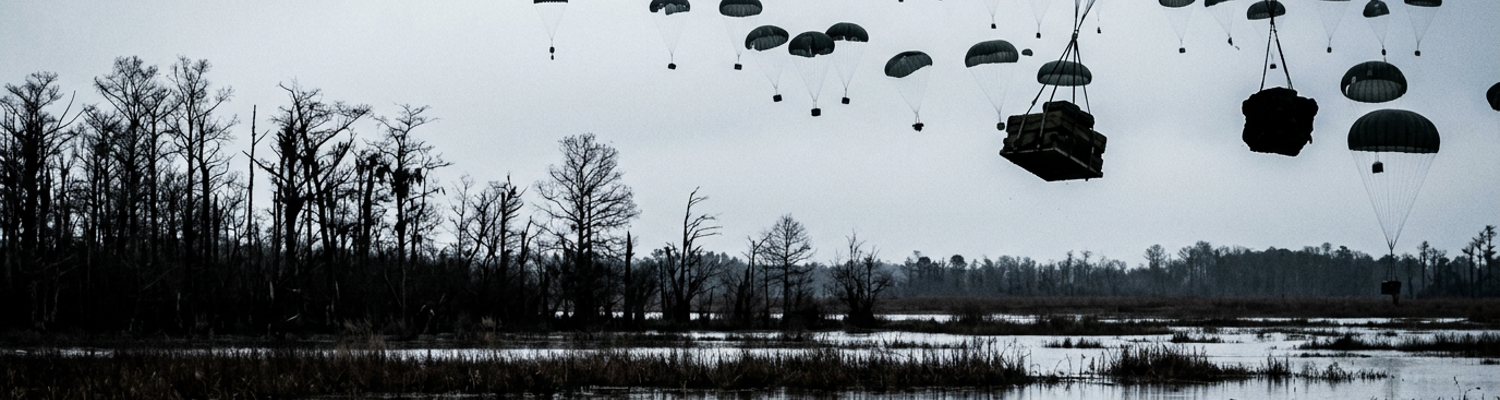
Aircraft flew in trail formation at an extreme low altitude of two hundred feet to evade heavy automatic weapons fire from tree lines along the canal embankments. The transports released twenty-four standard A-22 supply bundles over drop zone Alpha. Over fifty percent of these dropped cargo bundles disappeared directly into deep marsh silt or landed in enemy fire sectors. Cockpit crews pushed the canvas containers through the rear cargo doors at 120 knots. The low release altitude prevented the standard G-12 cargo parachutes from fully stabilizing before ground impact. Heavy timber-and-plywood skid platforms struck the black bog water at seventy miles per hour. Sixteen crates of small-arms ammunition and medical field packs weighed twelve hundred pounds each. They sheared their suspension clevises upon impact and plunged six to ten feet into liquid peat sediment. Ground teams wading through chest-deep mud reached the drop points only to find bubbling black water where the containers had slipped under the sub-surface slime.
Twelve supply bundles sank without leaving a trace on the surface.
Flight paths plotted by tactical air directors pushed the remaining cargo drops directly into prepared kill zones. Viet Cong machine gun crews established by the 261st Battalion on the raised dikes of the Cai Cai Canal maintained interlocking fields of fire over the southern approach of the landing grounds. Eight cargo parachutes drifted four hundred yards southwest of the marked smoke canisters. They settled across open waterways swept by concealed water-level bunkers. Paratroopers from the 5th Airborne Battalion attempting to recover these containers faced sustained 7.62mm and .30 caliber machine gun fire across the flattened reeds. Three recovery teams sent into the open channels sustained fourteen casualties in eleven minutes without securing a single crate. Insurgent combat squads hauled four of the stranded American containers onto dry canal dikes. Enemy forces stripped the harnesses to capture fifty-two thousand rounds of .30 carbine ammunition, eight crates of 60mm mortar shells, and forty cases of field rations.
Drop zones became ambushes.
Severe ammunition shortages paralyzed forward movement across the entire assault perimeter by 1230 hours. South Vietnamese airborne platoons expended their initial twelve-hour supply loads defending drop points from constant insurgent probes rather than driving inward toward enemy base areas. Riflemen had begun the morning with only one hundred and twenty rounds of ammunition per man. They burned through this allotment in defensive skirmishes across dense brush where targets were visible only by muzzle flashes. Captain Nguyen Van Thang found his company pinned down behind an exposed mud berm near coordinate XS431358. His unit could not advance five hundred yards northward to link up with the battalion command post. Platoons spent thirty to forty rounds per man repelling counter-rushes from Viet Cong assault teams attempting to overrun the landing perimeter. Soldiers were down to their final two or three rounds per magazine. Squad leaders collected loose cartridges from the web gear of dead and wounded paratroopers. The advance toward the canal tree lines stalled completely without replacement munitions arriving from the lost C-123 bundles. Two hundred airborne soldiers froze in waist-deep water while insurgent snipers picked off exposed sentries.
Quartermaster Autopsy and Tactical Repercussions
The official Quartermaster post-action autopsy compiled by Military Assistance Advisory Group evaluators in Saigon documented an immediate inversion of combat doctrine across the flooded paddies.
Tactical maneuver was subordinated entirely to aerial delivery failures. Ground commanders attempting to pin the Viet Cong 261st Battalion along the Cai Cai Canal halted offensive sweeps because their rifle companies had burned through their initial twelve-hour ammunition allocations. Captain Nguyen Van Thang and adjacent company commanders received no replacement rifle ammunition on dry ground. They turned combat platoons away from enemy positions and redirected them into recovery details across grid square XS4235. South Vietnamese paratroopers abandoned defensive berms and wading assault lines to dredge deep drainage ditches for lost wooden pallets. Tactical initiative transferred completely to the insurgent forces. Enemy units observed South Vietnamese airborne units breaking formation to locate submerged supply bundles rather than pressing flanking attacks against isolated machine gun nests. Company commanders spent four continuous hours plotting grid coordinates for missing supply canisters instead of coordinating interlocking mortar barrages.
Combat units had turned into salvage details under direct fire.
The salvage efforts produced devastating results along the canal banks. Platoons wading through five feet of acidic water tied recovery ropes to submerged canvas straps. The iron-weighted A-22 supply skids settled deep into liquid mud. Men attempting to dig out ammunition crates with trenching tools exposed their heads and torsos to sniper fire from concealed tree lines four hundred yards away. South Vietnamese soldiers drowned when shifting peat layers collapsed beneath recovery teams hauling heavy timber platforms to the surface. Twelve paratroopers had sustained fatal small-arms wounds by 1530 hours while attempting to drag three waterlogged medical kits and two mortar shell canisters out of the muck. Not a single offensive assault was initiated after 1300 hours. The entire afternoon operational schedule deteriorated into localized, desperate recovery actions aimed strictly at preventing total ammunition starvation before dusk.
Every radio fell silent under three feet of marsh water.
The technical review demonstrated that austere marshland combat requires dedicated waterproof communications and specialized aerial recovery equipment. Technicians inspecting the recovered AN/PRC-10 transceivers discovered that rubber casing gaskets disintegrated under exposure to sulfurous bog acids. Water entered the BA-279/U dry battery compartments and shorted the vacuum tube circuits within minutes of low-level drops. Field evaluations determined that standard infantry communications were completely unsuitable for swamp warfare. Evaluators recommended immediate deployment of the AN/PRC-25 radio with hermetically sealed chassis housings, pressurized connector caps, and water-resistant silicon seals. Logistical evaluators also condemned the use of standard A-22 canvas containers dropped with heavy timber skids over saturated deltas. Aerial resupply in wetlands required cargo parachutes equipped with pneumatic flotation bladders, water-activated carbon-dioxide inflation collars, and neon-orange surface dye markers that could keep heavy munitions containers floating on the water line. Ground troops in standing water possessed no physical mechanism to retrieve standard aerial cargo drops from peat silt without specialized grappling winches and tethered recovery lines mounted on escort helicopters.
The Quartermaster Corps filed the after-action analysis at Tan Son Nhut on November 14, 1962.