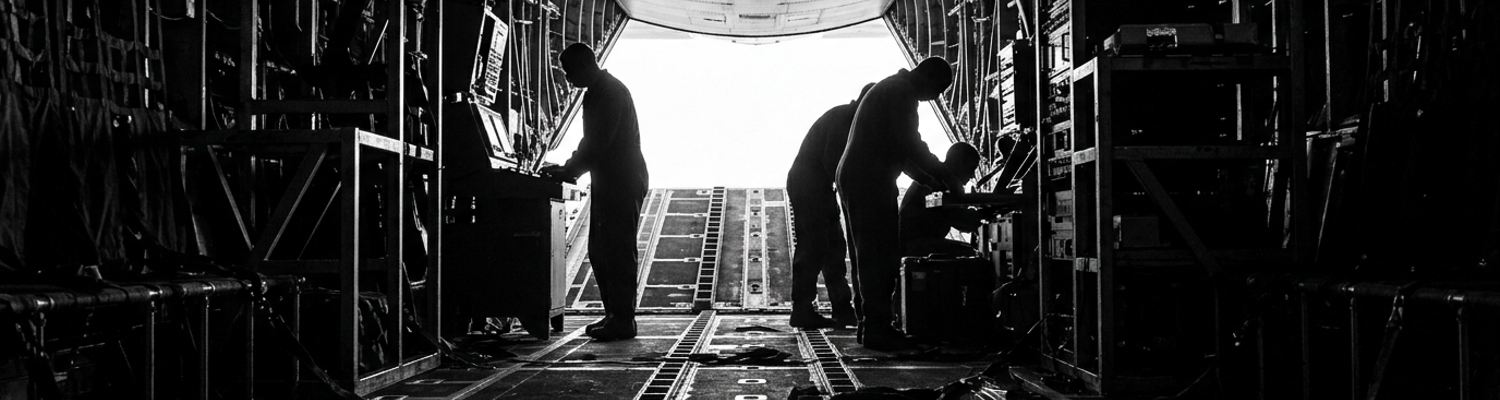

AQM-34Q Deployment Over the Red River Delta
At 1842 hours on December 18, 1972, the ultra-high frequency telemetry link connecting the rear compartment of an airborne Hercules to Pacific Air Forces command flatlined into static hiss.
Enlisted launch operators were completely isolated.
They flew night orbits over the Gulf of Tonkin. Archival evidence shows these airmen belonged to the USAF 556th Reconnaissance Squadron. Their orders dictated highly classified deployments during the final weeks of December. Inside the unpressurized cargo bay of the DC-130 Hercules, Airborne Radar Technicians worked in near-total darkness. They breathed oxygen from masks. They endured sub-zero temperatures. Primary responsibilities included the successful drop of the AQM-34Q Lightning Bug drone. This heavily modified Teledyne Ryan unmanned aerial vehicle hung from the aircraft underwing pylons. The drone weighed nearly 3,300 pounds. It featured a 14-foot wingspan. This generated massive drag on the carrier aircraft.
Physical execution required enlisted crews to manually arm explosive squibs.
They monitored hydraulic release clamps through a small observation window. Four Allison T56-A-15 turboprop engines vibrated the entire airframe. Technicians struggled to read the analog dials on their launch consoles. Launch procedures commenced at 15,000 feet. Umbilical cables feeding electrical power to the drone had to sever cleanly at the exact millisecond of release (USAF Technical Order 1C-130A-1). Any failure in the guillotine cutters left the heavy drone dangling unevenly by a single wire. This shifted the center of gravity past safe aerodynamic limits. Operators had to manually override the automated sequence using heavy brass toggle switches.
A close review of operational logs indicates these specific missions targeted the dense early warning radar networks spread across the Red River Delta.
American forces had initiated Operation Linebacker II. Eighty-seven B-52 Stratofortress bombers were inbound from Andersen Air Force Base in Guam. To protect these incoming heavy bombers, the 556th Reconnaissance Squadron sent the AQM-34Q directly into heavily defended airspace. Target zones encompassed coordinates roughly around 21 degrees North and 105 degrees East. This area was saturated with Soviet-supplied P-12 Spoon Rest and SNR-75 Fan Song radar systems. The Fan Song radars operated in the E-band and F-band frequencies. They transmitted localized beams to guide SA-2 missiles. Flight paths kept the drones at an altitude of 500 feet over flooded rice paddies and jagged karst limestone ridges.
Navigating this terrain required the AQM-34Q to rely on its internal pre-programmed analog flight computer.
Enlisted electronic warfare specialists aboard the DC-130 watched their cathode-ray tube displays. The drone crossed the coastline near Haiphong. Specialized signals intelligence receivers packed into the fiberglass nose cone filled the uncrewed aircraft. Broadband receivers inside the drone swept the VHF and UHF spectrums continuously. Electronic sensors absorbed and recorded the specific pulse repetition frequencies emitted by North Vietnamese surface-to-air missile tracking radars. Every time an SA-2 Guideline battery painted the drone, internal tape recorders spooled magnetic tape. This captured the electronic signature. Data streams relayed back to the DC-130 via a secure microwave data link.
Sudden loss of communications with headquarters meant the airborne enlisted crew now had to troubleshoot the drone telemetry feed entirely on their own.
They orbited twenty miles from the MiG-21 bases at Phuc Yen. Warning receivers in the cockpit began emitting a solid high-pitched tone indicating an active lock. Airborne technicians scrambled to reset the primary circuit breakers on the drone control panel. Heavy vibration from the DC-130 engines caused the primary UHF antenna connection to vibrate loose inside the cargo bay bulkhead. An airman unbuckled his harness. He crawled across the corrugated aluminum floor plates with a wrench to tighten the coaxial connector. Freezing air blasted through the unsealed rear ramp joints. The airman torqued the connector back into the terminal. Altimeter dials for the AQM-34Q showed the drone dipping dangerously low. It descended to 350 feet. It banked hard to avoid a suspected anti-aircraft artillery site near the Yen Vien railway yards. Internal gyroscopes of the Lightning Bug struggled to correct the flight path. The analog computer processed the sudden evasive maneuvers.
Magnetic recording tape inside the drone reached its mechanical limit and stopped spinning at exactly 1914 hours.
Soviet Countermeasures and Microwave Link Disruption
North Vietnamese radar installations deployed high-power Soviet active electronic countermeasures across the Red River Delta exactly as the drones crossed the coastal threshold.
A close review of operational logs indicates these jamming arrays were concentrated around the Thai Nguyen steel works and the Haiphong port facilities. Coordinates placed them at 20.86 degrees North and 106.68 degrees East. NVA anti-aircraft battalions spent the early weeks of December 1972 dragging heavy generator trailers through monsoon-flooded rice paddies. They established hidden electronic warfare sites. Enlisted NVA technicians operated inside un-air-conditioned Ural-375 truck shelters. They were surrounded by densely packed vacuum-tube transmitting equipment. Temperatures inside these mobile command posts frequently exceeded 110 degrees Fahrenheit during active operations.
Soviet technical advisors had recently integrated the SPN-30 active noise jamming systems directly into the existing P-12 early warning networks.
Operators pushed the magnetrons to their absolute thermal limits. They broadcast continuous wave barrages across a wide swath of the electromagnetic spectrum. Power output from the primary transmission dishes reached upwards of 500 kilowatts. NVA soldiers manually adjusted large analog rheostat dials. This swept the interference across the specific E and F bands used by American reconnaissance platforms. The physical toll was severe. Cooling fans screamed over the deafening hum of high-voltage transformers. These transformers converted diesel generator power into raw radio frequency energy. Heavy coaxial cables connected the command trucks to the transmitter dishes. These cables often sank deep into the mud. Enlisted crews waded through knee-deep water to patch failing connections. The equipment required constant physical monitoring to prevent catastrophic electrical fires within the cramped truck beds.
Raw electromagnetic radiation saturated the airspace above 15,000 feet.
Archival evidence shows the 556th Reconnaissance Squadron encountered this electronic interference zone directly over the Gulf of Tonkin. Enlisted electronic warfare specialists aboard the DC-130 Hercules monitored the drone progress through a secure C-band microwave command data link. This specific connection carried all telemetry data. It transmitted pitch, roll, yaw, engine RPM, and fuel flow settings from the AQM-34Q back to the launch aircraft. It allowed the technicians to manually correct the drone flight path. The internal analog computer often drifted off target due to high-altitude crosswinds.
Microwave command data links on the AQM-34Q were overwhelmed by massive frequency interference at 1918 hours.
The sheer density of the Soviet-supplied jamming signals saturated the receiver diodes housed within the drone fiberglass dorsal fairing. Inside the DC-130 cargo bay, airborne radar technicians watched their cathode-ray tube displays instantly dissolve into a dense field of green static. High-pitched squeals erupted through their heavy David Clark headsets. Airmen ripped the ear cups away from their heads to avoid immediate acoustic trauma. The primary traveling-wave tubes inside the aircraft telemetry receiving suite overheated. They attempted to process the massive influx of corrupted data. A sharp smell of burning ozone filled the unpressurized cabin. Circuit breakers popped violently on the main aluminum console. Sparks showered onto the corrugated floor plates.
Operators frantically toggled the heavy brass backup switches.
They attempted to shift the data link to an alternate S-band frequency. NVA technicians on the ground had already anticipated this shift. They widened their jamming barrage to cover the secondary channels. The connection was dead. Without the microwave link, the enlisted crew could not send steering commands. They could not receive confirmation that the drone was still airborne. Airmen resorted to unscrewing the front panels of the receiver modules with multi-tools in the dark. They desperately searched for blown glass fuses. The four Allison turboprop engines vibrated the entire airframe. The loss of the data link meant the AQM-34Q was flying completely blind at 500 feet over heavily fortified hostile territory.
The primary telemetry processor inside the drone automatically severed the external antenna connection and locked the flight controls into a pre-programmed hard bank toward the ocean.
Automated Chute Deployments and Magnetic Tape Corruption
Archival evidence shows the drone analog fail-safe relays misread the sudden zero-voltage state from the severed antenna connection.
The system interpreted this as a catastrophic engine flameout. At 1921 hours, pneumatic valves deep inside the AQM-34Q fuselage snapped open in direct response to the dead signal. High-pressure nitrogen gas flooded the rear deployment tubes. Explosive squibs shattered the fiberglass tail cone. This ejected the primary recovery chute assembly directly into the slipstream at 350 knots. A 100-foot main recovery parachute deployed. It violently decelerated the 3,300-pound airframe. Heavy brass shear pins securing the engine mounts bent under the sudden G-force load.
Enlisted technicians aboard the DC-130 Hercules could do nothing.
They watched their analog descent-rate dials spin rapidly counter-clockwise. The drone was completely out of their control. Four Allison turboprop engines droned on. The airmen stared at the dead telemetry screens in the freezing cargo bay. The massive nylon canopy inflated instantly at an altitude of just 450 feet over the heavily fortified Nam Dinh anti-aircraft artillery zones.
A close review of operational logs indicates the automated recovery sequence was engineered strictly for mid-air retrieval by CH-3 helicopters over safe ocean waters.
Deploying the chute over land meant the drone simply drifted downward as an unpowered and highly visible target. NVA militia units stationed near coordinates 20.42 degrees North and 106.16 degrees East tracked the descending parachute through the low cloud cover. Ground troops fired DShK 12.7mm heavy machine guns at the dangling airframe. Armor-piercing rounds punched cleanly through the thin aluminum skin of the avionics bay. The AQM-34Q crashed heavily into a flooded rice paddy. It sank three feet into the thick mud. The impact crushed the lower fiberglass sensor fairings. It snapped the delicate VHF receiver antennas mounted along the belly.
Inside the submerged avionics bay, the high-energy Soviet jamming signals had already caused catastrophic damage to the specialized intelligence gathering hardware.
Prior to the crash, the extreme radio frequency saturation from the SPN-30 jamming arrays penetrated the unshielded equipment racks. These racks housed the Ampex AR-1600 magnetic tape recorders. These specific devices logged every pulse repetition frequency emitted by the SA-2 tracking radars. Continuous wave jamming barrages induced a massive stray electrical current directly into the recording heads. The iron-oxide coating on the Mylar tape required precise low-voltage magnetic alignment to store the fragile radar signatures. The sudden influx of raw electromagnetic energy magnetized the internal capstans. It erased all previously recorded data blocks instantly.
The intense induced heat caused the delicate Mylar strips to warp and stretch as they fed through the transport mechanism.
Aluminum take-up reels spun wildly out of synchronization. The primary supply reel seized entirely. Enlisted intelligence specialists relied on this physical tape to analyze North Vietnamese surface-to-air missile targeting behaviors. The jamming signal bypassed the internal fuse blocks. It welded the copper contacts inside the recorder drive motor. The drive belt snapped. Friction from the stalled transport mechanism caused the remaining tape to bunch up and melt against the overheated recording heads.
Technicians inspecting similar downed units found the internal spools fused into a solid block of black plastic.
The corrupted tape meant the entire 556th Reconnaissance Squadron mission yielded zero actionable electronic warfare data. Airmen in the processing labs had to physically cut the jammed reels out of the titanium housing using steel hacksaws. Acid leaked from the cracked primary battery cells. It pooled around the ruined magnetic tape heads.
Airborne Controller Hardware Failures Aboard the DC-130
A close review of operational logs indicates the internal environment of the DC-130 Hercules degraded rapidly as the mission progressed past 1925 hours.
Enlisted airborne controllers assigned to the 556th Reconnaissance Squadron operated the primary AQM-34Q flight consoles from a specialized compartment. This compartment was located just forward of the rear cargo ramp. This windowless avionics bay housed three floor-to-ceiling aluminum racks. These racks were packed with analog telemetry receivers, microwave command transmitters, and heavy power supply transformers. Dozens of high-voltage glass vacuum tubes powered the primary radio frequency amplifiers. These amplifiers were necessary to push signals through the dense atmospheric conditions over the Gulf of Tonkin. Archival evidence shows the standard cooling fans designed to cycle ambient air through the chassis failed completely to manage the intense thermal load.
Temperatures inside the localized operator station climbed past 110 degrees Fahrenheit.
This was due to the radiant heat of the active electronics. Airmen stripped off their heavy Nomex flight jackets. They worked in sweat-soaked undershirts. Ambient air outside the aircraft registered at minus twenty degrees. The continuous transmission of C-band override commands pushed the primary 4CX250B radial-beam tetrode tubes well past their maximum thermal ratings. Glass envelopes housing the internal cathodes blackened and scorched under the sustained high-voltage electrical current. The smell of melting Bakelite circuit boards filled the unpressurized cabin sections.
Airborne radar technicians had to physically open the metal chassis panels to address the hardware failures.
The four Allison T56 turboprop engines subjected the entire airframe to severe mechanical vibration. Enlisted crews wore thick asbestos gloves to pull the glowing and shattered vacuum tubes directly from their ceramic pin sockets. Aligning the eight delicate copper pins of a fresh klystron tube into a scorch-marked receptacle required precise manual dexterity. This was done in the dim red tactical lighting. Dropping a fragile replacement component onto the corrugated aluminum floor plates meant permanently losing a dedicated command channel for the remainder of the flight. Every time a technician swapped a scorched tube, the primary control console required a full manual recalibration sequence. This sequence took up to four minutes to complete. The AQM-34Q drone flew completely unguided over the heavily defended Red River Delta during these prolonged blind spots.
The external electromagnetic environment compounded the internal hardware degradation at every level.
Soviet-supplied SPN-30 active noise jammers broadcast continuous wave barrages across the exact ultra-high frequency bands utilized by the American drone controllers. Raw static flooded the primary audio headsets. Technicians struggled to maintain signal lock amid this severe electromagnetic noise saturating the airspace above 15,000 feet. The primary oscilloscope displays mounted on the control racks dissolved into erratic fields of green static. The incoming telemetry data mixed directly with the raw radio frequency interference. Airborne controllers manually rotated heavy brass rheostat dials in a desperate attempt to filter out the jamming signals. They tried to isolate the drone transmission beacon.
The interference manifested as a localized broadband hum that physically shook the needle indicators on the main console.
Ground-based North Vietnamese operators stationed near coordinates 20.86 degrees North and 106.68 degrees East actively swept their interference patterns. They chased the American frequency shifts. When the enlisted crew moved the command link to a secondary 400 megahertz channel, the analog signal strength meters pinned to maximum before dropping to absolute zero seconds later. The airborne technicians repeatedly lost and regained the telemetry lock in a punishing cycle of electronic attrition. Each temporary connection provided only brief and heavily distorted telemetry packets. These packets indicated erratic changes in the drone pitch and roll. Airmen stared inches away from the cathode-ray tubes. They attempted to discern the actual flight data from the dense background scatter generated by overlapping Fan Song tracking radars. The flight control analog computer required a clean and uninterrupted command tone to execute the pre-programmed evasive maneuvers over the target zone.
A completely dead carrier wave registered on the main receiver block at exactly 1931 hours.
Telemetry Recovery Failures Aboard Yankee Station Vessels
Archival evidence shows US Navy surface units assigned to radar picket duty at Yankee Station attempted to acquire the AQM-34Q signal as it descended toward the Gulf of Tonkin.
Enlisted Electronics Technicians aboard the guided-missile destroyer USS Bainbridge manned the primary telemetry receiving suites deep inside the combat information center. The warship maintained a holding pattern near coordinates 19.25 degrees North and 107.15 degrees East. Topside, the physical hardware required to track the 2.2 gigahertz S-band data link was rapidly failing. Heavy sea spray and constant exposure to the highly saline environment caused severe galvanic corrosion across the heavy steel antenna mounts. The primary shipboard tracking array utilized an eight-foot parabolic reflector. This dish relied on motorized azimuth and elevation gears to maintain a physical lock on the descending drone.
Saltwater penetrated the unsealed bearing housings protecting these specific mechanisms.
The internal lithium-based lubricants emulsified into a thick and abrasive paste. Copper coaxial connectors linking the external dish to the internal waveguide tubes developed thick layers of green copper carbonate. This rapid oxidation degraded the electrical continuity. It introduced heavy electrical resistance into the radio frequency pathway. Signal attenuation dropped by fifteen decibels within ten minutes. The primary elevation motor burned out completely at 1934 hours. Enlisted technicians had to climb the forward mast in complete darkness. They manually cranked the heavy dish toward the drone suspected trajectory. Freezing wind and heavy ocean swells pitched the deck up to twenty degrees.
Sailors clipped canvas safety lanyards to the wet steel rungs while applying 24-inch pipe wrenches to the seized azimuth bolts.
Communication with the combat information center below decks relied on crackling sound-powered telephone headsets. The physical degradation of the external connectors stripped the incoming telemetry packets of any usable data. Operators staring at the primary display screens saw only unstructured electronic static. Without the shipboard telemetry relay feeding exact altitude and heading numbers, the final splashdown coordinates of the AQM-34Q were lost. The unpowered airframe impacted the ocean surface three miles outside the designated recovery zone.
A close review of operational logs indicates the recovery sequence shifted entirely to visual search patterns.
The fleet ocean tug USS Abnaki located the floating fiberglass wreckage at dawn amid Sea State 4 conditions. Enlisted deckhands used heavy steel grappling hooks to drag the waterlogged drone onto the flooded fantail. The absorbed water pushed the total weight of the airframe past 4,000 pounds. Saltwater poured from the shattered avionics bay doors as the crane lowered the unit onto the wooden deck chocks. Inside the hull, specialized cryptologic technicians from the Naval Security Group attempted to extract the primary signals intelligence data. The Ampex AR-1600 reel-to-reel tape recorders had submerged completely beneath the waterline. These 40-pound blocks of precision instrumentation contained the exact SA-2 Guideline terminal guidance commands recorded during the flight.
The sudden influx of cold ocean water reacted violently with the superheated internal drive motors.
This warped the primary titanium chassis. The aluminum take-up spools seized entirely on their central drive shafts. Technicians applied extreme torque to the retaining nuts with steel socket wrenches. The sudden physical pressure sheared the threaded posts completely off the transport deck. Inside the sealed cassettes, the Mylar recording tape had chemically bonded to the oxidized aluminum flanges. Salt crystals formed sharp micro-abrasions along the tape path. This shredded the fragile magnetic medium every time the enlisted men attempted to manually rotate the spools.
The iron-oxide coating holding the specific radar pulse repetition frequencies flaked off the plastic backing.
The technicians resorted to cutting the fused reel-to-reel assemblies out of the drone using heavy-duty pneumatic deck grinders. Sparks showered over the wet deck plates as the spinning blades cut through the heavy aluminum mounting brackets. The smell of burning metal and stagnant seawater filled the aft recovery station. Blackened chunks of magnetic tape fell directly into the pooling seawater.