
When the United States declared war on Germany on April 6, 1917, it committed the industrial might of a continent to the Allied cause. That might, however, did not extend to the air. America’s military air arm, the Aviation Section of the U.S. Army Signal Corps, was a neglected organization starved by years of institutional indifference and patent disputes that had stifled domestic aircraft development. The force numbered a scant 131 officers, only 26 of whom were fully trained pilots, and 1,087 enlisted men. Its inventory of fewer than 300 aircraft consisted entirely of primary trainers unfit for the lethal skies over the Western Front. This paltry force stood against the hardened air forces of France, Britain, and Germany, nations that had spent three years transforming aviation into a decisive instrument of industrial warfare. The American Expeditionary Forces (AEF) faced the immense task of building a modern air force from a foundation of almost nothing, on foreign soil, in the middle of a global conflict.
The first physical manifestation of this effort was the arrival of the 1st Aero Squadron in France on September 3, 1917. Commanded by Major Ralph Royce, the unit’s appearance exposed the chasm between American industrial potential and its immediate military reality. The squadron arrived with men and ambition but no operational aircraft. The transatlantic logistical chain was already choked with the immense tonnage required for a ground army. Shipping space was a non-negotiable premium, allocated to soldiers, food, and artillery shells, not the delicate, fabric-skinned wings of airplanes America was not yet producing for combat. The strategy was therefore one of blunt necessity. A commission led by Colonel Raynal Bolling had already surveyed Allied aviation and confirmed the U.S. could not produce and ship combat aircraft in time. The resulting plan was a simple, if humbling, transaction. America would ship raw materials, machine tools, and manpower to Europe. In return, France and Britain would provide finished aircraft, engines, and access to their mature network of airfields and training schools. This dependency defined the entire AEF Air Service experience, a strategy of borrowing technology and expertise to compress a generation of aerial warfare development into a matter of months.
Logistics Choke Points and European Reliance
The AEF’s command structure, under General John J. Pershing, accepted that it could not fight a war and build an air force simultaneously without massive foreign assistance. The entire apparatus of American air power in France was grafted onto an Allied framework. The initial agreement, revised in August 1917, called for France to supply 5,000 airplanes and 8,500 engines. This reliance meant American pilots would fly French machines, maintained by mechanics trained on French equipment, learning tactics from French and British combat veterans. The 3rd Aviation Instruction Center (3rd AIC) at Issoudun became the epicenter of this effort. It swelled into the largest air base in the world, a sprawling complex of eleven airfields covering fifty square miles. American pilot candidates, arriving from stateside ground schools, met the realities of military flying. They began in clipped-wing Caudron G.3 trainers nicknamed “penguins,” which could taxi but not fly, before progressing to more capable machines. The training was brutal and perilous. More than 170 Americans died in training accidents in France, a grim reflection of the risks involved in rapidly minting combat pilots. The instruction itself was a fusion of methods, combining the experience of French veterans with the standardized British “Gosport system” of communication between instructor and student in the air.
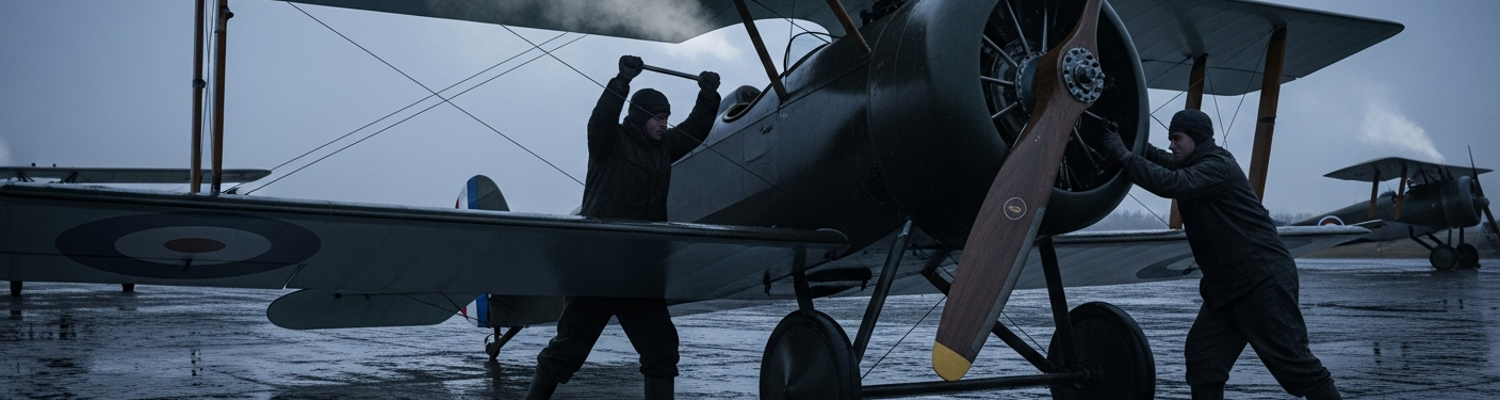
American squadrons arriving at the front were equipped almost exclusively with European aircraft. The first fighter flown in combat by AEF pilots was the French-built Nieuport 28. Powered by a 160 horsepower Gnome N-9 rotary engine, its top speed of 122 mph and twin Vickers machine guns made it a capable dogfighter. It possessed a dangerous structural flaw, however. The fabric on its upper wing had a tendency to shred in a sustained high-speed dive. Despite this, pilots of the 94th and 95th Aero Squadrons scored the first AEF victories in the type on April 14, 1918, when Lieutenants Alan Winslow and Douglas Campbell each downed an enemy aircraft. The more robust SPAD S.XIII soon replaced the Nieuport. Powered by a 220 horsepower Hispano-Suiza V8 engine, the SPAD was faster at 138 mph and exceptionally rugged, known for its excellent performance in a dive. The United States procured 893 SPAD XIIIs, which equipped fifteen of the sixteen American pursuit squadrons by the war's end. The only American-built aircraft to see combat in significant numbers was the de Havilland DH-4. A two-seat observation and day bomber, the U.S. version was powered by the much-lauded American Liberty L-12 engine. Over 1,200 DH-4s reached the front. Its performance was solid, but a design flaw placed the main fuel tank between the pilot and observer, leading to a grim reputation as the “flaming coffin” when hit.
Mitchell's Aerial Command at St. Mihiel
The fragmented, dependent state of the Air Service demanded a leader of singular drive and vision. It found him in Colonel William “Billy” Mitchell. Arriving in France as an observer before the main American deployment, Mitchell voraciously absorbed the lessons of aerial warfare from his Allied counterparts, particularly General Hugh Trenchard of the British Royal Flying Corps. Mitchell rejected the prevailing view of aircraft as mere adjuncts to the infantry. He championed a revolutionary concept, the concentration of air assets to achieve air superiority, followed by the use of that control to attack the enemy’s ground forces, logistics, and command structures. He envisioned air power as a strategic force capable of independent, decisive action.
Mitchell’s theories faced their ultimate test during the St. Mihiel Offensive in September 1918. The operation was the first major American-led offensive of the war, aimed at reducing a German salient that had existed since 1914. General Pershing gave Mitchell command of all Allied air assets supporting the American First Army. Mitchell seized the opportunity to orchestrate the largest concentration of air power yet seen in the war. He amassed a force of 1,481 aircraft from American, French, British, and Italian units. The armada comprised 701 pursuit planes, 366 observation planes, 323 day bombers, and 91 night bombers. Mitchell’s plan was a masterclass in combined-arms doctrine. The first priority was gaining and maintaining absolute air superiority over the battlefield. This would prevent German reconnaissance aircraft from observing the American buildup and free Allied aircraft to operate at will.
The aerial offensive commenced on September 12, 1918. Despite poor weather, the sheer weight of numbers overwhelmed the German Luftstreitkräfte. Mitchell’s pursuit squadrons, including top American aces like Eddie Rickenbacker, aggressively swept the skies, pushing their patrols deep into enemy territory to engage German fighters before they could reach the front. With the air secured, bombers systematically attacked enemy rail yards, supply dumps, bridges, and troop concentrations, strangling the German army’s ability to react and resupply. Low-flying DH-4s and SPADs strafed enemy trenches and retreating columns. Observation planes, flying with impunity, provided a constant stream of intelligence to First Army headquarters and directed artillery fire with devastating accuracy. The German command was effectively blinded. Within four days, the St. Mihiel salient was eliminated. The U.S. First Army captured 16,000 prisoners and over 400 guns at a low cost in casualties. The St. Mihiel operation was a resounding validation of Mitchell’s vision. The massing of airpower achieved localized air supremacy, which enabled observation and bombing aircraft to contribute directly to a rapid ground victory. It was a blueprint for the future of warfare, forged in the skies over France by an air force built on borrowed wings.