
Suchan Coal Branch Strategic Deployment
Archival casualty ledgers from the American Expeditionary Forces in Siberia record a massive equipment failure rate. Thirty-six percent of all rolling stock assigned to the maritime sectors broke down within the first sixty days of sub-zero operations. Non-combat hospital admissions for typhus, dysentery, and severe frostbite reached 1,842 cases before the end of 1918. At the drafty Ugolnaya rail telegraph shack northeast of Vladivostok, a lone field radio operator logged faint signals through headphones stiffened by ice.
A sudden blizzard dropped the ambient temperature to twenty-two degrees below zero Fahrenheit.
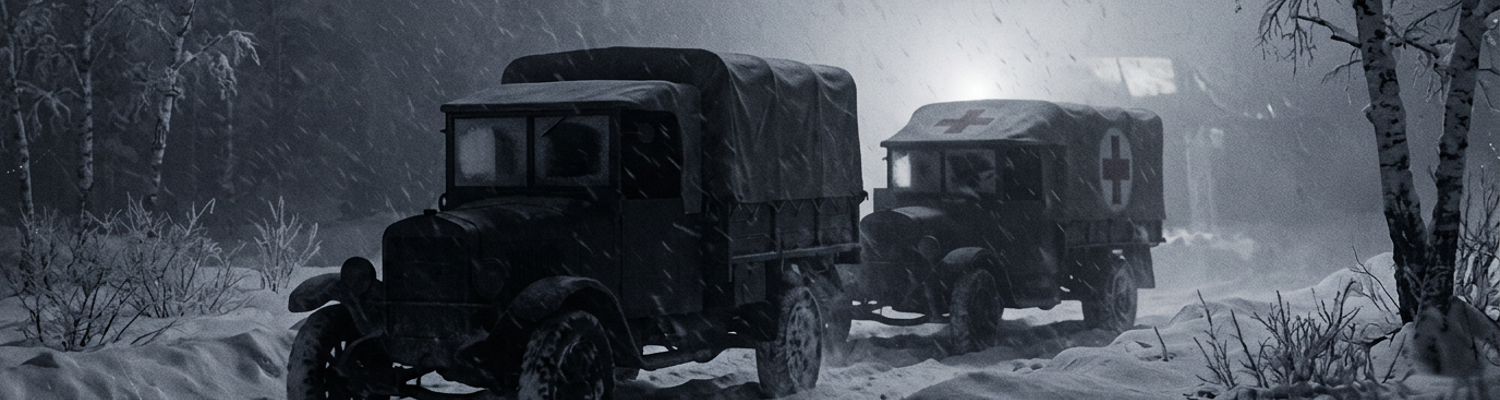
The storm buried the single-track rail bed under three feet of drifting snow. The operator tracked an unescorted motorized evacuation detail. Three Dodge Model 1918 ambulances and a pair of converted White three-ton trucks carried feverish soldiers. The convoy attempted to clear quarantine checkpoints along the frozen cart trails beside the spur lines.
Three ambulances carried forty-two litter cases across unmapped territory without an escort.
When examining the historical record, this situation stemmed directly from troop movements initiated two months prior. Major General William S. Graves received orders to disperse his expeditionary units deep along the rail corridors. He did not keep them concentrated in Vladivostok. Between October and December 1918, headquarters dispatched the 27th and 31st Infantry Regiments northeast into the interior of the Maritime Province. The soldiers had deployed directly from warm-weather garrison duty in the Philippine Department. They reached their forward posts with lightweight olive-drab uniforms and unlined canvas leggings. Standard leather boots froze brittle within hours. Colonel Henry D. Styer established elements of the 27th Infantry along the main Ussuri line from Nikolsk-Ussuriysky northward toward Spasskoye and Khabarovsk. The 31st Infantry placed detachments across the rail junctions northeast of Vladivostok to defend regional transport lines. Weapon mechanisms failed repeatedly. Standard whale-oil lubricants congealed inside Springfield rifle bolts. Browning machine gun cooling jackets ruptured from expanding ice.
Sub-zero temperatures fractured the chilled steel axles of every third boxcar.
A close review of operational logs indicates that Allied military control in the Russian Far East depended entirely upon an isolated railway. The Suchan coal branch sat roughly seventy-five miles east of Vladivostok in the Sikhote-Alin foothills. State-operated Suchan mines produced the only local supply of high-grade bituminous coal capable of fueling Russian locomotives across the Ussuri and Trans-Siberian lines. Without this fuel source, maritime port operations in Vladivostok faced total paralysis. Water pipes across Allied depots risked freezing solid. The branch line presented a severe engineering problem. Trains ran on Russian standard five-foot broad gauge from the Ugolnaya junction northeast to Kangauz. The steep mountain grade forced a mechanical transfer to a narrow-gauge system. From Kangauz upward into the Suchan basin, stationary steam winches dragged isolated hopper cars up forty-degree inclines. They used steel cables that frequently snapped in freezing weather. Bolshevik partisans and striking miners repeatedly cut these cables. They derailed empty coal wagons and destroyed wooden trestles to starve the coastal garrisons of heat.
Winter fuel reserves at the Vladivostok railhead dropped to a five-day margin.
By midnight, the radio operator at Ugolnaya heard only static over the 500-kilohertz frequency. The medical trucks approached the Kangauz transshipment choke point. A strict typhus quarantine cordon prevented the drivers from entering the heated depot buildings. Wounded men remained trapped inside canvas-topped truck beds. Radiator coolant had already crystallized into slush. Station logs at Kangauz confirmed that the last coal train had jumped its rails three versts north. The wreckage blocked the only cleared pathway through the valley.
Motorized Rail Draisines and White Model Trucks
Archival maintenance records from the Vladivostok base depot reveal extensive vehicle modifications. Quartermaster mechanics altered nearly every White Model 15 chassis before sending them into the Maritime interior. The White Model 15 featured a four-cylinder monobloc gasoline engine generating thirty horsepower. The vehicle possessed a standard fifty-six-inch wheel track. This width was designed for paved American thoroughfares. The frozen cart routes flanking the Suchan rail line consisted of narrow wagon paths worn deep by Russian telegas. Drivers forced the trucks through these frozen trenches. The outer edges of the heavy dual rear wheels rode the frozen dirt ridges. This snapped semi-elliptic leaf springs and fractured universal joints. Sub-zero drafts whistling through the hood louvers cooled the intake manifolds rapidly. Fuel condensed into droplets before reaching the combustion chambers. This caused continuous cylinder misfires. Drivers wrapped the crankcases in horsehair blankets. They jury-rigged sheet-iron shields beneath the engine pans to trap engine warmth. Mechanics substituted heavy gear oil with a diluted mixture of kerosene and cylinder lubricant. This prevented the steering boxes from locking rigid.
Tire rubber froze until the material shattered under impact loads.
A close review of operational logs indicates that Company C of the 31st Infantry spent forty-eight hours trying to push two White Model 15 cargo trucks across the frozen Shkotovo river flats toward Kangauz. Depot personnel lacked tire chains in sufficient quantities. They wrapped the solid rubber tires with raw hemp towing hawser secured by wire cable. This improvised wrapping shredded within five miles against razor-sharp ice crusts. When an engine stalled amid the blizzard, the water inside the cast-iron water jackets froze solid within twenty minutes. The expanding ice cracked the cylinder blocks across the valve seats. Drivers kept the engines idling continuously throughout forty-eight-hour duty shifts to keep the evacuation convoy rolling. They burned through fifty-gallon drums of scarce motor spirit at three times the standard fuel consumption rate.
Every stalled engine stranded frostbitten soldiers inside unheated wooden cargo beds.
When examining the historical record of rail security operations along the Suchan branch, forward surveillance depended almost entirely on motorized draisines. These vehicles ran point on the broad-gauge tracks. Allied railway detachments outfitted these lightweight four-wheel inspection cars with small two-stroke single-cylinder engines. They mounted a water-cooled Browning machine gun on an improvised pipe pedestal at the forward crossmember. Draisine crews operated twenty minutes ahead of any scheduled coal run or medical train. They scouted the right-of-way between Ugolnaya and Kangauz to identify partisan sabotage before loaded convoys walked into ambushes. Partisans frequently pulled track spikes. They unbolted fishplates on blind curves around the foothills. They suspended heavy pine logs from telegraph poles across the track clearance envelope. At twenty degrees below zero, the open-air frame offered zero windbreak. The cold numbed the two-man crew until operators lost the tactile sensation required to throw manual friction brakes.
A draisine hitting a displaced rail threw operators straight into the frozen ballast stone.
Archival telegraph intercepts from the Kangauz station confirm a specific incident at 0115 hours. Draisine patrol Number 4 struck an obstruction three miles west of the coal transshipment siding. A deliberate blast had shattered a ten-foot section of the left rail. Iron fragments scattered across the roadbed. The draisine operator engaged the manual reversing lever. The drive belt had frozen solid around the engine flywheel. It slipped across the metal drum without turning the wheels. The rail pathway was blocked. Partisan rifle fire opened up from the tree line. The radio shack at Ugolnaya logged the draisine crew abandoning the machine. They pulled manual detonator caps from their packs. They clamped explosive warning torpedoes onto the undamaged rail head to warn the approaching evacuation trucks.
Spanish Influenza and Typhus Quarantine Cordons
A close review of operational logs indicates that the Siberian autumn of 1918 transformed the Suchan rail corridor into an incubator for two separate pathogens. American troops assigned to the 31st Infantry disembarked in Vladivostok carrying latent strains of the global Spanish influenza virus. This virus flourished inside sealed Russian boxcars heated by crude cast-iron stoves. Within seventy-two hours of deployment to Kangauz, infantrymen developed violent coughing fits and cyanotic facial discoloration. Rapid-onset bronchial pneumonia drowned soldiers in their own pulmonary fluids before field surgeons could initiate supportive therapy. Regional louse-borne epidemic typhus struck simultaneously. Rickettsia prowazekii caused the disease. Body lice infesting displaced Russian civilians crowded into station waiting rooms carried the bacteria. The parasites jumped straight into American barracks. Soldiers slept three to a bunk to stave off the thirty-below frost. This allowed parasite-bearing lice to migrate across wool blanket fibers throughout the night. Evacuation Hospital No. 44 in Vladivostok reported forty fresh cases of acute typhus alongside eighty-five influenza admissions in a single forty-eight-hour period. The influx overwhelmed the fifty-bed isolation ward.
Body lice nested undetected inside the sheepskin seams of Allied winter overcoats.
Archival medical logs from the Maritime Province show that front-line field dressings and medicine chests carried zero effective treatments for either biological threat. Medical officers possessed only aspirin, camphor injections, and small quantities of tincture of digitalis. None of these arrested the peripheral vascular collapse caused by typhus toxins. At the Kangauz water tower siding, feverish soldiers from Company B stripped off their canvas field uniforms during delirious typhus spikes. They ran out into snowbanks before orderlies could physically restrain them. Delousing facilities simply did not exist along the single-track rail branch. The nearest functional steam sterilizer sat ninety miles away on an American Red Cross hospital train parked at the Vladivostok naval wharf. Influenza-induced pulmonary edema developed among patients already battling high-fever typhus stupor. Survival times dropped below thirty-six hours. Captain Frank Rogers of the Medical Corps logged eighteen deaths in a single twenty-four-hour shift. He attempted to isolate infected doughboys inside an unheated wooden freight shed.
Unheated freight depots became morgues before ambulance crews could unload their litters.
When examining the historical record, this medical crisis provoked immediate defensive reactions that shattered Allied transportation across the region. Japanese Imperial Army sector commanders, Czech Legion railway managers, and White Russian garrison authorities established rigid sanitary cordons at every major rail switch between Suchan and the sea. Czech railway detachments at the Shkotovo junction erected armed barriers of rolled barbed wire across the track ballast. They zeroed heavy Maxim machine guns directly down the rights-of-way. Standing orders issued by the Inter-Allied Railway Technical Board prohibited any rolling stock, handcar, or motorized vehicle from crossing district boundaries without formal disinfestation certificates signed by Allied sanitary inspectors. Telegraph wires east of Ugolnaya were down. Drivers hauling sick soldiers could not radio forward to request transit passes. Japanese sentries stationed at the Kangauz perimeter refused entry to American motor ambulances. They threatened to fire into the engine blocks if the vehicles advanced past the red quarantine flagmarkers driven into the frozen embankments.
Armed sentries turned back American ambulances at gunpoint.
Archival evidence shows that these rigid blockades forced the unescorted convoy of White Model 15 trucks and Dodge ambulances to abandon the cleared railway grade entirely. Armed sentries barred the convoy from the Kangauz depot platform. Convoy commander Lieutenant Ralph Miller turned the five vehicles onto unplowed logging trails. These trails wound south through the Sikhote-Alin range toward the coast. The detour added forty miles of trackless forest terrain through forty-inch snowdrifts. This cut off the convoy from rail-based telegraph networks and fuel dumps. Radiator caps cracked under pressure as water-methanol coolant boiled away during prolonged low-gear crawling. Drivers burned wooden ammunition crates in open steel drums placed inside the truck beds. This kept litter cases from freezing to the floorboards. At 0240 hours, the lead Dodge ambulance high-centered on a buried birch stump four miles south of the cordon line. Eight pneumonic soldiers were stranded in the open gale.
Nikolsk-Ussuriysky Field Hospital Triage Protocols
A close review of operational logs indicates that the makeshift American field hospital inside the Nikolsk-Ussuriysky rail depot operated under severe supply constraints by late December 1918. Major Paul Gallagher of the Medical Corps faced an influx of shrapnel casualties from skirmishes near Kraevsky. Dozens of men collapsed from lobar pneumonia. Ambient temperatures inside the brick station house hovered near twelve degrees below zero. Blood plasma froze inside glass delivery tubes before needles could penetrate collapsed veins. Surgeons worked in sheepskin mittens. They dipped their scalpels into boiling water to unstick them from frosted metal instrument trays. Evacuation back to base facilities in Vladivostok across seventy miles of snowbound track offered the only pathway to surgical survival. Motor transport officers allocated Gallagher thirty-five gallons of low-grade gasoline for the entire depot detachment.
Gasoline rations determined surgical priority over clinical severity.
Archival evidence shows that medical officers instituted a severe triage protocol directly linking patient survivability to vehicle fuel consumption rates. A White Model 15 cargo truck plowing through twenty-inch snowdrifts in second gear consumed one gallon of fuel every four miles. This extended transit times across the frozen Ussuri river plain to eight hours. When evaluating thoracic perforations and acute peritonitis, Gallagher calculated whether an individual soldier possessed sufficient circulatory strength to endure four hundred minutes of continuous mechanical vibration at forty degrees below zero. Casualties presenting with systolic blood pressure below seventy millimeters of mercury were marked with blue grease pencil on their foreheads. Orderlies moved them to straw pallets in unheated corner alcoves. Medical personnel assigned the scarce, heated forward cab seats of the White trucks exclusively to patients with compound fractures whose vascular integrity remained intact. Men whose injuries demanded continuous saline infusions were retained in the drafty station baggage room. Freezing rubber siphon tubes guaranteed that fluids would solidify into ice blockages within ten minutes of clearing the perimeter gates.
Every open truck bed became a rolling refrigeration chamber.
When examining the historical record of these evacuation runs, convoy drivers and corpsmen engaged in severe physical improvisations. They worked to keep delirious soldiers from freezing to death during transit. The Dodge Model 1918 ambulances and converted White flatbeds possessed neither cab heaters nor insulated compartments. Litters remained exposed to continuous sub-zero wind currents blowing beneath canvas tarpaulins. Soldiers suffering from louse-borne epidemic typhus experienced sudden hyperpyrexic spikes followed by violent shivering fits. They attempted to claw their way through the lashed canvas flaps in disoriented frenzies. Corpsmen used heavy cotton cargo webbing to strap delirious men flat against the canvas stretchers. They pinned their limbs beneath triple layers of coarse wool army blankets. Depot mechanics heated locomotive firebox firebricks over blacksmith coals to provide supplemental warmth. They wrapped the red-hot bricks in layers of burlap and shoved them between the soldiers wrapped boots. Orderlies filled copper canteen flasks with boiling water. They pressed them directly into patients groin seams and armpits to warm the femoral and brachial arteries.
Three men in the rear ambulance snapped their restraint webbing and died against the tailgate.
Archival telegraph logs confirm that convoy mechanics attempted to divert hot engine exhaust through flexible iron conduit piping beneath the truck floorboards. This field modification frequently cracked under severe road shocks. The broken pipes filled the rear canopies with toxic carbon monoxide gas. This drove semi-conscious patients into irreversible comas. Medical orderlies stationed in the rear cargo beds had to strip off their mittens every fifteen minutes. They cleared frozen mucous plugs from the nostrils of comatose pneumonia victims using flexible rubber catheters. By the time the convoy reached the southern quarantine perimeter outside Vladivostok, four of the twelve litter cases had suffered third-degree frostbite necrosis across their facial tissues. The engine oil in the trailing Dodge ambulance had congealed into solid sludge.
The November 17 Unescorted Convoy Gamble
A close review of operational logs indicates that the Headquarters radio detachment in Vladivostok entered transmission record forty-eight at 0420 hours on November 17, 1918. This officially documented the order to send an unescorted motorized column into the Sikhote-Alin interior. Field staff acting under Colonel Henry D. Styer authorized the departure of three Dodge Model 1918 light ambulances and two converted White Model 15 three-ton trucks from the rail transshipment depot at Ugolnaya. They assigned no armed rifle escort or armored draisine screen to protect the route. The duty operator entered the coordinates for the Kangauz spur into the sector dispatch ledger. He wrote that regular rail traffic was completely suspended because of blown track beds and downed telegraph wires. Captain Arthur C. Evans of the 31st Infantry Medical Detachment had requested an infantry platoon to guard the column. Base command had zero uncommitted rifle companies along the lower Suchan line to spare. Radio log sheets closed with an instruction directing convoy commander Lieutenant Ralph Miller to proceed independently under emergency parameters.
Five unarmored vehicles rolled past the Ugolnaya coal sidings without a single machine gun for perimeter defense.
Archival evidence shows that field commanders based this gamble on a deliberate tactical calculation. Mechanical exposure on an unmapped winter trail presented a lower statistical casualty risk than leaving wounded soldiers stranded in active crossfire zones. Armed partisan detachments and anti-Kolchak insurgent bands had encircled forward collection points around the Novitskaya siding. They engaged American outposts with continuous rifle fire. Field surgeons reported that wooden station sheds offered zero ballistic protection against standard 7.62x54mm Russian rounds. These bullets easily penetrated the uninsulated pine board walls and hit patients on their stretchers. Ambient air temperatures hovered around eighteen degrees below zero. Any vehicle that stalled faced total radiator freeze within twenty-five minutes. Remaining stationary still meant absorbing concentrated mortar and rifle fire from the forested ridges. Forward medical officers calculated that moving through twenty-five-mile-per-hour headwinds at eight miles per hour provided better survival odds. Keeping thirty-eight thoracic and head-wound cases pinned inside an indefensible rail shack guaranteed mass casualties.
Engine failure represented a fifty-percent hazard.
An overrun field depot guaranteed total loss.
When examining the historical record, this decision forced convoy mechanics to combat immediate mechanical breakdown the moment the trucks cleared the Ugolnaya perimeter switch. Drivers drained the cooling systems. They refilled the brass radiator tanks with a volatile compound of seventy percent industrial alcohol and thirty percent river water. They hoped the mixture would prevent cast-iron engine heads from cracking during low-gear hill climbs. Engine oil inside the White Model 15 crankcases had thickened into a heavy grease. Maintenance crews burned charcoal fires in cut-down five-gallon kerosene tins directly beneath the oil pans before turning the hand cranks. The Dodge ambulances suffered from ignition failures caused by condensation freezing inside the distributor caps. Drivers scraped ice from the copper contact points with bayonet tips. Convoy personnel maintained radio silence while following the frozen roadbed of the Suchan River. They steered away from the telegraph line where partisan ambush parties regularly laid felled timber across road cuts.
At 0615 hours, the Ugolnaya station receiver logged three clicks of a telegraph key.
This confirmed the five vehicles had crossed into the Shkotovo valley gorge.
Radio Tracking Through Partisan Ambush Zones
Static drowned out the spark transmitter every time the wind hit fifty miles per hour.
A close review of operational logs indicates that the radio operator sitting inside the Ugolnaya telegraph shack tracked the five-vehicle column using an SCR-67 radio set. He fought battery voltage that plummeted as the room temperature dropped to fifteen below zero. Convoy commander Lieutenant Miller carried an auxiliary pack set strapped to the floorboard of the lead White Model 15 truck. He tapped out coordinates in Morse code every fifteen minutes to confirm their position along the unmapped mining spurs running east of the Shkotovo valley. Gale winds blew snow sideways through the spruce timber. Visibility dropped to five paces. The trucks glass windshields coated in quarter-inch ice sheets. Drivers steered by following the iron rails of dead-end spurs with their left wheels riding between the ties. They lacked topographical surveys of the logging branches. The operator logged Millers signal at 0710 hours reporting a cracked antenna wire. Corpsmen held a copper telegraph lead against the trucks iron roof frame with bare hands. Each transmission grew fainter as frost accumulated across the transmitters spark gap. The convoy crawled onto an abandoned spur north of Kazanka. The operator could decipher only broken groups of three-letter code indicating the lead Dodge ambulance had slid sideways off the track bed into a four-foot drift.
Thirty-eight wounded soldiers lay trapped thirty miles from the nearest Allied outpost.
Archival evidence shows that local Bolshevik partisan bands operated freely throughout the forested ravines flanking the Suchan branch. They exploited the complete absence of American infantry patrols. Striking coal miners and anti-Kolchak fighters organized into small mobile detachments. They established concealed firing positions in the rocky bluffs overlooking the narrow defiles between Novitskaya and Sititsa. Millers medical detail lacked an infantry company to clear the ridges or an armored rail car running ahead of the trucks. They possessed only standard Springfield Model 1903 rifles and Colt .45 sidearms carried by the drivers. Partisans regularly blocked these tight cuts by dropping telephone poles and felling larch trees across the track bed. They opened fire with captured Russian Mosin-Nagant Model 1891 rifles and 1895 Nagant revolvers. A single well-placed 7.62x54mm round could puncture a cast-iron cylinder block. It could detonate the open cans of alcohol-diluted motor fuel stacked on the running boards. If an ambush stopped the column in a mountain cut, medical corpsmen had standing instructions to pull casualties into snow trenches beside the wheels. At twenty-four below zero, shock-trauma cases exposed to open air faced cardiac arrest within twelve minutes.
No relief detachment could reach the gorge before nightfall.
When examining the historical record of the 31st Infantry communications log, the Ugolnaya station logged a sudden drop in transmission strength at 0845 hours. Miller entered the Sititsa defile. The field radios dry cells had begun to freeze. Signal output reduced from twenty watts to barely three. Partisan spotters on the southern ridge had spotted the columns exhaust plumes rising above the snowdrifts. They initiated rifle fire that chipped wood splinters from the tailgate of the trailing White truck. Miller ordered the drivers to hold second gear and ram through a barricade of green pine boughs laid across the roadbed. They did not stop to return fire. The impact bent the lead trucks front axle by two degrees. It severed a rubber coolant hose, spraying boiling alcohol onto the manifold. Station logs at Ugolnaya recorded four rapid key clicks denoting transit through the sector. Sixty seconds of continuous transmitter hum followed before the carrier frequency went dead.
Winter Casualty Evacuation Outcomes in Siberia
Zero visibility blinded the drivers five miles south of Nikolsk-Ussuriysky.
A close review of operational logs indicates that the five-vehicle detachment reached the outer perimeter of the Nikolsk-Ussuriysky rail depot at 1415 hours on November 17. They had crawled seventy miles through an active blizzard that grounded all Allied aircraft and paralyzed rail traffic. Drivers steered by hanging out of open cab frames into thirty-mile-per-hour crosswinds. They watched for wooden surveyor stakes driven into the frozen ruts. Lieutenant Millers lead White Model 15 truck rolled through the station gates with two broken front leaf springs held together by wrapped telephone wire. The dry radiator had boiled off its last pint of wood alcohol ten versts back. Of the thirty-eight critical patients loaded at Novitskaya, thirty-four survived the transit. Orderlies from the 27th Infantry medical detachment rushed out with woolen blankets heated over iron stoves. They lifted litters that had frozen solid to the pine cargo floors. Major Gallaghers surgical team used hot water sponges to dissolve the blood-soaked canvas that adhered directly to skin and field dressings. Two soldiers suffering from late-stage lobar pneumonia died of respiratory collapse twenty minutes after entering the triage room. Thirty-two men survived because continuous mechanical motion prevented the lethal frostbite that killed stationary depot casualties.
The railway had failed completely.
Archival evidence shows that this successful run forced a radical revision of transport doctrine within the American Expeditionary Forces headquarters. Millers unescorted convoy negotiated mountain passes and bypassed partisan ambushes. Two dedicated Red Cross hospital trains sat paralyzed on the main Trans-Siberian line between Nikolsk-Ussuriysky and Spasskoye. Russian broad-gauge locomotives suffered catastrophic mechanical failures when condensation froze inside triple-valved air brake lines. This locked train brakes rigid across sixty miles of single-track corridor. Partisans had blown three wooden culverts near Baranovsky. They trapped twenty-two boxcars filled with wounded Czech and American troops in temperatures that fell to twenty-eight below zero. Track-bound trains could neither maneuver around severed rails nor evade the rigid quarantine cordons thrown up by Japanese sentries at major switchyards.
Rubber tires broke the rail monopoly.
When examining the historical record of Quartermaster transport evaluations compiled in early 1919, Colonel Henry D. Styer cited Millers November transit as definitive proof. Light motorized columns possessed operational advantages over heavy rail transport during extreme weather interdictions. Dodge Model 1918 ambulances and modified White trucks demonstrated that internal combustion vehicles could leave roadbeds entirely. They negotiated packed river ice and secondary cart paths that partisan sabotage teams ignored. Small motorized details operated independently of central coal water-towers and telegraphic train-dispatch grids. They bypassed quarantined rail junctions by cutting across perimeter trails under local command authority. Division medical inspectors altered evacuation standing orders across the Maritime Province. They assigned motorized ambulance sections to operate alongside rail spurs rather than relying on scheduled hospital trains. Technical reports forwarded to the War Department in Washington documented that four-cylinder Dodge engines maintained seventy-percent operational availability throughout January blizzards. They required treatment with diluted kerosene crankcase blends and alcohol cooling fluids. These same blizzards sidelined ninety percent of Russian steam locomotives.
Depot mechanics at Nikolsk-Ussuriysky spent the following morning using blowtorches to thaw the solid block of grease inside Millers steering assembly.