
Strategic Isolation and the Yangtze Patrol
Across the brown water of the upper Yangtze, the mechanical wail of the Chongqing air raid sirens cut off abruptly. Two miles of steep river gorge fell into complete stillness. Lookouts on the forward deck of USS Tutuila gripped their binoculars. They watched the northern ridgeline where the heat haze gathered above the rocky bluffs. Operational deck logs from that morning record an air temperature of ninety-six degrees Fahrenheit. The logs note zero measurable wind across the anchorage. Five thousand yards upstream, the stone alleys of the city were empty. The civilian population evacuated under municipal civil defense orders. The twin steam boilers aboard the gunboat burned low to conserve coal. The engineering department ran just enough auxiliary pressure to feed the electrical dynamos. Men stood by the fire hoses on the sun-baked steel deck plates. They listened for the twin-engine drone of incoming Japanese naval aircraft.
Nobody spoke.
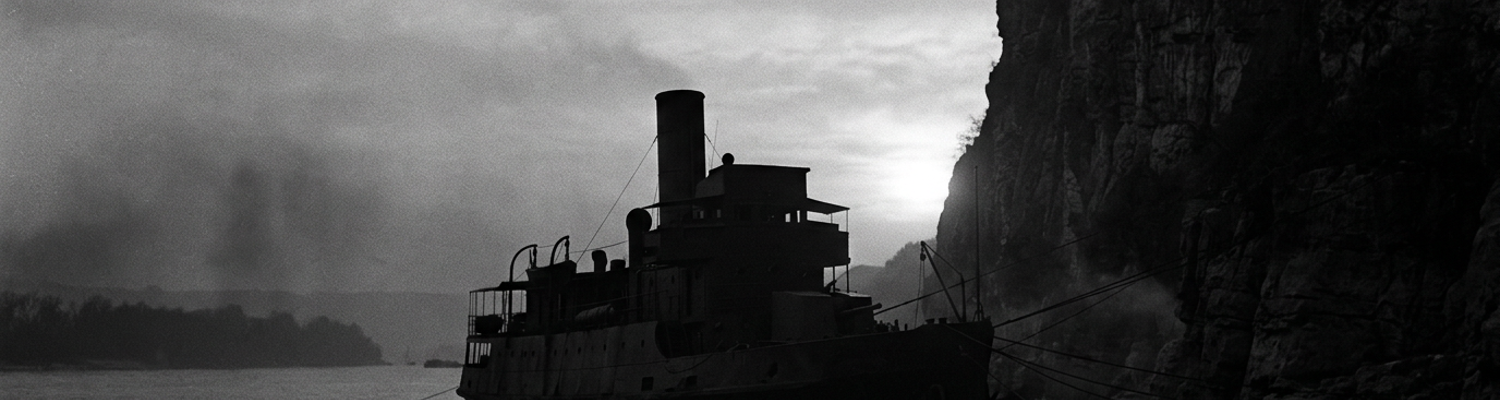
Archival evidence shows that USS Tutuila operated as a 370-ton river gunboat. The Navy commissioned the vessel in 1928. The ship was tethered to the riverbed along the South Bank beneath the precipitous cliffs of Nan'an. Flat-bottomed and carrying a draft of just five feet, the vessel was never built for oceanic combat. Its twin screws and shallow hull were tailored exclusively for Yangtze shoals. Commander Hugh P. Webster directed deck crews to secure heavy wire cables from the port bow directly into iron ringbolts. Shore parties drove these ringbolts into the granite shoreline. This anchoring system prevented the five-knot summer current from dragging the ship into the shipping channel. Across this narrow stretch of water sat the Nationalist government ministries. The South Bank itself functioned as an enclave for displaced Westerners. Below the cliffside American Embassy outpost, the gunboat acted as an emergency floating command center.
Staff members from the United States consular service gathered along the mudbanks beside the ship's gangway. American Red Cross relief directors and diplomatic couriers joined them. They relied on the vessel's low-power radiotelegraph set. They depended on armed bluejackets for emergency evacuation across the river if the city center burned.
Isolation defined every tactical decision.
Command authority did not reside on the river. It rested fifteen hundred miles away at Asiatic Fleet headquarters in Manila. Admiral Thomas C. Hart directed fleet policy through high-frequency radio transmissions. The naval communications station at Cavite bounced these signals to naval attaches in Shanghai. Decrypted dispatches reached the wireless room of Tutuila with severe time lags. Atmospheric static over the South China Sea frequently delayed the signals. The labor-intensive hand-decryption of administrative codes added further delays. A close review of operational logs indicates that administrative directives from Manila demanded strict accounting of expenditures. Headquarters required daily boiler fuel consumption reports and routine personnel rosters. They demanded these forms while bombs leveled the adjacent hillsides. Hart's staff managed the gunboat through formal circular letters and rigid telegraph traffic. They demanded comprehensive post-action accounts for minor supply requisitions. Telegraph cables snapped under falling masonry across the river. This procedural friction forced Webster to manage immediate life-and-death crises under standard naval peacetime accounting regulations.
Bureaucracy held the trigger.
When examining the historical record of United States naval policy in the theater, State Department neutrality circulars exerted a tight bind on shipboard operations. These diplomatic instructions strictly prohibited American naval vessels from opening fire on foreign aircraft. The rules allowed defensive fire only if foreign bombs struck the ship directly. The rules also allowed fire if aircraft executed an unmistakable strafing run along the decks. The gunboat mounted two 3-inch/50-caliber dual-purpose guns and ten .30-caliber Lewis machine guns. These weapons were capable of throwing fragmentation shells into low-flying attack formations. Gun crews received orders to keep canvas blast covers laced over the breeches during combat flyovers. This prevented gun captains from chambering rounds without written authorization from the bridge. Washington feared an unauthorized burst of antiaircraft fire would give Tokyo grounds to claim the United States had entered the war as an active belligerent. Gunners stood beside chained ready boxes on the open bridge wings. They tracked Mitsubishi G3M2 twin-engine bombers through mechanical sights. Diplomatic codes forbade them from touching the firing pins.
Operation 101 Saturation Bombing Raids
Operation 101 began in May 1940 with a single objective. The Imperial Japanese Navy intended to batter the Nationalist capital into submission through unbroken aerial bombardment.
When examining the historical record of the Imperial Japanese Navy air campaign, the summer offensive deployed hundreds of Mitsubishi G3M2 Model 21 twin-engine bombers. These aircraft belonged to the 1st Combined Air Group. They flew outward from conquered bases at Hankou and Wuhan. Operating in rigid formations of twenty-seven to thirty-six aircraft, these units crossed the Sichuan basin. They maintained altitudes between twelve thousand and sixteen thousand feet. Each twin-engine G3M carried up to eight hundred kilograms of ordnance inside internal racks and wing shackles. Ground crews typically loaded an alternating mixture of Type 98 two-hundred-and-fifty-kilogram high-explosive bombs and Type 97 sixty-kilogram thermite incendiary canisters. Air crews released their payloads simultaneously on visual signals from lead aircraft. Bombardiers used mechanical Type 90 bomb sights to carpet square kilometers of the central Yuzhong peninsula. Flight logs confirm that the intense heat of the Yangtze valley caused chronic vapor lock in the Mitsubishi Kinsei radial engines. This forced Japanese flight leaders to throttle back to conserve fuel. They made repetitive bombing passes over the city grid. Between May and September, over three thousand tons of explosives fell on the hillside urban sectors. The ordnance leveled commercial wards and cut civilian electrical conduits.
Geography made the destruction worse.
Archival evidence shows that the sheer limestone bluffs framing the river channel severely worsened the mechanical impact of every detonation. Chongqing sits on a narrow rocky promontory. The Jialing River empties into the Yangtze at this exact point. Granite and limestone walls rise three hundred to eight hundred feet above the waterline on both sides. When high-explosive ordnance detonated along the ridge crests or struck the river surface, these vertical stone faces deflected the supersonic blast waves. The kinetic overpressure could not dissipate into open air. It bounced between the rock faces. The pressure waves struck moored hulls below the waterline with the physical force of direct underwater collisions. A close review of operational logs indicates that the river currents ran at six to eight knots through the summer high-water runoff. This pinned vessels into a two-hundred-yard navigable corridor along the Nan'an bank. Flat-bottomed hulls lacked sea room to maneuver or disperse. Shockwaves traveling through the dense river water fractured sea-chest valves. The pressure popped hull rivets beneath coal bunkers. The force snapped two-inch hemp securing lines. Engine-room crews fought hull leaks while choked by dust clouds blowing off the crumbling stone ridges.
Safety lay only in strict combined positioning.
Faced with falling debris and zero room to maneuver, Commander Hugh P. Webster coordinated a shared static defense. He worked with the Royal Navy river gunboats HMS Falcon and HMS Gannet. The three vessels anchored along the southern shore within five hundred yards of one another. They formed an aligned riverine cordon beneath the foreign diplomatic compounds. Deck officers established continuous visual communications using shuttered Aldis signaling lamps and flag hoists. This linked their bridge watches to share air-raid warnings telephoned from forward Chinese spotter outposts at Baishiyi. Webster and the British commanding officers calculated overlapping fields of fire for their light antiaircraft weapons. Tutuila oriented its battery of ten .30-caliber Lewis machine guns toward the northern approach. Falcon and Gannet trained their .50-caliber Vickers guns and single 3-inch 20-hundredweight antiaircraft rifles on the eastern river bend. This covered the primary low-altitude ingress routes. American neutrality regulations barred Tutuila from firing outward without an unmistakable direct attack. The ships synchronized auxiliary fire-hose stations and damage-control parties. Medical personnel prepared to handle burning shrapnel that regularly pelted the exposed weather decks. Crews rigged collective soot screens and standby diesel bilge pumps. This prevented fires on one gunboat from spreading down the narrow South Bank anchorage.
Improvised Antiaircraft Mounts and Weapon Modifications
When examining the historical record, USS Tutuila floated beneath the Nan'an bluffs without a single dedicated modern antiaircraft director. The ship possessed no high-angle heavy gun battery. The vessel's primary armament consisted of two 3-inch/50-caliber low-angle single mounts installed in 1928. The Bureau of Ordnance designed these almost exclusively for direct-fire suppression of warlord field pieces. They were meant for targeting riverbank rifle trenches along the Middle Yangtze. These weapons possessed neither the elevation mechanisms nor the optical rangefinders required to track Imperial Japanese Navy multi-engine bombers. The Japanese flew in stepped formations at fourteen thousand feet. Deck logs indicate the ordnance lockers contained no mechanical time fuzes for the three-inch shells. This restricted gunners to point-detonating impact ammunition. The projectile exploded only if it physically struck an aluminum airframe. Ammunition supply cables from the Asiatic Fleet ordnance depot at Cavite had stopped carrying modern 3-inch antiaircraft stock to the interior of China after the fall of Hankou in 1938. Shipboard defense fell entirely upon adapted small-arms systems. Forty-five sailors had to defend a steel hull against coordinated saturation bombing using ground-support infantry weapons.
Standard infantry tripods could not point straight up.
Archival evidence shows that shipfitters and machinist's mates under Chief Machinist's Mate E. C. Brennan dismantled structural steel angle iron from shore-gangway supports. They used this material to build their own firing platforms. The crew cut cylindrical steel pipes from abandoned river barges tied near the Nan'an gravel flats. They carried the sections into the gunboat's tiny machine workshop. Working with oxyacetylene torches, welders constructed four custom high-elevation pedestal mounts. They fixed these directly to the weather deck plating and the upper bridge wings. These mounts elevated the weapon pintles forty-eight inches above deck level. This provided clearance for the gunners to pivot both .50-caliber Browning heavy machine guns and .30-caliber Browning M1919 light machine guns past an eighty-five-degree elevation angle. Standard naval issue deck sockets locked weapon barrels at a maximum elevation of forty-five degrees. This geometric limit rendered incoming bombers invulnerable during overhead release runs. Bluejackets bolted counterbalanced shoulder braces and spring-loaded equilibrator rings to the improvised steel pedestals. This absorbed the violent vibration caused by high-angle automatic fire. The gunners tracked fast Japanese formations against the cloud cover.
The guns melted their barrels in ninety seconds.
A close review of operational logs indicates that sustained high-volume fire caused immediate thermal failure in the air-cooled machine gun assemblies. Under continuous bursts aimed at waves of twenty-seven Mitsubishi bombers, Browning barrels warped. Expanding gas blew back through the receivers. This jammed the feed mechanisms. Shipboard engineers stripped galvanized plumbing tubes and scrap copper sleeves from disassembled sanitary piping inside the lower mess decks. Machinists sleeved these salvage tubes over the outer gun barrels. They brazed threaded bronze end-caps and leather gaskets at each junction to construct water-cooling jackets. Rubber bilge hoses connected the makeshift sleeves directly to an auxiliary steam pump. The engineers tapped this pump off the forward fire main. This fed sediment-rich Yangtze river water continuously around the hot rifling. Deck crews rigged manual hand pumps from lifeboat gear as an auxiliary system. They used this if steam line pressure dropped under shock concussions from near misses. Water circulated through the jackets at twelve gallons per minute. The system dumped boiling runoff over the gunwales. This allowed gunners to cycle through five hundred continuous rounds without stopping to switch out white-hot metal.
Machinists calibrated the feed trays to accept linked Chinese-manufactured 7.92x57mm ammunition crates. They did this whenever American .30-06 deliveries failed to arrive upriver.
Cryptographic Transmission Delays and Engagement Constraints
Archival evidence shows that an emergency radiogram transmitted from USS Tutuila took between six and fourteen hours to generate a coded response from Asiatic Fleet headquarters. Radiomen inside the gunboat's stifling radio shack on the main deck keyed cipher dispatches using a low-output model TEP high-frequency transmitter. They pushed Morse code through the summer atmospheric static of the Sichuan basin. High-frequency signals had to skip over the Qinling mountains. The signals traveled twelve hundred nautical miles southeast to the naval radio station at Cavite on Manila Bay. Once received on Luzon, enlisted operators transcribed the encrypted numeral groups by hand. They routed the raw decrypts to cipher clerks. The clerks used cumbersome mechanical strip systems and diplomatic code pads. Fleet staff officers stationed in the Marsman Building in Manila then evaluated the decrypted message. They conferred with Admiral Thomas C. Hart. The staff drafted an administrative reply. They sent the text back to Cavite for reciprocal manual encryption. Imperial Japanese Navy bomb wings appeared over the Nan'an river gorge in waves forty minutes apart. This multi-tiered electronic relay left the gunboat completely cut off from timely operational direction.
The air raids ended before Manila read the contact reports.
A close review of operational logs indicates that Admiral Hart's staff bound river craft to standing orders designed for peacetime diplomatic neutrality. They did not adjust for aerial bombardment conditions. Asiatic Fleet directives strictly prohibited river gunboats from engaging foreign aircraft. The rules required an enemy pilot to execute an unmistakable, deliberate strafing run directly across the ship's decks. The rules also allowed fire if ordnance physically struck the hull. These restrictive engagement parameters failed to account for high-altitude saturation tactics conducted by the 1st Combined Air Group. Japanese naval aviators flew formations of twenty-seven Mitsubishi G3M2 bombers at fourteen thousand feet. They discharged simultaneous stick releases. These releases blanketed hundreds of square yards of water with high-explosive ordnance. Bombs detonating thirty yards off the gunboat's shallow hull buckled lower compartment plates. The blasts severed auxiliary freshwater lines. The explosions showered the exposed decks with jagged casing fragments. Fleet headquarters classified these near-miss detonations as non-targeted collateral explosions. Gun captains stood by their improvised high-angle Browning machine-gun mounts. They operated under strict orders to keep firing pins detached. Shockwaves sheared hull rivets below the waterline.
Diplomatic protocol dictated absolute restraint while near misses fractured the ship's framing.
When examining the historical record of the July 1940 bombardments, Commander Hugh P. Webster chose to bypass the paralyzed command loop entirely. He needed to preserve his ship and crew. Delayed telegraph clearances from Manila meant that waiting for formal authorization invited catastrophe along the Nan'an granite bluffs. During an intense afternoon strike, twenty-four twin-engine bombers dropped two-hundred-and-fifty-kilogram demolition charges across the river anchorage. Kinetic overpressure bent the starboard propeller shaft. The pressure cracked cast-iron sea valves inside the auxiliary engine compartment. Webster refused to wait for Cavite to decrypt damage queries. The commanding officer directed his deck crews to cast off forward wire cables. He ordered them to run high-pressure hoses to flood forward powder stores. He ordered small-arms gunners to track incoming targets through open mechanical sights. Crewmen stripped canvas covers from improvised water-cooled machine guns. They loaded armor-piercing ammunition belts. They prepared defensive firing arcs coordinated directly with British sailors aboard the adjacent HMS Falcon. Ship logs record that Webster documented every unilateral survival measure in the vessel's rough deck journal. He wrote these entries after the bombers turned east toward Hankou. He accepted full personal responsibility for violating fleet administrative protocol.
Hull Plate Fractures and Bomb Shock Damage
Archival evidence shows that high-explosive ordnance detonating in the river channel generated hydraulic shockwaves. These waves struck USS Tutuila with unmitigated physical force. Two-hundred-and-fifty-kilogram Type 98 aerial bombs struck the water twenty to fifty feet off the gunboat's port side. The non-compressible river current transferred the full kinetic blast directly against the vessel's quarter-inch mild steel hull plates. Explosions did not have to hit the weather deck to cause severe structural failure. A close review of operational logs indicates that hydraulic overpressure sheared dozens of three-quarter-inch structural rivets. This occurred along the vessel's river waterline between frames twenty-two and thirty-eight. Steel plates separated outward at the riveted lap seams. This broke watertight integrity along the forward magazine bulkhead and lower storage flats. River water flooded across the inner framing. The hull plating bulged inward under the shock pulses. This separated longitudinal stringers from the vessel's vertical keel.
Silt-heavy river water poured into the lower compartments through gaps two inches wide.
When examining the historical record, repeated bombardments churned the shallow riverbed into a destructive field of jagged iron and displaced granite boulders. Flying casing fragments from detonations on the Nan'an riverbank ripped through the water. They severed exposed auxiliary cooling intake pipes. They punctured the cast-iron overboard discharge conduits beneath the main machinery spaces. Concussion tossed sunken river debris against the vessel's flat bottom. Discarded mooring chains and shattered wooden sampan timbers struck the hull. These underwater impacts bent the external steering quadrant. They crushed the exposed steel control cables connecting the pilot house to the twin balanced rudders. Auxiliary steam lines feeding the steering engine lost pressure. Fragments punched clean through secondary steam headers inside the steering gear flat. This sprayed scalding vapor across the compartment. It prevented mechanical adjustments from the bridge.
Rudders jammed thirty degrees to the starboard stop.
Archival evidence shows that the gunboat possessed zero access to drydock facilities. Regional shore repair infrastructure did not exist. All naval yards downstream sat in Japanese-occupied Wuhan and Shanghai. Commander Webster had to preserve the vessel's buoyancy using only the materials stored inside the ship's cramped hold. He used whatever timber his men could scrounge from the Nan'an hillside. Damage-control parties led by Carpenter's Mates assembled timber shores. They used six-by-six pine beams wedged against overhead deck girders. This held buckled transverse bulkheads in position against hydraulic pressure. Crewmen packed canvas caulking pads into leaking rivet holes. They applied white lead paste and tallow. They backed the seams with heavy oak wedges driven tight by eight-pound sledgehammers. Below the deck grates, sailors waded through waist-deep oily water. They cleared the suction strainers of the ship's single auxiliary steam bilge pump every fifteen minutes. They pulled out coal slurry, river sediment, and spent shrapnel that threatened to seize the pump impellers.
Hand pumps took over whenever auxiliary boiler steam dropped.
A close review of operational logs indicates that machinists mixed Portland cement with coarse Yangtze gravel. They poured solid concrete cofferdams directly over fractured hull plates in the forward bilge. Shipfitters manufactured custom steel backing plates on the machine shop's small lathe. They clamped them over ruptured auxiliary intake pipes with threaded iron U-bolts. This maintained cooling circulation for the ship's electrical dynamos. These poured concrete boxes and timber shoring arrays successfully contained river ingress across eight separate watertight subdivisions. They held the ship's shallow draft at five feet two inches through the final week of August 1940.
Command Detachment and Riverine Warfare Mechanics
Archival evidence shows that the Chongqing siege exposed the vulnerability of remote command doctrines. Managing isolated combat detachments from afar failed under combat conditions. Admiral Thomas C. Hart's staff in Manila operated fifteen hundred nautical miles away across oceanic cable routes. They treated the Yangtze Patrol as a static diplomatic detachment governed by rigid peacetime naval regulations. Operational radio dispatches from the Asiatic Fleet command center inside the Marsman Building demanded detailed administrative filings. They required itemized coal expenditures and balance sheets for small-arms ammunition. Japanese 250-kilogram demolition bombs shattered riverfront structures within twenty yards of the gunboat's mooring during these exact radio transmissions. Encrypted radiograms routed through Cavite arrived eight to twelve hours after bomb runs ended. This electronic delay forced Commander Hugh P. Webster to make split-second survival choices without authorization from Manila. Hart operated inside an institutional vacuum. He attempted to control local engagement parameters through State Department neutrality circulars. Washington offices drafted these circulars. The authors failed to grasp the mechanics of aerial saturation bombing in the Sichuan interior.
Distance severed the operational chain of command.
A close review of operational logs indicates that tactical improvisations aboard USS Tutuila established immediate patterns for surviving air attacks in confined river environments. Anchored in a narrow channel bounded by six-hundred-foot vertical limestone cliffs, the ship lacked maneuvering room. The vessel could not execute evasive turns against overhead bomb releases. Webster adapted by replacing standard single-point river anchoring with dynamic four-point wire hawser arrays. Deck crews secured these directly into forged iron eyelets drilled into the Nan'an granite. This allowed deck crews to manually warp the ship forty yards upstream or downstream using steam deck winches. They did this whenever spotters at Baishiyi reported inbound bomber formations. Machinist's mates tapped the auxiliary fire main. They pumped sediment-heavy river water through scrap copper water jackets. They brazed these jackets around the barrels of air-cooled .30-caliber Browning machine guns. This prevented barrel warpage during prolonged high-angle firing. Below decks, damage control parties pre-cut six-by-six pine shoring timbers. They stacked pre-measured bags of Portland cement beside open bilge hatches. They hung double-layered hemp collision mats over the port waterline. This cushioned the shallow hull plating against hydraulic shock pulses generated by underwater detonations.
Survival depended on tools fabricated in the engine room.
When examining the historical record, the diplomatic gunboat protocol disintegrated under the pressures of unconstrained air warfare. This occurred preceding the broader Pacific conflict. For nearly a century, the Yangtze Patrol functioned under nineteenth-century treaty frameworks. These frameworks relied on the physical presence of white-hulled rivercraft to deter warlord factions and suppress small-arms river piracy. That diplomatic posture assumed a mutual recognition of neutral immunity backed by established international maritime agreements. Imperial Japanese Navy air wings deploying massed formations across western China completely erased that assumption. High-altitude Mitsubishi G3M2 bombers releasing ordnance from fourteen thousand feet did not distinguish between Nationalist government targets and foreign river craft moored along the Nan'an shore. Asiatic Fleet orders prohibited defensive fire unless foreign bombs physically penetrated the deck plates. This left American crews exposed to cascading shrapnel. It rendered traditional riverine gunboat diplomacy useless seventeen months prior to the outbreak of general war in the Pacific. Webster's deck officers systematically abandoned standing diplomatic restrictions. They loaded live armor-piercing ammunition into modified deck mounts whenever Japanese air formations aligned their approach runs over the southern river bluffs.
On August 22, 1940, casing fragments from twelve high-explosive bombs cut the vessel's primary telephone line to the American Embassy. The same blast severed the auxiliary steam exhaust behind frame thirty-four.