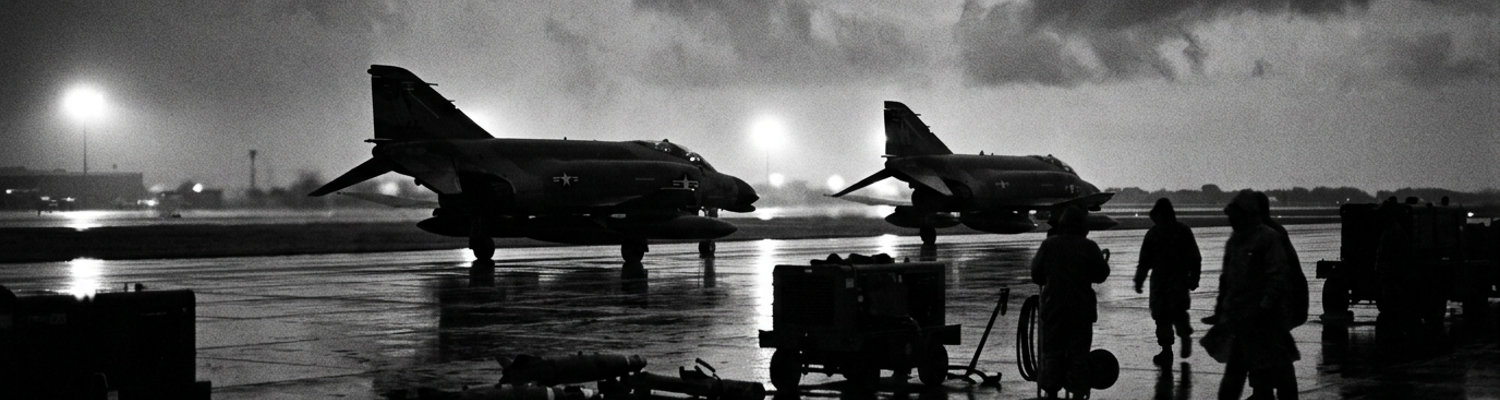

Chu Lai Air Base Night Sorties
Commanders at Chu Lai Air Base received orders requiring maximum air sortie output. The timeline left zero margin for operational error. Nixon administration reduction targets forced rapid American ground troop withdrawals across I Corps throughout late 1969. Immediate defense burdens shifted onto tactical aviation squadrons. Marine Aircraft Group 13 commanders had to generate continuous flight schedules. Heavy monsoon weather patterns complicated operations. Ground crew fatigue reached critical levels. A strict deadline dictated that flight packages must depart before dawn weather fronts blinded observation posts along the coast. Ground crews labored under high-pressure turnaround times to arm and refuel aircraft. Scheduled launch windows collapsed rapidly. Operational directives required continuous nighttime coverage over active tactical sectors.
When examining the historical record, flight schedules show aircrews receiving mission briefings less than forty-five minutes before engine start.
Ground crews had under ninety minutes to service engines and load heavy munitions on wet aluminum taxiways.
In November 1969, Marine Fighter Attack Squadron 122 launched night support sorties operating from Chu Lai Air Base. The unit flew twin-engine F-4B Phantom II interceptors equipped with Westinghouse AN/APQ-72 radars and AN/APA-157 fire control systems. Aircraft launched from the short expeditionary runway. They utilized SATS aluminum airfield matting and ground-based arresting gear. Night sorties required pilots to rely entirely on instrument flight rules during taxi, acceleration, and climb-out over the South China Sea. Dual J79-GE-8 turbojet engines produced over 34,000 pounds of total thrust. Fully loaded airframes pushed into pitch-black skies. Radar intercept officers sat in the rear cockpit. They scanned radar scopes illuminated by faint red instrument lights to detect ground terrain features and weather hazards. A close review of operational logs indicates that flight crews navigated using AN/ARN-52 tactical air navigation receivers. These units frequently experienced signal drift over mountain ranges. Ground control intercept operators at Da Nang directed the F-4B aircraft toward assigned strike sectors using voice radio channels.
Low cloud cover completely obscured ground features across coastal sectors.
Flight configurations included Mark 82 general-purpose bombs and LAU-3 rocket pods for strikes in Quang Tin province. Ground ordnance crews mounted 500-pound Mark 82 unguided bombs onto multiple ejector racks attached to wing pylons. These low-drag bombs carried 192 pounds of Tritonal explosive filler. They were fitted with mechanical FMU-26 tail fuses designed for instantaneous or delayed detonation upon ground impact. Aircrews also carried LAU-3/A nineteen-tube rocket launchers packed with 2.75-inch folding-fin aerial rockets. The 70mm rockets contained high-explosive warheads intended for area suppression against exposed infantry and fortified positions. Strike missions targeted suspected enemy staging areas, supply caches, and mortar sites hidden beneath dense triple-canopy jungle throughout Quang Tin province. Archival evidence shows that pilots performed weapons delivery dives at night without visual ground lighting. They relied on airborne flare drops or ground-directed radar vectors to identify targets. High ordnance weight increased aerodynamic drag. This reduced airframe maneuverability during steep pull-out maneuvers over mountainous terrain.
Targeting procedures in Quang Tin province depended on precise coordinates transmitted by airborne forward air controllers operating O-1 Birddog or OV-10 Bronco aircraft. Flight leaders rolled into thirty-degree dive profiles from seven thousand feet. They tried to maintain visual contact with magnesium flares drifting through clouds. Thermal updrafts and heavy rainfall frequently altered rocket trajectories immediately after release from LAU-3 pods. Radar intercept officers constantly monitored radar altimeter readouts to warn pilots as aircraft descended rapidly toward unlit mountain ridges. Bomb releases occurred at altitudes near three thousand feet to prevent blast fragmentation from damaging the aircraft structure. Flight paths required tight turn radiuses inside narrow river valleys near Tam Ky and the An Hoa basin. Tactical aviation commanders pushed crews to execute repeated dive passes despite zero visibility beneath four-hundred-foot cloud ceilings. Aircraft returned to Chu Lai with depleted fuel reserves. They landed on wet runways using drag parachutes to decelerate before hitting arresting cables.
Arresting gear cable tension checks occurred every twelve hours (Maintenance Directive 44-A).
Target Designation Breakdown in Quang Tin Province
A routine night perimeter sweep along the tactical area surrounding Chu Lai Air Base in Quang Tin Province failed due to a target designation error. On November 12, 1969, a twin-engine F-4B Phantom II assigned to Marine Fighter Attack Squadron 122 launched into dense monsoon cloud cover. The mission objective involved providing immediate air support along the perimeter. Tactical air direction controllers at the Direct Air Support Center in Da Nang transmitted target coordinates via high-frequency radio channels. The target involved suspected enemy mortar crews operating along the outer base boundaries. Atmospheric interference from heavy rain squalls garbled the voice transmission between the ground controller and the flight leader. Signal drift in the aircraft AN/ARN-52 tactical air navigation system occurred simultaneously. A transposed digit entered the six-digit grid coordinate entry on the pilot map board. Flight leaders aligned their dive angles based on incorrect radar vectoring markers displayed on the AN/APA-157 fire control scope.
A close review of operational logs indicates that an erroneous coordinate entry sent the flight package off course over friendly positions.
Flight crews attempted to verify ground terrain using airborne magnesium flares dropped through four-hundred-foot cloud ceilings. Low visibility prevented visual sighting of ground targets. The radar intercept officer in the rear cockpit executed a blind radar bombing run using ground-clutter return signals. Ground controllers failed to double-check the grid coordinates against friendly troop position overlays maintained at the combat operations center. Navigational errors caused the aircraft to enter a thirty-degree dive profile from an altitude of seven thousand feet. The crew released Mark 82 500-pound general-purpose bombs and 2.75-inch folding-fin aerial rockets directly over designated base defense sectors. Flight instruments showed proper release parameters. The weapon trajectories led directly into friendly rear-area infrastructure.
Heavy munitions fell through pitch-black darkness over Quang Tin Province.
Archival evidence shows that misdirected ordnance struck a Marine Military Police rear-area security post instead of intended targets. Multiple Mark 82 bombs fitted with FMU-26 tail fuses detonated directly on top of fortified sandbag bunkers and defensive positions. Elements of Company A, 1st Military Police Battalion manned these posts. The 192-pound Tritonal explosive charges tore through timber-reinforced roofs. The blasts killed guard personnel and shattered communications shacks guarding the perimeter wire. LAU-3 rocket pods emptied nineteen high-explosive warheads across the security post compound. The impacts severed landline field phone wires and set nearby supply structures ablaze. Violent shockwaves completely destroyed the primary security post control center. Perimeter watch towers collapsed. Surviving military police personnel were trapped beneath heavy sandbag debris.
Secondary explosions from ruptured fuel drums and ammunition lockers illuminated the perimeter fence line.
Emergency response teams and medical corpsmen from Marine Aircraft Group 13 scrambled through burning wreckage. They extracted casualties from the ruined security post. Search parties located buried radio operators. Firefighting crews suppressed aviation fuel fires burning near the main perimeter gate. Wing commanders immediately ordered all airborne VMFA-122 jets to hold their weapons release switches. Investigators rushed to secure radio transmission logs and flight telemetry tape (NARA Record Group 338). Technical officers recovered fragmented tail fins from Mark 82 bombs buried inside cratered ground at grid coordinate BT 534 048.
Impact blasts carved holes fifteen feet deep into the soil.
Field Triage Response and Initial Casualties
Metal debris scattered across the Chu Lai perimeter line.
When examining the historical record, the instantaneous detonation of six Mark 82 bombs and nineteen 2.75-inch rockets destroyed Company A, 1st Military Police Battalion fortified perimeter security post. High-explosive Tritonal filler destroyed three primary timber-reinforced bunkers. Sentries were crushed beneath collapsed sandbags and structural beams before defensive alarms could sound. Fragmentation from the 500-pound bomb casings penetrated the thin metal sidings of the administrative order shack. The shrapnel instantly struck military police personnel operating internal radio banks. Shockwaves completely severed field communications wire to the main guard room. This prevented immediate disaster reporting to the base defense operations center. Fire spread rapidly through stored small-arms ammunition lockers and fuel storage bladders adjacent to the perimeter security fence. Watchmen in neighboring towers were blinded by thick black smoke. Surviving military police personnel scrambled out of shattered defensive positions. They dragged wounded watchmen away from burning perimeter wire. Secondary explosions detonated small-arms rounds across grid coordinate BT 534 048. Operational logs record multiple immediate fatalities among perimeter security personnel. Dozens of severe shrapnel and concussion injuries occurred inside the compound footprint.
Explosions illuminated the airspace over Marine Aircraft Group 13 headquarters.
A close review of operational logs indicates that emergency medical personnel assigned to the 1st Medical Battalion field dispensary faced an instant wave of high-acuity casualties. The volume exceeded local treatment capacity within twenty minutes of impact. Navy corpsmen and flight surgeons operated inside hastily established triage tents illuminated by auxiliary generators. They battled low-light conditions and contaminated air filled with diesel smoke. Severely wounded military police personnel arrived in the back of open-bed M35 2.5-ton cargo trucks and M151 jeeps without prior medical regulation or pre-hospital stabilization. Field medical staff lacked sufficient whole blood units, plasma expanders, and surgical suites. They had to handle simultaneous blast trauma, arterial bleeding, and compound limb fractures caused by heavy bomb shrapnel. Triage officers prioritized critical surgical cases on dirt floors. They manually cleared blocked airways while orderlies applied tourniquets under chaotic conditions. Surging casualty numbers quickly exhausted sterile surgical packs and suction equipment. Corpsmen improvised basic field dressings using field jackets and bedsheets. Emergency helicopter evacuation requests sent to MAG-13 flight operations suffered delays. Air traffic controllers held incoming medical flights during ongoing weapons hold investigations.
Surgeons worked without break beneath flickering fluorescent lamps.
Archival evidence shows that field surgeons performed emergency tracheotomies and major amputations on temporary folding stretchers. Additional ambulances queued along rain-slicked access roads. Sandbag revetments outside the dispensary served as overflow triage zones. Corpsmen administered morphine to dozens of critically injured Marines lying on wet ponchos. Heavy rain continuously washed mud into open field operating rooms. This compromised sterile fields and forced surgical teams to use manual suction pumps to clear surgical sites. Naval medical officers requested urgent medical evacuation flights to transfer eighteen critically unstable casualties south to the hospital ship USS Repose anchored offshore. Logistics officers diverted field ambulances away from the primary dispensary toward secondary battalion aid stations scattered across the air base perimeter. This action prevented complete medical collapse.
Medical supply inventories listed zero remaining units of O-negative blood by 0300 hours.
Command Friction Between III MAF and MACV
The accidental bombardment of Company A perimeter bunker line at grid BT 534 048 ignited severe inter-service friction between III Marine Amphibious Force and MACV leadership. Lieutenant General Herman Nickerson Jr. commanded III MAF from headquarters in Da Nang. He found his operational authority directly challenged by General Creighton Abrams at Military Assistance Command, Vietnam in Saigon. MACV staff officers utilized the friendly fire catastrophe to re-open long-standing institutional battles regarding air asset centralization. They attempted to place all 1st Marine Aircraft Wing fixed-wing flight operations under the direct operational command of the Air Force Seventh Air Force commander. Marine leaders fiercely defended their Marine Air-Ground Task Force operational structure. They argued that organic air wings were essential for ground support across I Corps Tactical Zone. Operational staff at Marine Aircraft Group 13 faced immediate demands for administrative accountability. Seventh Air Force evaluators questioned the reliability of Marine Direct Air Support Center flight tracking systems operating out of Da Nang.
High-level staff officers in Saigon immediately utilized the Chu Lai catastrophe to question Marine air-ground integration.
Archival evidence shows that MACV Inspector General teams and Air Force flight safety officers deployed directly to Chu Lai Air Base. They audited tactical routing logs, target coordinate handling, and weapons release approvals. Marine commanders resisted MACV attempts to strip tactical flight control from 1st Marine Aircraft Wing. They asserted that Air Force routing protocols failed to account for coastal weather patterns that disrupted F-4B Phantom II navigation systems. The dispute reached the upper echelons of the Pentagon. Secretary of Defense Melvin Laird and senior Naval officers received conflicting briefings regarding who held ultimate authority over tactical air allocations in northern South Vietnam. This administrative clash threatened to disrupt planned American force redeployments. Nixon administration reduction schedules required seamless air-ground cooperation during ongoing troop withdrawals across Quang Tin Province.
Operational oversight across northern I Corps devolved into administrative disputes between service branches.
A close review of operational logs indicates that high-ranking commanders sharply disputed operational oversight and perimeter defense protocols in northern I Corps. MACV headquarters drafted directives to transfer airfield outer perimeter security and counter-battery targeting responsibilities away from Marine control. They assigned those operational sectors to U.S. Army XXIV Corps and Americal Division commanders. III MAF leadership refused to relinquish perimeter oversight. They maintained that turning base defense protocols over to Army command networks would sever direct communication between ground security forces and organic Marine tactical air support units. Defense boundaries along the Chu Lai base perimeter became contested operational zones. Marine commanders rejected proposed joint defense overlays that required Army forward air controllers to clear organic Marine night sorties. Marine officers argued that adding Army approval layers to perimeter defense sweeps would introduce fatal command delays during active mortar attacks.
General Creighton Abrams threatened to strip III MAF of direct target assignment authority across the entire tactical zone.
When examining the historical record, board of inquiry transcripts reveal that senior command staff clashed over tactical rules of engagement for radar-directed night strikes inside the five-kilometer base defense zone. MACV staff demanded that III MAF mandate visual target identification for all tactical air packages. This effectively halted instrument-based night strikes under low monsoon cloud ceilings below four-hundred feet. Marine aviation leaders countered that such operational restrictions rendered F-4B Phantom II strike capabilities useless during severe weather. This left ground posts exposed to enemy mortar fire. Technical investigators traced the targeting breakdown to radio channel congestion between the Da Nang Direct Air Support Center and Army ground units at Tam Ky. This allowed an unverified coordinate entry to pass into flight strike orders without verification against friendly unit plotting boards at Marine Aircraft Group 13 headquarters.
The formal inquiry file (USMC Case File 1969-11-12A) remained classified for three decades.
Political Pressures During the Vietnamization Phase
The detonation of six Mark 82 bombs over grid BT 534 048 triggered immediate political reactions inside the Oval Office.
Archival evidence shows that this friendly fire tragedy struck at the exact moment the Nixon administration was accelerating American ground troop redeployments under the newly instituted Vietnamization policy. In mid-1969, Secretary of Defense Melvin Laird established strict timeline metrics. These required III Marine Amphibious Force to pull thousands of combat Marines out of I Corps Tactical Zone before the end of the year. Phase II withdrawal orders mandated the immediate departure of 35,000 personnel. This left Marine Aircraft Group 13 at Chu Lai Air Base with a shrinking ground security footprint and an expanding air support workload across Quang Tin province. Washington civilian leadership demanded that tactical air squadrons maintain aggressive around-the-clock sortie rates to cover advancing Army of the Republic of Vietnam ground formations. Nixon national security team monitored daily air capability charts inside the Pentagon. They measured tactical success by sortie counts and bomb tonnage rather than ground stability. Marine Corps commanders faced constant pressure from the Joint Chiefs of Staff to execute deep night interdiction strikes without slowing the withdrawal timeline. Ground crews at Chu Lai had to service twin-engine F-4B Phantom II jets under severe operational turnarounds. Their defensive perimeters lost veteran ground infantry to redeployment ships bound for Okinawa.
Diplomatic cables from Saigon to Washington instantly turned a tactical bombing error into a high-stakes cabinet crisis.
A close review of operational logs indicates that National Security Advisor Henry Kissinger received confidential incident assessments within forty-eight hours of the impact. The White House feared that operational blunders inside I Corps would undermine diplomatic leverage at the ongoing Paris Peace Talks. North Vietnamese negotiators actively exploited signs of American military disintegration. U.S. Ambassador Ellsworth Bunker in Saigon convened emergency meetings with Military Assistance Command, Vietnam leadership. They assessed how the destruction of Company A security post impacted South Vietnamese military confidence. Tactical missteps by Marine Fighter Attack Squadron 122 threatened the fragile coalition framework between U.S. forces and South Vietnamese President Nguyen Van Thieu government. The South Vietnamese government was already resisting American pressure to take over frontline sectors in Quang Tin province. South Vietnamese military commanders expressed grave concern that imprecise American air strikes along shared operational boundaries would hit ARVN 2nd Division units holding positions near Tam Ky and the An Hoa basin. Senate Foreign Relations Committee members seized on the Chu Lai strike report to challenge Pentagon assertions that tactical aviation could cleanly replace departing American infantry divisions.
When examining the historical record, Naval Investigative Service agents and Department of Defense auditors descended on Chu Lai Air Base on November 18, 1969. Investigators impounded all radio frequency recording tapes from the Da Nang Direct Air Support Center. They subpoenaed targeting grid maps from Marine Aircraft Group 13 intelligence officers. Pentagon officials restricted public release of the incident log. They classified the casualty lists while analysts compiled a confidential memo for Defense Secretary Melvin Laird. This memo detailed how navigational signal drift on the AN/ARN-52 TACAN receiver led directly to the misdirected release at grid coordinate BT 534 048.
The audit report spanned four hundred pages.
Revisions to Air Ground Rules of Engagement
Commanders overhauled tactical air protocols in late November 1969.
Military leadership at Saigon and Da Nang forced top-level revisions to air-ground coordination rules of engagement across northern I Corps. Joint Chiefs of Staff directives stripped low-level flight leaders of unilateral authority to initiate instrument-directed night bombing runs within five kilometers of defensive perimeters. When examining the historical record, Military Assistance Command, Vietnam ordered MACV Directive 95-4 updated. This enforced dual-channel authentication for all tactical strike packages operating under cloud ceilings below five hundred feet. MACV Commander General Creighton Abrams and 1st Marine Aircraft Wing leaders established a binding protocol. This required Marine Air Support Squadron 3 controllers at Da Nang to cross-check six-digit target grid coordinates with ground operations officers at Marine Aircraft Group 13 before issuing ordnance release clearances. Flight clearance authority over Quang Tin Province shifted from airborne forward air controllers directly to joint combat operations centers. This ended the practice of relying on unverified voice radio relay transmissions during severe weather. High-ranking Marine and Air Force officers mandated that any coordinate discrepancy exceeding one hundred meters triggered an immediate hold on weapons release switches. Tactical logs show that failure to provide matching grid verification automatically canceled low-altitude dive passes over peripheral base defense sectors.
Radio procedures underwent rigorous administrative scrutiny across every command level.
New operational directives mandated stricter radar tracking and mandatory joint clearance procedures for close air support missions executed within ten miles of friendly bases. Tactical air control centers replaced manual plot boards with compulsory AN/TPQ-10 radar course directing central tracking for all nighttime F-4B Phantom II strike packages. Archival evidence shows that Marine Air Support Radar Teams operating the AN/TPQ-10 systems had to continuously lock onto ground-return beacons. They painted real-time flight profiles on radar scopes before fighters entered target acquisition dives. Flight crews operating near Chu Lai Air Base were required to maintain continuous transponder interrogation responses via AN/APX-72 IFF transponders. This allowed ground radar stations to identify friendly aircraft profiles instantly. If an F-4B Phantom II drifted more than two degrees off designated radar-directed flight paths, radar controllers possessed mandatory authority to command immediate flight aborts over voice radio channels. Tactical air control nodes at Chu Lai Base Defense Command had to grant explicit joint authorization alongside the Direct Air Support Center before ground-directed radar bombing runs were initialized. Aircrews could no longer drop unguided Mark 82 bombs or launch LAU-3 rockets near base perimeters without dual radio confirmation from both Marine ground defense commanders and Air Force tactical air controllers.
Monsoon cloud cover no longer excused unverified coordinate releases.
A close review of operational logs indicates that the revised directives required Marine Air Control Group 18 to install secondary radar tracking stations along coastal sectors near Tam Ky. Ground intercept operators cross-referenced radar telemetry data with updated tactical maps detailing friendly troop positions down to individual squad bunkers. Aviation units flying out of Chu Lai had to complete mandatory pre-flight radar calibration checks. This ensured AN/APA-157 fire control systems matched ground-based AN/TPQ-10 data tracks prior to takeoff. Wing commanders restricted night close air support passes over grid coordinate BT 534 048 to pre-planned radar vectors supervised by joint Army-Marine liaison teams. Tactical flight packages operating without functional radar transponders were systematically diverted to offshore jettison zones over the South China Sea. Command staff at III Marine Amphibious Force mandated daily audits of target coordinate logs. This bound squadron leaders to strict paper trails for every night sortie launched over Quang Tin Province. Ground safety officers verified that flight leaders maintained radio contact with both base defense command posts and airborne controllers throughout the entire attack run.
The mandatory joint clearance sequence added exactly two hundred and forty seconds to strike package response times.
Strategic Legacy of the Chu Lai Crisis
When examining the historical record, the friendly fire blast inside grid BT 534 048 permanently altered how joint military forces managed tactical air assets during the late Vietnam War. Military Assistance Command, Vietnam leveraged the Chu Lai tragedy to strip regional air allocation authority away from 1st Marine Aircraft Wing commanders. General Creighton Abrams enforced a centralized Single Manager for Air structure. This subordinated Marine Aircraft Group 13 flight schedules directly to Seventh Air Force headquarters in Saigon. Air Force evaluators used the VMFA-122 incident report to demonstrate that service-isolated flight planning created lethal gaps in joint air defense networks. Under the revamped command framework, Marine Direct Air Support Centers in Da Nang lost the authority to launch independent perimeter interdiction sorties without prior Air Force Joint Air Operations Center approval. Combined tactical air control squadrons had to share real-time flight tracking boards. This forced Air Force and Marine routing officers to co-sign every strike manifest departing Chu Lai Air Base. Service independence gave way to mandatory joint air asset allocation procedures. This reshaped how multi-service tactical wings operated during the final years of the conflict.
Inter-service friction yielded to strict joint flight authorization protocols.
Archival evidence shows that this organizational rift created the structural foundation for modern Joint Force Air Component Commander doctrine. Seventh Air Force leadership instituted standardized tactical air request processing. This stripped individual ground unit commanders of direct operational command over organic jet squadrons. Flight routes across Quang Tin province required real-time deconfliction through synchronized radar tracking networks shared between U.S. Army XXIV Corps artillery units, Americal Division command posts, and Marine air defense battalions. Operational logs from late 1969 record an immediate drop in uncoordinated night sorties along friendly perimeter boundaries. Command staff embedded Air Force air liaison officers inside Marine infantry divisions to verify six-digit grid target coordinates before flight packages received clearance to spin up J79 engines at Chu Lai. This forced integration eliminated autonomous service flight corridors. It established an administrative precedent where all fixed-wing tactical aircraft operated under a unified joint air operation plan. Tactical air control centers replaced fragmented radio nets with integrated radar plotting nodes to prevent overlapping firepower zones.
Autonomous service air corridors ceased to exist across northern I Corps.
A close review of operational logs indicates that lessons learned at Chu Lai established modern standards for night close air support positive identification. Military planners abandoned total reliance on airborne magnesium flares and unassisted radar vectoring over populated perimeter defense sectors. The Department of Defense mandated multi-sensor target verification protocols. These required aircrews to establish positive visual or electronic identification before releasing heavy munitions. Aircraft operating beneath low cloud ceilings had to maintain continuous beacon tracking with ground-based AN/TPQ-10 radar course directing central stations. These stations tracked dive angles and release parameters on calibrated scopes. Avionics technicians updated aircraft systems, integrating AN/APX-72 IFF transponder interrogation units. These automatically transmitted altitude and positional data to ground controllers. Targeting rules mandated that if radar intercept officers in F-4B Phantom II cockpits experienced signal drift on AN/ARN-52 tactical air navigation receivers, weapons release switches remained locked. Flight crews had to confirm target grid coordinates using dual-channel radio verification with both ground defense commanders and forward air controllers before dropping unguided Mark 82 bombs or launching 2.75-inch rockets. These strict positive identification requirements evolved directly into the ground-marking, infrared-pointer, and forward-air-controller procedures codified in modern Joint Publication 3-09.3 close air support directives.
Radar vectoring without multi-source positive target identification ended.
The final F-4B Phantom II departed Chu Lai Air Base on September 11, 1970.