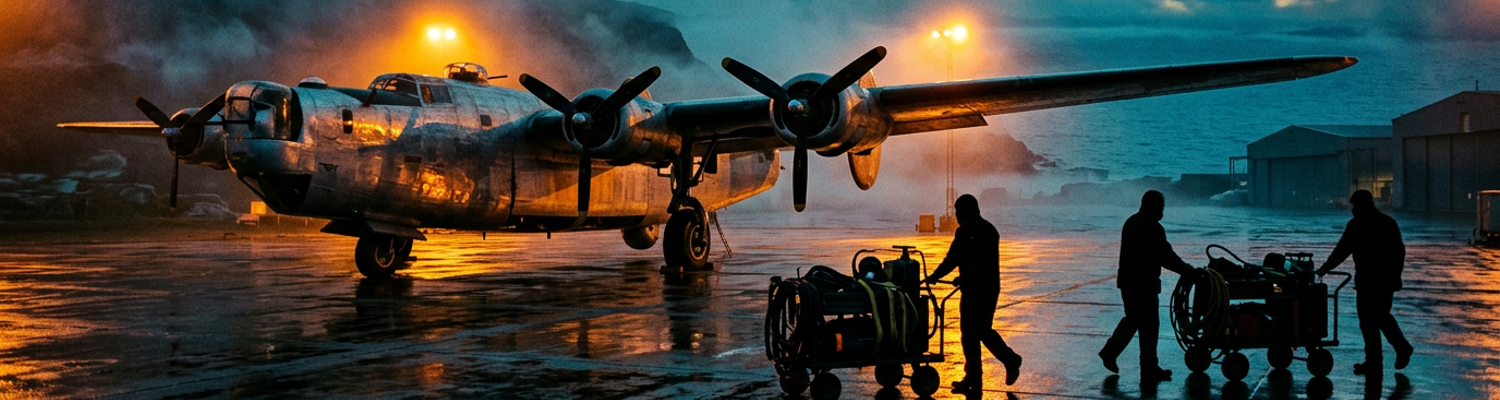

Initial Silence Across Baltic Sea Airspace
Steel control cables inside the empennage snapped when explosive cannon shells shredded the rudder linkage and severed primary hydraulic lines. A Patrol Squadron 26 PB4Y-2 Privateer disappeared off Liepaja on April 8, 1950, following an encounter with Soviet interceptors over the Baltic Sea. Pilots wrestled with the vibrating control yoke as pressurized fluid drained out of the fractured lines, locking the control surfaces and throwing the heavy patrol bomber into an uncontrollable descent. Flight engineers desperately worked fuel mixture levers and shutoff valves to extinguish a spreading fire on the number two Pratt and Whitney radial engine. Radio operators hammered out emergency distress calls on their high frequency transmitters, but the severed antenna wire prevented any signal from leaving the plunging airframe. Seawater swallowed the shattered fuselage moments later, leaving nothing behind except a widening fuel slick and scattered aluminum debris on the surface.
Ocean currents pulled the drifting fuel slick and loose wreckage westward through the cold water of the Baltic Sea. Radar operators at coastal listening stations along the border tracked the sudden vanishing of the target from their cathode ray screens without receiving a single voice message. Ground personnel at the forward staging airfield in West Germany waited beside empty runways as the designated landing hour came and passed in complete silence. Refueling crews left their fuel trucks idling near the hangars while tower dispatchers repeatedly broadcast call signs into the empty evening sky. Navigators in the flight operations office plotted the bomber fuel timeline with grease pencils, calculating that every gallon of high octane gasoline in the wing tanks had now run out. Staff officers checked civilian airfields and alternate military landing strips across West Germany and Scandinavia, confirming that the plane had made no emergency landing.
Runways throughout Scandinavia and West Germany showed no sign of the missing aircraft as night deepened across the region. Naval command centers across Western Europe recorded unbroken radio silence as the aircraft failed to return to its forward base. Teletype machines in London, Frankfurt, and Port Lyautey printed urgent inquiries from military headquarters, producing paper printouts that carried no information about the ten crewmen aboard. Communications officers inspected antenna arrays and radio receiver logs line by line, finding only flat static instead of the expected position reports. Intelligence staff analyzed intercepted Soviet military communications, detecting coded messages that showed Soviet fighter units had intercepted an unidentified aircraft near the coastline. Duty officers immediately pulled technical operating manuals for the PB4Y-2 Privateer to review life raft deployment systems, calculating that the freezing water temperatures gave downed fliers less than two hours to survive.
Mechanics at Erding Air Base prepared long range search planes under bright hangar floodlights to reach the suspected crash zone at first light. Ground crews loaded yellow inflatable life rafts, floating survival kits, and chemical sea marker dye into the cargo holds of Douglas C-47 transport planes and Boeing SB-17 rescue aircraft. Senior officers in Heidelberg coordinated with Danish and Swedish authorities to establish search routes over international water near the Soviet border. Search pilots studied weather charts showing thick fog and rough surface swells across the commercial shipping lanes off Liepaja. Navigators drew detailed search grids across large nautical charts, setting compass headings for the morning flights that would scour hundreds of square miles of open sea.
Mobilization of Search Assets from Bremerhaven
Compass headings marked on navigation logs sent flight crews running across the damp concrete at daybreak as naval facilities at Bremerhaven hastily launched maritime patrol and rescue sorties into contested Baltic airspace. Aviation mechanics disconnected external power carts and pulled wheel chocks away from heavy patrol aircraft while radial engines blew clouds of exhaust into the morning air. Pilots throttled their engines forward and climbed through the low overcast, turning eastward toward the Kurland coast where Soviet radar installations guarded the shoreline. Crewmen strapped into waist stations and observation blisters wiped moisture from the plexiglass panels to scan the dark water below for life rafts, floating debris, or oil slicks. Radio operators switched their receivers to international distress frequencies, monitoring the airwaves for any faint Morse code taps from the missing crew while listening posts along the border warned of Soviet air activity.
Fighter squadrons operating from Soviet coastal airfields tracked the incoming aircraft as United States Navy search efforts unfolded alongside multinational Swedish and British flights without unified operational theater control. Royal Air Force Coastal Command Avro Lancaster bombers and Swedish Air Force Catalina flying boats swept across the same coordinates, yet no central command post existed to assign flight altitudes or coordinate radio channels among the three nations. Navigators on American aircraft looked through cockpit windows at unfamiliar foreign silhouettes flying through the haze, identifying them only after recognizing British roundels or Swedish three crown markings on the wings. Flight leaders improvised basic visual separations, banking their heavy planes away from one another whenever other aircraft emerged from the low cloud cover. Pilots kept their attention focused on the distant coast, knowing that a minor navigation error in the crowded airspace could push an allied plane inside Soviet territorial boundaries and trigger an armed interception.
Drift meters guided the pilots through deteriorating visibility when sudden rain squalls obscured the distant shoreline, forcing aircrews to calculate headings strictly by dead reckoning over the rough sea. Lookouts rotated through open waist hatches every thirty minutes, their fingers stiffening inside leather flight gloves as cold air blew through the unheated fuselages. Binoculars helped spotters inspect every wave crest and floating timber, though crews repeatedly checked false sightings whenever fishing net floats or patches of foam drifted past the water. Flight engineers continually monitored fuel gauges as the four engine planes burned high volumes of gasoline during low altitude passes just above the water. Search planes reached the limit of their operational fuel reserves and turned back toward the west, leaving the contested maritime zone empty until relief aircraft could arrive on station.
Pilots cut their engines on the Bremerhaven tarmac with nearly empty fuel tanks while intelligence officers ran toward the parked planes to collect navigation logs. Navigators handed over handwritten position charts showing empty search sectors, noting where Swedish and British flight paths had crossed their own routes without prior coordination. Mechanics gathered around the warm engines with wrenches and oil drums, inspecting cylinder heads for damage caused by hours of low altitude flight through salt spray. Ground personnel pumped fresh aviation fuel back into the wing tanks while technicians restocked flare dispensers and emergency survival gear inside the fuselages. Operations officers entered the fresh search reports into command logs and drew new flight paths on wall charts for the next wave of sorties scheduled to launch into the contested airspace.
Communications Breakdown and Radio Frequency Mismatches
Radiomen struggled to relay those fresh flight paths to surface vessels because search aircrews and naval surface elements suffered severe radio frequency mismatches that fractured tactical coordination. Airborne patrol crews relied heavily on very high frequency and ultra high frequency transceivers designed for air to air communication, while naval destroyers and coastal cutters monitored high frequency channels. Patrol pilots spotted suspicious surface wakes, cargo ships, and possible wreckage patches on the water, but they could not talk directly to the helmsmen navigating below them. Navy radiomen dialed manual frequency knobs back and forth across different bands, listening only to empty rushing static on their headsets. Pilots had to bank their planes low over ship masts and rock their wings or fire signal flares to guide surface vessels toward coordinates of interest. Surface lookouts watched these visual signals from rolling decks and attempted to interpret the intentions of the aircraft through binoculars, losing crucial minutes during each sighting.
Cryptographers received these visual sighting logs from the lookouts, but rigid encrypted relay delays stalled critical contact reports between deployed patrol planes and maritime command centers for multiple hours. Every transmission describing debris sightings, drifting markers, or Soviet patrol movements had to pass through mechanical cipher machines and multiple relay stations before reaching operational headquarters in West Germany or London. Radio operators typed raw text into mechanical rotors, waited for encrypted tape strips to punch through the machines, and then transmitted the coded pulses over static filled high frequency waves. Intermediate relay stations along the German coast had to copy the Morse code transmissions by hand, verify the signal groups, and route them through naval teleprinters to senior task force controllers. By the time command officers deciphered the coordinates and evaluated whether a contact warranted immediate surface diversion, ocean currents had moved the suspected wreckage miles away from the reported position. Naval destroyers arrived at coordinates hours late, finding only empty gray swells where aircraft had circled earlier in the afternoon.
Commanders aboard the searching destroyers documented these missed intercepts in their deck logs, forcing communications officers at Bremerhaven to confront the glaring technical flaws in the operation. Staff personnel sat under bare lightbulbs in port offices, frantically compiling lists of incompatible crystal frequencies, mismatched emergency bands, and unworkable encryption bottlenecks. Radiomen pointed out that patrol planes carried modern very high frequency sets suited for tactical air defense networks, while naval cutters and foreign partner ships possessed only older low frequency and high frequency gear. Communications planners drafted emergency frequency sharing tables on manual typewriters, attempting to assign common tactical channels that could bypass bureaucratic encryption rules during active rescue runs. Junior officers clipped these typed radio instructions onto clipboards and hand delivered them to ready rooms where incoming relief pilots prepared for dusk departures.
Pilots grabbed the new frequency sheets and carried them directly into the cockpits of waiting patrol planes on the tarmac. Flight engineers taped the paper channel guides beside the radio control boxes while navigators adjusted their transmitter settings to match the new frequencies. Radio operators flipped power switches on their transmitters, tuned the dials to the assigned maritime channels, and broadcast test tones toward the naval stations along the coast. Surface radio shacks at Bremerhaven acknowledged the test transmissions with brief Morse code bursts, confirming that the aircrews and surface ships finally shared a working voice link. Pilots locked their cockpit hatches, advanced the engine throttles, and taxied down the runway toward the open sea.
Navigational Confusion and Miscommunicated Grid Coordinates
Engines droned at full climbing power as the patrol planes lifted off the Bremerhaven runway and headed eastward across the gray expanse of the Baltic Sea. Navigators unrolled tactical charts across their plotting tables, but operational confusion surfaced almost immediately when shore coordination cells began transmitting search sector assignments using an incompatible grid system. Ground personnel at naval headquarters recorded target boxes using standardized military grid coordinates derived from land maps, while airborne crews navigated strictly with nautical charts divided by degrees and minutes of latitude and longitude. Radio operators copied down long strings of unfamiliar alphanumeric coordinate codes that could not be plotted directly onto cockpit flight charts without tedious mathematical conversions. Navigators had to manually translate every shore message onto paper scratch pads while balancing their brass dividers against heavy cockpit turbulence.
Pencil marks smeared across damp paper charts as navigators made manual conversion errors under that violent turbulence. Incompatible search grid reference formats between aircrews and shore coordination cells led to duplicate searches and neglected sectors across hundreds of square miles. Aircrews frequently plotted identical target boundaries in different locations, causing multiple patrol planes to scour the exact same patch of ocean at the same time. Pilots looked through side blisters only to watch friendly aircraft flying search patterns across waves that had already been swept clear an hour earlier. Wide swaths of water where the Privateer or its crew might have drifted went completely uninspected, while shore officers checked off empty sectors on command room wall maps under the mistaken belief that those zones had been thoroughly covered.
Ocean currents and shifting gale force crosswinds pushed the searching aircraft even further off course as the flights progressed. Navigators took drift meter sightings through optical floor ports in the fuselage, but low cloud ceilings forced the planes to skim just hundreds of feet above the choppy waves, where surface winds differed sharply from high altitude forecasts. Flight crews relied on dead reckoning to estimate their position, yet each aircraft calculated wind speed and ocean drift using separate instruments and varying observations. Navigational drift calculations diverged rapidly, preventing search planes from maintaining visual coverage over the primary datum point where the Privateer had vanished. Planes flew widening irregular circles across the gray water, losing sight of the floating smoke flares that had been dropped to mark the original search center.
Dye markers vanished beneath the rising swells as flight crews realized their dead reckoning had pulled them completely away from the designated datum point. Flight engineers adjusted fuel mixture knobs to extend their flight time while navigators radioed shore coordination cells to request updated radar fixes. Shore stations could not provide positional corrections because their coastal radar sets did not reach far enough to track low flying planes near the Soviet coastline. Lookouts in the waist hatches kept binoculars pressed against their eyes, scanning the empty water while daylight began to fade over the eastern horizon. Pilots banked their aircraft back onto compass headings toward the estimated search boundary, plotting revised course lines on their clipboards as fuel gauges dropped toward empty.
Emission Control Orders and Tactical Paralyzation
Navigators checked the pencil lines on their clipboards while shutting down radar gear, obeying strict electronic emission control directives that restricted search aircraft from utilizing radar sets near Soviet controlled coastal sectors. Cathode ray screens stayed dark inside the fuselage cabins because command headquarters feared that electronic pulses from American equipment would be tracked by coastal Soviet listening posts and treated as hostile surveillance. Radar technicians sat idle at their control consoles with their rubber viewing hoods pulled back, unable to sweep the fogged ocean surface for floating wreckage or lifeboats. Lookouts had to press their foreheads against cold observation blisters instead, using handheld binoculars to inspect the rolling water through dense layers of gray Baltic sea mist. Thick cloud banks and coastal haze completely blocked visual sightings beyond three miles, preventing the patrol bombers from seeing anything along the exact coastal waters where the missing Privateer was believed to have gone down.
Pilots pushed their control wheels forward to descend underneath the heavy fog bank, but operational fears of triggering broader naval conflict with Soviet forces restricted low altitude search sweeps for possible survivors. Military planners in Western Europe worried that any American aircraft skimming the water within sight of the shoreline would draw fire from Soviet shore batteries or provoke fighter scramble attacks over international waters. Orders from naval command strictly held the search planes at designated medium altitudes, forcing the crews to circle far above the wave tops where survival rafts and wreckage markers were impossible to distinguish from ocean whitecaps. Crewmen knew that downed aviators floating in freezing water could survive for only a few hours without immediate recovery, yet the altitude limits prevented spotters from identifying small yellow rafts hidden within the wave troughs. Flight officers scribbled frustrated entries in their tactical logs as they peered downward through binoculars, watching floating patches of dark kelp and shadow that they could not drop down to verify.
Binoculars slipped in the cold hands of spotters who tracked promising ocean debris into the distance, unable to confirm whether the dark shapes were floating aircraft parts or ordinary flotsam. Naval radio officers on board support ships received dozens of uncertain sighting reports from the high flying planes, yet captains could not send motor launches or small cutters toward the Kurland coast without risking direct confrontation with Soviet patrol boats. Warships stayed pinned to safe patrol tracks miles offshore, their gun crews standing at relaxed ready positions while lookouts monitored Soviet gunboats patrolling aggressively along the territorial limit. Soviet jet fighters shadowed the American search planes from high above the clouds, their swept wing silhouettes visible whenever breaks appeared in the overcast. Search pilots gripped their throttles and maintained level flight within their assigned corridors, fully aware that any sudden maneuver toward the coast or down toward the water could be interpreted as an aggressive move and ignite an armed engagement.
Engines burned through thousands of gallons of high octane fuel along those rigid patrol corridors while the search effort stalled into complete operational paralysis. Navigators packed away their plotting rulers and rolled up their sea charts as darkness fell across the Baltic water, leaving the fate of the ten missing crewmen entirely unresolved. Command officers back at Bremerhaven gathered the daily flight logs, noting how the combination of electronic silence and altitude caps had paralyzed the rescue mission before it had a realistic chance of success. Intelligence clerks stamped red classifications across the initial mission summaries, documenting that tactical fear of escalating conflict had effectively neutralized the finest maritime search capabilities in Western Europe. Technicians rolled fresh fuel trucks toward the hangars to service the returned aircraft, preparing the planes for another morning of restricted flights under the same unbending rules of engagement.
Operational Realities of the March 1950 ONI Review
Intelligence officers pulled printed folders of Volume 5, Number 3 of the classified ONI Review issued in March 1950 from metal safe drawers inside the Bremerhaven flight control office, comparing the restrictive engagement rules against the tactical assessments on their desks. That publication had explicitly documented expanding Soviet coastal radar rings and aggressive intercept postures along the Baltic shoreline, warning that Soviet air defenses were shifting from passive surveillance to forward offensive action. Staff officers examined the mimeographed maps, tracing how new Soviet ground controlled intercept radars in the Baltic military district coordinated directly with jet squadrons stationed at coastal airfields. These intelligence summaries detailed how Soviet radar operators used overlapping radio coverage to guide interceptors onto foreign patrol aircraft flying outside territorial waters within minutes of detection. Tactical planners circled the coastal radar sectors with red grease pencils on the intelligence charts to measure how far the Soviet detection envelopes extended into the rescue grid.
Navigators compared those red radar zones against the failed search tracks, recognizing that the search crisis unfolded along the precise communications seams and rescue deficiencies identified in the ONI assessment weeks earlier. The March review had outlined how disparate radio networks between naval patrol squadrons, allied European military stations, and civilian maritime services would fail during an operational emergency in the Baltic basin. Airborne crews during the first search wave had encountered that exact problem, lacking common frequencies to talk directly to merchant vessels or Swedish rescue aircraft operating in adjacent sectors. The classified assessment had also highlighted critical rescue deficiencies across Western Europe, emphasizing that naval aviation units had inadequate numbers of long range amphibious rescue planes capable of landing on open water during cold Baltic storms. Watch officers clipped the open pages of the assessment directly to the operational logbooks on the briefing table.
Pilots examined those clipped logbooks under the harsh ceiling lamps, using the documented intelligence to adjust morning search routes away from known Soviet intercept corridors. Operations officers drafted revised search patterns that kept American patrol aircraft beyond the outer boundaries of the coastal radar rings while still allowing visual surveillance of the international shipping channels. Communications technicians spent the night rewiring receiver racks and distributing updated frequency lists to ensure that outbound search crews could coordinate directly with Danish and Swedish radio stations. Crew chiefs checked emergency life rafts and survival kits inside the rear compartments of the patrol planes, replacing standard equipment with cold weather survival gear suited for freezing water temperatures. Mechanics tightened fuel line fittings on the freshly loaded patrol planes and wheeled boarding ladders up to the crew hatches for the dawn takeoff.
Technical Evaluations at Naval Air Stations
Aviators climbed those wheeled ladders into the rumbling cockpits, flew the assigned search corridors over the gray water, and taxied back to park under hangar spotlights with binders of handwritten navigation sheets. Intelligence officers at Bremerhaven and regional naval air stations gathered flight logs from every returning crew during immediate post operation debriefs to discover why the operation had fractured so quickly across national and service boundaries. Debriefing teams spread the wet paper logs and grease pencil charts across wooden trestle tables, comparing American naval flight tracks against logs submitted by Air Force rescue units and allied European stations. These comparative reviews exposed fatal multi agency disconnects that left vital ocean sectors completely unmonitored while competing search planes flew over identical coordinates miles away. Clerks transcribed pilot statements showing that naval squadrons operated under orders completely unknown to Air Force rescue detachments at Erding or regional civilian air traffic facilities. Communications officers recorded how urgent sighting reports bounced through separate branch switchboards for hours before reaching the ships that actually possessed the equipment to investigate.
Radiomen unbolted emergency transceivers and directional homing antennas from naval supply storehouses to determine why search aircraft had failed to hear any distress beacons over the water. Material investigations verified that survival radio gear and automated homing systems failed to establish reliable beacons in the maritime environment of the Baltic. Technicians lowered hand cranked emergency transmitters into salt water test tanks inside the maintenance shop, discovering that freezing spray rapidly corroded the exposed wiring terminals and deadened the power coils. Automated homing receivers mounted in the nose cones of patrol bombers lost calibration in the damp coastal air, drifting off standard emergency frequencies and registering only dead static when operators swept across the beacon bands. Testing teams assembled dummy antennas on metal workbench fixtures, documenting that wet signal masts snapped under moderate sea swell action and plunged the transmitter cables beneath the surface.
Seawater shorted the delicate vacuum tube circuits inside the yellow survival sets when snapped cables dragged the housings under, draining the dry cell batteries before any automated distress pulses could radiate outward. Aviation machinists inspected the rubberized survival rafts recovered from warehouse stock at Bremerhaven, finding that salt encrustations jammed the manual inflation valves and prevented emergency gear containers from deploying correctly. Survival specialists placed the recovered life raft beacon kits into refrigerated chambers to simulate April water temperatures, watching the rubber seals crack and let moisture leak directly into the battery housings. Naval engineers marked red tags across dozens of survival gear assemblies on the workshop floor, ruling the standard emergency equipment incapable of supporting human life in freezing open ocean conditions. Squadron commanders reviewed these equipment failure tags alongside the debriefing transcripts, recognizing that any survivors in the water possessed no functional way to guide rescue planes toward their life rafts.
Inspectors compiled these engineering findings into typed technical memorandums, attaching physical fragments of failed wiring and ruptured seals directly to the inspection folders. Staff officers at Bremerhaven combined the material failure reports with the tangled flight logs, drafting emergency revision packages for European theater command. Draftsmen drew new wiring schematics for water sealed antenna assemblies while radiomen established a single emergency frequency channel to connect naval squadrons with Air Force rescue cells. Supply sergeants loaded crates of modified cold weather survival suits and waterproofed radio kits into transport trucks heading toward forward coastal airfields. Operations officers stamped final action seals onto the consolidated Baltic search evaluation files and couriered the binders to naval commanders in Heidelberg.
Structural Overhaul of Cold War Rescue Doctrine
Staff officers in Heidelberg unbuckled the leather courier binders to examine the operational post mortem spread across their conference tables. Page after page of flight transcripts confirmed that eleven days of scouring the Baltic Sea had yielded only an empty life raft, leaving ten aviators swallowed by the sea without a single confirmed coordinates fix. The failure to locate wreckage or survivors prompted the immediate restructuring of United States Navy maritime search and rescue protocols in Europe. Planners recognized that the ad hoc dispatching of aircraft from separate services without unified theater control had paralyzed the Baltic mission from its opening hours. Senior officers discarded the fragmented wartime emergency plans that left naval squadrons, Air Force units, and regional European authorities operating on incompatible radio wavelengths and divergent grid systems. Draftsmen sketched new command flowcharts on drafting tables to place all emergency search assets under a single maritime controller whenever an aircraft failed to return.
Engineers translated those new control flowcharts into immediate hardware requirements for every operational base in Europe. Naval leadership established standardized joint frequency channels and revised emission control exceptions for active air sea rescue operations to eliminate the radio silence that had crippled search crews near Soviet airspace. The revised directives explicitly granted aircraft commanders emergency authority to activate airborne radar sets and transmit unencrypted contact reports the instant a distress call sounded, overriding operational fears of Soviet electronic tracking. Radio technicians issued pre cut crystals to Navy and Air Force squadrons alike, locking all maritime patrol aircraft onto identical very high frequency and ultra high frequency channels. Flight crews received laminated frequency sheets taped directly beside their cockpit control boxes so pilots could speak directly with allied naval vessels, merchant cutters, and regional coastal stations without routing messages through distant shore relays.
Mechanics bolted modified equipment racks and water sealed transceiver boxes into the cockpits of European patrol planes to support the new voice channels. Squadron commanders replaced outdated wartime life rafts with redesigned multi person rubber rafts featuring automatic saltwater activated beacons, thermal immersion suits, and cold weather emergency rations. Training officers at naval air stations in West Germany and Britain scheduled mandatory joint rescue drills, requiring Navy patrol crews to practice coordinated search patterns alongside Air Force SB-17 bombers and amphibious rescue planes. Navigators trained with standardized probability of detection formulas and single grid plotting methods to calculate wind drift and surface currents on matching nautical charts. Instructors drilled aircrews to treat every overwater disappearance as an urgent combat recovery where survival was measured in hours rather than days.
Squadrons across the European theater incorporated these aggressive rescue mandates into their daily readiness boards as new tensions simmered along the Iron Curtain. Duty officers at forward airfields kept search configured patrol bombers parked on continuous alert with full fuel tanks, survival gear strapped inside the cargo bays, and pre tuned emergency radios warming on ground power carts. Tactical plotters hung redrawn Baltic search sectors on operations room walls, noting where newly authorized radar sweeps could be executed directly up to international airspace boundaries without hesitation. Ground crews pushed freshly inspected Privateers and Neptune patrol bombers onto the dispersal pads with updated doctrine binders stowed behind the pilots seats, ready to launch within thirty minutes of an emergency alarm.