
Profound silence preceded the engagement. Aboard the wooden-hulled minesweepers of the US Navy task group, sailors felt the biting Arctic air of the Bering Strait. They were a specialized force operating at the edge of the world, tasked with keeping sea lanes clear in a physically hostile environment. Every creak of the non-magnetic hull was amplified. The mission was a routine patrol, a presence assertion and a practice of mine countermeasures. In these waters, routine could turn deadly in an instant. Men on deck scanned the grey, churning sea and the perpetually overcast sky, their world shrunk to the sensory inputs of cold, water, and the low thrum of their ship’s engines.
An examination of naval records from the period (NARA Record Group 38) shows a typical US Navy minesweeper task group in these high-latitude choke points was a small unit, built around the core of Aggressive-class ocean minesweepers (MSO). These 172-foot vessels were constructed primarily of wood and other non-magnetic materials to reduce their vulnerability to magnetic mines. A standard crew consisted of around seven officers and seventy enlisted men, each trained for the painstaking work of mine neutralization. Their primary tool was the AN/SQQ-14 variable depth sonar, a system designed specifically for mine-hunting. This device, deployed on a cable, could be lowered below thermal layers in the water that might otherwise hide a tethered mine. Once an object was detected, the crew would deploy various sweeps. Mechanical cables cut mooring lines. Towed sleds generated acoustic and magnetic signatures to trigger influence mines from a safe distance. Operations in the Bering Strait were a constant rehearsal for a conflict many believed was imminent, ensuring these specialized skills did not atrophy.
At only 56 miles wide at its narrowest point, the strait served as the only sea link between the Pacific and Arctic Oceans. It was a transit corridor for both American and Soviet submarine forces. For the Soviet Pacific Fleet based in Vladivostok, it was a gateway to deploying ballistic missile submarines under the Arctic ice cap, providing a stealthy route to striking positions against North America. For the US, denying or controlling this passage was a primary objective. The hydrography of the region presented a unique set of obstacles. Strong, unpredictable currents and a generally shallow depth made submarine operations hazardous. Mine-laying was an attractive option for area denial. During the long winter months, advancing sea ice could render surface navigation impossible, further complicating any sustained naval presence.
The natural environment of the Arctic was already hostile to the High Frequency (HF) radio signals that formed the backbone of long-range naval communications. Auroral activity and polar cap absorption events, caused by solar radiation interacting with the Earth’s magnetic field, could naturally degrade or completely black out HF communications for hours or even days. Military commanders knew this and often mistook such natural phenomena for enemy action. Layered on top of this atmospheric chaos was a deliberate and sophisticated Soviet effort to dominate the electromagnetic spectrum. The Soviets deployed extensive resources for radio-electronic combat, including dedicated ground-based jamming stations and airborne platforms like the An-12 'Cub-C' designed to blind enemy radar and disrupt command-and-control links. Their doctrine included barrage jamming, where a high-power signal floods a wide band of frequencies, and spot jamming, which targets specific channels with precision. The over-the-horizon radar system near Chernobyl, known for its repetitive tapping noise on shortwave bands, was a constant source of interference, a powerful demonstration of Soviet capability. For the sailors on the minesweeper, the crackle of static on their radios was a potential sign of a targeted, invisible assault.
The first indication of the new threat was not a sonar ping. It was visual. A lookout on the USS Force (MSO-445) spotted the object. A dark sphere, barely visible as it broke the surface between two massive swells. It was a horned contact mine. Its presence here, in a deep-water channel presumed clear, was tactically incoherent. Soviet naval planners had developed a range of sophisticated deep-water assets designed for chokepoint denial. The R-1 and R-2 moored mines were simple, but archival evidence shows the deployment of far more advanced threats from modified submarines. These included the PM-1 and UDM-series ground mines, resting on the seabed and armed with a suite of sensors. They were built to listen, waiting for the specific acoustic signature of a heavy warship or the unique magnetic deviation caused by a steel hull passing overhead. The most feared weapon was the PMT-1, an encapsulated torpedo mine. This device was a self-contained launch tube anchored to the seafloor which, upon detecting a valid target, would launch a homing torpedo. The task group, with its wooden hulls and quiet engines, was optimized to defeat traditional magnetic mines, not to outwit an intelligent weapon system lying in wait on the ocean floor.
The immediate response was to deploy countermeasures. The environment conspired against them. The task group commander ordered the minesweepers to begin a standard clearance pattern. The process began with the Oropesa sweep, a mechanical system designed to sever the mooring cables of traditional mines. This involved two ships steaming in parallel, towing a heavy wire between them suspended by floats and controlled by paravanes. Paravanes were winged underwater devices that pulled the sweep outwards. In the recorded sea state of 8, with waves reaching up to 40 feet, the paravanes were repeatedly torn from the water, causing violent, uncontrolled motion. This action caused the cutting wires to go slack and then snap taut with thousands of pounds of force, leading to multiple cable partings. The mechanical sweep was rendered ineffective. The next option was to trigger the influence mines. The ships deployed their towed acoustic and magnetic sleds. The acoustic generator, a large, water-driven hammer, was designed to mimic the sound of a large ship’s propellers. The magnetic sweep was a towed cable that pulsed a powerful electrical current to simulate a steel hull’s magnetic field. In the churning water, the sleds were impossible to control. They were thrown against the hulls of the minesweepers and the unsteady tow depths made their acoustic and magnetic signatures erratic.
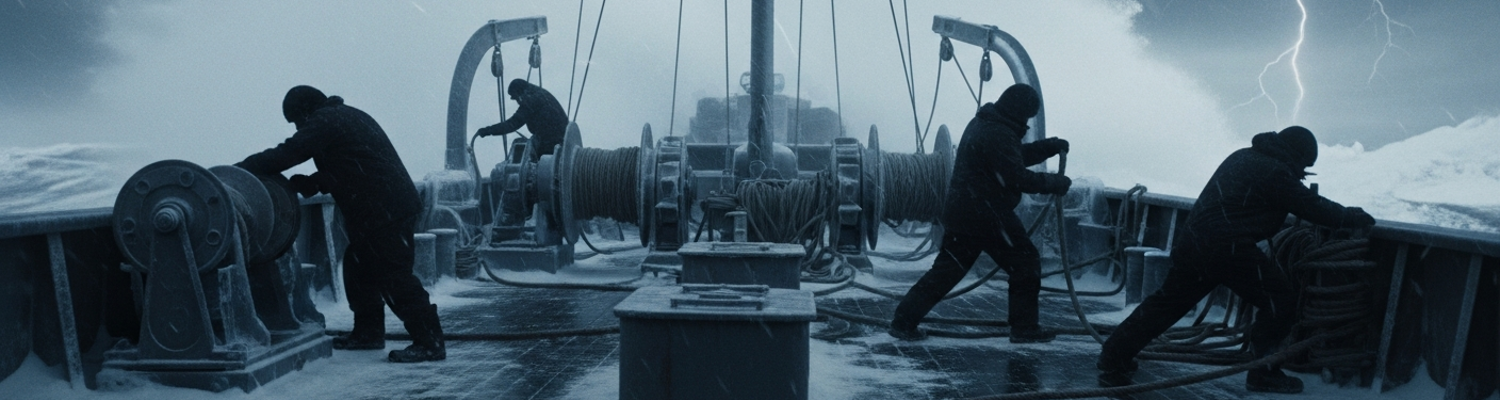
Freezing rain began to fall. The operational effectiveness of men and machines plummeted. A thin, clear layer of ice formed on every exposed surface, making the decks dangerously slick. The crew, already exhausted and battling seasickness, now had to contend with the numbing cold and treacherous footing. The complex machinery required for mine countermeasures began to fail. Winches used to deploy and retrieve the heavy sweep gear became coated in ice, their motors straining. Post-incident analysis revealed that the grease in the winch bearings congealed in the sub-zero temperatures, causing two motors to burn out entirely on the USS Implicit (MSO-455). On deck, sailors in heavy gear used rubber mallets in a futile attempt to knock ice from the frozen steel cables of the Oropesa rig. The AN/SQQ-14 variable depth sonar became a liability. Ice accretion on its tow cable increased its weight beyond the winch’s safety limits, forcing the crew to leave it deployed at a fixed depth. It was functionally blind in the turbulent water. The physical strain on the crews was severe. The ship’s superstructure itself accumulated tons of ice, raising its center of gravity and making it dangerously top-heavy in the high seas.
The attack began as a series of fleeting radar contacts, ghosting in and out of the sea clutter. Lookouts, their faces raw from the wind, strained to distinguish the low-slung shapes from the whitecaps. The enemy materialized from the freezing mist. A coordinated group of Project 183R Komar-class missile boats.
A review of Soviet naval doctrine reveals the Komar was engineered for this kind of engagement. They were small, just over 25 meters long, with wooden hulls that offered a minimal radar cross-section. Four diesel engines could push them to speeds approaching 44 knots. This was a vessel built to sprint from the radar horizon, launch its payload, and vanish. Each boat carried two KT-67 launchers, holding the P-15 Termit anti-ship missile, known to NATO as the SS-N-2 Styx. The Styx was a subsonic cruise missile over six meters long carrying a 480-kilogram shaped-charge warhead. It was designed to shatter the spine of a warship. Its unexpended liquid propellant often ignited upon impact, acting as a powerful incendiary. Soviet crews were trained for high-speed, coordinated strikes, closing to within the 30-40 kilometer range of their missiles, launching in a volley to overwhelm a target’s defenses, and then retiring at flank speed.
The defensive arsenal of an Aggressive-class minesweeper was inadequate for this new threat. After-action reports on their configuration show they were armed for close-in self-defense against conventional threats, not a high-speed missile swarm. Their primary armament typically consisted of a single 20mm cannon mount and two .50 caliber machine guns. These were manually aimed, crew-served weapons, entirely dependent on the skill of a gunner peering through an open sight in pitching seas. The 20mm cannon had a practical rate of fire limited by its 60-round drum magazine, which could be expended in seconds of sustained fire. This forced a slow reload by a half-frozen crewman. The effective range of these weapons was under 2,000 yards, a distance a Komar-class boat could cover in less than two minutes. Against multiple, disparate targets maneuvering at high speed, the gun crews could not effectively track and engage one threat without being flanked by another.
The tactical doctrine for the minesweeper task group fractured upon contact. The ships were trapped, forced to simultaneously execute two mutually exclusive missions: the slow process of mine clearance and the sudden necessity of surface combat. The commanders faced an immediate choice. To cut the cumbersome Oropesa and influence sweep gear adrift would mean abandoning the primary mission and losing irreplaceable equipment. It was the only way to regain the maneuverability needed to unmask their own weapons and evade the attackers. The decks, already treacherous with ice and heavy machinery, descended into a state of ordered chaos. Gunners struggled to traverse their weapons. Other teams worked with desperate speed to decouple the thousands of pounds of sweep wire dragging behind the ships. Conflicting orders echoed over the intercoms. Calls for damage control parties to stand by. Commands for gun crews to open fire. Frantic reports from the radar plot of multiple inbound missile launches. The engagement devolved into a series of isolated duels.
Command cohesion within the task group evaporated. The electronic warfare assault, layered on the natural Arctic signal blackout, rendered the task group’s tactical radio network useless. What remained was shrieking static. Aboard the USS Force, the task group commander was tactically blind, unable to receive reports from his other ships or issue coordinating orders. Each minesweeper, from the Implicit to the USS Adroit (MSO-509), became an operational island. Its captain was solely responsible for the 75 souls aboard. The doctrine of coordinated defense against a swarm attack, which relied on overlapping fields of fire and designated targeting priorities, was an impossibility. On the bridge of the Adroit, the captain faced reports of three separate Komar contacts on three different bearings. Standard procedure, as outlined in Allied Tactical Publication 1, was to turn the ship to present the narrowest target profile and unmask the main armament. But which contact was the primary threat? Without guidance from the flagship or a shared radar picture, the decision was a gamble made in isolation.
Initiative devolved to the lowest ranks. With officers on the bridge consumed by maneuvering decisions, the actual fight fell to the enlisted gun crews on the open decks. The ship’s defensive armament was entirely manually operated. A gunner, strapped into the shoulder rests of the 20mm mount, had to physically swing the weapon’s mass to track a 44-knot target, all while peering through a simple ring-and-bead sight into the freezing spray. The extreme cold had congealed the grease in the gun mounts, making them sluggish. Archival evidence shows that on at least two ships, gunner’s mates used knives to chip away frozen lubricant and then worked the traverse and elevation gears back and forth frantically between lulls to keep them from seizing. The 20mm cannon’s 60-round drum magazine could be expended in under eight seconds of continuous fire. Reloading was a clumsy process. A loader, his hands numb, had to haul a new 40-pound drum into place and seat it correctly on a pitching, ice-slicked deck. This was often too slow, forcing gunners to switch to firing in deliberate, single shots to conserve ammunition.
Post-action personnel reviews detail the psychological impact. The crew of a minesweeper operates in a claustrophobic environment. This battle exploited that. There was no rear area, no safe space below decks on a wooden ship facing incendiary missile warheads. Every sailor was on the front line. The physical misery was a foundation for the terror. Studies on cold-weather operations consistently show significant increases in anxiety, anger, and cognitive degradation. Sailors were simultaneously battling hypothermia, seasickness, and the fear of inbound missiles whose roaring rocket motors were audible over the wind. The sustained stress response led to documented cases of uncontrollable shaking, disorientation, and an inability to follow basic commands. The nature of the ship itself, a non-magnetic wooden hull, became a source of unique horror. The crew understood that a direct hit from a Styx missile would not just punch a hole. It would shatter the vessel, turning the hull into a storm of wooden splinters and instantly igniting the wreckage with its unspent propellant.
The visual record of the engagement exists because of the US Navy’s Photographer’s Mates (PH). A review of their typical loadouts from the period (per NAVAIR 10-1-512) shows a reliance on equipment chosen for mechanical resilience. The preferred camera bodies were often fully mechanical 35mm SLRs like the Nikon F or rangefinders like the Leica M3. Their all-metal construction and lack of battery-dependent shutters made them functional in extreme cold. The Arctic environment still presented severe mechanical challenges. Lubricants inside the lens focusing helicoids and shutter mechanisms would congeal, making adjustments stiff and slow. Film itself became a liability. In the sub-zero air, it would grow brittle, risking tears or cracks as it was advanced. Photographers kept spare batteries for their light meters warm in interior pockets, swapping them frequently to get accurate readings in the flat light of an overcast Arctic day. The film stock of choice was almost universally Kodak Tri-X. It was a high-speed black-and-white film with an ISO of 400 that could be processed to 1600 or even 3200, a necessity for capturing fast action in low light. This process dramatically increased the grain and contrast, creating images that were gritty and sharp. These technical limitations were byproducts of the hostile environment that inadvertently created a visual language suited to the chaos.
To document the battle was to occupy a position of unique peril. The Photographer’s Mate had to stand on exposed decks or pitching bridge wings to get a clear field of view. Their mandate was to record, not to intervene. Archival analysis of combat photography doctrine shows a clear directive. The photographer was an instrument of naval intelligence and historical record. Every frame was intended for after-action reports, training manuals, and public affairs releases. This created a severe paradox. The photographer might witness a sailor struggling to reload a jammed cannon, and the duty was to capture the event on film, not to drop the camera and assist. This professional detachment was a psychological necessity, a way to process the immediate situation by filtering it through a viewfinder.
The visual narrative of the swarm attack is constructed from two distinct photographic approaches. Wide-angle lenses, likely in the 28mm to 35mm range, were used to establish the scale of the engagement. These shots capture the minesweeper’s deck pitching violently, with sea spray blurring the edges of the frame, while multiple Komar boats can be seen as small shapes on the horizon. The wide perspective communicates disorientation. In contrast, telephoto lenses, perhaps a 105mm or 135mm, were used to isolate the human element. These tight shots focus on the individual sailor: a gunner’s face etched with strain; hands fumbling with an ice-covered ammunition drum; the intense focus of an officer on the bridge. These images, often blurred by the ship’s violent motion, convey the personal, physical struggle against both the enemy and the elements. The combination of these techniques, the wide, chaotic establishing shots and the tight, personal close-ups, creates a visceral and comprehensive record of the doctrine’s ground-level consequences.