
The Dual Threat of History and Insurgency
The men were already worn down. Before the first fuze wrench was laid on a corroded casing, the oppressive heat of Luzon, the biting insects, and the endless marches through jungle terrain soaked by the southwest monsoon extracted a heavy toll. Hunger was a constant companion on extended remote operations. Sleep was a luxury stolen in rain-filled foxholes. This was the entry point for every mission undertaken by US Army Explosive Ordnance Disposal teams in the Philippines in 1957.
Operational logs show their mission existed within a demanding Cold War context. The 1951 Mutual Defense Treaty cemented the Philippines as a cornerstone of American anti-communist strategy in the Pacific. Just under 10,000 U.S. military personnel were stationed in the country as of July 1957, supporting a forward strategy against perceived threats from China and Vietnam. Massive installations like Clark Air Base and Naval Base Subic Bay were not just bases; they were logistical hubs designed to project American power across Southeast Asia. EOD teams were essential for national stability. The new Philippine government under President Carlos P. Garcia needed to assert control, a task made impossible by leftover munitions and an active insurgency. American EOD technicians, operating under the 1947 Military Assistance Agreement, provided the specialized capability the Armed Forces of the Philippines required to tackle this dual threat.
The first layer of the threat was historical. Twelve years after the Japanese surrender, the archipelago remained profoundly contaminated with unexploded ordnance (UXO). The fierce fighting for the islands had left a deadly legacy of bombs, artillery shells, and mortars. Archival evidence shows Japanese ordnance presented a unique problem. Many Japanese bombs, such as the Type 97 and Type 99 series, used picric acid as their main explosive filler. Picric acid, when in contact with metal casings over time, becomes exceptionally unstable. It forms highly shock-sensitive metallic picrate crystals. After more than a decade submerged in mud or baking in tropical humidity, a corroded fuze or the slightest vibration could be enough to initiate a detonation. EOD teams constantly encountered these items, from 60kg land bombs to smaller mortar rounds. Any construction, farming, or simple excavation could turn into a large-scale ordnance disposal event.
The second threat was immediate and actively hostile. While the main Hukbalahap (Huk) Rebellion had been officially defeated by 1954, remnant factions of the communist-led group remained active in the mountains of Central Luzon. These insurgents were adept at guerrilla warfare and the use of improvised explosive devices (IEDs). Their tactics were not random. Huk fighters used their knowledge of the terrain to target Philippine Constabulary and Army patrols, often on the same jungle tracks EOD teams were required to use. The devices were crude but lethal, often built from scavenged materials like unexploded American grenades or artillery shells, and triggered by simple tripwires or pressure plates. Unlike the passive threat of WWII UXO, the Huk IED was placed with specific intent to kill.
This dual-threat environment created unrelenting pressure. Small, often two-man teams, would be dispatched into remote provinces, far from the security of a major base. The monsoon turned the landscape into a morass of mud and swollen rivers, making radio communication unreliable. Every metallic glint in the soil had to be assessed with life-or-death gravity. Was it a chemically unstable Type 99 bomb, or a freshly planted Huk booby trap with a trigger inches away? This constant, high-stakes analysis was the beginning of the psychological erosion.
The Monsoon as a Hostile Actor
The 1957 southwest monsoon across Luzon was exceptionally severe. It directly degraded the operational capacity of Explosive Ordnance Disposal teams. Meteorological records from the period, combined with after-action reports (NARA Record Group 407), paint a picture of relentless torrential rainfall that far exceeded seasonal averages.
This was not uncomfortable weather; it was a force that actively worked against the men.
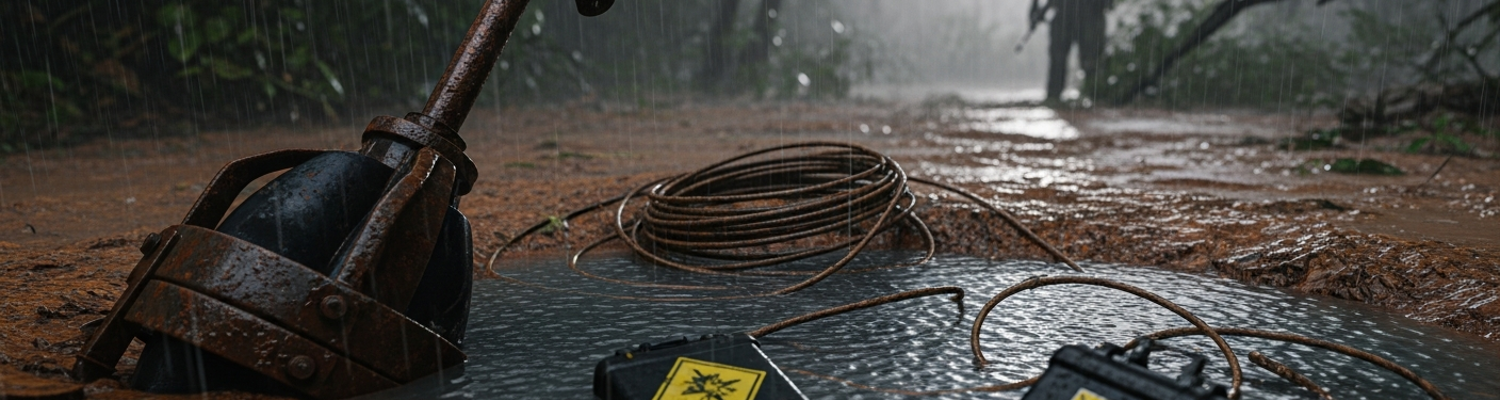
The constant, driving rain turned mission sites into quagmires of mud, collapsing the walls of pits dug to access buried ordnance and submerging devices in feet of opaque water. Visibility was frequently reduced to a few yards, eliminating effective overwatch for teams operating in remote areas. The sheer noise of the downpour masked the subtle sounds an EOD technician relied on, like the faint scrape of a tool against a fuze or the approach of a Huk patrol. Equipment suffered. The extreme humidity, often approaching 100%, caused condensation within the sensitive electronics of the time, leading to short circuits. Metal tools, including specialized fuze wrenches, began to rust, demanding constant maintenance to remain functional.
What were once dirt tracks became impassable rivers of mud, forcing teams to move on foot through dense, triple-canopy rainforest. A journey that might take hours in the dry season could stretch into a multi-day ordeal. Soldiers contended with flash floods, landslides, and swollen rivers. The physical toll was immense. Leeches were a constant misery. The perpetually waterlogged conditions led to widespread cases of trench foot and other debilitating fungal infections that could take a technician off the line as surely as any enemy action. This physical degradation had a direct and dangerous impact on mission performance. EOD work demands intense concentration and fine motor skills. A technician suffering from days of sleeplessness, hunger, and physical misery, with hands shaking from cold and exhaustion, was at a significant disadvantage when attempting to disarm a sensitive fuze.
Unsanctioned Solutions and Field Expedients
Established procedures for explosive ordnance disposal were written for a conventional war in Europe. They presumed stable munitions and a functioning logistical chain. In the waterlogged jungles of Luzon, facing ordnance that was actively decomposing and an enemy that was actively trying to kill them, these procedures became suggestions at best. A reliance on innovative, often unauthorized, disposal techniques became standard practice.
The primary driver was the chemical instability of Japanese ordnance. Bombs like the Type 99, filled with picric acid, could form exquisitely sensitive metallic picrate crystals in the threads of a fuze well. The standard procedure of applying a wrench to unscrew the fuze was an invitation for a catastrophic detonation. Operational logs show that technicians quickly abandoned this approach. They developed remote methods born of necessity, using materials at hand to minimize physical contact.
One common field modification involved creating a small, focused explosive charge to surgically sever a fuze from the bomb body. Technicians would use their issued Composition C4, pack it into an empty C-ration can to create an ad-hoc shaped charge, and detonate it remotely. This directed the blast, cutting the fuze off without disturbing the main charge. Another technique involved using waterproofed blasting caps and time fuse, meticulously sealed with grease or wax, to initiate a controlled burn of the explosive filler from a safe distance. For ordnance submerged in mud and water, teams devised methods to displace the water with locally sourced bamboo poles, creating a channel to lower a counter-charge directly against the casing.
Each of these solutions was a direct violation of by-the-book doctrine, which emphasized disassembly. They were, however, grimly effective adaptations.
This creative divergence was driven from the bottom up. Junior non-commissioned officers and young lieutenants, isolated for weeks at a time, became the primary architects of EOD tactics in the Philippines. Far from the oversight of a command headquarters, these two-man teams devised their own solutions on-site. A Staff Sergeant from the 706th Ordnance Company, faced with a 250kg bomb half-buried in a rice paddy, could not wait for specialized equipment that would never arrive. His team leader, a young First Lieutenant, had to make a command decision based on the NCO’s experience, not a field manual. These small units developed a unique, unwritten doctrine passed between teams during their brief returns to Clark Air Base. They shared techniques for identifying the subtle signs of picrate crystallization or for building field-expedient tools from vehicle leaf springs to remotely probe a device.
The conditions in Luzon forced a significant divergence from 1950s EOD philosophy. Official doctrine was built around the render-safe procedure, a meticulous process to disarm a munition and preserve it for intelligence gathering. In the Philippines, this was often an unaffordable luxury. The dual threat made time a critical factor. Teams frequently defaulted to demolition in place as the primary solution. It was faster and removed the immediate threat to the technician, but it went against the intelligence-gathering mission. The entire operational model shifted from careful analysis to rapid, decisive destruction, a change dictated by the sergeants and lieutenants who faced the consequences.
The Erosion of the Senses
The soundscape of the Luzon monsoon was a weapon. The relentless, drumming rain was not a passive environmental factor; it was an active antagonist. Its constant, roaring noise masked the auditory cues essential for survival. A technician could no longer hear the faint scrape of his own tools against a corroded fuze, the soft shift of mud around a pressure-sensitive plate, or the sound of an approaching enemy.
This auditory blackout forced a dangerous level of sensory compensation. The brain, deprived of one sense, latched onto others with ferocious, exhausting intensity. A close review of logs details frequent failures of the AN/PRC-10 backpack radios, their electronics succumbing to the humidity. The resulting static was not just an annoyance; it was a source of profound psychological stress. The crackle and hiss that cut through the downpour represented isolation, a severing of the link to support. In the deafening quiet between static bursts, the technician’s world shrank to the sounds of his own body and the device in front of him. The tiny click of a fuze wrench seating properly, the groan of rusted metal threads, the wet suck of a bomb casing being eased from the mud. These noises became unnaturally loud, each one a potential prelude to detonation. The most punishing sound was silence. The suspended moment after a procedure was initiated, where the technician held his breath, listening for nothing, was the point of maximum strain.
Sustained exposure to this operational tempo led to a predictable erosion. Unlike a conventional infantryman who experiences peaks of combat, the EOD technician’s battle was a constant, simmering state of engagement. Each call-out was a life-or-death encounter. A successful render-safe procedure did not bring lasting relief; it merely reset a psychological clock, with the technician aware that the law of averages was working against him.
The requirement to switch between two entirely different analytical frameworks was especially taxing. When approaching WWII ordnance, the technician had to think like a chemist, aware of picrate crystal formation. Every movement had to be slow and deliberate. Hours later, the same team could be tasked with a Huk IED. Here, the technician had to think like a counter-insurgent, anticipating the malicious logic of the bomb-maker. Was the obvious tripwire a decoy? Was there a secondary, anti-tamper mechanism? This rapid analytical shifting placed an extraordinary load on a mind already frayed by physical exhaustion.
Administrative Evidence of a Breaking Point
By late 1957, the physical and behavioral manifestations of this sustained pressure became impossible to ignore. There was no concept of downtime. Teams would complete a multi-day mission, return to Clark Air Base for a rapid refit, and be dispatched on a new tasking within hours. The human nervous system was not afforded a recovery period. This relentless cycle created a unique form of combat fatigue.
It was a war of attrition against the nervous system.
Unit records from the 706th Ordnance Company show a sharp rise in personnel being declared temporarily unfit for duty for reasons other than direct physical injury. The most operationally catastrophic symptom was the onset of uncontrollable tremors in the hands. For a technician whose life depended on fine motor control, shaking hands meant the end of a career and a direct threat to his teammate. Other failures were noted. Experienced NCOs reported sudden, momentary lapses in procedural memory, freezing over a device as they struggled to recall a critical step in a sequence they had performed hundreds of times. This was not a failure of training; it was a symptom of a mind reaching its breaking point.
The breaking point was inevitable. The intense pressure began to sever the bonds of trust that held the two-man EOD teams together. After-action reports, though heavily redacted, contain references to uncharacteristic arguments and heightened irritability between partners during hazardous procedures. Upon their brief returns to base, men known for their camaraderie became withdrawn and isolated. A review of personnel files from the period reveals a significant increase in official requests for transfer to any other military occupational specialty. The desire to leave the EOD field was no longer a quiet sentiment; it became a documented administrative trend, signaling a deep crisis in morale and a fundamental erosion of the unit’s specialized human capability.