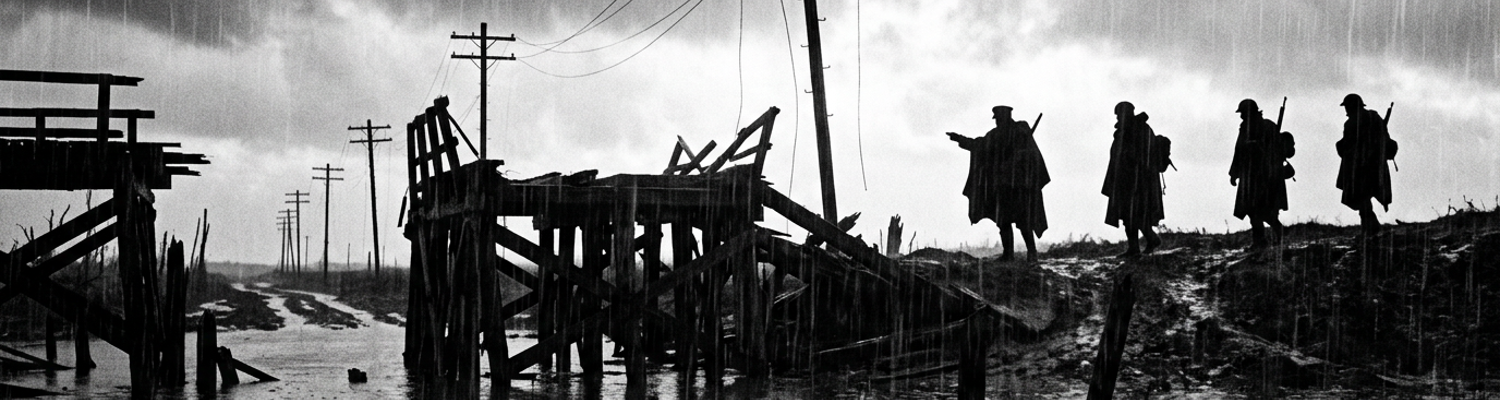

January Flooding and Telegraph Line Collapse
Headquarters issued orders allocating a seventy-two-hour window for Department of the Gulf commanders to establish secure telegraph connections between garrison posts in northern Louisiana. Archival evidence shows that on January 8, 1873, severe floodwaters along the Red River rapidly overtopped protective levees across Bossier and Caddo Parishes. This severed key telegraph wire networks binding federal detachments at Shreveport to outpost stations in Natchitoches and Alexandria. Heavy torrential rains pushed the river water three feet above the documented high-water mark. Hundreds of timber support poles submerged along the low-lying floodplain. Waterlogged cypress poles softened at their subterranean anchor points. Thirty-mile stretches of iron telegraph wire snapped under the physical strain of floating timber and torrential currents. Glass insulators cracked when falling limbs collided with the lines. The electrical current grounded directly into the water.
Maintenance details from the United States Army Signal Corps attempted field repairs.
They discovered copper-clad jumper cables short-circuited inside flooded terminal boxes.
Signalmen lacked replacement batteries.
They lacked insulated copper cabling.
Outpost officers found themselves completely cut off from district headquarters in New Orleans. Isolation settled over the garrison posts within forty-eight hours of the initial water surge. A close review of operational logs indicates the flooding expanded eastward toward Monroe. Rising water destroyed railway trestles connecting garrisons across northern Louisiana. Swollen bayous undercut the creosote-treated pine pilings supporting the Vicksburg, Shreveport and Texas Railroad trestle over the Bayou Pierre drainage basin. Torrential currents battered the wooden cross-bracing. Two hundred feet of timber superstructure collapsed into six feet of rushing silt on January 14, 1873. Iron rails twisted under the weight of unsupported ballast. Supply trains carrying winter rations and rifle ammunition intended for the 19th Infantry Regiment detachments stalled on the tracks.
Command officers at Shreveport dispatched work crews equipped with block-and-tackle rigging. Swift currents made it impossible to set new timber bents into the mud. Transport steamers could not navigate around the submerged debris. Troops sat stranded in unheated wooden barracks without rail transport or a line of resupply. Quartermaster logs record freight wagons attempting overland bypass routes sinking up to their axles in saturated alluvial clay along the Red River valley roads.
Engineers logged water levels eight feet deep over the primary railbed near Loggy Bayou.
When examining the historical record, garrison commanders recorded an immediate collapse in tactical coordination across the region. Company officers at Fort Jesup relied on mounted couriers to transmit dispatch orders. Horses collapsed in the waist-deep mud along the river turnpikes. Courier packets containing orders for troop movements sat stranded at swollen creek crossings for days. Water levels continued to rise. Steam boilers on regional river transports clogged with silt. This prevented emergency evacuations or tactical redeployments along the waterway. By January 22, three distinct federal garrisons operated without knowledge of neighboring troop positions. They operated without operational directives from New Orleans headquarters. Quartermaster stores ran dangerously low on dry firewood, hardtack, and forage for draft animals. Deprived of telegraphic communication and rail links, post commanders froze active scout operations. They consolidated remaining forces within flooded fort perimeters.
Couriers took five days to cover a twelve-mile stretch between Bossier City and the Shreveport perimeter.
Archival records from the Department of the Gulf confirm repair parties could not clear river debris or string temporary line until mid-February. Floodwaters finally receded six inches below the railbed caps. Signal Corps teams retrieved seven miles of rusted wire from the riverbed near Grand Ecore. They found every splice corroded by river mud.
Isolation of Federal Garrisons in Northern Louisiana
Archival evidence shows that by late January 1873, Department of the Gulf headquarters in New Orleans lost all tactical contact with its forward garrisons spread across the Red River valley. The primary telegraphic connection relied on Gravity battery stations using zinc and copper plates submerged in copper sulfate solution (Signal Corps Equipment Ledger 44-A). This system collapsed entirely when floodwaters flooded intermediate relay cabins at Coushatta Chute and Colfax. Water saturated the pine floors. It submerged glass battery jars and neutralized the chemical solution necessary to maintain line voltage across eighty miles of wire. Terminal registers at district command recorded complete electrical silence starting on January 18.
Staff officers in New Orleans attempted to re-establish contact.
They routed dispatches through commercial lines via Vicksburg.
Broken lines in the Mississippi delta halted those transmissions at Monroe. Without functional telegraphic apparatus or working battery arrays, regional commanders possessed no mechanism to transmit revised winter patrol schedules or tactical alerts to distant outposts.
Command headquarters went completely dark.
When examining the historical record, dispatch logs reveal mounted couriers failed to bridge the gap created by destroyed wire infrastructure. Orderlies dispatched on horseback from district headquarters at Shreveport encountered five miles of continuous water coverage along the road to Natchitoches. Depth gauges marked four feet of swift runoff near the Bayou Wallace crossing. Saturated clay soil stripped horses of shoes and caused severe tendon injuries. Couriers abandoned their mounts at farmhouses along the route. Swollen creeks swept away wooden road bridges at Spanish Lake. Couriers made forty-mile detours through thick cane brakes in Sabine Parish. Out of twelve courier packets sent south from Bossier Parish between January 19 and January 27, only one reached its intended recipient. It arrived nine days late. The leather dispatch pouch soaked through. Blurred ink rendered the handwritten orders unreadable.
The communication chain ceased to function.
A close review of operational logs indicates enlisted infantry units stayed pinned inside isolated outposts. They were bound by strict standing orders to hold their posts until written instructions arrived from New Orleans. At Grand Ecore, seventy-two men belonging to Company C of the 19th Infantry Regiment found themselves trapped inside timber-framed barracks. Five feet of standing water and liquid mud surrounded the structures. Mud clogged the drainage ditches surrounding the parade ground. It rose above the bottom logs of the wooden barracks and seeped through the floorboards into sleeping quarters. Enlisted men spent forty-eight hours at a time standing on wooden crates. They did this to keep their leather boots and wool uniforms out of the grey alluvial slurry. Standard Department of the Gulf doctrine strictly prohibited company commanders from abandoning assigned posts or moving stores without written authorization signed by the departmental adjutant general. No couriers or telegraph messages penetrated the flood zone. Company C stayed stranded in the mire. They consumed half-rations of moldy hardtack and wet salt pork while waiting for orders that never arrived.
No fresh orders reached the perimeter.
Thirty miles to the west, Company K of the 19th Infantry sat stranded at a temporary encampment near Bellevue. Continuous rain transformed the pine-clearing bivouac into a knee-deep swamp of red clay and decaying vegetation. Field quartermasters recorded supply wagons carrying dry firewood and clean canvas tents sinking to their wagon beds in saturated gumbo soil three miles outside the camp perimeter. Draft mules broke their legs in deep mud ruts. Soldiers shot the animals. Soldiers burned wooden fence rails, rifle stocks, and empty ammunition crates to heat raw flour rations over open fires in saturated mud pits. Respiratory illness spread rapidly through the camp. It disabled twenty-eight of the forty-five enlisted personnel by February 2. The commanding lieutenant refused to march his sick men to higher ground at Mindon without formal authorization from district headquarters. Archival morning reports show Company K stayed stationary in the saturated clearing for nineteen consecutive days. They maintained round-the-clock perimeter guards in waist-deep mud. They waited for dispatches stuck in a flooded courier pouch at the bottom of Bayou Pierre.
Severe Rifle Rusting and Ordnance Degradation
Water saturated the wooden floorboards of every armory in the district.
A close review of operational logs indicates relentless atmospheric humidity and persistent standing water inside barracks destroyed the serviceability of standard-issue Springfield rifles across the 19th Infantry Regiment. At Grand Ecore and Fort Jesup, relative humidity levels hovered near one hundred percent. Thick orange rust bloomed across unpolished iron barrels within twenty-four hours of exposure. Standing water seeped directly into the breech-locking mechanisms of Model 1870 Allin-conversion Springfield rifles. Moisture corroded internal lockplates. It froze mainsprings. Heavy iron oxide buildup jammed firing pin channels. Enlisted men lacked sperm whale oil or purified petroleum solvents to coat metal fittings. They scraped scaling rust off barrel bores using bayonet points and crushed brick dust. Scrape marks ruined internal rifling grooves and stripped the weapons of ballistics accuracy. By January 29, quartermaster inspections at Company C reported forty-three out of fifty-five issued shoulder arms suffered locked breechblocks or bound hammer tumblers. Soldiers attempting to cock rifle hammers snapped brittle internal tumbler springs weakened by deep metal pitting. Rust fused bayonets inside steel-tipped scabbards.
Rust disabled the weaponry faster than any armed adversary.
Archival evidence shows saturated storage conditions inside unheated log arsenals completely ruined army ammunition stocks and personal infantry accouterments. Moisture penetrated wooden ordnance crates stored at the Shreveport supply depot. It turned paper-wrapped .50-70 cartridge bundles into soft wet pulp. Water saturated the paper casings of the black powder rounds. Coarse black powder charges inside dissolved into non-reactive charcoal slurry. Exposure to moisture oxidized fulminate of mercury priming caps. This rendered entire crates of ammunition completely inert (Ordnance Department Circular No. 4). Enlisted men carried leather cartridge boxes that absorbed rainwater until the leather softened, stretched, and collapsed inward on internal wooden divider blocks. Mold rotted heavy cotton stitching on waist belts. Cartridge pouches and bayonet frogs tore away from soldiers waists during perimeter guard rotations. Constant exposure to liquid mud dissolved leather shoulder straps on knapsacks into black strips of decayed hide. Dry socks and wool blankets inside knapsacks soaked up water through cracked rubberized shelter halves. Infantrymen were left without a single dry item of clothing.
Every piece of issued leather gear disintegrated in the mud.
When examining the historical record, company commanders recorded a complete breakdown in defensive readiness across northern Louisiana outposts. At Natchitoches, the garrison armorer recorded thirty-six hundred rounds of .50-70 paper-wrapped ammunition fused into a single solid mass of wet cardboard and damp lead inside the magazine shed. Quartermasters attempted to dry out salvaged paper cartridges over open hearth fires inside mess halls. The heat ignited three loose powder packages. The flash burned two enlisted men from Company K and destroyed sixteen square feet of wooden floorboards. Command officers halted all required daily target practice. Firing pin strikes consistently failed to detonate wet primers. On February 3, Company C officers attempted a test burn of twenty randomly selected cartridges from the post magazine. Eighteen failed to ignite. Two produced low-pressure hangs leaving lead bullets lodged halfway down rusted barrel bores. Without functional firearms or dry ammunition, post guards relied on unmounted iron artillery pieces loaded with loose canister scrap to protect perimeter lines. Company commanders logged zero operational rifles capable of sustained fire across three whole parishes.
Chemical Failures Among Press Photography Details
Waterlogged darkroom wagons sank into the mud along the Red River. Visual coverage of the crisis ended completely.
Archival evidence shows civilian press correspondents attached to the Department of the Gulf suffered catastrophic chemical losses when rising floodwaters inundated field darkrooms near Shreveport and Grand Ecore. Wet-plate collodion photography required photographers to coat heavy glass plates with a viscous liquid of nitrocellulose dissolved in ethyl ether and alcohol. They then submerged the glass into a sensitizing bath of silver nitrate. Floodwaters overflowing from Bossier Parish bayous rushed through temporary bivouac sites. The water submerged wooden chemical chests and field transport wagons under four feet of muddy river water. Silt-laden water penetrated stoppered glass carboys. It diluted delicate silver nitrate baths with alluvial river sediment and neutralized the exact chemical concentration required to form light-sensitive silver iodide crystals. Ether rapidly evaporated from submerged supply bottles. Correspondents lacked the volatile solvent necessary to mix fresh collodion batches. Civilian photographers attempted to pour contaminated chemical mixtures across glass plates. The syrupy solution failed to adhere. It slipped off the wet glass into darkroom mud pits.
Photographers lost their entire chemical supply within forty-eight hours of the initial levee breach.
When examining the historical record, field reports confirm visual documentation of the Reconstruction garrison crisis collapsed entirely due to physical damage suffered by glass photographic plates. Transport wagons jolted through flooded road ruts near Loggy Bayou. They repeatedly tossed wooden storage crates into swirling flood currents. Hundreds of unexposed glass plates cracked against iron wagon fittings. Photographers managed to expose salvaged plates in the field. They discovered river water contamination created severe chemical fogging, deep silver halide pitting, and localized emulsion lifting across every glass surface. High relative humidity inside waterlogged canvas darkroom tents prevented collodion coatings from drying at normal rates. The wet emulsion peeled completely away from glass backings during development in ferrous sulfate solution. Potassium cyanide fixing baths diluted by rainwater dripping through darkroom tenting failed to clear unexposed silver halides. Potential negative images turned into opaque, milky sheets of ruined glass.
A close review of operational logs indicates press editors in New York and New Orleans received zero usable photographic negatives from the flooded northern parishes between January 15 and February 20, 1873. National news outlets relied on hand-drawn woodcut engravings based on secondhand dispatches rather than direct photographic evidence of the operational collapse. Visual proof of federal soldiers standing in flooded barracks at Fort Jesup did not exist. Quartermasters burning wooden rifle stocks for heat in Bossier Parish went undocumented. Public awareness of the garrison isolation remained minimal in Eastern cities. Chemical decay destroyed forty-eight coated glass plates intended for official historical exhibition at departmental headquarters in New Orleans. Inspection teams from the Quartermaster Department logged twelve ruined darkroom outfits across three garrison sectors. They declared chemical stocks completely unrecoverable due to organic silt contamination.
Field darkroom operators at Natchitoches discarded eighty damaged glass negatives into a flooded drainage ditch on February 12.
Manual Repair of Collapsed Bridge Abutments
Archival evidence shows a specialized detachment of United States Army engineers arrived at the shattered wooden road trestle spanning Bayou Pierre near the Bossier Parish border on January 26, 1873.
A close review of operational logs indicates the original pine footings supporting the bridge abutments sheared off six feet below the waterline when the flood surge hit the embankment. No replacement timbers were available from regional depots. Engineer details worked entirely by hand to fabricate timber cribbing using felled cypress and white oak trees cleared from nearby bottomlands. Eighteen men from the 19th Infantry Regiment used six-foot two-man crosscut saws and broadaxes to square forty heavy logs. Each log measured twelve inches thick and sixteen feet long. The men worked without mechanical cranes or block-and-tackle rigs. They carried these green timbers across two hundred yards of liquid mud. They dropped them into position around the unstable bridge footings. Enlisted personnel used hand-turned wood augers to bore three-inch holes through the overlapping log ends. They secured the stacked cribbing frames with iron drift bolts pounded into place using twenty-pound sledgehammers. Soldiers drove wooden deadman anchors ten feet into the saturated bank to stabilize the earth behind the collapsed abutments. They wired them directly to the timber framing using twisted lengths of recovered telegraph wire. The manual installation of forty-eight cribbing timbers took ninety-six consecutive hours of physical labor.
Sledgehammers tore through wet leather work gloves within hours.
When examining the historical record, quartermaster reports confirm a portable steam pile-driver intended for the site sat stranded on a disabled flatcar forty miles to the east in Monroe. Work parties operated without any heavy machinery or steam-powered winches. They relied exclusively on human muscle, hemp rope, and wooden lever poles to hoist three-ton timber bents into alignment against the roaring current. Continuous torrential rains drenched the workers. Air temperatures plummeted to twenty-nine degrees Fahrenheit on the night of January 28. A thin sheet of ice formed over standing floodwaters. Soldiers stood chest-deep in freezing water and liquid mud for six-hour shifts. They used iron pry bars to dislodge submerged river boulders and tree roots blocking the alignment of the new support piers. Draft mules brought to pull the heavy timber framing repeatedly slipped in the knee-deep clay along the riverbank. They snapped harness traces and sank to their chests. Work details unhitched the animals and dragged the loads themselves. Mud coated the wooden handles of every axe and saw. Tools slipped from frozen hands into six feet of swift runoff. Hypothermia disabled fourteen enlisted men during the first forty-eight hours of excavation. Only twelve fit soldiers remained to complete the manual shoring process.
Not a single piece of steam-driven equipment reached the Bayou Pierre bridgehead during the entire three-week operation.
Inspection logs from the Department of the Gulf document engineer details driving twenty-two hand-carved oak piles into the riverbed using a makeshift thirty-pound wooden maul operated by four men standing on an unstable timber raft. Torrential downpours washed away three newly placed gravel ballast beds on February 1. Soldiers packed the abutment cavities with two hundred hand-filled burlap sandbags retrieved from the abandoned Shreveport magazine. Saturated bank soil sloughed off into the riverbed three separate times. Hand-sawn support beams were buried under four feet of river silt. The detail dug out the wood with short-handled trench spades. The work party managed to secure the southern bridge abutment by February 5. Light supply wagons crossed the bayou under strict speed limits enforced by guard sentries. Quartermaster returns for that week recorded twelve unserviceable axes, four broken crosscut saws, and eighty-four pairs of ruined wool trousers discarded in the mud at the repair site.
Makeshift Chaplain Services and Enlisted Morale
Spiritual collapse threatened the garrisons long before the physical floodwaters receded.
A close review of operational logs indicates severe cases of dysentery, bronchial pneumonia, and scurvy afflicted over forty percent of the 19th Infantry Regiment personnel across outposts at Grand Ecore, Bellevue, and Natchitoches by February 6, 1873. Regimental chaplains assigned to the Department of the Gulf stepped into flooded barracks to perform improvised field services for enlisted men confined to standing on wooden crates. Chaplains lacked dry chapel spaces or portable altars. They held religious rites inside unheated timber mess halls where standing water measured twelve inches deep over rotten pine floorboards. They constructed temporary altars using overturned pork barrels, salt-cured meat boxes, and stacked wooden ammunition crates. This kept brass communion cups and Bibles out of the liquid mud slurry. Rainwater dripped continuously through rot-damaged pine shingles. The water soaked prayer books and mildewed wool vestments. Chaplains organized non-denominational services twice daily to address deteriorating garrison morale. They led weakened soldiers through communal hymns while men leaned against damp wall studs for physical balance. At Fort Jesup, field chaplains distributed salvaged tobacco rations and warm coffee boiled over open hearth fires to soldiers serving eight-hour perimeter guard shifts in sub-freezing night air. Morning reports from Company C show chaplains personally recorded handwritten last wills and testaments for twenty-six bedridden infantrymen. Their hands were too stiff from acute articular rheumatism to hold lead pencils.
Faith and warm liquid remained the only operational defense against total psychological breakdown.
Archival evidence shows floodwaters receded eight inches below the embankments by February 14, 1873. Garrison commanders deployed physical labor details of enlisted men to re-establish broken supply routes and rebuild shattered telegraph networks. Fatigue parties comprised of seventy-five soldiers from Companies C, H, and K worked without functional draft animals or heavy steam machinery. They cleared mud-caked timber debris along twelve miles of the primary turnpike connecting Bossier City to the Shreveport perimeter. Soldiers used hand axes, heavy iron crowbars, and double-braided hemp tackle to drag three-ton uprooted cypress trunks out of saturated road ditches. Quartermaster logs record work details filling over nine hundred hand-stitched canvas sandbags with river gravel to pack flooded railbeds along the Vicksburg, Shreveport and Texas Railroad line. Concurrently, Signal Corps repair crews waded through three feet of standing water along the Red River floodplain to manually re-string thirty-five miles of severed telegraph line. Technicians spliced recovered copper-clad jumper cables by hand. They wrapped bare joints with rubber-impregnated friction tape before hoisting iron wire back onto standing timber poles using wooden push-forks. Men climbed wet cypress poles using iron climbing spurs. They replaced cracked glass insulators and cleared tangled river vegetation from metal line brackets. Field mechanics restored electrical voltage to the terminal registers at Shreveport on February 21. They used salvaged chemical battery cells filled with refreshed copper sulfate solutions. Manual wagon details hauled twelve thousand pounds of dry flour and salt pork across the reinforced timber trestle at Bayou Pierre on February 24. This broke a thirty-five-day supply blockade.
Signalmen logged the first successful telegraphic pulse from Shreveport to New Orleans at 4:15 PM on February 22.