
The Cold War Era and the Race for Global Supremacy
The global landscape following the conclusion of the Second World War was fractured and tense. The world found itself divided into two distinct ideological camps. On one side stood the United States and its Western allies who championed capitalism and democratic systems. On the opposing side stood the Soviet Union which aggressively expanded its communist ideology across Eastern Europe and beyond. This profound ideological divide birthed the Cold War. It was an era defined by extreme paranoia, geopolitical brinkmanship, and an unprecedented arms race. Both superpowers recognized that direct military confrontation would likely result in mutual assured destruction. Therefore, the battleground shifted from traditional trenches to the laboratories of engineers and the drawing boards of military visionaries. The goal was to achieve technological supremacy that would deter the enemy from ever launching an attack.
The pursuit of absolute military dominance drove the Soviet Union to invest astronomical amounts of money and resources into experimental defense projects. Soviet engineers were pushed to the absolute limits of their imagination. They were tasked with creating weapons that could bypass American defenses, survive nuclear blasts, and strike with unimaginable speed. The Kremlin demanded innovation at a pace that often ignored the practical limitations of physics and economics. This relentless drive resulted in the creation of some of the most bizarre and terrifying military machines ever conceived. However, many of these Soviet superweapons remained shrouded in absolute secrecy for decades. The general public had no idea these machines existed until long after the Soviet Union collapsed.
The United States was not blind to these developments. Through a sophisticated network of spies, high-altitude reconnaissance flights, and eventually satellite surveillance, American intelligence agencies closely monitored Soviet military progress. The Central Intelligence Agency and the Department of Defense compiled vast dossiers on every suspected Soviet project. These documents were highly classified and kept hidden from the public eye for decades. Only through the passage of time and the diligent application of the Freedom of Information Act have these files been brought to light. Today, the declassified U.S. archives serve as a treasure trove for historians and military enthusiasts. They reveal the hidden history of an arms race that nearly pushed humanity to the brink of extinction.
The Treasure Trove of Declassified U.S. Archives
Understanding how we know about these secret Soviet superweapons requires a deep dive into the mechanisms of American intelligence gathering during the Cold War. The United States government established a massive infrastructure dedicated to watching the Soviet Union. Early on, the CIA relied heavily on human intelligence. Spies operating deep within the Soviet military-industrial complex would smuggle out blueprints and technical specifications. However, human espionage was incredibly dangerous and often yielded fragmented information. The execution of captured spies was a constant threat, and the Soviet counterintelligence apparatus known as the KGB was brutally efficient.
To overcome the limitations of human spies, the United States turned to technological solutions. The U-2 spy plane became the premier tool for looking behind the Iron Curtain in the late nineteen fifties. Flying at altitudes exceeding seventy thousand feet, the U-2 could capture high-resolution photographs of secret Soviet testing facilities. When Soviet surface-to-air missiles finally managed to shoot down a U-2 flown by Francis Gary Powers, the United States accelerated its satellite reconnaissance programs. Project CORONA and later Project HEXAGON placed powerful cameras in orbit around the Earth. These satellites silently crossed Soviet airspace and snapped thousands of pictures of military bases, shipyards, and secret laboratories.
The imagery captured by these satellites was analyzed by dedicated teams in Washington. These photo interpreters spent countless hours poring over grainy images using magnifying glasses and stereoscopes. Whenever they spotted an unusual shape or an incredibly large structure, they would flag it for further investigation. The reports generated by these analysts were compiled into extensive briefings for the President and top military commanders. These briefings contained detailed estimates of Soviet capabilities, educated guesses about the purpose of strange new vehicles, and strategic recommendations on how the United States should respond.
For many years, these intelligence reports were locked away in secure vaults. The U.S. archives were tightly sealed to protect sources and methods of intelligence gathering. It was only after the fall of the Berlin Wall and the subsequent collapse of the Soviet Union that the strict veil of secrecy began to lift. Historians and researchers began submitting requests to declassify these documents. Gradually, the government released thousands of pages of intelligence assessments, satellite photographs, and technical analyses. These declassified files offer a fascinating glimpse into the minds of American intelligence officers as they tried to make sense of Soviet engineering anomalies. The archives reveal a mixture of genuine fear, technical admiration, and occasional bewilderment at the sheer scale of Soviet ambition. By studying these documents, we can uncover the true story behind the secret Soviet superweapons that never saw combat.
Weapon 1: The Ekranoplan Also Known As The Caspian Sea Monster
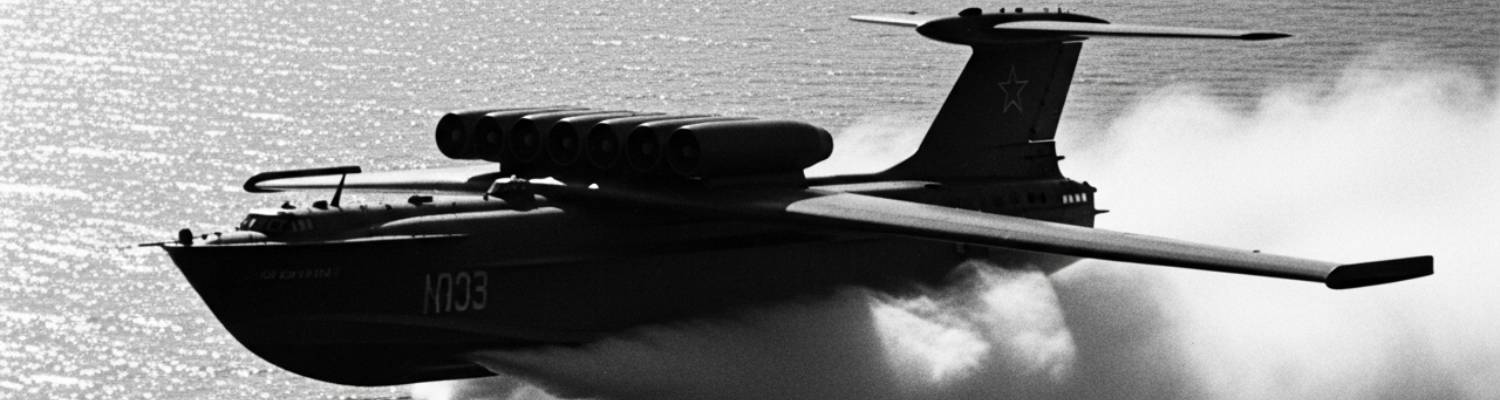
One of the most famous discoveries made by American intelligence during the Cold War was a massive, bizarre vehicle skimming across the surface of the Caspian Sea. In the late nineteen sixties, CIA photo analysts examining satellite imagery spotted something that defied conventional categorization. It looked like an airplane but it possessed incredibly short wings. It was roughly the size of a jumbo jet but it appeared to operate exclusively over water. The analysts were completely baffled by the vehicle. Because they did not know its official Soviet designation, the CIA informally dubbed it the Caspian Sea Monster. The letters KM painted on the side of the fuselage only added to the mystery, though historians later learned this simply stood for Korabl Maket which translates to Prototype Ship.
The Caspian Sea Monster was actually an ekranoplan. This was a revolutionary type of vehicle designed by brilliant Soviet engineer Rostislav Alexeyev. The ekranoplan operated on a principle known as ground effect. When an aircraft flies very close to the surface of the Earth, the air squeezed between the wings and the ground creates a cushion of high pressure. This aerodynamic cushion provides immense lift and significantly reduces aerodynamic drag. Alexeyev realized that a vehicle designed specifically to harness this effect could carry massive payloads across oceans at speeds far exceeding conventional ships. The Soviet military quickly recognized the strategic potential of such a machine. They envisioned fleets of ekranoplans transporting troops, tanks, and nuclear missiles rapidly across the Black Sea or the Baltic Sea to surprise NATO forces.
The sheer scale of the Caspian Sea Monster was awe-inspiring. It measured over three hundred feet in length and weighed over five hundred tons. To lift this colossal weight, the vehicle was equipped with ten powerful turbojet engines. Eight of these engines were mounted on a forward canard to blow exhaust gas directly under the main wings to create the initial air cushion required for takeoff. Once the vehicle was lifted out of the water, the two rear engines would propel it forward at speeds exceeding three hundred miles per hour. The U.S. archives show that American intelligence was deeply concerned about the tactical implications of the ekranoplan. A vehicle traveling at that speed while hugging the surface of the ocean would be incredibly difficult for radar to detect. It could theoretically launch a devastating surprise attack against coastal targets or enemy carrier strike groups before anyone knew it was there.
Despite its incredible potential, the Caspian Sea Monster never saw combat. The engineering challenges associated with operating a high-speed vehicle just feet above the water proved to be immense. The ekranoplan required relatively calm seas to operate safely. Large waves could easily strike the wings and cause a catastrophic crash. The salt water environment also wreaked havoc on the jet engines and the aluminum hull, leading to massive maintenance issues. Furthermore, the handling characteristics of the vehicle were notoriously difficult. Pilots had to constantly monitor their altitude to avoid plunging into the sea or climbing too high and losing the ground effect lift.
In nineteen eighty, a pilot error caused the Caspian Sea Monster to crash and sink in the Caspian Sea. The Soviet military lacked the funds and the desire to recover the massive prototype. While later, smaller versions like the Lun class ekranoplan were built and even equipped with anti-ship missiles, the dream of a massive ekranoplan armada never materialized. The declassified U.S. archives detail the slow decline of the ekranoplan program. American analysts watched as the vehicles sat rusting in naval yards as the Soviet economy began to falter. The Caspian Sea Monster remains one of the most ambitious and unusual superweapons of the Cold War, a testament to a time when engineering imagination knew no bounds.
Weapon 2: The Sukhoi T-4 Sotka High Speed Bomber
The arms race of the nineteen sixties was largely defined by the pursuit of speed. The United States and the Soviet Union were locked in a fierce competition to build faster and higher-flying aircraft. When American engineers began developing the XB-70 Valkyrie, a massive bomber designed to fly at Mach 3, the Soviet military establishment panicked. A bomber traveling at three times the speed of sound could outrun any interceptor and bypass anti-aircraft missile defenses. In response to this perceived threat, the Soviet government issued a frantic directive to its top aerospace design bureaus. They demanded a domestic aircraft that could match or exceed the capabilities of the American Valkyrie. The Sukhoi design bureau answered the call with the highly classified T-4 project.
The Sukhoi T-4, affectionately known as the Sotka, was envisioned as a supersonic strategic bomber and missile carrier. Its primary mission was to hunt down and destroy American aircraft carrier strike groups using long-range hypersonic cruise missiles. To achieve the required speed of Mach 3, the engineers at Sukhoi had to overcome incredible aerodynamic and thermal challenges. Flying at three times the speed of sound generates immense kinetic friction. The air rushing over the fuselage heats up to hundreds of degrees, a temperature high enough to melt conventional aluminum aircraft skin. To solve this problem, the Sotka was constructed primarily from titanium and stainless steel. Working with titanium was notoriously difficult and required the invention of entirely new welding techniques in specialized oxygen-free chambers.
The most striking feature of the Sukhoi T-4 was its drooping nose. During takeoff and landing, the nose would hinge downward to give the pilots a clear view of the runway. However, once the aircraft reached high speeds, the nose would raise to form a perfectly streamlined dart shape. This configuration completely obscured the forward canopy. For the duration of the high-speed flight, the pilots had to rely entirely on instruments and a deployable periscope to see where they were going. U.S. intelligence gathered fragmented data on the Sotka through intercepted communications and satellite imagery of the Zhukovsky testing facility. The archives indicate that American analysts were highly impressed by the sheer aggressiveness of the design. The T-4 represented a massive leap forward in Soviet metallurgical and aerodynamic engineering.
Despite successfully completing several test flights and proving it could handle the stresses of supersonic flight, the Sukhoi T-4 never entered active combat service. The program became a victim of changing strategic doctrines and internal political squabbling within the Soviet military complex. As the T-4 was being developed, advancements in surface-to-air missile technology made high-altitude supersonic bombers highly vulnerable. The strategic focus shifted away from high-altitude penetration toward low-level flying bombers with variable sweep wings. Furthermore, the cost of manufacturing the T-4 was astronomical. The titanium construction made the aircraft incredibly expensive to produce at a time when the Soviet economy was already strained.
The Soviet Air Force leadership ultimately decided that resources would be better spent on the MiG-23 fighter program and more conventional bomber designs. The Sukhoi T-4 project was officially canceled in nineteen seventy-four. Only one flyable prototype was ever completed. Today, the lone surviving Sotka sits quietly in the Monino Central Air Force Museum outside of Moscow. The declassified U.S. archives reveal that American intelligence tracked the cancellation of the project closely. They noted that the demise of the T-4 signaled a shift in Soviet military strategy from pure speed to tactical versatility. The Sotka remains a brilliant but doomed masterpiece of Cold War aviation engineering.
Weapon 3: The Polyus Orbital Space Weapons System
The theater of the Cold War was not confined to the land and the sea. The race for supremacy eventually expanded into the dark void of outer space. The militarization of space became a terrifying reality in the nineteen eighties when United States President Ronald Reagan announced the Strategic Defense Initiative. Commonly referred to as Star Wars, this initiative aimed to create a shield of space-based lasers and interceptors that could shoot down Soviet intercontinental ballistic missiles before they reached their targets. The Soviet leadership was completely terrified by this prospect. If the United States could successfully deploy a space-based missile shield, the entire doctrine of mutual assured destruction would be nullified. The United States would be able to launch a nuclear strike without fear of retaliation.
In a desperate scramble to counter the American initiative, the Soviet Union authorized the development of its own orbital weapons platform. This highly classified project was known as Polyus. The goal was to create a massive spacecraft armed with a powerful carbon dioxide laser capable of blinding or destroying American defense satellites. The development of Polyus was incredibly rushed. Soviet engineers were given an impossibly short deadline to design, build, and launch the massive weapons platform. To save time, they cannibalized parts from other space programs, including the hull of a canceled space station and various components from the Buran space shuttle project.
The resulting spacecraft was an absolute behemoth. It weighed over eighty tons and measured nearly one hundred and twenty feet in length. To lift such a massive payload into orbit, the Soviets relied on the newly developed Energia heavy-lift rocket. The Polyus system was packed with advanced technology. Aside from the primary megawatt carbon dioxide laser, it featured a recoilless cannon designed to defend against anti-satellite missiles. It also housed an automated targeting system and stealth technology designed to hide it from American radar. U.S. archives contain numerous intelligence assessments from this period highlighting the profound concern among American military planners regarding Soviet anti-satellite capabilities. A functional orbital laser would have drastically shifted the balance of power in space.
The launch of the Polyus spacecraft took place in May of nineteen eighty-seven. The entire operation was cloaked in the highest levels of secrecy. The Energia rocket successfully lifted the massive payload off the launch pad and carried it into the upper atmosphere. However, the rushed development of the project ultimately doomed it. Because of the unconventional way Polyus was mounted to the rocket, it had to perform a complex one hundred and eighty degree rotation maneuver once it separated from the booster to point its engines in the correct direction for orbital insertion. A critical software programming error caused the spacecraft to continue rotating past the intended mark. When the main engines fired, they did not push the weapon into orbit. Instead, they acted as a massive brake. The Polyus slowed down, re-entered the Earth's atmosphere, and burned up before crashing into the remote waters of the South Pacific Ocean.
The failure of the Polyus launch was a closely guarded secret for many years. It was only after the collapse of the Soviet Union that the true nature of the payload was revealed to the public. However, the U.S. archives indicate that American early warning satellites and tracking stations observed the failed launch and the subsequent re-entry. Intelligence analysts correctly deduced that the Soviets were attempting to put a massive military payload into orbit. The Polyus incident remains one of the most chilling episodes of the Cold War. It represents the closest humanity has ever come to deploying a weapon of mass destruction in outer space. The wreckage of the Polyus now rests at the bottom of the ocean, serving as a silent reminder of a time when the heavens were nearly turned into a battlefield.
Weapon 4: The Object 279 Heavy Nuclear Survival Tank
While rockets and lasers dominated the skies, the ground forces of the Cold War prepared for a much more visceral type of combat. The plains of Eastern Europe, specifically the Fulda Gap in Germany, were viewed as the most likely battleground for World War III. Soviet military doctrine relied heavily on massive armored formations capable of punching through NATO defenses and racing toward the English Channel. However, military planners on both sides understood that any major ground war in Europe would likely involve the widespread use of tactical nuclear weapons. The traditional tanks of the era were highly vulnerable to the devastating shockwaves and intense radiation generated by a nuclear blast. Soviet engineers were ordered to design a new type of heavy tank that could survive and operate on a nuclear battlefield.
The result of this directive was Object 279. Developed in the late nineteen fifties by the Kirov Plant in Leningrad, this tank was unlike any armored vehicle ever constructed. The most immediate and striking feature of Object 279 was its bizarre elliptical hull. The tank looked almost exactly like a flying saucer mounted on tank treads. This shape was not a stylistic choice but a highly calculated engineering solution. The sloped, saucer-like armor was designed to deflect the massive aerodynamic shockwave produced by a nearby nuclear explosion. The engineers calculated that the sloping armor would prevent the tank from being flipped over by the sheer force of the blast. The armor itself was incredibly thick, measuring over three hundred millimeters in some places, providing unprecedented protection against conventional anti-tank shells.
To support the immense weight of the heavily armored hull, Object 279 utilized a highly unorthodox suspension system. Instead of the traditional two tracks, this tank featured four separate tracks running along the length of the vehicle. These four tracks distributed the sixty metric tons of weight over a much larger surface area. This gave the heavy tank an incredibly low ground pressure, allowing it to easily traverse soft mud, deep snow, and treacherous swamps that would bog down conventional vehicles. The tank was also equipped with a massive one hundred and thirty millimeter rifled gun capable of destroying any NATO tank in existence at the time. Furthermore, the interior of the tank was completely sealed and featured an advanced overpressure life support system to protect the crew from radioactive fallout and chemical weapons.
U.S. military intelligence obtained details about Object 279 through various espionage channels and technical evaluations of Soviet armor trends. The declassified U.S. archives show that American tank designers were simultaneously impressed and puzzled by the design. While the blast deflection capabilities were theoretically sound, the mechanical complexity of the four-track system was viewed as a logistical nightmare. Maintaining and repairing four sets of tracks and complex suspension components in the middle of a muddy battlefield would be nearly impossible. American analysts concluded that while Object 279 was a terrifying opponent in a one-on-one engagement, it was likely too complex to be manufactured and maintained in large numbers.
The American assessment proved to be entirely accurate. The Soviet military leadership eventually soured on the concept of super heavy tanks. Soviet Premier Nikita Khrushchev was a staunch advocate for guided missile technology and believed that heavy tanks were obsolete relics of the past. He ordered that no new tank could weigh more than thirty-seven tons. Object 279 was far too heavy to meet this new requirement. Furthermore, the handling of the tank was poor, and the four-track system proved to be just as unreliable and difficult to repair as the Americans had predicted. The project was officially abandoned in nineteen sixty. Only one prototype was ever built. It survives today as a museum exhibit, an imposing metal saucer that serves as a fascinating footnote in the history of armored warfare.
Weapon 5: The VVA-14 Amphibious Anti-Submarine Aircraft
The threat of nuclear annihilation during the Cold War was not solely confined to land-based missiles or high-altitude bombers. The oceans concealed one of the most deadly elements of the nuclear triad. The deployment of American nuclear-powered submarines equipped with Polaris ballistic missiles terrified the Soviet naval command. These submarines could lurk silently off the coast of the Soviet Union and launch a devastating nuclear strike with almost no warning. Finding and destroying these submarines before they could launch their payloads became a top priority for the Soviet military. Traditional ships and helicopters were deemed too slow and vulnerable for the task. The Soviet Navy required a rapid response vehicle that could take off from land, fly at high speeds over the ocean, land directly on the water, and hunt down enemy submarines.
To solve this complex tactical problem, the Soviet government turned to Robert Bartini. Bartini was an Italian aristocrat who had defected to the Soviet Union because of his communist beliefs. He was considered a highly eccentric but brilliant aeronautical engineer. Bartini proposed a radical aircraft design known as the VVA-14. This stood for Vertikalno-Vzletayuschaya Amphibia which translates to Vertical Takeoff Amphibian. Bartini envisioned a machine that combined the speed of an airplane, the hover capability of a helicopter, and the buoyancy of a boat. The VVA-14 was designed to be an amphibious aircraft that could take off vertically from any surface, fly quickly to the suspected location of an American submarine, and land on the ocean surface to deploy sonar buoys and torpedoes.
The physical appearance of the VVA-14 was utterly bizarre. It looked like a creature from a science fiction movie rather than a military aircraft. The vehicle featured a central fuselage that housed the crew and the weapons bay. Flanking the main fuselage were two massive pontoons that gave the aircraft its buoyancy on the water. Bartini incorporated the ground effect principle into the design, allowing the VVA-14 to skim efficiently over the ocean surface for long distances to conserve fuel. The most ambitious aspect of the design was its propulsion system. The aircraft was meant to be equipped with a battery of twelve specialized lift engines mounted directly in the center of the fuselage to provide the necessary thrust for vertical takeoff and landing.
U.S. intelligence agencies closely monitored the development of Soviet anti-submarine warfare capabilities. Documents found within the U.S. archives reveal that American analysts tracked the progress of the VVA-14 through satellite imagery of the Taganrog aviation complex. The bizarre shape of the aircraft caused considerable confusion at first. Analysts struggled to determine if it was a conventional seaplane, an ekranoplan, or something entirely new. When the vertical takeoff requirement was deduced, American military planners took notice. An aircraft that could launch without the need for vulnerable runways and rapidly hunt submarines posed a credible threat to the American naval deterrent strategy. The archives show that the United States actively updated its submarine evasion tactics in response to the perceived threat of Soviet rapid response amphibious aircraft.
Despite the brilliant vision of Robert Bartini, the VVA-14 was crippled by massive engineering obstacles. The biggest problem was the lift engines. The Soviet aviation industry simply could not produce engines that were powerful enough and reliable enough to lift the heavy amphibious aircraft vertically. The prototype had to rely on conventional takeoff and landing methods using inflatable rubber pontoons, which proved highly susceptible to damage. Furthermore, the complex aerodynamic interactions between the fuselage, the pontoons, and the ground effect cushion made the aircraft exceptionally difficult to pilot. Following the death of Bartini in nineteen seventy-four, the project lost its primary champion. The Soviet military officially canceled the VVA-14 project shortly thereafter. The prototype was eventually dismantled and its massive, bizarre fuselage was dumped in a field outside Moscow where it remains to this day.
The Role of U.S. Intelligence Operations and Analytical Triumph
To truly appreciate the magnitude of these Soviet superweapons, one must understand the complex apparatus the United States built to uncover them. The discovery of projects like the Ekranoplan and the VVA-14 was not a matter of mere coincidence. It was the result of a highly orchestrated and massively funded intelligence campaign that spanned several decades. During the height of the Cold War, the Central Intelligence Agency and the Department of Defense worked tirelessly to piece together the puzzle of Soviet military engineering.
The primary tool in this espionage war was high-altitude photography. Before satellites became the norm, the U-2 spy plane provided the earliest glimpses of secret Soviet test facilities. Pilots flew perilous missions deep into hostile airspace, capturing high-resolution images on massive rolls of film. When anti-aircraft technology made these flights too dangerous, the United States turned to space. Project CORONA was the first operational photographic reconnaissance satellite system. These early satellites carried large mechanical cameras that snapped pictures over Soviet territory and then ejected the film canisters back to Earth. The canisters would deploy a parachute and float down through the atmosphere where they were snatched out of the air mid-flight by specially modified American cargo planes. This incredible logistical feat allowed the United States to gather fresh intelligence on Soviet military movements on a regular basis.
The raw photographs were sent to the National Photographic Interpretation Center in Washington. This highly secretive facility was staffed by brilliant analysts who possessed an incredible eye for detail. They used advanced stereoscopic viewing equipment to create three-dimensional models of the structures and vehicles seen in the two-dimensional photographs. By measuring shadows and analyzing surrounding infrastructure, these analysts could calculate the size, speed, and potential purpose of unknown Soviet machines. For example, when examining the Caspian Sea Monster, analysts measured the distance the vehicle traveled between successive satellite photo frames to estimate its incredible cruising speed. They also analyzed the wake left by the vehicle to understand its displacement and aerodynamic properties.
The declassified U.S. archives are filled with internal memos and intelligence estimates produced by these analysts. These documents offer a fascinating narrative of the scientific detective work that occurred behind closed doors. When the Sukhoi T-4 bomber was first photographed, analysts debated fiercely over its construction materials. They studied the exhaust patterns and the shape of the engine intakes to determine if it was capable of Mach 3 flight. In the case of Object 279, American tank experts reviewed the satellite imagery of the testing grounds and combined it with human intelligence reports to assess the viability of the four-track suspension system. The archives show that American intelligence was rarely caught completely off guard. Even when a weapon was as bizarre as the VVA-14, the analysts calmly and methodically evaluated its threat potential based on the laws of physics and the known limitations of Soviet manufacturing.
The Staggering Cost and the Soviet Economic Engine
One of the most recurring themes found within the declassified U.S. archives is the sheer economic toll these superweapon projects extracted from the Soviet state. The Soviet Union operated on a command economy. The central government controlled all resources, factories, and labor. While this allowed the state to funnel massive amounts of money and manpower into specific military projects quickly, it also created gross inefficiencies. The relentless pursuit of technological superiority over the United States starved the civilian sector of essential goods. While brilliant engineers were designing laser-armed space stations and titanium bombers, the average Soviet citizen often faced long lines for basic groceries and household necessities.
American intelligence agencies closely monitored the Soviet defense budget. The archives reveal that the CIA produced regular reports detailing the unsustainable nature of Soviet military spending. Projects like the Sukhoi T-4 and the Polyus required vast amounts of rare materials, highly skilled labor, and expensive testing facilities. The titanium required for just one T-4 prototype cost an astronomical amount of money. The specialized facilities needed to weld the titanium in an oxygen-free environment required years to build. When these projects were ultimately canceled, millions of rubles and countless hours of labor were effectively flushed down the drain. This rampant waste was a direct consequence of a military-industrial complex that lacked the checks and balances found in democratic systems.
The Soviet leadership often authorized competing design bureaus to develop redundant projects. The competition between the Sukhoi, MiG, and Tupolev bureaus was fierce and highly political. Instead of pooling resources, these bureaus operated in absolute secrecy from one another, leading to duplicated efforts and massive cost overruns. The U.S. archives highlight this chaotic procurement process. American analysts noted that while the Soviet Union produced brilliant individual prototypes, they frequently struggled to mass-produce these advanced weapons. The transition from a hand-built prototype to a reliable production line was a hurdle that many Soviet superweapons could never overcome.
Ultimately, the ambition of the Soviet military apparatus outpaced the capacity of its economy. By the nineteen eighties, the immense cost of maintaining a massive conventional military while simultaneously trying to match the American Strategic Defense Initiative pushed the Soviet economy to the breaking point. The rushed and disastrous launch of the Polyus weapons system perfectly encapsulated the desperation of the era. The Soviet Union simply could not afford to keep fighting the arms race. The declassified archives show that American policymakers were well aware of this economic vulnerability. The United States deliberately pursued high-tech defense programs like Star Wars not just to gain a military advantage, but to force the Soviet Union into an unwinnable spending war. The economic strain caused by the pursuit of these very superweapons was a major contributing factor to the final collapse of the Soviet Union in nineteen ninety-one.
The Historical Declassification Process and Accessing the Archives
The journey these documents took from top secret CIA vaults to public accessibility is a fascinating story in itself. For decades, the information regarding the Ekranoplan, the Sotka, and the Polyus was heavily classified. The United States government operated under strict security protocols to ensure that the Soviet Union never knew exactly how much the Americans knew. If the Soviets realized that American satellites could read the serial numbers on a prototype tank, they would simply build roofs over their testing facilities. Therefore, the intelligence assessments and the spy photographs were kept on a strict need-to-know basis.
The process of declassification is slow and highly bureaucratic. It requires military historians and civilian researchers to submit formal requests under the Freedom of Information Act. Once a request is filed, government reviewers must meticulously read every page of the requested documents. They must ensure that releasing the information will not compromise modern national security, reveal the identities of confidential informants, or expose sensitive intelligence-gathering methods that are still in use today. During the nineteen nineties and early two thousands, major declassification initiatives led to the release of millions of pages of Cold War historical documents. Agencies like the National Reconnaissance Office declassified the entire CORONA and HEXAGON satellite programs, releasing incredible imagery of Soviet military bases to the public.
Today, researchers can visit the National Archives and Records Administration or browse digital repositories to view these incredible documents. The released files often feature heavy black redactions where sensitive technical details remain hidden. However, the available information paints a vivid picture of the Cold War arms race. By studying the declassified memos, analysts can see the evolution of American strategic thought. They can read the exact words of CIA directors warning the President about the potential capabilities of a Soviet space laser or a massive flying boat. These archives serve as an invaluable resource for understanding the geopolitical dynamics of the twentieth century. They remind us that history is not just a collection of dates and battles, but a complex narrative driven by fear, innovation, and human ambition.
The Legacy of Cold War Innovations in Modern Military Strategy
While the five superweapons detailed above never saw combat and were ultimately abandoned, their legacy continues to influence modern military engineering and strategic thought. The radical ideas born during the Cold War did not disappear when the Soviet Union collapsed. Instead, they laid the conceptual groundwork for many of the advanced weapon systems we see today. The wild experimentation of the nineteen sixties and seventies pushed the boundaries of aerodynamics, material science, and propulsion systems. Modern engineers frequently look back at these canceled projects to find inspiration and to learn from the mistakes of the past.
The concept of the ekranoplan, for example, is experiencing a modern renaissance. Several nations and private aerospace companies are currently exploring ground effect vehicles for rapid coastal transport and naval logistics. The fundamental aerodynamic principles proven by the Caspian Sea Monster remain valid. With modern lightweight composite materials and advanced computerized flight control systems, the stability issues that plagued Rostislav Alexeyev's massive prototype can now be overcome. The dream of fleets of high-speed, low-flying transport vessels skimming over the oceans is closer to reality today than it ever was during the Cold War.
Similarly, the materials research conducted for the Sukhoi T-4 Sotka paved the way for modern high-speed aircraft. The incredibly difficult titanium welding techniques developed by Soviet engineers are now standard practice in the aerospace industry. The quest for hypersonic speed, which drove the development of the T-4, is now the primary focus of major world powers. Modern hypersonic glide vehicles and cruise missiles utilize many of the aerodynamic and thermal management concepts that were first explored in the titanium laboratories of the Sukhoi design bureau. The desire to strike a target at unimaginable speeds before enemy air defenses can react remains a critical component of modern military strategy.
The terrifying concept of the Polyus space weapon also echoes loudly in contemporary military doctrine. The militarization of outer space is no longer a theoretical debate. Nations around the world are actively developing anti-satellite weapons, orbital surveillance networks, and space-based electronic warfare platforms. The United States Space Force was explicitly created to address the growing threats in the orbital domain. The fear that an adversary could deploy a weapon of mass destruction in orbit, blinding defense networks or attacking ground targets, is a direct continuation of the panic sparked by the Polyus launch in nineteen eighty-seven. The declassified U.S. archives regarding Polyus serve as a sobering historical case study for modern defense planners tasked with securing the ultimate high ground.
Even the bizarre Object 279 and VVA-14 offer valuable lessons in military procurement. Object 279 serves as a classic textbook example of over-engineering. It stands as a warning to modern defense contractors about the dangers of creating overly complex machines that cannot be practically maintained in field conditions. Modern tank designers prioritize modularity, ease of repair, and logistical simplicity over impenetrable armor and bizarre suspension systems. The failure of the VVA-14 highlights the critical importance of ensuring that propulsion technology can match aerodynamic ambition. Modern vertical takeoff aircraft like the F-35B Lightning II succeeded precisely because the engine technology finally caught up to the operational requirement, a luxury that Robert Bartini never had.
Conclusion: The Echoes of a Forgotten Arms Race
The history of the Cold War is often told through the lens of nuclear standoffs, proxy wars, and diplomatic crises. However, the story of the secret Soviet superweapons found within the declassified U.S. archives provides a distinctly different perspective. It reveals a hidden world of brilliant engineers, paranoid military commanders, and dedicated intelligence analysts locked in a high-stakes battle of wits. The Ekranoplan, the Sukhoi T-4, the Polyus, the Object 279, and the VVA-14 were born from a genuine fear of annihilation and a relentless desire for absolute security.
These machines were monuments to human ingenuity and, simultaneously, monuments to human folly. They represented the absolute pinnacle of twentieth-century scientific ambition but were ultimately undone by the harsh realities of physics, economics, and basic logistics. The Soviet Union bankrupted itself attempting to build a military machine capable of dominating every domain of warfare. The United States, through its vast intelligence network, watched this massive effort unfold from the silent vantage point of high-altitude spy planes and orbiting satellites.
Today, these superweapons exist only as rusting hulks in obscure museums or as wreckage at the bottom of the ocean. Yet, their stories survive in the millions of pages of declassified intelligence reports sitting in American archives. These documents offer a profound warning about the dangers of unchecked military spending and the terrifying potential of an arms race unbound by practical limitations. As we move further into the twenty-first century and face new eras of global competition, the lessons locked within these archives remain incredibly relevant. The bizarre shapes of the Caspian Sea Monster and the flying saucer hull of Object 279 remind us that in the pursuit of ultimate power, reality is often far stranger than fiction. Exploring these declassified U.S. archives ensures that the incredible engineering feats and the cautionary tales of the Cold War will never be forgotten.