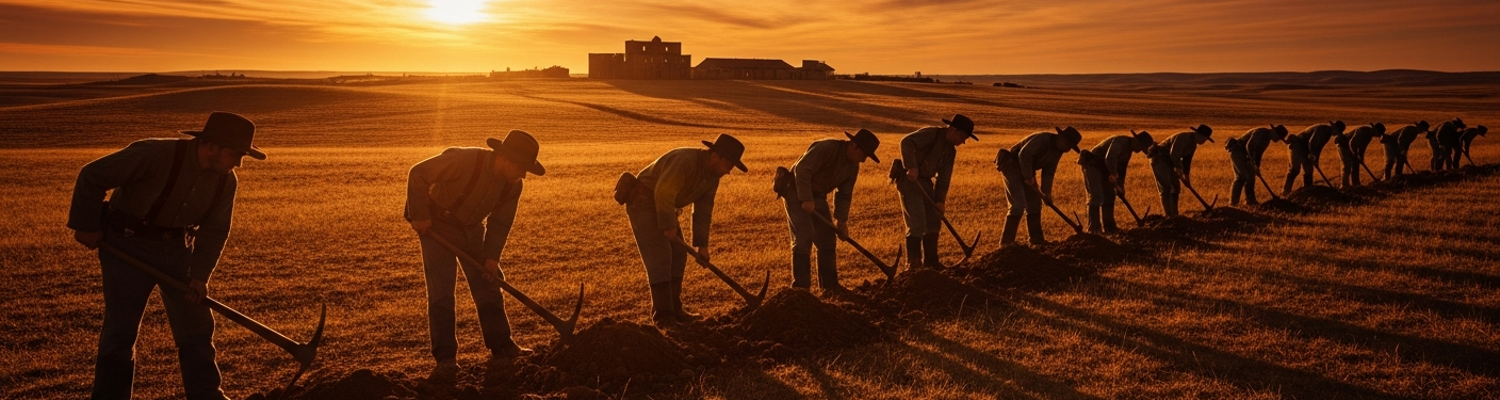

The United States Army that pushed west after the War of 1812 faced an enemy more persistent than any tribal confederation. This adversary was distance. Supply lines stretched for hundreds, then thousands of miles over rivers and nascent trails. They delivered salt pork, beans, and hard flour, but they could not deliver freshness. This simple logistical failure fostered a constant, internal threat to every frontier garrison, the nutritional deficiency disease known as scurvy. In response, the War Department turned to an ancient solution. It ordered its soldiers to become farmers, to cultivate post gardens as a weapon against disease and a bulwark against strategic irrelevance. The success or failure of these humble gardens held profound consequences, shaping the army’s ability to project power and dictating its relationship with the civilian populations, both settler and indigenous, whose lands it now occupied.
The Grand Failure at Council Bluffs
In 1819, Secretary of War John C. Calhoun authorized the ambitious Yellowstone Expedition. Its goal was to project American military power deep into the Missouri River basin, countering British influence and securing the fur trade. Colonel Henry Atkinson led the military arm of this venture, pushing his 6th Infantry Regiment from Plattsburg, New York, toward the wild confluence of the Missouri and Platte Rivers. Logistical problems plagued the expedition from the start. Contracted steamboats, except for the experimental, purpose-built Western Engineer, proved incapable of navigating the treacherous, shallow river, forcing the main body of troops to march overland. Atkinson’s force established a winter camp called Cantonment Missouri near Council Bluffs in late 1819. The men, subsisting on a monotonous diet of salted meat and flour, soon fell victim to what army surgeons termed the “scorbutic taint.” The disease tore through the ranks. Lethargy gave way to swollen limbs, bleeding gums, loosened teeth, putrid breath, and the horrifying reopening of old, healed wounds. Of the 1,126 soldiers in Atkinson’s command, over 300 perished that first winter, with scurvy as the primary killer. The disaster demonstrated with brutal clarity that an army on the frontier could not survive on contractor provisions alone.
When spring floods inundated the camp, the survivors moved to the bluffs and began constructing a permanent post, aptly named Fort Atkinson. Here, Colonel Atkinson, under immense pressure to justify the expedition's cost, doubled down on an agricultural solution. He directed the soldiers of the 6th Infantry to cultivate vast fields, putting an estimated 506 acres to the plow. The men built not just barracks, but a grist mill and a saw mill to support the enterprise. This grand experiment in military self-sufficiency represented the first major American farming operation in the territory that would become Nebraska. Yet the environment proved a relentless opponent. The same soldiers tasked with planting and harvesting corn also performed military drills, built fortifications, and conducted patrols. The Plains weather, with its late frosts, violent hailstorms, and blistering droughts, offered no quarter. Plagues of grasshoppers and army worms descended on the crops, stripping fields bare in a matter of days. The great agricultural project failed. It never achieved the self-sufficiency Atkinson envisioned. The garrison remained dependent on costly and unreliable supply chains, forced to purchase goods at inflated prices from local traders like Manuel Lisa's Missouri Fur Company. This logistical vulnerability was a stark warning. The failure to feed itself from its own soil tied the army’s hands, making it a supplicant to the very civilian frontier it was meant to control and a potential competitor for scarce resources with the region’s indigenous inhabitants.
A War on Strategic Debilitation
The primary driver for turning soldiers into gardeners was the urgent need to combat scurvy. This was not a matter of comfort but of combat readiness. A garrison crippled by dietary disease was a strategic liability. Its soldiers could not effectively patrol, pursue raiding parties, or defend the post from attack. Army medical officers of the period understood the empirical cause of scurvy, even if the specific science of Vitamin C was a century away. They knew that a diet devoid of fresh vegetables was a death sentence on the isolated frontier. The standard army ration consisted of foods that could survive long-distance transport: salt beef or pork, beans, coffee, and hardtack biscuits. At posts cut off by winter ice or impassable trails, this was often the only food available for enlisted men for months. The results were predictable and catastrophic. At Fort Laramie, the isolation and lack of fresh forage made scurvy a recurring winter threat. At Fort Rice during the winter of 1864, scurvy became the leading cause of death among the garrison. General Philippe Regis de Trobriand, commanding Fort Stevenson in Dakota Territory in 1867, watched scurvy sicken 79 of his men. He noted in his journal the very real fear that he would be unable to field a credible fighting force if needed. This reality elevated the post garden from a chore to a critical component of military operations. A successful potato and onion harvest was as important as a full powder magazine. The availability of fresh produce directly translated to unit readiness. Soldiers who foraged for wild onions or tended plots of turnips maintained their health and their ability to perform their duties. Officers, who often had the personal funds to purchase better quality food from post traders or sutlers, were less frequently afflicted, a fact that highlighted the life-or-death gap between the official ration and a healthy diet. The garden was a proactive public health measure, a direct assault on the internal enemy that threatened to rot the army from within. A healthy garrison could project American authority. A sick one invited contempt and attack, undermining the nation’s tenuous hold on its expanding borders.
The Slow March to Institutionalization
The War Department recognized the problem early, if inconsistently. The 1818 General Regulations for the Army directed commanders of remote posts to cultivate their own vegetables where the Quartermaster was unable to procure them locally. These early efforts were largely ad-hoc, dependent on the initiative of individual post commanders and the suitability of the local environment. The lessons from failures like Fort Atkinson were learned slowly and painfully. The Quartermaster Department, re-established in 1812 to manage the army’s increasingly complex logistical needs, gradually evolved its approach. Instead of banking on massive, state-run farms, the army began to formalize and support smaller, more manageable post gardens. The Quartermaster Corps began to view gardening as an official, necessary activity. Regulations evolved to encourage the practice, allowing for the creation of post funds from the sale of surplus vegetables to officers, their families, and civilian employees. This provided a tangible incentive for the soldiers who performed the labor, as the funds could be used to improve company messes or purchase recreational items. The department also began to distribute seeds and simple tools like spades and hoes, attempting to standardize and enable cultivation across a wide range of frontier environments. This centralized approach carried its own challenges. Seeds suitable for the Ohio Valley might fail completely in the high desert of the Southwest or the short growing season of the northern Plains. Shipments of tools or seeds could arrive long after the planting season had passed. Commanders continued to learn and adapt at the local level. General de Trobriand, after the disastrous winter of 1867, did not rely on a garden alone for the following year. He took the institutional lesson to heart and had the Quartermaster lay in large supplies of antiscorbutics that could be preserved. Barrels of pickled onions, sauerkraut, and vinegar were stockpiled. These preserved items were less prone to freezing and provided the necessary protection against scurvy when fresh produce was unavailable. The next winter, only five of his men fell ill. This shift shows a maturing logistical philosophy. The army learned it could not wholly depend on turning soldiers into full-time farmers. The garden became one tool in a larger system of sustenance that also included preserved foods and, where possible, local procurement. This formalization, though imperfect, represented a critical institutional learning process. The army was beginning to understand that controlling the frontier required mastering the logistics of survival, a lesson that had direct implications for its interactions with the wider world.
A garrison that could reliably feed itself was less of a burden on strained supply lines and a more stable presence. This stability, however, represented a more permanent American footprint on lands often contested with Native American tribes, who had their own sophisticated understanding of local agriculture and foraging that kept them free of scurvy. The struggle to cultivate the frontier was more than a battle against disease. It was a warning about the fundamental realities of expansion. The army’s logistical successes and failures rippled outward, influencing everything from local economies to Indian relations. When gardens failed, the army’s demand for food could strain local markets, creating competition with new civilian settlers. This sometimes forced the military into an uneasy dependence on Native American suppliers, creating complex alliances of convenience that could shift with the seasons. When the gardens succeeded, they showcased a model of self-sufficiency but also entrenched the military’s presence, transforming temporary outposts into permanent fixtures of occupation. The plowshare was an instrument of occupation as much as the sword. This history serves as a stark reminder that a military force’s greatest vulnerability can be its own supply chain. An army that cannot feed itself projects weakness, creates unintended dependencies, and can become a destabilizing force in the very region it is meant to pacify. The enduring lesson from the humble post garden is that logistical resilience is the true bedrock of strategic power.