
Silence was the first enemy. It pressed in on the six men, a physical weight as tangible as the ninety-pound rucks on their backs. Water dripped from the triple-canopy jungle, a slow metronome counting the seconds since their insertion craft’s muffled engine had faded downriver. The air, thick with wet earth and decay, was a suffocating blanket of ninety-eight percent humidity. For the US Army Long Range Reconnaissance Patrol team, callsign Mantis-1, this was the beginning. Deep within French Guiana’s Maroni River basin, hundreds of kilometers from any support, the psychological erosion had already commenced. Every snapping twig, every alien cry of a nocturnal bird, was a potential threat. The mission demanded they become ghosts.
Archival evidence from the period points to the mission’s politically sensitive nature. Designated Operation LANCEHEAD, the team’s objective was strategic surveillance. They were not sanctioned to be there. US intelligence suspected that Cuban special forces, operating with Soviet backing, were using the vast, unpatrolled Maroni River network to covertly supply Marxist guerillas in neighboring Suriname. The ultimate fear was destabilization that could threaten Europe’s primary launch site, the Guiana Space Centre at Kourou, a site of high strategic importance to NATO and France. The six-man team, technically a detachment from the 75th Infantry Regiment (Ranger), was inserted as a deniable asset. Their orders were explicit: establish a long-term Observation Post overlooking a specific bend in the river, document all traffic with high-powered optics, and remain completely undetected. Contact was forbidden. Discovery by French authorities or the target elements would create a significant international incident.
The team itself was a microcosm of specialized skills. A seasoned Staff Sergeant led, flanked by his Assistant Team Leader, who also served as the primary Radio Telephone Operator (RTO). The RTO was responsible for the team’s sole lifeline, the AN/PRC-77 radio. Two two-man sniper/observer pairs formed the core of the mission’s surveillance capability. A heavy weapons specialist, carrying an M60 machine gun, provided the unit’s only answer to overwhelming force. Their insertion was a masterclass in clandestine waterborne operations. A heavily modified Patrol Boat, River (PBR) painted flat black and running on muffled engines had navigated miles up the twisting, caiman-infested waters under a moonless night.
The boat did not stop. It slowed just enough for the six men, faces painted in camouflage, to slip over the side into chest-deep water. They waded the final hundred meters to the predetermined entry point on the riverbank, the PBR never deviating from its course as it continued upriver, a phantom creating a false trail. Once on solid ground, the real work began. The humidity was an instant foe, fogging optics and ensuring every piece of clothing was soaked through. The terrain was a vertical nightmare of mud-slicked slopes, tangled roots, and dense vegetation that limited visibility to mere feet. They relied almost entirely on compass and pace count. They moved with practiced slowness, each footfall deliberate, placing feet to avoid snapping a branch that could echo for a mile in the quiet. Their objective was still three days of arduous, silent infiltration away. The primary AN/PRC-77 radio, its H-189/GR handset secured in a waterproof bag, had passed its last function check just before they slipped into the water.
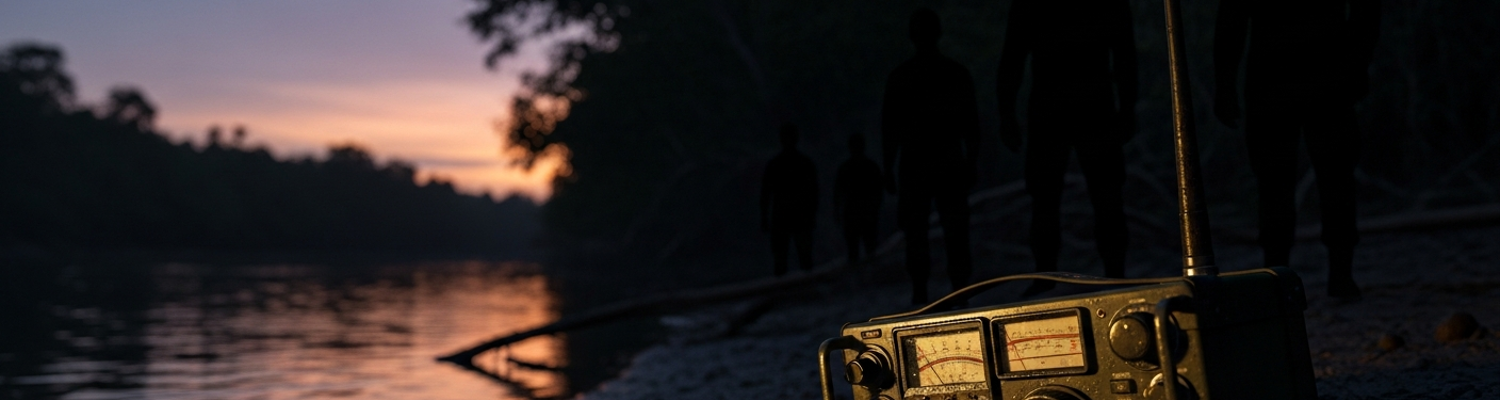
The failure occurred without warning on the fourth day. The RTO had just set up the ten-foot AT-271A/PRC multi-section whip antenna, its base connected to the top-mounted port of the AN/PRC-77 transceiver. It was time for their scheduled, burst-transmission check-in. He keyed the handset, expecting the familiar hiss of an open channel. He got nothing. A quick check of the dials confirmed the frequency was correct. He tried again. The silence from the handset was absolute. A cold knot formed in his stomach as he began standard troubleshooting. He swapped the primary BA-5598/U battery for the spare, ensuring the contacts were clean and dry, a constant battle in the corrosive humidity. Still nothing. He unscrewed the whip antenna and attached the shorter, more reliable AT-892 steel tape antenna. No change. Technical manuals for the AN/PRC-77 show that while rugged, the radio was susceptible to internal module failure, particularly from hard shocks or pervasive moisture ingress affecting the RT-841 transceiver. For the RTO, sitting in the Guyanese jungle, the technical specifics were irrelevant. The 1.5-watt transmission power was gone. He looked up at the Team Leader, held the inert handset, and shook his head.
The radio’s death was immediate. For a Long Range Reconnaissance Patrol, the radio is more than a communication device; it is a lifeline. It is the justification for their presence. It represents the promise of extraction, the availability of emergency medical evacuation, and the hammer of air and artillery support. With the AN/PRC-77 silent, Mantis-1 was utterly alone, a self-contained island of six men adrift in a sea of hostile jungle. The knowledge that a snakebite, a severe infection, or a combat wound now meant almost certain death descended upon the team. The deniable nature of their mission, once a source of professional pride, now took on a terrifying new meaning. No one was coming for them because, officially, no one knew where they were.
This severed communication created a catastrophic tactical dilemma. The purpose of a LRRP team is to gather and report intelligence. They are the eyes and ears of the commander. With their radio out of action, Mantis-1 was effectively deaf and mute. They could still observe the suspected guerilla supply routes, but any intelligence gathered would be useless, locked in notebooks and minds with no way to transmit it. Standard Operating Procedure for communications loss in a conventional unit dictates moving to a pre-designated rally point. This was not a conventional unit. Their clandestine mission profile had no such contingencies. Aborting the mission to attempt the multi-week trek back towards a friendly border would create a massive movement signature, vastly increasing the risk of detection. Continuing the mission meant accepting that their core function was nullified. The Team Leader faced a command choice that fell far outside doctrinal guidance. The AN/PRC-77, once the team’s link to salvation, was now just 13.75 pounds of dead weight, a metal box strapped to the RTO’s back, a constant, physical reminder of just how cut off they were.
The Team Leader’s decision fell outside of established doctrine. A review of LRRP operational procedures for the period shows no contingency for a mission continuation of this type following a total communications failure in denied territory. Standard procedure would have been exfiltration. The multi-week trek back to the border was judged a higher risk than proceeding with the primary objective, now only a few kilometers distant. The team moved with heightened caution. They reached the designated location for Observation Post Viper’s Nest late on the fifth day. The site was a low ridge overlooking a bend in the Maroni River, a natural choke point for riverine traffic. The two sniper pairs immediately began constructing their hide sites. Using small entrenching tools, they carefully excavated two shallow depressions, just large enough for two men to lie prone. The excavated earth was meticulously scattered. They constructed a low canopy of scavenged branches over the position, weaving in native vegetation until the hide was nearly invisible from a few feet away. The primary sniper rifle, an M21 Sniper Weapon System, was set in place. This rifle was a highly accurized version of the M14, selected for its reliability in jungle environments. The team established overlapping fields of fire and laid out Claymore mines on their flanks, their tripwires carefully concealed.
Their position offered concealment and a maddeningly difficult field of view. The triple-canopy jungle created a perpetual twilight on the forest floor, with shafts of bright sun intermittently piercing the gloom, causing optics to flare and shadows to shift. Visibility was often limited to less than fifty meters on the ground. The sniper team’s target area, a small wooden jetty on the opposite bank roughly 400 meters away, was only visible through a narrow keyhole in the dense foliage. This forced the observer to stare through his spotting scope for hours, waiting for a fleeting glimpse of movement. The humidity was a constant battle, fogging the 10-power Unertl scope on the M21 and requiring constant, gentle wiping with a lens cloth. Sound discipline was absolute. A cough or the metallic click of equipment could travel unnervingly far in the dense, wet air.
The target was codenamed 'Alacrán'.
Intelligence briefings reviewed before the mission identified 'Alacrán' as a colonel in Cuba’s General Directorate of Intelligence, likely a member of the elite "Black Wasps" special forces. He was a veteran of Cuba's foreign military campaigns in Africa and was considered a key figure in the effort to professionalize and equip Marxist guerillas in Suriname. His presence was a direct indicator of a larger Cuban and Soviet-backed strategy to destabilize the region, a strategy that posed a direct threat to the Guiana Space Centre at Kourou. The primary mission for Mantis-1 was to observe and document Alacrán’s pattern of life, confirm the supply chain, and identify other key personnel. Eliminating him was a secondary objective, one that would require explicit authorization. With their radio dead, the sniper team was in the agonizing position of being able to execute the mission’s secondary objective, but completely unable to fulfill their primary intelligence-gathering function or receive the order to fire.
The engagement was a miscalculation, born from the deceptive nature of the jungle. For two days, the sniper team had observed nothing at the target jetty 400 meters across the river. Then, movement flickered through the narrow observation lane. The triple-canopy forest created a disorienting battlespace of deep shadow and sudden, blinding shafts of sunlight. Visibility was poor. The humid air turned to a light mist that further obscured details through the Unertl scope. The figures moving near the jetty were hunched and carrying long, pole-like objects. In the context of the mission, every shadow was a potential threat, and the standing order was to neutralize any enemy combatants identified at the location. The team leader, viewing the scene through his own optics, gave the confirmation. The target appeared to be an armed guerilla securing the landing zone. The sniper adjusted for the 400-meter distance, controlled his breathing, and squeezed the two-stage trigger of the M21. The crack of the 7.62mm round was instantly swallowed by the jungle. The lead figure dropped. The second figure, startled, was brought down by a rapid follow-up shot from the semi-automatic rifle.
After-action debriefings reveal the psychological whiplash that struck the team as they cautiously approached the position. Instead of Cuban-backed guerillas, they found two Brazilian men, known locally as garimpeiros, or gold prospectors. They were not carrying rifles. They had been holding long-handled sieves and shovels. The shock was absolute. The sniper, a man trained for the detached precision of long-range engagement, was now standing over the two men he had just shot. One was dead. The other was grievously wounded and choking on his own blood. The team’s medic, a cross-trained infantryman with advanced first-aid skills, immediately went to work. This was no longer a tactical problem. It was a traumatic medical emergency conducted under the constant, paranoid threat of discovery. While two team members established a perimeter, the medic ripped open the wounded man’s shirt. He found a sucking chest wound. Using the plastic wrapper from a ration pack, he improvised a chest seal, taping it down to prevent air from being drawn into the pleural cavity. He worked with a silent intensity in the humidity, his hands slick with blood, aware that every second spent on the open river bank increased their vulnerability. The wounded man’s moans were a terrifying breach of noise discipline. The medic administered a morphine syrette and attempted to start a saline lock, a procedure made nearly impossible by the man’s dehydrated state and collapsing veins.
This unforeseen contact with civilians invalidated every parameter of the mission. Clandestine operations have no contingency for managing civilian casualties in denied territory. The team was now faced with a set of disastrous choices. With their radio inoperable, they could not call for a medical evacuation. To abandon the wounded man was to condemn him to a slow death. To attempt to carry him would be a slow, arduous process, creating a massive signature of movement that would almost certainly lead to their discovery. Every operational protocol for Operation LANCEHEAD was now useless. The Team Leader made a decision that fell outside any written doctrine. They would build a travois and carry the wounded man toward the nearest landmark on their map that might indicate a native village, a gamble that sacrificed their stealth for a sliver of conscience.
Operational logs from similar clandestine missions reveal a persistent tension between stated objectives and implicit command expectations. Officially, the primary mission for Mantis-1 was surveillance, an objective that demanded total invisibility and the strict avoidance of all contact. Yet, a secondary, unspoken pressure existed, a byproduct of a command culture fixated on quantifiable results. The very presence of a high-value target like 'Alacrán' created an unwritten imperative to be prepared to act. This placed the team in an impossible position. The directives were fundamentally at odds: remain ghosts, but also be ready to hunt. The tragic engagement with the garimpeiros was the direct result of this doctrinal conflict. The sniper, following what he believed to be the implied intent of his mission, acted on incomplete information and made a fatal judgment.
The rules had collapsed.
The psychological fallout manifested as a severe moral injury, a wound to the conscience caused by acting against one’s own values. For the men of Mantis-1, killing unarmed civilians was a catastrophic failure that shattered their professional and personal identity. The injury was deepened by their complete isolation. The dead AN/PRC-77 radio was a symbol of their abandonment, severing them from the very command structure whose conflicting directives had led them to this point. There was no one to report to, no one to ask for guidance, and no one to share the burden of their mistake. The medic’s attempts to save the wounded prospector, using improvised field dressings on a man his own team had just shot, became a physical manifestation of this internal crisis. It was an act of penance, an attempt to reclaim a sliver of humanity. The trauma was not born of fear, but of guilt, shame, and the knowledge that they had violated a fundamental moral line in the service of a broken mission.
Doctrinal procedure for a compromised clandestine operation was clear: exfiltrate immediately. But doctrine had no contingency for a wounded, non-combatant casualty that the team itself had created. To abandon the man was to compound their mistake with an act of profound inhumanity. This was a moral boundary the Team Leader was unwilling to cross. The alternative was to attempt to carry him, a decision that nullified every principle of stealth and operational security. A man on a travois would create a wide, slow-moving trail, a massive signature in a jungle where a single snapped twig was a security breach.
The decision was made to carry the man. This choice represented a complete inversion of the mission’s purpose. The team was no longer a ghost-like intelligence asset. They had become a rescue party, their new objective defined not by strategy but by conscience. The mission to observe the Maroni River was over, replaced by a self-imposed humanitarian task: move a critically wounded civilian toward the faint hope of a village, all while deep in denied territory, cut off from all support, and hunted by the consequences of their own actions.
The psychological erosion began the moment the radio died. Combat stress studies show that prolonged operations in such an environment trigger a cascade of physiological and mental decay. For the men of Mantis-1, the humidity was a constant presence. It rotted the fabric of their gear, caused painful immersion foot, and turned every minor cut into a potential source of infection. Sleep became a currency more valuable than ammunition. A two-man watch schedule meant no soldier ever achieved more than three hours of uninterrupted rest. This state of chronic deprivation is known to degrade complex mental functions like planning and adaptation. The jungle’s perpetual twilight, broken by blinding shafts of sun, strained their eyes, while the chorus of unfamiliar animal sounds kept their adrenal glands in a state of constant, exhausting alert.
Fatigue manifested in small, dangerous ways. A soldier fumbled a magazine during a silent reload, the metallic click echoing like a gunshot. Another, wracked with muscle cramps from lying motionless for hours, shifted his weight, causing a cascade of loose soil to trickle down the embankment. Each mistake frayed the team’s nerves. Irritability replaced the easy camaraderie of a professional unit. Commands were clipped. Responses were terse. The RTO, burdened by the dead weight of the AN/PRC-77, became a sullen ghost. This loss of morale and motivation is a direct consequence of sleep loss and sustained stress. The inability to fulfill their primary intelligence-gathering function created a vacuum of purpose. They were no longer a scalpel for high command; they were merely survivors.
The breaking point arrived with the crack of the M21 rifle. The decision to fire on the two figures 400 meters away was the culmination of every degrading factor. Cognitive performance, particularly the ability to accurately identify threats under pressure, is severely compromised by fatigue. The sniper and team leader, their judgment clouded by days of hypervigilance and sleep deprivation, saw what their compromised minds were primed to see: enemy combatants. The shock of discovering they had shot two unarmed garimpeiros shattered the team’s operational framework. This was the moment of moral injury. The medic’s frantic effort to save the wounded prospector was no longer a tactical procedure but an act of penance. The team leader’s final decision, to abandon all stealth and carry the wounded civilian, was a complete inversion of their purpose. It was not a tactical choice; it was a human one, born from the total collapse of their professional identity.
The debriefing was a sanitized fiction.
The post-mission medical file for the sniper, conducted at Walter Reed Army Medical Center (NARA Record Group 112), reveals a far more complex story than the official after-action report. The evaluation took place in a small, climate-controlled room, its beige walls a universe away from the dripping humidity of the Maroni River basin. The assessing officer, an Army Medical Corps psychiatrist, noted the soldier’s flat affect and his tendency to stare at a fixed point on the wall. Standardized diagnostic tools of the era, including the Minnesota Multiphasic Personality Inventory (MMPI), were administered. The core of the evaluation came from structured interviews. Records show the sniper struggled to articulate the events in a linear fashion, often circling back to the moment of target acquisition through the Unertl scope. He described the disorienting play of light and shadow, the jungle mist, and the absolute conviction in his mind that the figures were armed threats. The psychiatrist observed a pronounced startle response when a book was accidentally dropped in an adjacent office. The soldier reported pervasive insomnia, stating he could still hear the wounded man’s moans and the wet sound of the medic’s improvised chest seal being applied.
He was diagnosed with acute combat fatigue.
The formal assessment, however, only scratched the surface. The evaluating officer’s private notes contain references to a profound sense of guilt and shame that did not fit neatly into the established diagnostic criteria. This was the signature of moral injury. The trauma was not rooted in the fear of dying, but in the act of killing an unarmed civilian, a direct violation of the sniper’s own moral code. The injury was compounded by the mission’s specific circumstances. The failure of the AN/PRC-77 radio severed the team from the moral authority of command, leaving them to grapple with their mistake in total isolation. The conflicting directives of the mission had created the psychological pressure cooker that made the fatal miscalculation almost inevitable.
Because Operation LANCEHEAD was a deniable, off-the-books mission, no official record of the civilian casualties existed. The team was ordered to never speak of the engagement with the gold prospectors. This enforced silence isolated each man, preventing them from processing the trauma collectively. Archival service records show a distinct pattern following their return. The sniper was diagnosed with what would today be recognized as severe Post-Traumatic Stress Disorder and was given a medical discharge within eighteen months. The Team Leader was passed over for promotion and took an early retirement. The medic requested, and was granted, a transfer to a non-combat, stateside training role. The official after-action report for Operation LANCEHEAD concluded that the mission was aborted due to “prolonged communications failure and environmental degradation,” with no mention of human contact.