
Operation Watchtower’s timeline was not a schedule. It was a countdown to a calculated risk. On July 2, 1942, commanders of the 1st Marine Division under Major General Alexander Vandegrift were handed an operational deadline demanding an amphibious assault by August 1. This left a single month to plan and stage the first major Allied land offensive against the Empire of Japan. The initial landings on Guadalcanal on August 7 seemed deceptively simple. The 11,000 Marines who came ashore between Koli and Lunga Points met minimal resistance. Intelligence suggested the primary opposition would be from naval construction units. The Japanese forces abandoned the nearly completed airfield with little fight, fleeing west toward the Matanikau River. This initial success masked a lethal miscalculation. Planners had underestimated both the combat capabilities of the Japanese construction troops and the ferocity with which Japan would contest the island. The belief in a swift, surgical seizure of an airfield evaporated within days. It was replaced by the onset of a sustained campaign for which the division’s medical assets were completely unprepared.
The first shock was the body count. Pre-invasion assessments had not anticipated the tenacity of Japanese defenders, even those not from elite combat formations. The fighting on the satellite islands of Tulagi, Gavutu, and Tanambogo offered a grim preview, where Japanese naval troops fought nearly to the last man, inflicting 248 casualties on the attacking Marines. On Guadalcanal itself, the first major Japanese counter-attack at the Tenaru River on August 21 was an awakening. Colonel Kiyono Ichiki’s force attacked Marine positions in a frontal assault, expecting to overwhelm them. Instead, the well-positioned 1st Marines, supported by artillery, annihilated the attackers. Nearly 900 Japanese soldiers were killed, while the Marines suffered 34 killed and about 80 wounded. While a tactical victory, the sheer number of enemy dead signaled a defensive fanaticism that would produce American casualties at a rate far exceeding what the division’s medical battalion was structured to handle. Archival evidence shows that intelligence severely misjudged the willingness of Japanese naval construction personnel and garrison troops to act as effective infantry. They were not just laborers; they were an armed and determined component of the Imperial war machine.
This deluge of casualties crashed immediately against a shoreline medical infrastructure that was perilously thin from the moment it was established. The 1st Medical Battalion landed with its companies A, B, and C, intending to establish a clear evacuation chain: from battlefield corpsmen to battalion aid stations, then to a collecting station, and finally to a divisional field hospital for surgery or transport offshore. This system was predicated on controlling the sea and air around the island. That premise collapsed on the evening of August 8, when Vice Admiral Frank Jack Fletcher, concerned about his carriers, withdrew his air cover. This was followed by the disastrous Battle of Savo Island, where a Japanese cruiser force sank five Allied cruisers, forcing Rear Admiral Richmond K. Turner to pull out the amphibious transport ships. They left with nearly half of the 1st Marine Division’s supplies still in their holds, including essential medical equipment. Company E of the 1st Medical Battalion lost all its supplies when the transport USS George F. Elliott was hit and later sank. Left ashore was a medical service stripped of its logistical depth, forced to operate with only the equipment and consumables carried in by hand. By August 10th, B Company had managed to set up a functioning field hospital in a wooden building near the airfield, but it was a single node in a system that was supposed to be a network.
A review of operational logs from the first 72 hours reveals a near-complete breakdown in casualty processing. The original plan, which called for prompt evacuation of the wounded to hospital ships, became impossible the moment the Navy withdrew. There were no ships to evacuate to. Battlefield corpsmen, pinned down with infantry units, struggled to move the wounded under fire. The notional chain of evacuation dissolved into a series of desperate improvisations. Wounded men were collected at informal aid stations, often located in little more than hastily dug shelters or captured Japanese structures. The building near the Lunga perimeter nicknamed the 'pagoda' served as the main divisional hospital. There, a handful of surgeons worked with dwindling supplies of ether, morphine, and bandages. Without whole blood, surgeons could do little for men suffering from severe shock. The system of tagging and tracking casualties fell apart in the chaos. Records became a secondary concern to the immediate task of saving lives. The first air evacuation of casualties did not occur until early September. For weeks, every serious casualty on Guadalcanal was a long-term patient for a medical system designed for stabilization and rapid transit.
The seeds of the Guadalcanal medical crisis were sown long before 1942, within the structure of American interwar strategic planning. The Joint Army and Navy Board, the forerunner to the Joint Chiefs of Staff, spent the 1920s and 1930s developing a series of color-coded war plans. The most developed of these, War Plan Orange, addressed a conflict with Japan, but the ultimate strategic framework adopted was Rainbow 5. This master plan correctly anticipated a two-ocean war but fundamentally misread its character. It designated Germany as the primary enemy and relegated the Pacific to a strategic defensive. All logistical tables and medical support annexes were built on a 'Europe First' model. Planners envisioned a war fought across large, developed landmasses with established ports and rail lines, where corps- and army-level hospital centers could be established well behind static fronts. The concept of seizing, holding, and supporting a division on a primitive, malarial island with no infrastructure, thousands of miles from any primary base, was an operational footnote. The Rainbow 5 logistical plan, therefore, contained no specific, high-fidelity doctrine for amphibious medical support, casualty evacuation under contested sea control, or the unique supply needs required for jungle warfare.
This flawed strategic vision was compounded by a fatally fragmented command structure for medical supply and evacuation. On paper, the 1st Marine Division was a naval asset, falling under the Navy’s administrative and logistical control. Its doctors and corpsmen were Navy personnel, supplied by the Navy’s Bureau of Medicine and Surgery (BuMed). However, its function as a large ground combat formation mirrored the Army’s. This created a bureaucratic chasm. The Navy controlled the ships and the 'last mile' of supply to the beachhead, while the Army controlled the vast majority of bulk medical production and strategic stockpiles in the Zone of Interior. On Guadalcanal, this division of responsibility became a paralysis of authority. The theater commander, Vice Admiral Robert L. Ghormley, was in Nouméa, over a thousand miles away, and demonstrated a distinct lack of personal leadership. Tactical command of the naval forces was split between the carrier commander, Rear Admiral Frank Jack Fletcher, and the amphibious force commander, Rear Admiral Richmond K. Turner. The landing force commander, Major General Alexander Vandegrift, could only request medical supplies. He had no authority to command the ships that carried them or the strategic depots that filled the orders. This fractured system meant that when Turner, fearing for his vulnerable transports after the Battle of Savo Island, withdrew his ships, he did so with almost no direct consultation with Vandegrift about the medical consequences. The decision was a naval one, made by a naval commander, with the land force’s survival as a secondary consideration. A direct outcome of a command structure that was joint in name only.
This fractured authority guaranteed slow decision-making. The initial supply plans called for 60 days of provisions, but the abrupt withdrawal of the transports left the Marines with only a fraction of that, particularly in specialized medical equipment. Archival evidence shows that subsequent requests for resupply entered a bureaucratic vortex. A plea for more surgical instruments or blood plasma from the 1st Medical Battalion on Guadalcanal had to travel from the island via intermittent radio or courier to Vandegrift’s headquarters. From there, it went into the Navy’s South Pacific Area (SOPAC) command structure under Ghormley. It was evaluated against competing priorities for cargo space on the few ships daring to run the gauntlet of 'the Slot.' The response to malaria was the most devastating example. The island was a known hyperendemic zone for the disease, but initial supply estimates for anti-malarials were insufficient. The Japanese occupation of Java had cut off 90% of the world’s supply of quinine. The synthetic alternative, Atabrine, was available but not yet mass-produced, and there was widespread disagreement among medical officers about its efficacy and proper dosage. Directives from the theater surgeon’s office regarding suppressive therapy did not even appear until August 1942. Requests for the drugs languished. While thousands of men began to fall ill, incapacitating entire units, requisitions were processed with peacetime deliberation. It was not until early September that the first dedicated air evacuation of casualties began. Not until well into the campaign, after Ghormley’s replacement by the more aggressive Admiral William 'Bull' Halsey, did the supply of items like Atabrine and the deployment of hospital ships like the USS Solace begin to match the desperate need. For the men on the island, these delays were measured in fevers, amputations, and graves.
The single greatest threat to American forces on Guadalcanal was not a Japanese soldier. It was an insect. The island existed in a hyper-endemic malarial state, a fact known to planners but whose operational consequences were underestimated. Medical intelligence confirmed the local population was heavily infected, yet initial supply manifests for the 1st Marine Division were critically deficient in anti-malarial drugs. The Anopheles farauti mosquito, the primary local vector, thrived in the stagnant water that pooled in shell craters, bomb holes, and the water-logged tracks left by vehicles and men. Its peak biting hours were in the early evening, a time when exhausted Marines were trying to dig in or establish night defenses, making the use of mosquito netting impractical.
The results were immediate. By October 1942, more than half of the Marines on the island had contracted the disease. At its peak, malaria was causing more casualties than combat, with some estimates suggesting a ratio as high as five to one. Medical logs document that by the time the 1st Marine Division was relieved, over 8,000 men had contracted malaria. This effectively disabled two-thirds of the division through disease. The debilitating cycle of fever, chills, and fatigue rendered entire combat units ineffective, a biological attrition that no battlefield tactic could counter.
This microscopic problem was aided by the weather. The campaign coincided with the onset of the monsoon season, which transformed the island into a morass of mud. Torrential rains fell almost daily, turning the red laterite soil into a thick, adhesive paste that bogged down vehicles, collapsed foxholes, and made every movement an exhausting struggle. Constant humidity approaching 100% and temperatures that rarely dropped below 90 degrees Fahrenheit created a suffocating, steam-bath environment. For troops wearing heavy herringbone twill utility uniforms and carrying full combat loads, the physical toll was high. Heat exhaustion and dehydration became constant threats, worsened by a chronic shortage of potable water. Medical records from the period show a sharp increase in non-battle injuries such as sprains and fractures from men slipping in the mud. The oppressive climate also had a direct impact on materiel. Leather boots and webbing rotted, weapons rusted, and sensitive radio equipment corroded and failed.
These conditions cultivated a host of other debilitating ailments. Chief among them was 'jungle rot,' a catch-all term used by troops to describe a variety of aggressive fungal and bacterial skin infections. Constant exposure to dampness from rain, sweat, and fording streams meant that Marines’ skin, particularly on their feet and in their groin areas, was never truly dry. Minor scratches, insect bites, or abrasions quickly became infected in the filth. These infections developed into oozing, puss-filled ulcers and aggressive fungal rashes that could incapacitate a man as surely as a bullet. Medical personnel, lacking specific treatments for these novel tropical dermatoses, were often forced to resort to trial-and-error methods, such as painting the affected areas with silver nitrate. Compounding this was epidemic-level dysentery, spread by flies and contaminated water sources like the Lunga River. The combination of malnutrition from meager rations, the physical misery of malaria, and the constant agony of skin infections produced a physiological and psychological degradation that eroded combat effectiveness from within.
After-action reports from the 1st Medical Battalion reveal a system on the verge of collapse from the first hours of the campaign. The primary cause was a severe deficiency in two lifesaving assets: blood plasma and surgical teams. The medical companies that landed on August 7, 1942, were equipped for a doctrine of rapid stabilization and immediate offshore evacuation. They were not structured to function as long-term, self-sufficient hospitals. The abrupt withdrawal of naval forces after the Battle of Savo Island stranded the division and its medical personnel. This turned the primary field hospital, a captured Japanese storehouse near the Lunga perimeter, into the final destination for hundreds of grievously wounded men. Refrigeration for whole blood was a logistical impossibility. Dried plasma was the only viable tool to combat hemorrhagic shock. Stocks of it, along with morphine and ether, were almost immediately exhausted. Surgeons were forced to perform amputations and other radical procedures on men who were poor surgical risks due to shock that could not be reversed. The small number of surgeons available worked in grueling shifts, often under direct enemy bombardment, with inadequate lighting and a dwindling supply of sterilized instruments. Company E of the 1st Medical Battalion lost its entire stock of supplies when its transport ship went down, placing further strain on an already threadbare inventory.
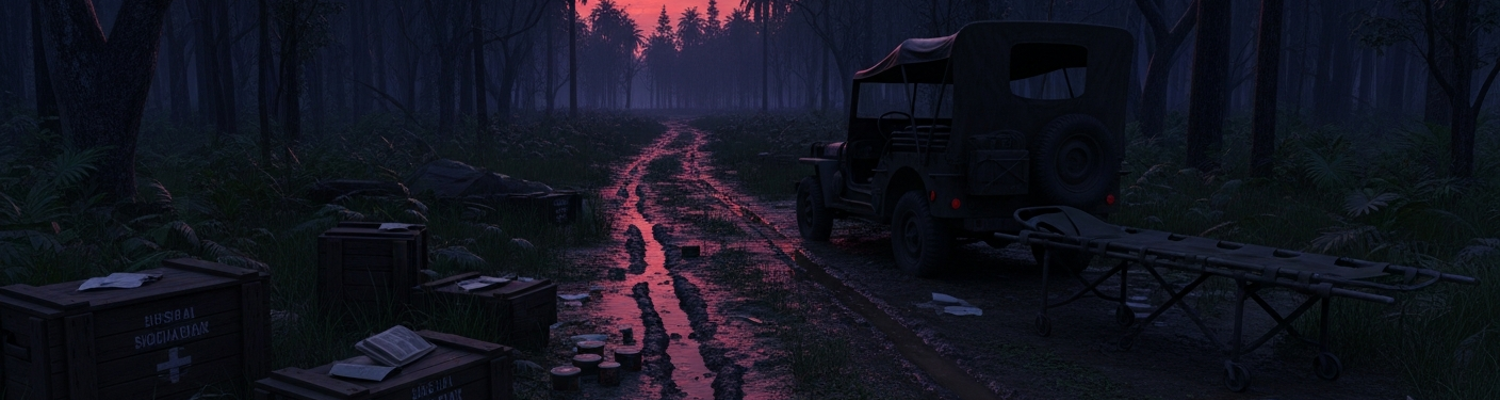
This crisis inside the hospital was compounded by the impossibility of moving casualties from the battlefield. The terrain of Guadalcanal was a physical obstacle. Standard wheeled ambulances, of which only six were landed initially, were restricted to the immediate vicinity of the Lunga perimeter and the nearly completed airfield. The island’s interior was a trackless expanse of dense jungle, steep grassy ridges, and mud-choked ravines. The onset of the monsoon season rendered it even more impassable. The primary evacuation vehicle became the Willys jeep, often field-modified with racks to hold two stretchers. These vehicles could push farther inland than the ambulances but were frequently bogged down in mud or blocked by terrain a human could barely climb. For units fighting along the Matanikau River or in the foothills, the only option was manual evacuation by stretcher-bearers. A journey of a few hundred yards could transform into an hours-long ordeal, exposing the casualty and the bearers to continued enemy fire and the elements. Operational records document that men died from shock and blood loss while being carried, their lives slipping away before they could reach even the most rudimentary aid station. For actions near the coast, Higgins boats were sometimes used to ferry wounded from the beach to the main hospital at Kukum, but this was only an option for units fighting near the shoreline.
Medical resupply routes were just as compromised as the evacuation paths. The daily torrential rains of the monsoon turned the few existing dirt tracks into impassable quagmires, swallowing vehicles and making foot movement an exhausting struggle. A box of sulfanilamide powder or a case of bandages offloaded onto the beach at Lunga Point had to be moved forward by hand, a process that was slow, inefficient, and dangerous. There was no secure rear area. Japanese snipers and patrols often infiltrated the porous Marine perimeter, turning every supply run into a potential ambush. The larger logistical network was choked at its source. Japanese naval and air power operating in 'The Slot' made every resupply convoy a high-stakes gamble. This forced a reliance on air resupply, with C-47 transport planes flying in cargo and evacuating the most serious casualties on their return trip. These flights were intermittent and could only deliver a fraction of the required tonnage. The result was a series of isolated medical crises across the front. Forward battalion aid stations operated independently. Their Navy corpsmen and doctors were forced to ration every bandage and morphine syrette while knowing that resupply was not guaranteed.
The operational autopsy began before the crisis had even passed. A review of after-action annexes and personal correspondence reveals a disorganized effort by medical personnel to document the catastrophe unfolding around them. In the hospital tents at Lunga, surgeons and corpsmen, working between air raids, made notes in the margins of field manuals, on the back of casualty tags, and in personal diaries. These were not formal reports; they were raw, unprocessed data points logged in an attempt to make sense of a system that had failed. These initial observations were fragmented and often contradictory, a direct reflection of the chaos. One surgeon might note the shortage of surgical instruments, while a corpsman with a forward rifle company would record the impossibility of evacuating wounded over the razorback ridges south of the airfield. There was no central collation, only a disparate collection of experiences that, when pieced together later, painted a damning portrait of institutional failure.
Almost immediately, these scattered observations coalesced around a single, glaring conclusion: the systemic failure of pre-war amphibious medical doctrine. The entire medical plan for Operation Watchtower was built on the assumption of absolute sea control and the ability to evacuate casualties to offshore hospital ships like the USS Solace. When the transports vanished after the Battle of Savo Island, this doctrine shattered. The medical companies of the 1st Medical Battalion were structured as little more than waystations, designed to stabilize casualties for transit. They were never intended to function as long-term care facilities. The loss of Company E’s supplies on the transport George F. Elliott was a blow, but the conceptual error was far greater. The official record shows that the entire evacuation chain, from battlefield to battalion aid station to the divisional hospital, now terminated abruptly at the beach. There was nowhere else for the wounded to go. This single point of failure cascaded through the system, rendering wheeled ambulances useless in the trackless jungle and turning every stretcher-carry into a potential death sentence.
This created an urgent demand for a complete overhaul of Pacific medical and logistical doctrine. The initial, frantic reports from the 1st Marine Division’s surgeons flowed up the chain of command, bypassing layers of bureaucracy through their sheer intensity. A close review of the DIVISION COMMANDER’S FINAL REPORT ON GUADALCANAL OPERATION shows these field reports were incorporated directly, lending them enormous weight. The message was unambiguous: the 'Europe First' model of large, rear-area hospitals was useless in the Pacific. What was needed were smaller, self-sufficient, and highly mobile surgical units that could operate independently for extended periods. There was a direct call for a new type of medical organization, one built for the realities of island-hopping warfare. These demands, born in the confines of the 'pagoda' field hospital, led directly to the development of new tactical doctrine and new units designed specifically to address the failures identified on Guadalcanal. The experience forced a fundamental rethinking of how to keep men alive in a war fought at the far end of a strained supply line.