
War Department Directives and South Pacific Staging
The cast iron drive gear inside the starboard deck winch of a Liberty ship docked at Noumea sheared four teeth. A sharp metallic crack echoed across the harbor. Gray oil and iron shavings sprayed across the wooden planking. The primary steam manifold lost forty-five pounds of pressure in three seconds. Dockworkers watched the suspended five-ton sling drop twelve feet. It hit the bilge of Hold Number Two. Green timber splintered. Galvanized fuel drums ruptured. Grease bubbled over the warped hoist drum. The relief valve hissed superheated vapor into the tropical rain. Nobody had replacement drive gears on hand. The damaged cargo hook sat wedged into the shattered hold floor. Half an infantry regiment lost heavy maintenance gear beneath three layers of waterlogged dunnage.
SOPAC was coming apart at the waterline.
A close review of operational logs indicates that the breakdown originated thousands of miles away in the Pentagon. In mid-May 1944, the War Department issued an operational directive. It ordered the immediate dissolution of the South Pacific Area as an active offensive theater. Planners mandated the rapid redistribution of over two hundred thousand soldiers to General Douglas MacArthur and Admiral Chester Nimitz. Base commanders received orders to strip bases across the Solomon Islands, the New Hebrides, and New Caledonia. These schedules were built for peacetime railheads rather than isolated coral atolls. Formations including the Americal Division and the 37th Infantry Division were instructed to prepare personnel and materiel for immediate sea movement. Local garrison commands liquidated their fixed base infrastructure. Planners in Washington set these schedules assuming cargo manifests matched depot ledgers. Shipping availability figures on paper bore no relationship to the small pool of operational transports operating between Guadalcanal and Auckland.
Theoretical staging timetables outran sea transport capacity by six weeks.
Archival evidence shows that base quartermasters reacted to the directive by ordering staging units to pack all organic cooking equipment weeks ahead of ship arrivals. Supply sergeants dismantled gasoline-burning M-1937 mobile field ranges. They drained the pressure tanks. They slushed the iron fire units in heavy Cosmoline. They nailed them shut inside spruce shipping crates. Soldiers crated the immersion-type water heaters used to boil wash water for mess kits. They stacked them in open-air staging areas alongside the tent camps. Field manuals dictated that troops in transit would receive fresh hot meals up to forty-eight hours before embarkation. Infantry companies instead spent twenty-eight consecutive days bivouacked in monsoon mud on Guadalcanal and New Caledonia with no operational mess gear. They subsisted entirely on unheated Type C rations and melted chocolate D-ration bars. Without hot water from the immersion heaters to sterilize aluminum mess gear, bacterial contamination swept through battalion cantonments. Hundreds went to the hospital with bacillary dysentery before they ever boarded a gangway.
When examining the historical record of maritime staging points, the crisis peaked along the docks of Noumea in New Caledonia and Espiritu Santo in the New Hebrides. The port of Noumea possessed deepwater berthing for only four standard freighters. Up to ninety Liberty ships sat at anchor across Dumbea Bay for two months at a time. Cargo handling broke down completely on the shoreline. At Espiritu Santo, stevedore battalions worked twelve-hour shifts in deep mud. They unloaded crated artillery and ration cases onto open beaches without warehouse cover. Supply ships arrived from San Francisco without stowage plans. Shore crews hauled out thousands of tons of unwanted engineering timber just to reach buried crates of balanced B-rations and medical kits. By late June 1944, over one hundred thousand measurement tons of military freight sat exposed to torrential humidity. Cardboard containers rotted. Bulk flour turned into solid mold. Convoys waited on empty bunkers.
Theoretical Mess Operations Versus Staging Conditions
Archival evidence shows that War Department doctrine laid out an orderly feeding cycle for every soldier moving through maritime staging areas. Quartermaster Field Manual 10-205 mandated continuous Class A ration service throughout the entire redeployment pipeline. Fixed base depots were required to supply staging cantonments with fresh chilled beef, pork loins, potatoes, and daily baked bread until units physically walked up transport gangways. War Department planners based these dietary regulations on European rail operations. They assumed troops in holding areas would draw fresh refrigerated perishables from stationary cold-storage warehouses right up to the hour of embarkation. Theater supply tables budgeted thirty-eight hundred calories of balanced fresh foods per man per day. Manuals instructed mess personnel to maintain twenty-four-hour hot food lines. Cooks ran continuous shifts to feed staggered troop details arriving from inland staging camps.
Paper timetables failed to reckon with cargo cranes.
A close review of operational logs from Guadalcanal and Espiritu Santo indicates that battalion commanders were forced to make an impossible choice between maintaining hot chow lines and meeting ship loading deadlines. Navy transport quartermasters required all organic battalion equipment crated, weighed, marked with theater destination codes, and consolidated at waterhead piers forty-eight hours prior to a transport arrival. Battalion mess sergeants had to pull their standard-issue M-1937 mobile field ranges out of service weeks ahead of schedule. Maintenance details drained leaded gasoline from the burner tanks. They flushed the iron pre-heater coils with mineral spirits. They slushed the cast-iron grates with grade-four Cosmoline to prevent salt corrosion. They hammered the components into double-walled spruce shipping crates banded with steel strapping. Company-level immersion water heaters, cleavers, galvanized serving pans, and fifty-gallon aluminum boiling kettles vanished into the bottom layers of palletized equipment dumps along Lunga Point and the Segond Channel.
The cooks had nothing left to light.
When troop transports were delayed by enemy submarine alerts or harbor congestion, thousands of combat infantrymen remained stranded in staging bivouacs stripped bare of cooking gear. Ground forces of the 37th Infantry Division and the 182nd Infantry Regiment sat for up to five weeks in muddy staging paddocks on Guadalcanal. They were completely immobilized beside their crated kitchens. Base depots possessed no auxiliary mess facilities to feed ten thousand stationary soldiers at once. Local island commanders solved the deficit by dipping directly into crated operational reserves of Type C and Type K combat field rations. These specialized rations had been scientifically formulated by the Quartermaster Subsistence Research and Development Laboratory solely for short-duration assault operations not exceeding seven consecutive days.
Canned pork and egg yolks sustained men who were not moving.
Troops consumed the same canned meat hash, hardtack biscuits, and processed cheese spreads three times daily while sitting idle beneath waterlogged canvas. The human body could not efficiently process the dense sodium loads, hydrogenated fats, and synthetic concentrates of emergency combat rations without the heavy physical exertion of active patrol work. Medical inspection reports from the Americal Division in July 1944 recorded widespread gastrointestinal disorders. Persistent acid dyspepsia and chronic constipation ran through units that ate combat rations for more than eighteen consecutive days. Soldiers boiled C-ration cans in fifty-five-gallon oil drums filled with brackish swamp water. They swallowed the congealed fat cold because open fires produced grease fires on wet coral. Vitamin C levels plummeted. Tropical ulcers, severe dental gum inflammation, and chronic fatigue accelerated across resting infantry battalions. Field hospitals on New Caledonia admitted six hundred and fourteen infantrymen for acute digestive tract inflammation caused entirely by sixty consecutive days of stationary K-ration consumption. At the Luganville supply dump, nine hundred tons of crated Class A frozen beef spoiled inside dead refrigerated trailers. Six stranded battalions four miles down the road ate canned meat and beans with unwashed bayonets.
High-Line Underway Replenishment Failures
Transfer lines parted without warning in open water.
A close review of operational logs indicates that fleet store ship transfers during the June 1944 drawdown were governed by rigid Bureau of Ships underway replenishment doctrines. These were formulated in calm coastal waters. Regulations dictated that auxiliary store ships steam on straight, fixed headings alongside receiving transports at a sustained speed of eight to ten knots. Civilian-crewed Maritime Commission Type C2 freighters operated under the same rules. Standing fleet operating instructions required bridge officers to maintain a constant lateral separation distance of eighty to one hundred feet. Deck divisions rigged single manila high-lines suspended between welded deck kingposts. They relied on twenty-man working parties on the receiving ship to heave and slack the lines by hand using wooden snatch blocks. Bureau manuals prohibited ships from altering rudder angles or adjusting engine revolutions while high-line trolleys remained suspended between hulls. Bridge officers were unable to maneuver when sea conditions worsened. Transfer doctrine assumed smooth water would keep line tension steady. It completely discounted the dynamic loading caused by open ocean swells south of the Solomon Islands.
The open ocean did not match peacetime naval calculations.
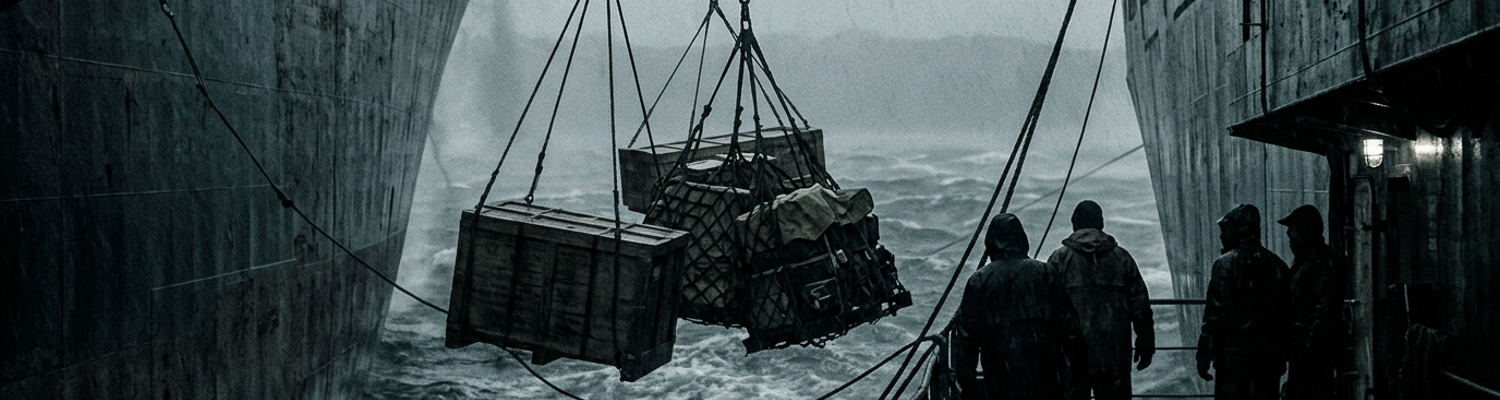
When examining the historical record of operations in the Coral Sea between Espiritu Santo and Guadalcanal, heavy tropical swells running twelve to fifteen feet routinely threw high-line rigs completely out of mechanical tolerance. Rolling motions of the deep-draft store ships fell out of phase with the lighter, faster-rolling troop transports. The hulls rolled inward toward each other. The manila high-line lost tension instantly. It droofed forty feet into the sea. The ships rolled apart. The suspended wire snapped taut with multi-ton shock loads. Cargo nets loaded with fifteen-hundred-pound drafts of Class I subsistence stores swung violently. They plunged directly into the sea between the two hulls. Crates of canned B-rations, vacuum-packed roasted coffee, and dried fruit dragged through salt brine at nine knots before line-handling crews could haul them clear of the foam. In dozens of recorded instances off San Cristobal, line tenders let go of the wet rope falls to prevent their hands from being drawn into the deck fairleads. They dropped complete sling loads of dry rations straight into three thousand fathoms of water.
Submerged crates that reached the deck carried saltwater into the holds.
Archival evidence shows that Class I cargo reaching the receiving ships suffered extensive contamination from salt brine, bilge drainage, and spilled diesel fuel. Underway replenishment protocols paired subsistence transfers with simultaneous fueling operations. Deck scuppers regularly ran with diesel runoff from leaking six-inch rubber fuel hoses. Crewmen dragged wet cargo nets across slick steel decks. They pulled saturated burlap sacks of flour across puddles of heavy petroleum. Once deposited into the cargo holds of transports like the USS President Jackson, sea water dripped off the outer crates and pooled in the unpumped bilges below damaged dunnage boards. Bulk wheat flour packed in standard three-ply paper bags absorbed fuel slicks and brackish bilge water within minutes. The damp flour formed a gummy paste along the exterior seams that sealed in diesel vapors. Entire ten-ton lots of dry garrison rations, rolled oats, and granulated sugar stored in the lower holds soured.
Board of survey officers at Tulagi condemned eighty-four tons of fuel-soaked baking ingredients from Hold Number Four on July 14 alone.
Cold Storage Depots and Shore Spoilage
Archival evidence shows that by early July 1944, shore cold-storage capacity at Noumea on New Caledonia and Espiritu Santo in the New Hebrides was overwhelmed by arriving shipments of frozen cargo. Army Quartermaster refrigeration companies operated permanent wood-and-cork cold storage warehouses behind the Grand Quai at Noumea. Navy construction battalions maintained four Quonset-style refrigerated reefer units along the Luganville waterfront on the Segond Channel. These insulated plants contained banks of York Ice Machinery three-cylinder ammonia compressors running twenty-four hours a day to preserve thousands of tons of Class I perishables. Walk-in compartments held solid stacks of thirty-pound fiberboard cartons of frozen boneless carcass beef. They held crate upon crate of New Zealand mutton, salted butter tubs, and wire-bound wooden hampers of California cabbage and valencia oranges. Shipping directives from the San Francisco Port of Embarkation continued discharging bulk reefers without checking theater distribution capacity. Warehouse aisles were choked right up to the ceiling coils. Heavy wooden warehouse doors could not swing shut against the overstow. Moist equatorial air flooded through the unsealed canvas vestibules. It coated floor gratings and electrical switch boxes in thick rime frost while interior temperatures crept from zero degrees upward past forty-eight degrees Fahrenheit.
Cooling coils choked under three inches of ice.
A close review of operational logs indicates that the distribution system broke down along the shoreline because base commanders lacked refrigerated harbor craft. Port directors possessed standard uninsulated steel pontoon barges. The South Pacific Area had only two self-propelled refrigerated lighters assigned to cover both Dumbea Bay and the Segond Channel. Transferring perishable cargo across three to five miles of open harbor required insulated hulls with functioning mechanical chillers. Stevedore working parties from the 24th Quartermaster Truck Regiment were ordered to load frozen beef quarters into open, unshaded steel lighters under direct noon equatorial sun. Surface temperatures on the bare iron deck plates routinely reached one hundred and thirty degrees. Tugs took four to six hours to tow these dead-weight barges against incoming tides toward the outer transport anchorages. By the time an open barge bumped alongside the cargo net of a converted attack transport, the outer three layers of boxed beef had thawed into soft, bloody mush that dripped brine across the bilge timber.
Ammonia vapor leaked into the harbor mud.
When examining the historical record of Base Button at Espiritu Santo, mass condemnations of shore provisions occurred while offshore troopships faced severe food rationing. Over four hundred tons of chilled vegetables and frozen meats rotted inside depot buildings during the third week of July 1944 alone. Compressor drive belts snapped. Replacement bronze bearings failed to arrive from Auckland. Base health officers condemned eighty thousand pounds of New Zealand mutton in a single afternoon at Luganville. They directed D-8 Caterpillar bulldozers to dig deep burial trenches through the coral limestone south of the airfield. Two miles offshore, seven thousand soldiers of the 37th Infantry Division sat confined aboard crowded transports like the USS Pinkney and the USS President Monroe. Galley cooks were ordered to cut mess rations by half. Men who had been staged for sea deployment lived on thin dehydrated bean soup, hard sea biscuits, and sulfur-tainted drinking water while listening to bulldozers scrape shore trenches through tons of spoiled flank steaks.
Records from the Dumbea anchorage document identical breakdowns aboard the troopship USS Wharton. Its shipboard refrigeration units remained inoperative due to blown condenser gaskets. Six tons of liquefying poultry from the Ducos peninsula cold stores had to be jettisoned over the ship side into the harbor. Naval medical officers refused to clear the rotting hens for consumption. Two full battalions of the Americal Division divided five hundred cases of dry emergency biscuits and unsweetened black coffee. On July 28, harbor patrol craft reported thousands of green, bloated chicken carcasses washing up onto the beaches of Ile Nou directly in front of the naval repair base.
Habitability and Subsistence Conditions Aboard Transports
Steel decks baked under thirty days of equatorial sun while troop holds turned into stagnant airless ovens.
Archival evidence shows that converted attack transports and assault cargo ships operating across the Solomon Islands were never engineered to carry full infantry regiments through weeks of tropical harbor delays. Aboard vessels including the USS President Adams and the USS Hunter Liggett, combat units were packed into holds four decks beneath the waterline. Four-tier canvas standee bunks left fourteen inches of clearance between men. Ventilation depended entirely on Buffalo Forge axial-flow electric intake fans feeding through uninsulated sheet-metal ductwork. When anchored in the breathless roadsteads off Tulagi and Purvis Bay, air entering the deck cowls measured ninety-eight degrees before it passed through sun-blasted weather decks. By the time this air reached the bottom troop compartments in Hold Three, friction and deck heat drove internal temperatures past one hundred and twenty degrees with ninety-six percent humidity. Salt deposits, rust flakes, and grease choked the lower louver grates, dropping airflow down to a fraction of design volume. Soldiers stripped down to cotton shorts. They gasped over wet steel floor plates as sweat ran into bilge scuppers. Ship surgeons treated dozens of men daily for heat stroke, salt-depletion collapse, and infected prickly heat rashes that blistered open flesh.
The sea breeze stopped at the hatch coaming.
When examining the historical record of convoy staging at Tulagi and Espiritu Santo, prolonged roadstead confinement transformed field rations into toxic ballast. The 148th Infantry Regiment of the 37th Infantry Division sat immobilized aboard anchored transports for up to twenty-two days awaiting escort groups. They were forbidden from going ashore due to security mandates. Naval supply officers refused to draw on ship cold stores for Army personnel. Thousands of soldiers lived on unissued crates of Type C combat rations stacked on open forecastle decks and damp cargo squares. Solar heat on steel plating repeatedly warmed and cooled these soldered tin cans. This liquefied the congealed lard inside the meat-and-vegetable hash and hash-and-beans units. Handling damage from rough crane drops split can seams, admitting moisture and tropical mold spores into the vacuum seals. Bulging can lids signaled gas production from anaerobic bacterial rot inside the ration cases. Soldiers opening dented cans encountered sour, gray sludge and floating rancid fat. This induced violent episodes of gastroenteritis, vomiting, and dehydrating dysentery across the holds.
Men threw swollen cans into the roadstead by the hundreds.
A close review of operational logs indicates that vessel galley facilities were physically incapable of feeding the overloaded Army complements. Designed to serve standard naval crews of five hundred sailors and baseline combat teams of one thousand men, transports regularly embarked over twenty-two hundred infantrymen during the SOPAC liquidation. The four oil-fired ranges and eight sixty-gallon steam-jacketed copper kettles in the central troop galleys could not keep pace with continuous feeding cycles. Griscom-Russell low-pressure seawater evaporators could not generate enough fresh water to sustain the propulsion boilers, clean the cooking equipment, and feed thousands of passengers simultaneously. Transport captains imposed strict water rationing. They shut off freshwater lines to troop heads. They limited galley cooking water to two one-hour intervals every twenty-four hours. Galley crews abandoned all efforts to boil supplementary dry garrison foods, such as navy beans, dehydrated cabbage, and rolled oats, because the kettles lacked the water volume required for rehydration. Mess personnel were reduced to serving a single ladled portion of watery synthetic bouillon or tepid black coffee twice a day. Soldiers stood in four-hour lines that wound across exposed steel decks in the midday sun.
The daily fresh water allowance per soldier dropped below two canteen cups.
Morbidity Spikes in Unit Morning Reports
Company clerks made red ink entries across standard War Department Form 1 morning reports before buglers sounded morning mess calls.
Archival evidence shows that during July and August 1944, infantry regiments staging across Guadalcanal and New Caledonia documented rapid medical degradation in their daily personnel rolls. In the 37th Infantry Division, company commanders in the 129th and 145th Infantry Regiments bivouacked near the Tenaru River filled morning report remark sections with dozens of soldiers shifted from full duty to sick in quarters or evacuated to the 52nd Field Hospital. The primary driver was bacillary dysentery caused by Shigella cultures, accompanied by severe non-specific gastroenteritis. Because company field kitchens sat crated in depot yards, men ate cold canned rations out of unwashed mess kits using fingers caked with mud. Camp sanitation fell apart when three consecutive weeks of equatorial downpours flooded open straddle-trench latrines. Untreated fecal runoff spread into company bivouac zones. Water purification trailers equipped with Wallace and Tiernan hypochlorinators broke down after rubber pump diaphragms rotted in the humidity. Base depots lacked replacement seals. Troops drank directly from untreated shallow tube wells and sluggish streams. Company sick bays filled with patients suffering from bloody diarrhea, abdominal cramps, and persistent vomiting. By July 26, the 1st Battalion of the 129th Infantry carried two hundred and fourteen men on sick-in-quarters status. Single rifle companies were left with fewer than sixty men capable of reporting for morning muster.
Battalion aid tents exhausted their stores of bismuth subcarbonate within seventy-two hours.
A close review of operational logs indicates that regimental surgeons faced a catastrophic convergence of heat exhaustion and severe nutritional degradation. Medical officers attached to the Americal Division 164th Infantry Regiment recorded that forty-five consecutive days of subsisting on canned combat rations produced overt physical symptoms of B-complex avitaminosis. Surgeons logged bilateral cheilosis, ulcerated tongues, and bleeding gums among troops who had not consumed fresh fruit, leafy vegetables, or unpreserved meats since leaving wet staging areas in late May. Salt-depletion collapse struck work details on the coral landing strips and cargo beaches at Lunga Point. Ambient air temperatures hit ninety-six degrees with relative humidity exceeding ninety percent. Infantrymen performing heavy stevedore duty lost between eight and twelve grams of sodium chloride daily through heavy sweating. Bulk Quartermaster shipments of sodium chloride tablets arrived useless. The paper packaging disintegrated in damp storage to leave behind hard, contaminated brine crusts inside wooden shipping crates. Deprived of supplemental salt and restricted to half-canteen rations of warm, metallic water from canvas Lyster bags, men collapsed on the docks with violent abdominal spasms, subnormal body temperatures, and arterial hypotension. Field hospital surgeons at Espiritu Santo admitted sixty-two cases of acute peripheral circulatory failure from salt depletion between July 15 and July 22 alone. Unconscious soldiers were treated with improvised infusions of unbuffered saline run through reused rubber tubing.
The human frame could not retain fluid on unshaded coral flats.
When examining the historical record of pre-embarkation inspections, combat readiness ratings across staging infantry formations cratered weeks before transport ships dropped ramp gates. Rifle battalions scheduled for immediate transfer to the Southwest Pacific Area for upcoming operations in the Philippines could not assemble functional tactical echelons. Across the 37th Division, average body weight fell by fourteen to eighteen pounds per soldier during the staging period. Infantrymen were stripped of the muscular stamina required to carry standard sixty-pound combat loads. During mandatory twenty-mile conditioning marches conducted along the coast of Guadalcanal in late July, more than thirty percent of the 148th Infantry Regiment fell out before the five-mile marker. Their physical endurance was crippled by chronic gastrointestinal dehydration and muscle wasting. Company commanders reported that their rifle platoons were incapable of lifting heavy organizational equipment onto transport loading barges. This included water-cooled Browning M1917A1 machine guns and three-inch mortar baseplates. When the attack transport USS Feland docked to embark assault elements at Tulagi on August 4, port inspection officers determined that only four hundred and ten out of eight hundred and ninety men in the staging battalion were physically fit to walk up the gangway under arms. Medical officers red-lined the remaining personnel. Division headquarters stripped hospital convalescent wards to fill out minimum shipboard manifest requirements.
On August 12, Company G of the 182nd Infantry marched twenty-two ambulatory riflemen out of an authorized complement of one hundred and ninety-three to the embarkation dock.
Reforms in Joint Supply Protocols
Paper directives arrived too late to save the men already hospitalized with dysentery on Guadalcanal.
Archival evidence shows that the breakdown across the South Pacific prompted the Joint Chiefs of Staff to initiate an inquiry through the Joint Logistics Committee in August 1944. Washington planners confronted an administrative chasm separating the Army Quartermaster Corps from the Navy Bureau of Supplies and Accounts. Under wartime directives, the Navy handled ocean shipping and beachhead lighterage. They treated Class I subsistence merely as bulk displacement tonnage to be offloaded at high water. The Army viewed ration distribution as an unbroken tactical lifeline requiring daily caloric and nutritional balance. When cargo manifests were scrambled at San Francisco, Navy transport captains routinely disowned responsibility for soldiers stranded on anchored transports. They refused to break into shipboard cold rooms or adjust galley routines for Army passengers. The Joint Chiefs intervened by establishing joint procurement and storage boards at Pearl Harbor and Noumea. Individual service branches were stripped of unilateral authority over forward subsistence dumps. New protocols mandated that whichever branch controlled the primary logistics base held sole accountability for the continuous feeding of all embarked troops. Navy supply officers were forced to sign manifest receipts guaranteeing daily Class A or B meals to Army units from the hour of embarkation.
Inter-service ledgers had to account for calories instead of raw freight tonnage.
A close review of operational logs indicates that technical revisions to Class I packaging moved just as fast through the Quartermaster Subsistence Research and Development Laboratory in Chicago. The structural failure of standard commercial cardboard containers in open-sea transfers forced an immediate transition to dense, resin-impregnated V-board packaging, designated V2s and V3s. These containers utilized waterproof adhesives and multi-wall kraft paper laminated with microcrystalline asphaltum. They withstood twenty-four hours of total submersion in saltwater without structural delamination. For open-water underway transfers and cargo transfers to landing craft, the Navy Bureau of Ships and the Army Transportation Corps engineered specialized protective covers for standard cargo nets and palletized drafts. Riggers fabricated heavy rubberized canvas shrouds and vinyl-coated tarpaulins fitted with brass tie-down grommets. These were designed to encase fifteen-hundred-pound drafts of dry subsistence before slings were hoisted from cargo holds. When rolling swells swept high-line nets through seawater off shore reefs, the reinforced protective shrouds shed diesel-slicked spray and salt wash. Sack flour, sugar, and dehydrated vegetables remained bone-dry between the cargo winch and the wet deck of an amphibious truck.
Salt brine no longer reached the ration cartons.
When examining the historical record of staging operations in New Caledonia and the Solomon Islands, operational commands addressed the collapse of camp field kitchens through direct punitive revisions to movement standing operating procedures. In September 1944, Headquarters South Pacific Base Command issued revised staging regulations. These explicitly prohibited infantry formations from packing, Cosmoline-coating, or crating their organic cooking equipment more than forty-eight hours prior to verified ship boarding times. Regimental supply officers had previously crated M-1937 field ranges, immersion water heaters, and galvanized kitchen gear weeks before transport arrivals to clear depot processing deadlines. Thousands were forced to consume cold canned rations while sitting in staging mud. Under the updated regulations, island port commanders were required to construct permanent, garrison-operated consolidated mess sheds. These were equipped with heavy stationary oil ranges and chlorinated immersion wash tanks at every primary staging camp along Lunga Point, Luganville, and Dumbea Bay (NARA Record Group 338). Ground combat units were forbidden from relinquishing their operational field stoves until base port quartermasters formally certified in writing that shore mess stations were fully operational. Medical inspectors from the theater surgeon general office conducted unannounced inspections of battalion staging zones. They were empowered to stop embarkation movements if any staging company logged consecutive days without hot water sanitization for individual mess equipment.
On September 18, base quartermasters at Espiritu Santo unsealed forty-two tons of crated kitchen parts to restore hot mess operations for the 37th Division before the transports cleared harbor.