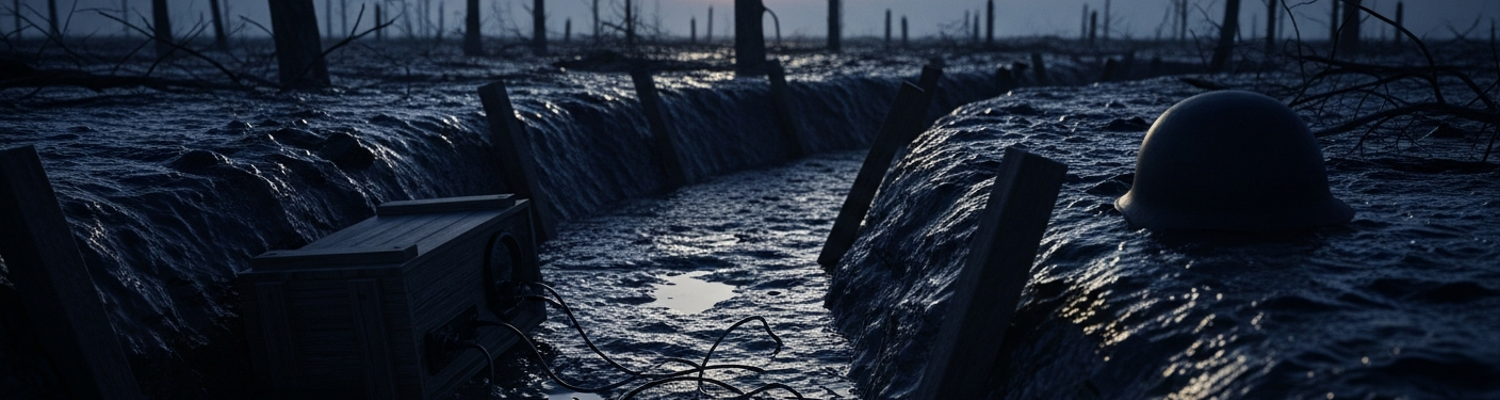

American Expeditionary Forces high command arrived on the Western Front with a doctrine built for a different war. Their concept of “open warfare” was a direct rejection of the static, attritional combat that had defined the European experience for years. It prioritized infantry marksmanship, rapid advances, and aggressive bayonet charges. In this model, artillery was a responsive tool, not a blunt instrument for prolonged bombardment. General Pershing’s ideal was fire and movement, where forward observers would advance with the infantry, identify targets of opportunity, and relay targeting data back to gun crews for immediate suppression. This was intended to restore mobility to the battlefield and allow American divisions to avoid the set-piece slaughters of their allies. The entire theory rested on speed, accuracy, and perfect coordination between the observer and the gun pit.
This doctrinal theory met its end in the physical environment of the Western Front. A close review of operational logs from the Meuse-Argonne offensive reveals a near-total collapse of the concept under the weight of German artillery.
The primary communication channel for this rapid-fire doctrine was the field telephone. Its connection was a simple, fragile wire. Signal Corps linemen were tasked with laying and maintaining tens of thousands of miles of these combat lines. They unspooled them from reels on trucks or by hand through a landscape already shattered by years of fighting. The wires were laid across ground pulverized into a fine dust, through mud that could swallow a man, and across fields of view dominated by enemy machine guns. Constant, heavy artillery bombardment meant these lines were perpetually being cut. A single high-explosive shell could sever communications for an entire sector, leaving forward observers isolated and advancing infantry without their protective fire.
Finding and repairing these breaks was an exercise in futility. Linemen crawled through the chaos, often under direct fire, attempting to locate two severed ends of a thin copper wire in a cratered moonscape and splice them back together. Every explosion was a potential disconnection. The linchpin of American offensive theory became its most significant point of failure.
The AEF arrived in France with a critical shortage of modern equipment and was forced to rely on its allies from the outset. The Signal Corps had entered the war with outdated radio sets like the SCR-49 and SCR-50, capable only of Morse code. They had to adopt French and British communication methods to function at all. This meant an initial dependence on French field telephones and howitzers. Advancing units even resorted to using captured German communication wires. The British Fullerphone, a more secure telegraph device that resisted eavesdropping, was also adopted to counter German signal intelligence. While these foreign systems filled a crucial gap, they were the technologies of a static war. American signalers and artillerymen had to learn these systems while simultaneously attempting to adapt them to their own doctrine of mobile warfare. A tactical friction developed between the static-war equipment they possessed and the open-warfare doctrine they were ordered to execute.
The continuous failure of field telephone lines under relentless shelling created an urgent need for a wireless alternative. Signal Corps planners saw radio as the only viable path to realizing the AEF’s doctrine, a way to unshackle forward observers from the fragile copper wire. The hope was that radiotelegraph and, eventually, radiotelephone sets could provide continuous communication between advancing infantry and supporting guns. This turn to wireless technology introduced a new set of challenges at the ground level.
The first attempted solution, the SCR-54, was not a purpose-built infantry radio. It was an adaptation of a French aircraft receiver, designed to allow artillery batteries to receive targeting coordinates from observation planes. It was a receiver only, incapable of transmitting. Its core technology was a primitive crystal detector made of galena, which required constant, delicate adjustment with a “cat’s-whisker” wire to find a receptive spot on the crystal. This adjustment was difficult in a quiet laboratory; in a trench under bombardment, it was nearly impossible. A nearby explosion or a heavy footstep could knock the whisker off its sensitive point, instantly severing communication. Housed in a wooden box, the complete SCR-54 kit with its BA-4 battery, antenna, and accessories was bulky. Its fundamental limitation was its fragility and the one-way nature of its communication. A forward observer with a transmitter could not know if his message was ever received by the SCR-54 operator at the battery. The system was blind.
The SCR-77 was intended to be the answer. A true two-way radiotelegraph, it was designed for forward area use. “Portable” was a relative term. The entire set, including its spark-gap transmitter, receiver, batteries, and a hand-cranked generator, could weigh over 200 pounds. It had to be broken down into multiple wooden crates carried by a team of soldiers. Moving the SCR-77 across a battlefield was a slow, exhausting process that made its crew a prominent target. Its effective range was severely limited. While theoretically capable of several miles, the shattered terrain of the Western Front, with its hills, forests, and metallic debris, often reduced its reliable range to less than a mile. The set’s most significant vulnerability was its large, conspicuous antenna, which was required for transmission and acted as a magnet for German artillery and machine-gun fire.
German communication capabilities reveal a different technological philosophy. While also reliant on vulnerable telephone wires, German industry had produced more robust and practical trench radio sets. More significantly, German units made extensive use of optical signaling systems, or Lichtsprechgerät. These devices, developed by firms like Carl Zeiss, transmitted voice communications over modulated beams of light, sometimes using infrared filters to make them invisible to the naked eye. This method was secure from Allied eavesdropping and, being wireless, was not subject to shell damage in the same way as telephone lines. Its primary limitation was the requirement for a direct line of sight between stations, making it unsuitable for highly mobile advances over broken ground. In the established trench systems of 1918, however, it provided a reliable and secure channel for communication between key points. The AEF possessed no equivalent system.
A forward observer’s world was a narrow one. In the Meuse-Argonne sector, the natural environment was the first enemy. Heavy autumn rains turned shell craters into viscous pools of mud. A persistent, suffocating fog could cling to the broken terrain for days, reducing visibility to less than a yard. An observer, lying in a hastily scraped hole, was rendered completely blind by this weather, his primary function nullified before the first shot was fired. When the fog did break, the night brought a different kind of visual assault. German practice involved the widespread use of signal pistols like the Hebel Model 1894, which launched brilliant white flares. These were not just for illumination. Fired directly at suspected American positions, the intense magnesium glare would temporarily blind an observer, destroying his night vision for critical minutes and starkly silhouetting him for machine gunners. Then there was gas. German artillery doctrine mixed high explosives with chemical shells. An observer wearing his cumbersome respirator could barely see or breathe, let alone use his field glasses. Worse was dichloroethyl sulfide, or mustard gas, which had a delayed effect and lingered in the soil for days. Contact with the contaminated earth caused severe chemical burns. Its most terrifying effect was on the eyes. Exposure led to agonizing inflammation, swelling, and the feeling of grinding sand under the eyelids, often progressing to temporary or permanent blindness. Over 90 percent of soldiers exposed to mustard gas sustained eye injuries.
Archival medical reports document a condition soldiers called “shell shock.” Symptoms included uncontrollable tremors, paralysis, amnesia, and sensory loss like hysterical blindness or deafness. This was the direct result of existing in an environment of perpetual, random violence. An artillery observer was stationary, a fixed point in a landscape being systematically erased by high explosives. The sound of an incoming shell, the ground-shaking concussion of a near miss, and the screams of the wounded were the unending soundtrack to his work. Men lived in a state of high-alert exhaustion where sleep was impossible. The very act of observation, peering over a parapet or through a periscope, invited a sniper’s bullet. Operational logs show that observer teams were high-priority targets for German marksmen. This unending stress degraded the functions necessary for the job. Calculating distances, reading maps, and transmitting coherent grid coordinates required a level of concentration that the battlefield was designed to shatter. Many men simply broke. They were found paralyzed by fear, unable to speak or move.
Maintaining any coherent situational awareness under these conditions was a near impossibility. The German Army had spent four years perfecting its defensive positions, often building them on reverse slopes, shielded from direct observation. From his compromised vantage point, an AEF observer might only catch a fleeting glimpse of a machine-gun crew relocating, a target that would be gone long before a fire mission could be requested and executed. The battlefield was not a static map but a fluid, lethal space of instant change. German doctrine stressed rapid, decentralized counter-attacks by specialized Sturmtruppen, meaning a sector that appeared clear one moment could be swarming with enemy infantry the next. The observer’s knowledge was a fragmented mosaic of smoke, fog, and terror.
The physics of early wireless technology ensured that clear communication was a theoretical luxury. AEF radio operators were equipped almost exclusively with spark-gap transmitters, devices that generated radio waves through a powerful electrical spark. By their nature, these transmitters produced an electrically “noisy” signal spread across a wide band of the spectrum. Careful frequency planning was required simply to keep friendly sets from drowning each other out. Layered on top of this inherent chaos was the environment. Atmospheric conditions, especially the electrical storms common to European autumns, filled the ether with static that could render Morse code transmissions unintelligible. The true crisis, however, came from the battlefield itself. In sectors like the Meuse-Argonne, with hundreds of guns firing continuously, the air was filled with the electromagnetic pulse of exploding shells. This constant, violent wash of radio frequency interference turned an operator’s headphones into a storm of noise, beneath which the faint tone of a Morse signal struggled to be heard. The physical concussion of near-misses was just as destructive. The ground-shaking shockwaves could instantly knock the delicate “cat’s-whisker” wire off its contact point on a receiver’s galena crystal or shatter the fragile vacuum tubes of the newer sets, severing contact in a single jolt.
A massive gulf existed between the orderly instruction received by Signal Corps personnel and the functional anarchy of the front line. A recruit’s training took place in the quiet, academic setting of a stateside university like Yale or in organized field exercises at camps in France. There, he learned the proper, systematic deployment of his equipment, following manual instructions for laying out long wire antennas to achieve maximum range and clarity. He practiced sending and receiving messages using formal protocols. Some men were sent to the front with as little as three weeks of such instruction. This training was immediately invalidated by the conditions of combat. An observer team did not have the luxury of finding a clear, flat space to unspool a 120-foot antenna; they were lucky to string a short, damaged wire between the lips of two adjacent shell craters, drastically reducing their signal strength. An operator had to tune his fragile set while covered in mud, his hands shaking from cold and fear, often fumbling with the controls through thick gloves or the fogged-up eyepieces of a gas mask. The rigid message formats and call signs learned in a classroom evaporated, replaced by frantic, abbreviated bursts of Morse code as German stormtroopers swarmed a position.
The most frequent cause of lost contact was the simple destruction of the equipment and its operators. A radio team was an immediate and high-priority target. The process of moving a set like the SCR-77, with its multiple wooden crates weighing over 200 pounds total, was slow and highly visible. Setting up the hand-crank generator and, most critically, erecting the transmitting antenna, was an open invitation for German machine gunners and artillery observers. Their own doctrine prioritized the elimination of enemy command and communication posts. Archival analysis of after-action reports from the Meuse-Argonne campaign reveals the constant loss of radio links as a recurring tactical problem. A single high-explosive shell did not need to score a direct hit. The shrapnel from a near miss could shred an antenna, disable the generator, or kill the exposed soldiers working the set. When a direct hit occurred, the entire position was obliterated, the wooden radio crates splintering into fragments alongside their operators. For the infantry units depending on that link, the result was catastrophic. A platoon pinned down by machine-gun fire or a company preparing to repel a German counter-attack would suddenly find itself alone, its calls for artillery support met with unresponsive silence.
A review of German operational doctrine reveals a clear tactical priority. The decapitation of enemy command and control. This placed every American Signal Corps specialist, whether a lineman unspooling wire or a radio operator erecting an antenna, directly in the crosshairs. They were not incidental casualties; they were specific, high-value targets. During the Meuse-Argonne Offensive, where the AEF suffered over 122,000 casualties, the work of the signalman was a near-certain path to becoming one of those numbers. The simple act of stringing a telephone wire across open ground, a task performed while exposed to direct enemy observation, drew immediate machine-gun and mortar fire. Radio teams were even more vulnerable. The large, conspicuous antennas required for transmission acted as beacons for German artillery spotters, who would methodically bracket and destroy the position.
Archival analysis of after-action reports from divisions like the 77th and 28th shows that the highest losses were often among the men sent out to fix the perpetually severed communication lines. The task of the lineman was an ordeal of grim courage. A single artillery barrage could cut a combat wire in dozens of places. Repair teams, often just two men, would have to crawl out from their trench or shell hole into the kill zone, moving through mud thick with poison gas and human remains, to find the two broken ends of a single copper strand. They followed the line by hand, fully exposed, until they reached the break. There, with frozen fingers, often under the light of enemy flares, they would have to scrape the insulation from the wires and splice them back together. A nearby shell burst could undo their work in an instant or kill them outright. Many linemen were killed while carrying their heavy reels of new wire, their bodies found tangled in their equipment.
The enormous gap between stateside training and frontline conditions forced constant, desperate improvisation. Signalmen who had learned to operate radios in controlled environments now had to make them work while covered in filth and under direct fire. When a standard-issue antenna was destroyed by shrapnel, operators would string up scavenged German wire or any other available metal fragment between shell craters, creating weak, inefficient antennas that were just barely functional. Formal Morse code protocols learned in training camps were abandoned for frantic, abbreviated bursts meant to convey coordinates before the position was overrun. Linemen became experts at salvaging equipment, splicing together different types of French, British, and American wire to keep a circuit active. When their own lines failed completely, some teams resorted to tapping into abandoned German communication wires, using enemy infrastructure to support the American advance. This resourcefulness extended to the very power sources of their equipment, with men jury-rigging battery packs and hand-crank generators that had been damaged by shock or moisture.
A close examination of AEF operational records reveals an intelligence apparatus forced into existence by battlefield necessity. The United States entered the war catastrophically unprepared for radio intelligence. This became immediately apparent when British counterparts informed AEF command that they had identified huge portions of the German order of battle simply by listening to and decoding radio messages. This prompted the rapid formation of the Radio Intelligence Section (RIS), also known as G-2 A6, under Captain Frank Moorman on July 28, 1917. Starting with almost no dedicated equipment or trained personnel, the RIS had to build its entire operation from scratch, initially leaning heavily on French and British hardware and expertise. The core of the early effort involved establishing listening stations near the front lines to intercept German radiotelegraph traffic around the clock. These stations, sometimes jointly manned with French operators, used rudimentary receivers and specialized goniometers, a type of radio direction-finding antenna, to pinpoint the location of enemy transmitters. The process was a painstaking triangulation exercise. By having two or more stations take a bearing on the same Morse code signal, intelligence officers could plot the intersecting lines on a map to locate a German headquarters or artillery battery. By war's end, a network of eight American listening stations had intercepted over 72,000 German messages.
Raw intercept was useless without decryption. Here, AEF intelligence personnel faced a formidable challenge. German radio security was layered. For high-level communications, the German Army used the ADFGVX cipher, a complex system invented by Colonel Fritz Nebel. This cipher first substituted each letter of a message with a two-letter pair from a 6x6 grid, then scrambled those pairs using a columnar transposition based on a secret keyword. The six letters, A, D, F, G, V, and X, were specifically chosen because their Morse code equivalents are highly distinct, reducing the chance of transmission errors. At the tactical level, German units used simpler but frequently changed three-number or three-letter codes within the forward trench systems. Even when a simple code was broken or a message was sent in the clear, a significant language barrier remained. The RIS required a constant supply of German-speaking analysts to translate the traffic. Any delay in translation could render the intelligence obsolete. Despite these difficulties, the combined Allied effort, particularly the work of French cryptanalyst Georges Painvin, led to breakthroughs, including a famous intercept that helped blunt a major German offensive in June 1918.
When the ether was silent or filled with impenetrable code, intelligence gathering reverted to its most primitive forms. The first fallback was the listening post, often nothing more than a shallow pit or shell crater occupied by two or three soldiers in the middle of No Man’s Land. Sometimes located just 30 yards from the enemy’s front line, these positions, also called “sap-heads,” were used to physically overhear German activity. The occupants, dangerously exposed and isolated, would lie motionless for hours, listening for the sound of digging, the metallic clatter of wiring parties, or orders being shouted. These posts were prime targets for enemy raids and artillery. In some sectors, both sides employed elaborately camouflaged observation posts disguised as dead or shattered trees, complete with armored interiors and periscopes, to watch enemy lines unseen.
If an observer in a listening post gathered critical information, or if any forward unit was completely cut off from electronic communication, the final link was the human runner. This was one of the most dangerous jobs in the infantry. Typically a low-ranking soldier chosen for his fitness and agility, a runner was equipped with little more than a sidearm and a gas mask. His task was to physically carry a written or memorized message across a landscape designed to kill him. He navigated zig-zagging trenches and, in the worst cases, sprinted across open ground raked by machine guns and bracketed by artillery. Because the risk of a runner being killed or wounded was so high, commanders often dispatched the same message with two or three different runners via separate routes, hoping that at least one would make it through.