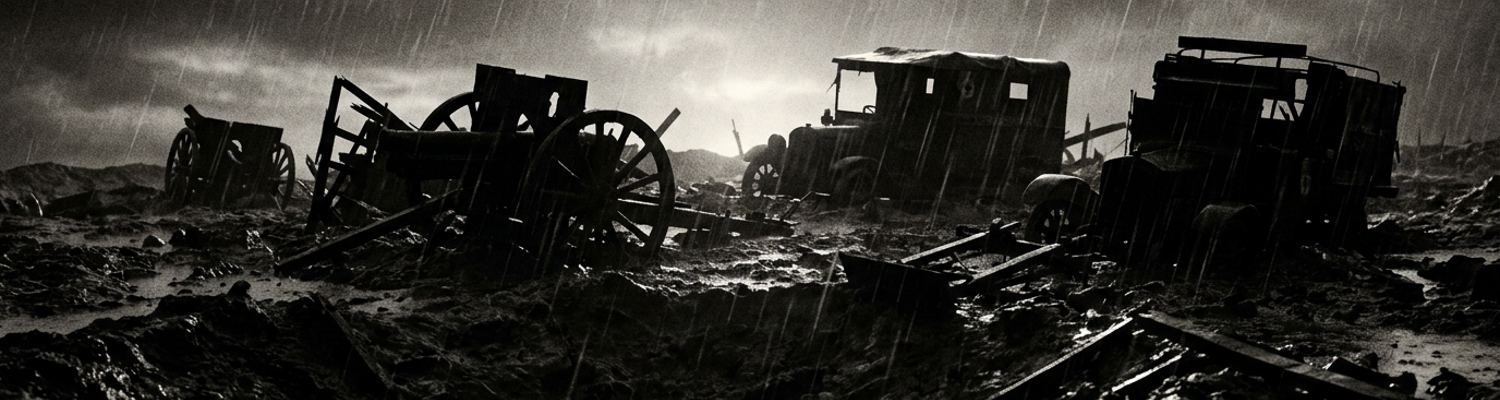

Post-Action Evacuation Crisis at Cheppy Ravine
United States Army Field Service Regulations promised a continuous chain of litter-bearers. They guaranteed motorized ambulance convoys. These systems were supposed to move a casualty from the front line to an evacuation hospital within four hours. Outside Cheppy on the morning of September 29, 1918, men lay untreated in the freezing mud for sixty hours. Deep shell holes along the Cheppy-Varennes road held clusters of shattered infantrymen from the 137th and 138th Infantry Regiments. These soldiers received neither dressings nor water.
The rain did not stop.
When examining the historical record of the Aire Valley fighting, the physical cost of exposure emerges across every medical log. Scores of wounded American soldiers succumbed to shock and hypothermia while awaiting evacuation in forward assembly pockets outside Cheppy. Temperatures dropped into the low forties each night following the initial September 26 assault. This weather saturated the clay slopes of the ravine with rainwater and runoff from German artillery churn. Men with penetrating abdominal wounds and shattered femurs were deposited on canvas stretchers directly onto the sodden earth. Their woolen uniforms soaked through with trench mud and blood. Blanket stocks sat trapped eight kilometers to the south in the supply jam at Boureuilles.
Stretcher bearers stripped nearby German dugouts of tarpaulins and overcoats to shelter the accumulating casualties. Wet cloth provided no defense against prolonged drops in core body temperature. By the third night vascular collapse killed dozens before triage tags could be written. Battalion surgeons ran out of morphine and iodine by noon on September 28. Orderlies watched as secondary shock stopped the hearts of soldiers whose initial battle trauma was survivable.
Internal bleeding paired with cold wet soil turned minor limb wounds fatal.
Archival evidence shows that senior American Expeditionary Forces medical inspectors documented a near-total breakdown of division-level casualty handling by September 29. First Army inspectors entering the Cheppy sector found dead and dying soldiers scattered across four hundred yards of torn terrain around the ruined sugar refinery. They lacked food, shelter, or medical sorting. Colonel Alexander N. Stark observed that the 35th Division surgeon had lost control of his subordinate units. Ambulance companies from the 110th Sanitary Train wandered disconnected along secondary tracks. They failed to establish forward clearing stations. Hand-drawn field maps compiled by the inspecting officers showed motorized Model T ambulances sitting bumper-to-bumper behind bogged artillery caissons on the single north-south corduroy track through the ravine. They were completely immobilized.
Wounded men crawled into roadside ditches to avoid being run over by iron-rimmed ammunition carts.
Inspectors noted that division headquarters had received zero casualty estimates from the forward brigades for thirty-six hours. This blinded rear-area field hospitals to the thousands of incoming surgical cases.
Only four of the division's twelve operating tables were active.
A close review of operational logs indicates that the 110th Sanitary Train abandoned thirty-two motor ambulances along the Cheppy corduroy road. Cracked axles and empty fuel tanks caused this abandonment on the afternoon of September 29. Replacement drivers sent forward lacked maps of the regimental aid posts. They dumped litter patients at an abandoned German ammunition dump two miles north of Neuvilly without medical supervision. Inspecting officers counted seventy-eight unattended corpses stacked beside the road at coordinates 04.2-71.8 by sunset.
Exhaustion of Supplies at Field Hospital 139
Archival evidence shows that Field Hospital 139 established its primary dressing station within the splintered timber frames of an orchard south of Cheppy. This occurred at map coordinates 04.8-71.2 on the morning of September 27. Field Hospital 139 and forward battalion aid stations completely exhausted surgical dressings within 36 hours of the initial artillery jump-off. They also ran out of splints and injectable morphine.
Regimental stockpiles vanished.
Standard divisional supply tables allotted each battalion aid station forty individual first-aid packets. They also provided twelve Thomas splints and forty quarter-grain morphine sulfate tablets for three days of continuous combat. German counter-battery barrages from the heights of Montfaucon inflicted more than two thousand casualties across the 137th, 138th, 139th, and 140th Infantry Regiments before the second night had fallen. Forward surgeons of the 137th Infantry along the sunken road leading toward Charpentry cut open their final packs of compressed gauze before noon on September 27. Litter bearers arriving from the front line carried soldiers with open femur fractures. Telephone wire and splinters from destroyed artillery wagons held these broken bones together. Medical supply trucks attached to the 110th Sanitary Train sat pinned seven kilometers south in Neuvilly. Military police prohibited soft-skinned logistics vehicles from using the single crushed-stone corridor reserved for ammunition caissons.
By dusk on September 27 the division expended its last syrette of injectable morphine.
A close review of operational logs indicates that the depletion of critical items paralyzed surgical processing across all four brigades. Regimental surgeons running aid posts in abandoned German concrete shelters near Hill 221 were forced to immobilize compound fractures using willow branches wrapped with stripped copper wire. Dressings were stripped off dead soldiers to bandage the open chest wounds of incoming casualties. Stretcher bearers tore the lining out of standard-issue rain ponchos and woolen overcoats to compress arterial bleeds. Bacterial contamination spread through open abdominal injuries within hours. Muddy water pooled on the floorboards of the triage shelters. Medical requisition runners sent south along the Cheppy ravine on foot reached the division depot at Rarecourt. They found the supply storehouses empty of sterile materials. First Army railheads at Saint-Mihiel had failed to dispatch second-echelon medical trains forward.
Sterile gauze ceased to exist across the entire divisional sector.
When examining the historical record of the 110th Sanitary Train, unarmed Medical Corps officers were forced to triage hundreds of severe shrapnel wounds without basic anesthetics or antiseptic material. Division regulations strictly prohibited medical officers from carrying sidearms or trench knives into forward sectors. They were defenseless while managing masses of screaming patients crammed into the mud outside Cheppy. High-explosive 77-millimeter and 150-millimeter artillery fragments left ragged lacerations packed with manure and toxic topsoil. Chloroform and ether containers brought forward in medical chests had shattered during the initial transport over shell-cratered tracks. Surgeons used unsterilized manual bone saws to amputate mangled limbs on open canvas cots. Four enlisted orderlies physically held the screaming soldier down. Iodine ampoules had run out during the first twelve hours. Corpsmen washed deep tissue lacerations with unfiltered river water boiled over smokeless ration heaters.
Triage classifications were written in blue grease pencil directly onto the foreheads of dying men.
This indicated which cases were too far gone to receive intervention. Operating logs from the 35th Division show that Field Hospital 139 processed 1,142 wounded men between September 27 and September 29 without a single can of operative anesthetic in stock. Major medical officers drafted written reports to the corps surgeon requesting immediate air drops of ether, bandages, and antiseptic solution directly onto coordinates 05.1-72.3. No aircraft were allocated to medical resupply duties. Surviving surgeons discarded contaminated sponges into roadside ditches. They stitched abdominal wounds with unsterilized cotton sewing thread recovered from abandoned German knapsacks.
Evacuation Sap Failures in Captured Trenches
A close review of operational logs indicates that the collapse of casualty evacuation through the Cheppy Ravine stemmed directly from catastrophic drainage failures inside captured German defenses. German construction battalions had spent three years fortifying the ravine sector with concrete revetments. They built interlocking timber revetment walls and subterranean box-flume drains designed to funnel torrential runoff into lower creek basins near the Aire. Elements of the 138th Infantry stormed these trench complexes on September 26. Intense preparatory artillery fire from both sides had fractured the timber floorboards and smashed the recessed wooden culverts.
Company B and Company C of the 110th Engineer Regiment arrived without diaphragm trench pumps.
They lacked replacement timber planking or heavy picks needed to clear the crushed drain mouths. Hand-litter teams assigned to the 137th and 138th Infantry Regiments were forced to trample through cracked duckboards to move casualties south toward the ravine exit at map coordinates 04.4-71.9. This constant foot traffic broke the remaining sub-floor drainage tiles. Thousands of gallons of surface water became trapped behind barricades of displaced soil and shattered duckboards.
Drainage ditches became static catch basins.
Archival evidence shows that these damaged communication saps rapidly deteriorated into continuous channels of liquid clay and toxic chemical runoff. German artillery units positioned on the ridges around Montfaucon dropped hundreds of yellow-cross dichloroethyl sulfide shells and blue-cross diphosgene rounds into the Cheppy depression between midnight and dawn on September 28. Heavy autumn rain dissolved these persistent vesicant agents. Chemical oil slicks washed down trench parapets straight into the evacuation pathways. Liquefied clay rose to a depth of three to four feet throughout the primary zigzag evacuation sap connecting forward regimental aid posts to the Cheppy sugar mill. Hand-litter squads were already physically spent after forty-eight hours of continuous carry details without rations. They found it physically impossible to lift canvas stretchers above the fluid line.
Four-man bearer teams sank past their knees into viscous muck.
This created an adhesive vacuum with every step. The suction tore the soles off standard-issue marching shoes. Canvas litters inevitably sagged into the liquid. Bandages and open flesh wounds soaked in mustard-gas effluent. This burned exposed tissue down to the muscle fascia within twenty minutes of contact.
Litter teams abandoned their stretchers directly in the mire.
When examining the historical record of the 110th Sanitary Train, medical officers documented total gridlock along every tributary trench leading out of the 69th Infantry Brigade front. Hand-litter movement slowed to fifty yards per hour inside the saps. Divisional tables had estimated a speed of two miles per hour over open ground. Bearers carrying compound-fracture cases from Hill 221 were forced to balance heavy wooden-framed litters on their shoulders to keep patients out of the gas-laced water. Slips were frequent and lethal. Dropped litters flipped in the narrow trenches. Immobilized soldiers were pinned beneath murky runoff before team members could regain footing against the suction of the clay floor.
At several sharp traverse angles near coordinates 04.9-72.4, dead bodies formed underwater dams.
Discarded Springfield rifles and abandoned wicker shell baskets added to these blockages. This raised the water level to the chest line of walking wounded. Battalion surgeons attempted to establish an alternate overland carry route along the crest of the ravine on September 28. Concentrated fire from German Maxim 08 machine guns on the flanking heights drove surviving bearers back into the submerged communication lines. By the afternoon of September 29 the chief surgeon of the 137th Infantry reported that three hundred yards of the primary regimental sap held eighty submerged stretchers. They could neither advance nor retreat. Litter-bearers were completely incapacitated by chemical burns across their legs and groins.
Hand-Litter Relays and Bearer Casualties
A standard two-man litter squad carrying an incapacitated soldier could not maintain continuous footing across fifty yards of churned Meuse-Argonne soil.
Archival evidence shows that stretcher teams required six to ten hours to carry individual casualties across pulverized shell fields to regimental aid posts. The linear distance measured barely two kilometers between the forward assault lines near Charpentry and the regimental aid post established in a sunken chalk road south of Cheppy at map coordinates 04.1-72.6. German counter-preparation bombardments had overlapped three years of crater networks. The clay terrain became an obstacle course of five-foot craters filled with yellow water, tangled concertina wire, and unstable spoil banks. Four-man teams from the 139th and 140th Infantry Regimental Medical Detachments bore the weight of regulation ash-wood and canvas litters weighing twenty-two pounds. They were loaded down with adult soldiers who often weighed over one hundred and eighty pounds with saturated uniforms and mud-caked equipment.
Bearers sank past their mid-calves on every step.
Sucking mud tore heels away from trench boots. Soldiers hauled litters while barefoot or wrapped in burlap strips. Teams negotiated each forty-foot crater rim by dropping to their knees. They dragged the litter frame inch by inch over broken limestone rubble. This prevented compound fracture patients from rolling off into contaminated water.
The journey broke the physical endurance of four-man teams within five hundred yards.
When examining the historical record of the 110th Sanitary Train, relay posts designed to sit every four hundred yards along the axis of evacuation failed to function as planned. Medical officers had designated three intermediate hand-litter relay stations between the Baulny ridge and the Cheppy ravine. Eight replacement bearers from Ambulance Company 139 staffed each station. By the morning of September 28 these collection posts were empty. Inbound teams arriving with thoracic and head cases found no relief personnel waiting in the shell scrapes. Bearers who had already completed five hours of continuous physical labor were forced to retain their grips on the litter poles. They dragged patients across an additional mile of terrain toward the railway embankment at coordinates 03.8-71.5. Hand muscles cramped into fixed spasms. Orderlies at the aid post had to physically pry open the frozen fingers of bearers with metal tongue depressors.
Stretcher poles snapped under the wet weight of waterlogged stretchers.
A close review of operational logs indicates that high rates of physical exhaustion and direct artillery fire reduced forward litter-bearer strength by more than half within forty-eight hours. The four infantry regiments entered the offensive on September 26 with approximately six hundred authorized litter bearers distributed across company detachments and sanitary train units. By dusk on September 28 fewer than two hundred and seventy remained operational. German forward observers stationed on the crest of Hill 221 directed observed 77-millimeter shrapnel fire onto exposed carry squads attempting overland transit. They paid zero heed to white Geneva brassards. Exploding air-burst rounds swept the open plateaus outside Charpentry. Twelve bearers from the 137th Infantry were shredded in a single ten-minute barrage on the morning of September 27. Those who escaped blast fragmentation collapsed from acute physical breakdown.
Men went sixty hours without hot rations or potable water.
They drank sulfurous surface liquid from crater basins. This triggered acute bacillary dysentery and uncontrolled vomiting along the trail. Company commanders attempted to draft combat riflemen from the 69th Infantry Brigade to replace fallen medical personnel. They discovered that frontline battalions were already below fifty percent combat effectiveness from machine gun fire. At 1800 hours on September 28 the surgeon of the 140th Infantry recorded that forty-two casualties lay immobilised on the forward face of Hill 218. Only three able-bodied bearers were left standing in the entire second battalion sector.
Ambulance Gridlock Along the Vauquois Defile
A close review of operational logs indicates that the collapse of the 35th Division casualty extraction began twenty-four hours before the first artillery salvo was fired. On September 25, 1918, the 110th Sanitary Train became hopelessly gridlocked along the corduroy track from Neuvilly to Vauquois. First Army logistics planners had funneled twenty-seven thousand men, nine thousand draft animals, and hundreds of motor transport vehicles onto a single four-meter-wide corduroy track. This track was laid over the destroyed terrain north of Neuvilly-en-Argonne at map coordinates 02.1-66.8. Engineers had constructed this passage out of split pine logs laid crosswise over churned marshland and shell craters. Heavy afternoon rain on September 25 liquefied the subsoil beneath the timber beds. The round logs shifted, floated, and separated under continuous wheel traffic.
Three-ton Packard supply trucks from the 110th Motor Supply Train slid off the untreated wood into roadside craters.
Their heavy differentials sank into bottomless clay. This stopped all northbound movement. Two full companies of sanitary train vehicles halted completely along the narrow defile flanked by steep, wire-strewn slopes.
Two entire columns of forward transport halted without a single bypass route.
Archival evidence shows that motorized Dodge ambulances were stranded miles behind the assault lines before zero hour. They were unable to bypass stalled animal-drawn supply trains. Division surgical orders directed Ambulance Company 139 and Ambulance Company 140 to position their four-cylinder Dodge light motor ambulances within direct contact distance of the 69th and 70th Infantry Brigades at the jump-off trenches near Vauquois by midnight. These light motor vehicles sat bumper-to-bumper four miles south of their assigned positions. Escort wagons and caissons belonging to the 110th Ammunition Train and the 129th Field Artillery occupied the same nine-foot timber corridor. Exhausted six-horse teams drew these wagons. The animals collapsed in their harnesses. Dead horses were cut from their traces and rolled into the ditches. Overturned artillery wagons blocked the single-lane track completely. Drivers attempted to steer their 35-horsepower Dodge ambulances around the horse-drawn wreckage. They plunged into swampy verges. Cast-iron steering knuckles snapped. Driving axles sheared against concealed tree stumps.
Military police stationed at the Neuvilly crossroads had no telephone wire connection to Vauquois.
They possessed no authority to divert artillery caissons to clear a passage for medical vehicles. Zero hour arrived while the division motorized medical transport sat completely immobilized in Neuvilly.
When examining the historical record of the 110th Sanitary Train, medical officers found themselves physically cut off from the assault battalions before the infantry left their jump-off trenches. At 0530 on September 26 the 137th and 138th Infantry Regiments advanced into the German barbed wire belts under heavy machine gun and artillery fire. Not a single motor ambulance was north of Vauquois Hill. Forward aid stations established in former German trenches at coordinates 03.5-70.2 had immediate casualty rosters numbering in the hundreds. The ambulance drivers four miles south were ordered to keep their engines idling in cold rain. Sustained low-gear idling fouled spark plugs. Sixty-gallon fuel tanks drained before the vehicles had advanced five hundred yards up the incline. Drivers stripped dry cork clutch facings attempting to push bogged vehicles through wet timber gaps. Twenty-four Dodge chassis stalled with broken transmissions between kilometer posts 18 and 22. Sanitary train commanders attempted to send foot couriers forward to report the obstruction. They discovered that all telephone lines along the Neuvilly corridor had been severed by horse hooves and caisson wheels during the night.
Traffic Control Failures and Roadway Competition
Archival evidence shows that competition for road space turned the single-lane corduroy causeway between Neuvilly and Cheppy into an impassable corridor of broken timber and mechanical wreckage. Gun crews from the 60th Field Artillery Brigade and heavy four-wheel-drive trucks of the 110th Ammunition Train commandeered the logs. They forced outbound motor ambulances directly off the timber planking. Artillery officers prioritized the movement of 75-millimeter caissons and French-built Schneider 155-millimeter howitzers forward. They needed to break the German fallback positions along the Kriemhilde Stellung.
Two-way passage proved impossible along the eight-foot corduroy strip.
Artillery drivers used heavy draft mules and iron-reinforced wagon hubs to crowd the lighter Ford Model T and Dodge ambulances of the 110th Sanitary Train into axle-deep roadside ditches. Lightweight ambulance chassis slipped off wet log edges. Driving gears submerged in thick clay. Steering knuckles snapped against submerged tree stumps. Drivers attempting to winch vehicles out burned through transmission bands. Combat-arms teamsters threatened medical personnel with trench shovels to keep ammunition routes rolling forward.
Steel-rimmed caisson wheels sheared the running boards off immobilized ambulances.
When examining the historical record, First Army military police detachments failed to designate or enforce dedicated casualty evacuation corridors through the devastated forward zone. Provost marshal detachments stationed near the destroyed bridge crossings outside Boureuilles and the Cheppy crossroads possessed neither communications wire nor specific operational instructions regarding sanitary trains. Military police units received orders strictly mandating the forward push of artillery, engineer bridging supplies, and small-arms ammunition carts. Traffic control posts established by the 1st Army Military Police Battalion at coordinates 03.2-68.5 operated without casualty-sorting priorities or return-route plans for empty or full medical vehicles. Provost marshal officers at Varennes and Neuvilly treated medical columns as secondary obstructions rather than protected conduits.
Sentries waved heavily loaded ammunition convoys onto southbound routes designated on map overlays for outbound evacuation.
This forced incoming and outgoing columns into head-on deadlocks. Stalled columns sat paralyzed under intermittent German 105-millimeter battery fire for five hours at a stretch. Not a single military policeman intervened to clear lanes for dying men.
No alternate path existed through the crater fields.
A close review of operational logs indicates that this total lack of corridor enforcement marooned entire ambulance companies in the forward battle sector between September 27 and September 29. Ambulance Company 137 had nineteen Dodge motor ambulances trapped in line behind bogged ammunition limbers near map coordinates 04.1-70.8. Sixty-eight recumbent litter cases were exposed to engine exhaust heat or freezing under cold downpours. Stretcher patients inside these trapped ambulances suffered repeated secondary hemorrhages. Idling engines shook chassis frames for thirty hours continuously. Replacement motor ambulances dispatched from the corps depot at Rarecourt ran dry of gasoline while idling behind stalled five-ton artillery tractors. Spark plugs fouled. Lead-acid batteries drained. Drivers abandoned forty-two vehicles on the roadway between Cheppy and the Neuvilly railhead. Military police refused them right-of-way to return north to pick up the mounting casualties accumulating outside the Cheppy churchyard.
First Army provost logs recorded zero traffic citations or corrective rerouting orders issued across the 35th Division corridor throughout the seventy-two-hour engagement.
Institutional Flaws in First Army Sanitary Doctrine
Archival evidence shows that First Army medical directors built their operational evacuation plans around dry-weather transit formulas. These formulas completely ignored the physical geology of the Argonne. Colonel Alexander N. Stark and the I Corps medical planning staff drafted casualty evacuation routes using pre-war French road maps. They calculated that motorized sanitary trains could sustain an average road speed of twelve miles per hour between frontline clearing stations and the railheads at Souilly and Rarecourt. Planners made zero allowance for the destructive impact of continuous autumn rains on the gaize foundation of the Aire Valley. Porous clay rested directly over impermeable bedrock in this region. Steady downpours saturated the region on the night of September 25. The crushed-limestone surfaces along the axes between Neuvilly, Boureuilles, and Cheppy dissolved under the sheer mechanical weight of heavy transport.
Subgrade soils liquified into an emulsion.
This emulsion swallowed vehicle undercarriages to the axles. Combat engineers prioritized the forward movement of French 155-millimeter howitzers and ammunition caissons. They spread thin gravel over craters rather than installing the timber corduroy or deep side ditches required to prevent water accumulation. This oversight left four-cylinder Dodge and Model T ambulances trapped behind five-ton Holt artillery tractors. The steel treads of the tractors pulverized the remaining roadbed into impassable troughs of liquid muck.
Army staff manuals had calculated road capacities based on static paved arteries in central France.
A close review of operational logs indicates that First Army planners ignored written warnings submitted by French Fourth Army liaison surgeons. These warnings detailed the rapid failure of Argonne cart tracks under heavy autumn moisture. American planners had scheduled sixty motorized ambulances per division to cycle between regimental aid posts and field hospitals twice every twelve hours. Deep ruts along the single-track corridor through the Vauquois defile at map coordinates 02.4-67.1 measured twenty-eight inches deep by September 27. This grounded low-clearance medical transport and sheared drive shafts. Evacuation timetables collapsed. Round trips that planners scheduled for ninety minutes stretched into twenty-four-hour endurance trials.
Paved thoroughfares existed only on outdated paper overlays.
When examining the historical record of American Expeditionary Forces sanitary planning, pre-offensive doctrine drastically underestimated the volume of litter-bearers needed to maintain contact with rapid combat advances across fortified sectors. Tables of Organization allotted only forty-eight litter-bearers to each infantry regiment. Sixteen men were expected to clear the casualties generated by an entire thousand-man assault battalion. Field manuals assumed that infantry units would punch cleanly through defensive lines into open country. This would require brief stretcher carries of no more than eight hundred yards over dry ground before motor transport took over. Combat across the German defensive belts around Cheppy and the Baulny ridge shattered these assumptions within hours. Advancing battalions from the 137th and 138th Infantry Regiments struck interlocking zones of concertina wire, pulverized concrete emplacements, and shell craters up to twenty feet wide. Thousands of wounded men were scattered across two miles of deeply dissected terrain.
Moving an incapacitated soldier over this pulverized obstacle course required six to eight bearers per litter rather than the doctrinal two-man team.
Carrying parties exhausted their physical reserves within five hundred yards. Forward aid stations fell miles behind the assault waves as infantrymen pushed north toward Montrebeau Wood. The authorized allocation of stretcher-bearers could not handle even five percent of the opening day casualties. Surgeons with the 110th Sanitary Train reported that the doctrinal four-bearer relay system broke down completely once casualty density exceeded thirty wounded men per kilometer of front. Staff planning tables had estimated a standard four-man litter squad could evacuate four patients per twelve-hour shift across rough terrain. In the mud outside Cheppy a single casualty evacuation across two kilometers required eight relief squads working across six relay posts. This tied up forty-eight men for eight hours to transport one wounded infantryman. Combat losses among infantry companies prevented front-line officers from detailing riflemen to supplement medical detachments. Over eight hundred wounded men lay untended in water-filled craters along the eastern slopes of Hill 221 by dusk on September 28.