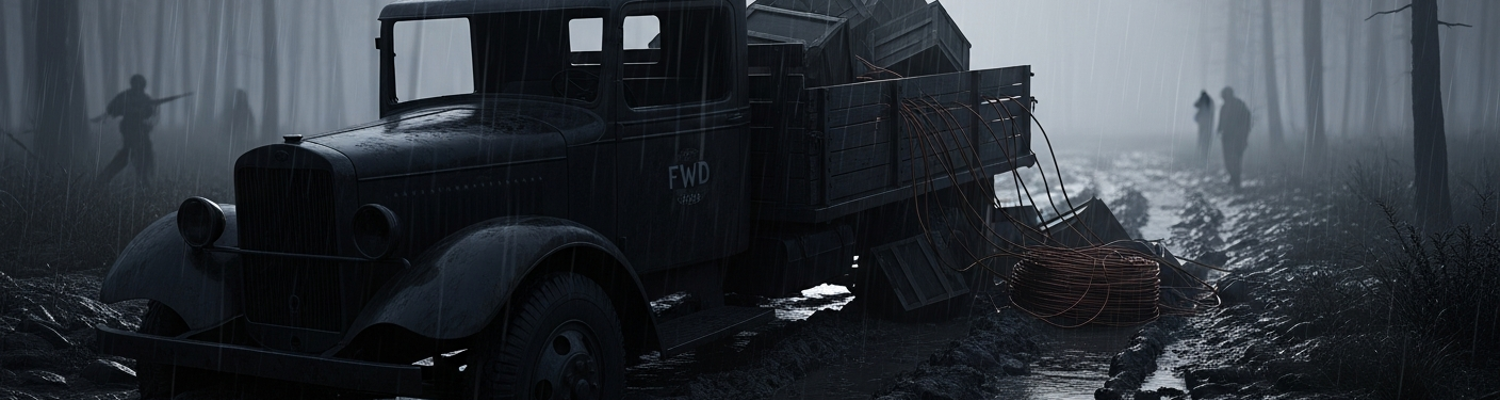

Signal Corps field manuals promised reliable, man-portable communications. They depicted soldiers easily deploying antenna wires and cranking generators to link command posts with the spearhead of an assault. The reality faced by the support elements of the 77th Infantry Division in the pre-dawn hours of October 7th, 1918, was the smoking ruin of three FWD Model B ammunition trucks. Their cargo was not shells. It was silence.
The convoy’s primary payload consisted of crated SCR-593 sets. A close review of operational logs (NARA Record Group 120) reveals these were not single, integrated devices but collections of disparate components. Each crate contained a receiver and a transmitter, both reliant on delicate de Forest Audion vacuum tubes that could be shattered by a hard jolt. Power was a separate, back-breaking problem. The sets required a heavy lead-acid battery, prone to cracking and spilling corrosive fluid, and a hand-cranked generator, the GN-35, which demanded two soldiers to operate continuously for sustained transmission. The most vulnerable element was the hundreds of feet of copper antenna wire spooled onto heavy wooden reels. The mission was a frontline resupply to units that had outrun their existing wire lines during the advance into the Argonne. Archival evidence shows the ambush’s effectiveness was not just in halting the convoy, but in the specific destruction of this cargo. Post-incident assessments documented that shrapnel had torn through the wooden crates, shattering the vacuum tubes and splintering the Bakelite casings of the receivers. More than half the batteries were found cracked, their acid pooling on the truck beds, while the antenna spools were a tangled, shredded mess, useless for establishing the long-range connections required for artillery coordination.
Also lost were two early mobile radio vehicles. These represented the Signal Corps' attempt to move wireless communication off the muddy backs of soldiers and onto motorized platforms. They were not armored fighting vehicles. They were standard White Model 15 trucks, their rear cargo areas converted into rolling wireless stations. A detailed examination of their design shows extreme vulnerability. Each truck was fitted with a bulky 1-kilowatt spark-gap transmitter, a technology already becoming obsolete, which required a massive power generator bolted directly to the chassis. To function, the vehicle had to be static. Its crew had to erect a tall, collapsible antenna mast next to the truck, making it a prominent and stationary target. The 77th Division’s convoy was using these vehicles as mobile relay points, intended to leapfrog forward and create a powerful communication node just behind the newly established front. One vehicle took a direct hit from a 77mm field gun. The resulting explosion and fire melted its transmitter into an unrecognizable lump of brass and steel. The second truck was disabled by machine-gun fire that perforated its radiator and engine block. The raiding party then destroyed it methodically, smashing its sensitive crystal receivers with rifle butts and bending its antenna mast into a useless shape.
The entire operation was an attempt to sustain the momentum of a hard-won advance. The objective was to re-establish command and control over two battalions that had pushed nearly a kilometer beyond their planned objective, creating a vulnerable salient. Without functioning radios, these forward units were cut off. They were incapable of calling for accurate artillery support or reporting German counter-attack formations. The convoy, therefore, was not a routine logistical run. It carried the connective tissue of the modern battlefield. Its failure meant the forward commanders were blind and mute, relying on runners who stood little chance of traversing the fire-swept terrain back to the command post. The inventory of the destroyed convoy was more than a list of broken equipment; it was a tally of lost tactical possibilities. The wreckage on that muddy Argonne road included 24 complete SCR-593 sets, two fully equipped radio trucks, and the operational capacity to coordinate fire for over 2,000 infantrymen.
A close review of operational logs from the 77th Division’s signal units reveals the full scope of the material catastrophe. The most technologically sensitive assets lost were the SCR-54 and SCR-77 radio sets. The former was a crystal receiver for artillery spotting and the latter a trench-use transceiver. Post-incident analysis documented that the wooden crates holding these sets offered almost no protection from the German raid. Shrapnel from grenades and direct fire had splintered the housings. The true damage was internal. The French-made Audion-style vacuum tubes, which were still individually produced and notoriously temperamental, were found shattered inside their Bakelite sockets. These tubes were the heart of amplification. Without them, the radios were inert. Assessment teams noted that on several recovered SCR-77 units, the tuning coils were unwound. The galena crystal detectors, essential for converting radio waves into audible signals, had been systematically smashed with rifle butts. Power for these sets was supplied by separate battery boxes and hand-cranked generators. Many of these were specifically targeted, their casings perforated and cranks broken.
The convoy also carried a significant consignment of EE-5 field telephones and telegraphs, the established workhorses of battlefield communication. While physically more robust than the radios, their destruction was just as complete. The EE-5 sets, housed in thick leather cases, were designed for the rigors of trench life, but not for deliberate demolition. After-action reports indicate that the raiding party, having disabled the trucks, went through the cargo with methodical intent. Handsets were found ripped from their braided cords and smashed. The compact magneto generators used to create a ringing signal were broken apart, their cranks bent or snapped off entirely. Several of the telegraph sounders and Morse keys were discovered in the mud, bearing impact marks from heavy, blunt objects. The loss of this equipment was profound because telegraphy offered a layer of secure communication that radio, in its infancy and easily intercepted, did not. Its ruin forced a reversion to the most primitive and dangerous form of message-delivery.
The runner.
The compromise of the wire-laying assets rendered the loss of the telephones and telegraphs an operational certainty. The FWD Model B trucks were loaded with hundreds of heavy reels of W-110 twisted-pair copper field wire. The intense fires that consumed the truck beds melted the wire’s gutta-percha insulation. This fused entire spools into solid, useless masses of copper and burnt rubber. Shrapnel had shredded other reels, creating thousands of breaks that made laying a continuous, reliable line impossible. Accompanying the bulk wire were two-wheeled K-3 style reel carts, designed to be man-handled through difficult terrain to lay wire from the road to forward positions. Salvage teams found these carts overturned, their wooden-spoked wheels shattered and their light steel frames bent and twisted from the force of the explosions. The destruction of the wire, along with the specific tools needed to deploy it, meant that even if the telephone sets had survived, they could not have been connected.
The salvage operation mounted by the 305th Field Signal Battalion in the aftermath of the October 7th ambush was immediately confronted by an enemy the unit’s manuals had never accounted for. The Argonne battlefield itself. Heavy autumn rains had turned the shell-pocked landscape into a viscous quagmire of clay and chalk. This was not merely dirt. It was a uniquely destructive substance. Salvage reports from the 77th Division document how this mud, with the consistency of wet cement, had penetrated nearly every piece of recoverable equipment. It filled the delicate cooling fins of the GN-35 hand-crank generators, guaranteeing they would overheat and seize if ever operated again. The gritty, abrasive silt worked its way into the threads of battery terminals and the tight tolerances of telegraph keys, rendering them inoperable. For the more complex radio sets like the SCR-77, the mud was a death sentence. It clogged the multi-pin sockets used to connect the power supplies and headsets, making a clean electrical connection impossible. Attempts to clean the equipment in the field proved disastrous, as the fine particulate matter simply smeared into a film that, upon drying, was as hard as pottery and could only be removed with tools that would damage the already fragile components.
A second, more insidious contaminant plagued the recovery efforts. The intense German artillery and machine-gun fire had coated the entire wreckage site with a fine, greasy residue from the partially combusted cordite propellant used in their shells and cartridges. A close technical analysis of salvaged components revealed the true nature of this problem. Composed of nitroglycerine and nitrocellulose stabilized with petroleum jelly, the cordite residue was both corrosive and electrically conductive. This fine, black soot settled over every surface. It turned Bakelite insulators into partial conductors and created pathways for short circuits. On the delicate tuning coils and crystal detector contacts of the SCR-54 and SCR-77 radios, the residue attracted moisture from the damp air, promoting rapid galvanic corrosion between dissimilar metals. Signal Corps repair teams attempting to restore salvaged equipment found that even after wiping components clean, trace amounts of this film remained, causing inexplicable power drains and signal degradation. The petroleum jelly component made the residue resistant to water. The only effective solvents available in the field were gasoline and scarce amounts of medicinal alcohol, both highly flammable and representing a significant risk at a site littered with unexploded ordnance.
The very ground the recovery teams walked upon was hostile. The Argonne Forest in October was covered in a thick, slick carpet of decaying leaves, which the constant rain had turned into a pulpy mash. This organic layer concealed a host of dangers, from shell craters filled with water to German S-Mines and other booby traps left by the raiding party. Operational logs detail the physical challenge for salvage teams, who struggled for footing while carrying heavy equipment back through the treacherous terrain. Beyond the physical hazard, the decaying foliage had a direct, negative operational impact on attempts to test or use any salvaged signal equipment. A functional radio transmitter of that era required a solid electrical ground to operate effectively. This was typically achieved by driving a copper stake deep into the earth. The thick, non-conductive layer of leaf pulp and root systems, often several feet deep, insulated the ground, making it nearly impossible to establish a low-resistance connection. Any signal transmitted from such a poorly grounded set would be dramatically weaker, severely limiting its range and clarity.
The destruction of the signal convoy on October 7th, 1918, plunged the forward elements of the 77th Division into an operational void. For the 1st and 3rd Battalions of the 308th Infantry Regiment, which had advanced deep into a salient near the Charlevaux ravine, the silence was absolute and immediate. A close review of operational logs from the hours following the ambush shows that company commanders in the pocket lost all contact with their regimental headquarters. Their existing EE-5 field telephone lines, laid during the initial advance, had been cut by German patrols or shredded by the same artillery barrage that had targeted the convoy. The few remaining SCR-77 trench radios they possessed were rendered inert. These sets were notoriously temperamental, and with the convoy’s supply of spare vacuum tubes and batteries destroyed, a single cracked tube or a depleted battery meant the end of wireless capability. The silence was not passive. It was an active threat. Without communications, the artillery liaison officers attached to the battalions could not call for counter-battery fire against the German guns that were now ranging their positions with impunity. They could not report the massing of German Stosstruppen for a counter-attack, information critical for the division's planning. The command structure was deaf and mute.
This forced a reversion to the most primitive form of communication. The runner. With telephone wires cut and radios dead, battalion and company commanders had no other choice for sending or receiving orders and intelligence. It was a desperate measure. The terrain between the isolated battalions and the rear command posts was a fire-swept kill zone of mud and shattered trees. A runner’s mission was often a suicide run. Archival evidence from the 77th Division’s records for this period indicates a casualty rate among runners that often exceeded 75 percent for a single attempt. A corporal chosen for his fitness and map-reading skills would be handed a written message, often a hastily scribbled plea for ammunition or artillery support. He was sent out of the relative safety of a foxhole into a landscape swept by machine-gun and sniper fire. The time delay introduced by this method was crippling. A message that a functioning field telegraph could transmit in minutes now depended on one man’s ability to traverse a kilometer of hostile territory, a journey that could take an hour or more, if he survived at all. Information about a German attack forming on the flank was often obsolete by the time a runner reached headquarters.
The failure of both electronic communications and runners drove the trapped units to their final, desperate option. Improvised visual signaling. The dense, rain-soaked canopy of the Argonne Forest severely limited the effectiveness of these methods. Signal flags, such as the semaphore or wig-wag systems, were almost useless, as a clear line of sight beyond a few dozen yards was rare. Signal lamps, which transmitted Morse code using focused light, were equally problematic. The persistent overcast sky and rain made heliographs, which used sunlight, impossible. The electric Lucas lamp was a beacon for enemy fire. Activating one was an invitation to a sniper or machine gunner. The most frequently used method became pyrotechnics. Very pistols and 37mm flare guns were used to launch colored flares according to a pre-arranged code. A green flare might mean position secure, while a red flare signaled an attack. This system was extremely limited. It could not convey complex information like coordinates, enemy strength, or specific supply needs. Worse, the Germans could see the flares as well, using them to pinpoint American positions or even launching their own captured flares to sow confusion. Ground-to-air signaling with large white cloth panels, intended to be seen by observation aircraft, was also attempted, but the low, thick cloud cover that characterized the Meuse-Argonne autumn kept Allied planes grounded, leaving the panels unseen.
The lessons from the Charlevaux ravine ambush were recorded in real-time, under extreme duress. A close review of the after-action reports, scribbled in field notebooks by officers of the 305th Field Signal Battalion, shows a frantic effort to capture perishable data. These were not calm assessments. They were triage. Surviving convoy personnel were debriefed immediately, their accounts cross-referenced with the physical evidence of the wreckage. Officers documented the precise grouping of bullet holes on the engine blocks of the White Model 15 trucks and the unarmored FWD Model B haulers. They noted the destruction of specific components, distinguishing between incidental shrapnel damage and the methodical smashing of radio crystals and telegraph keys. Burn patterns were sketched, indicating where fires started and how they spread through the trucks’ cargo beds, fusing spools of copper wire into slag. Every detail, from the caliber of enemy cartridges found at the scene to the failure points on cracked lead-acid battery casings, was recorded. This data was not for history. It was for an urgent telegram to American Expeditionary Forces headquarters, a raw, unvarnished warning that existing Signal Corps operational assumptions were fatally flawed.
Based on this flow of incident data, convoy protection protocols underwent an immediate and contentious revision. The prior doctrine, which treated signal convoys no differently than standard supply runs, was proven inadequate. The AEF G-3 (Operations) section, acting on the 77th Division’s report, issued a provisional directive within 72 hours. A study of this directive shows a shift in mindset. It mandated that all convoys carrying Class V-S (Signal) equipment be classified as high-value targets. The new rules required a dedicated infantry escort of at least one platoon for any convoy operating within ten kilometers of the front line. Vehicle spacing was increased from ten meters to fifty meters to mitigate the effects of a single artillery shell. The most sensitive assets, particularly the mobile radio trucks and crates of vacuum tubes, were to be placed in the center of the formation, shielded by trucks carrying more robust cargo like wire spools and telephone sets. This was not universally accepted. Logistical commands protested the diversion of infantry from combat roles for escort duty. The Signal Corps argued that the loss of a single radio convoy could cripple an entire offensive, a point grimly validated by the 308th Infantry’s communication blackout.
The ambush’s most lasting impact was on the physical design of the equipment itself. The failure of the SCR-77 and other sets was not just due to enemy action, but to their own inherent weaknesses. Post-incident technical analyses performed by the Signal Corps Engineering & Research Laboratory laid bare the vulnerabilities. The French-made Audion tubes were too susceptible to shock and vibration, even before being subjected to enemy fire. The lead-acid batteries cracked and leaked under the strain of transit over shelled roads. In response, a new set of design imperatives was established. A review of procurement orders from late 1918 and onward shows the emergence of requirements for ruggedized construction. New radio specifications demanded that vacuum tubes be seated in shock-absorbing mounts. Contracts began to specify reinforced, spill-proof battery casings. The thin wooden crates used for transport were to be replaced with reinforced containers featuring internal padding. The destruction of the White Model 15 radio trucks led directly to the first design studies for purpose-built, lightly armored signal vehicles, moving away from the practice of converting standard, soft-skinned trucks for a frontline role.