
Pre-War Replenishment Doctrine and Environmental Disconnect
In the pre-dawn darkness of March 26, 1945, the waters surrounding the Kerama Retto island group sat in a heavy stillness. Radar operators aboard the destroyer USS Barton tracked distant atmospheric anomalies. Deck crews stood by heavy fueling hoses. They waited in absolute silence. Archival evidence shows that temperatures hovered near sixty degrees Fahrenheit as sailors scanned the black horizon for inbound enemy aircraft. Gun directors tracked invisible targets across the Philippine Sea. Men stationed at the five-inch gun mounts gripped their loading trays. They listened to the low hum of the ship generators. Operation Iceberg was days away. The fleet required immediate refueling.
The theoretical foundation of American naval supply was about to disintegrate.
A close review of operational logs from the interwar period reveals a severe vulnerability in United States Navy planning. Pre-war naval manuals assumed calm waters and secure anchorages for underway replenishment operations. Planners drafting the Tactical Orders and Doctrine, U.S. Fleet built their entire resupply framework around the predictable conditions of protected lagoons. Fleet Problem XIV took place in the 1930s. This exercise explicitly required fleet oilers to execute the broadside refueling method only in Sea State 2 or lower. Ship-to-ship distances were mandated at exactly forty to sixty feet. Deck crews relied on standard eight-inch Manila hawsers and manual tensioning winches to keep heavy rubber hoses suspended over the water. These mechanical components possessed no automatic tension-release mechanisms.
The gear was rigid.
If a receiving destroyer rolled beyond fifteen degrees, the heavy span wires would snap instantly. Tons of equipment would drop into the ocean. Planners calculated supply schedules based on an uninterrupted flow rate of 1,500 barrels of fuel oil per hour. They expected destroyers to tie up alongside oilers at a dead stop in flat water. The doctrine strictly forbade attempting to transfer ammunition or heavy ordnance while under way in open ocean swells. Rigging teams were trained to operate on dry decks during daylight hours. High-ranking officers at the Naval War College approved these manuals without testing the equipment in rough seas. (NARA Record Group 313, Pacific Fleet Command Files).
None of these controlled conditions existed at the Ryukyu Islands.
The anchorage at Kerama Retto presented unpredictable shoreline topography and violent local weather patterns. Situated at coordinates 26 degrees 12 minutes North, 127 degrees 16 minutes East, this small cluster of volcanic outcroppings featured steep cliffs. These geological formations created highly dangerous wind tunnels. When examining the historical record of Service Squadron Ten, reports detail how the narrow channels between Tokashiki and Zamami islands funneled standard Pacific trade winds into sudden squalls. Wind speeds would spike from ten knots to forty knots in less than five minutes. The surface whipped into heavy froth. Subsurface terrain dropped abruptly from thirty feet to over two hundred feet within a few dozen yards. This severe gradient prevented standard Mark 2 stockless anchors from catching firmly in the coral substrate. Anchorages offered zero holding friction.
Ocean swells refracted off the steep western cliffs of Aka Shima. Cross-chopping waves hit anchored vessels from three different directions simultaneously. Fleet oilers attempting to transfer high-octane aviation fuel found themselves pitching violently. Unpredictable vortexes of wind battered their superstructures. Heavy cruisers dragged their anchors across the limestone bottom. They drifted dangerously close to adjacent supply ships. Rapid shifts in barometric pressure blinded early surface-search radar systems with sea-clutter interference. Navigators struggled to take accurate bearings. Heavy cloud cover obscured celestial reference points. Supply ships attempting to hold a steady heading for alongside replenishment found their rudders completely ineffective against the chaotic subsurface currents.
On April 6, a sudden downdraft slammed the fleet tug Munsee directly into the side of an ammunition ship.
USS Cache Winch Gear Failure During Torrential Rains
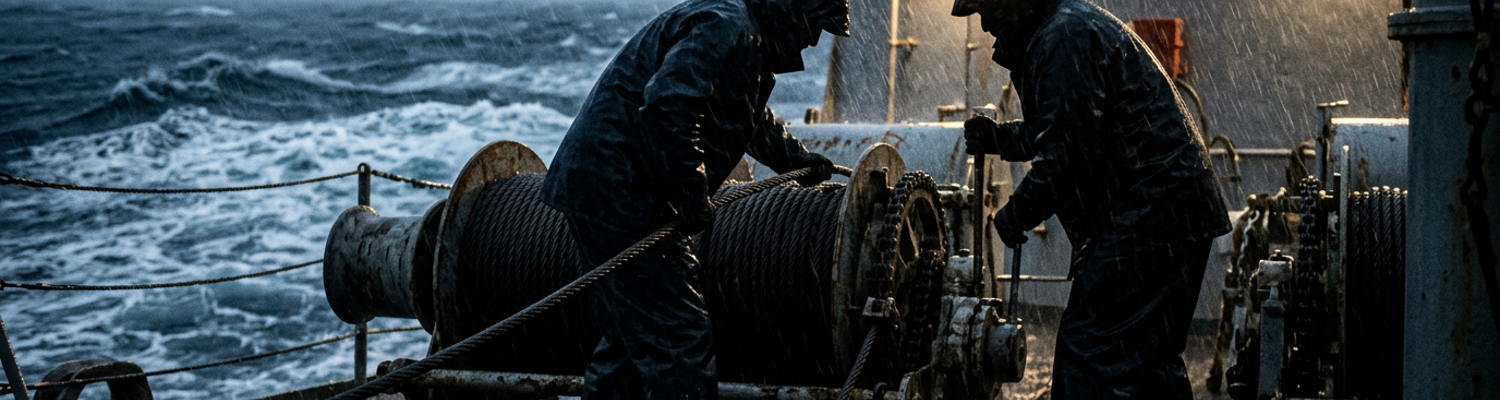
On April 11, 1945, a severe low-pressure system stalled directly over the Kerama Retto anchorage. The storm centered at coordinates 26 degrees 11 minutes North, 127 degrees 17 minutes East. It dumped three inches of rain per hour onto the exposed decks of Service Squadron Ten. A close review of operational logs indicates that sustained thirty-five-knot winds generated Sea State 6 conditions across the narrow supply channels. Waves crested at eighteen feet. Fleet oilers utilizing the standard Spencer-Miller high-line transfer system relied on friction-based tension control mechanisms. These systems kept fuel hoses suspended between pitching hulls. The complex rigs utilized large asbestos brake linings to manage the payout of seven-eighths-inch steel wire rope.
Heavy downpours completely saturated the exposed mechanical housings.
Water soaked deep into the porous asbestos material. Marine-grade lithium grease packed into the pawl and ratchet assemblies washed away under the continuous deluge. Deck engineers manually turning the heavy brass hand-wheels lost the ability to maintain precise friction coefficients on the main tensioning drums. Steam regulating valves fed the winch cylinders. These valves became coated in a slick layer of saltwater and spilled oil. Operators could not grip the brass controls to adjust the boiler steam pressure accurately. Without dry brake bands, the heavy high-line tension control mechanisms slipped uncontrollably with every ocean swell.
The Suamico-class fleet oiler USS Cache attempted to refuel a division of Fletcher-class destroyers amid this atmospheric chaos. Archival evidence shows that at 0814 hours on April 14, the destroyer USS Wallace L. Lind made a high-speed approach along the starboard side of the supply ship. Captains on both vessels ordered engine revolutions matched at exactly twelve knots. The ships rolled up to twenty-two degrees in the trough of the waves. Their red anti-fouling lower hulls exposed directly to the wind. Deck crews aboard the Cache fired a brass line-throwing projectile across the eighty-foot gap. This established the initial messenger line. Rigging teams hauled the primary span wire across the churning water. They connected the heavy rubber fuel hose to the steel saddle block.
The steam-driven constant-tension winch aboard the oiler began to take up the slack.
Internal reduction gears inside the winch housing ground violently against each other. The destroyer pitched downward into a deep trough. The sudden distance increase placed over fourteen thousand pounds of lateral force directly onto the winch drive shaft. Cast-iron gear teeth designed to handle smooth loads snapped under the instantaneous torque. The main bronze drive shaft warped three inches out of alignment within a fraction of a second. A catastrophic winch gear failure disabled the primary refueling rig.
Shrapnel from the shattered reduction gear casing tore through the forward pump room bulkhead of the oiler. The main tension drum went into a completely free spin. Three hundred feet of heavy steel span wire unspooled in less than four seconds. This created a highly dangerous whiplash effect across the open deck. The receiving destroyer surged forward on a wave crest. The unspooling wire wrapped around its aft Mark 37 gun director tub. Officers on the bridge of the Cache triggered the general alarm. The oiler captain executed an emergency breakaway maneuver. He ordered the helm thrown hard to port. The starboard engine went into full reverse. This rapidly increased lateral separation between the colliding hulls.
Boatswain mates on the fueling deck seized standard-issue fire axes.
They hacked directly through the primary Manila retaining hawsers holding the hose saddles to the forward kingpost. The severed six-inch transfer hose dropped between the two violently pitching ships. Two tons of reinforced rubber, bronze couplings, and unrefined bunker crude oil sank immediately beneath the surface. The disabled winch left the Cache completely unable to conduct starboard replenishment operations for the next three weeks.
Japanese Cave Snipers and Improvised Deck Defense
A close review of operational logs reveals a highly lethal threat emanating directly from the shoreline topography of the Kerama Retto anchorages. The limestone karst formations of Tokashiki and Zamami islands contained thousands of natural caves overlooking the deep-water channels. Remnants of the Imperial Japanese Army 1st Sea Raiding Base Battalion dragged Arisaka Type 99 rifles into these elevated positions. They also brought Nambu light machine guns and heavy crates of 7.7mm ammunition. High tides and steep cliff faces allowed fleet oilers to anchor within four hundred yards of the beach. This close proximity placed the elevated weather decks of the supply ships directly inside the effective kill zone of concealed infantry weapons.
Navy planners drafting the underway replenishment doctrines had never calculated for close-quarters infantry engagements during open-water refueling operations.
The men operating the heavy steam winches stood on raised steel platforms. They were completely silhouetted against the ocean background. They wore only light cotton uniforms. They lacked any ballistic protection. The 7.7mm armor-piercing rounds easily penetrated standard naval dungarees. The projectiles also punched cleanly through the thin brass housings of steam-regulating valves.
Archival evidence shows that on April 2, 1945, the Suamico-class fleet oiler USS Kaskaskia anchored near coordinates 26 degrees 11 minutes 30 seconds North, 127 degrees 16 minutes 45 seconds East. The ship prepared to transfer high-octane aviation gas to a destroyer squadron. Pumping operations commenced at 0730 hours under heavy cloud cover. A Japanese sniper positioned inside a narrow limestone fissure approximately eighty feet above the waterline engaged the ship. The first 7.7mm projectile struck the primary winch operator in the upper chest. He collapsed instantly onto the steel deck grating. Falling backward, his grip slipped from the heavy brass control wheel of the constant-tension winch. The steam-driven drum immediately lost internal friction.
Four hundred feet of heavy steel span wire went slack in seconds.
A pressurized six-inch rubber fuel hose dropped directly into the churning ocean swells between the two vessels. Additional rifle fire struck the exposed steam manifolds. Copper pressure gauges sheared off. Scalding vapor vented across the rigging station. Two more sailors sustained gunshot wounds to their extremities while attempting to manually lock the spinning winch brake drum. Standard doctrine explicitly forbade the deployment of small arms on the weather decks of fleet oilers during active fuel transfer. Pre-war safety manuals mandated that all firearms stay locked inside the central armory while pumping 100-octane aviation fuel or handling bulk munitions. Planners knew that stray sparks from muzzle flashes or ejecting shell casings posed a catastrophic ignition risk near open fuel vents.
Deck crews at Kerama Retto abandoned these regulations completely.
Boatswain mates aboard the Kaskaskia and adjacent oilers unbolted half-inch steel boiler plates from their lower engine room bulkheads. Welders carried acetylene torches onto the weather decks right next to the active fuel lines. Sparks showered the deck as they permanently fused these heavy steel slabs directly to the deck grating. They erected crude armor shields around the constant-tension winch stations. Rigging teams hauled hundreds of heavy canvas sandbags up from the lower dry-goods holds. Sailors stacked these bags three feet high over the vulnerable steam-line manifolds. They covered the primary brake housings and the exposed hydraulic pumps.
Ship captains bypassed the chain of command entirely to distribute infantry weapons to their supply crews.
Ship commanders authorized the direct distribution of M1928A1 Thompson submachine guns to the supply personnel. They handed out M1 Garand rifles and Browning Automatic Rifles. As the oilers pumped thousands of gallons of highly volatile aviation fuel across the water, deck engineers actively returned fire at the shoreline. Hot brass shell casings ejected directly onto steel decks covered in flammable bunker crude residue. Riggers and machinist mates swept the limestone cliffs with heavy suppressive fire. They aimed their weapons at the dark cave openings just above the waterline. The ship 20mm Oerlikon anti-aircraft gunners depressed their mounts to their lowest physical elevation limits. Gunners fired high-explosive incendiary rounds directly into the coral outcroppings to shatter the sniper positions. The concussive blasts from the heavy anti-aircraft cannons shattered the glass dials on the adjacent fuel pressure gauges.
Shrapnel and pulverized limestone fell directly onto the exposed rubber fuel hoses.
Winch Operator Fatigue and Administrative Personnel Integration
A close review of operational logs from April 1945 exposes a catastrophic failure in human endurance aboard the supply ships of Service Squadron Ten. Bureau of Naval Personnel records documented extreme fatigue and rising casualty rates among specialized operators. These men were tasked with managing the heavy underway replenishment rigs. Pre-war doctrine assumed these men would work standard eight-hour shifts in calm harbors. The environment at Kerama Retto forced winch engineers to remain at their open-air stations for up to seventy-two consecutive hours. These sailors manually manipulated heavy brass steam-regulating valves. They adjusted cast-iron friction brakes to keep thousands of pounds of steel span wire taut between pitching vessels.
Operating the constant-tension winches required intense physical exertion.
Operators fought the violent ocean swells refracting off Tokashiki island. Deck engineers absorbed the shock of every wave directly through the mechanical feedback of the hand-wheels. Saltwater spray and leaked hydraulic fluid coated the steel deck gratings. Operators constantly tensed their leg muscles to avoid slipping into the heavy machinery. Lactic acid buildup caused severe muscle tremors in the arms of the primary winch operators. Medical officers aboard the ammunition ship USS Mazama recorded a sharp spike in crushing injuries and severed digits during the first two weeks of Operation Iceberg. Archival evidence shows that specialized boatswain mates and machinist mates suffered severe physical degradation. The operational tempo outpaced their biological limits.
Fatigue degraded their reaction times.
A delay of a half-second in releasing a winch brake during a sudden fifteen-degree roll resulted in snapped cables. Dropped ordnance followed. As the specialized riggers collapsed from exhaustion or sustained injuries from flying shrapnel and sniper fire, the ammunition ships lost their only trained personnel. These men were the only ones capable of safely transferring heavy explosives across open water. The fleet demanded uninterrupted resupply to sustain the naval bombardment of Okinawa. To offset the severe manpower shortage, commanders issued emergency reassignments of administrative clerks. They needed bodies to maintain continuous high-speed ammunition transfers.
Officers bypassed standard training protocols entirely.
Yeomen, mail clerks, payroll specialists, and storekeepers received orders to report directly to the weather decks. These men had spent their entire naval careers operating typewriters. They filed requisition forms inside illuminated compartments deep within the ship hulls. They possessed zero physical conditioning for heavy rigging operations. Deck officers handed these administrative personnel heavy leather gloves. They positioned them along the primary transfer lines. The standard Burton rigging system utilized for high-speed ammunition transfers required precise hauling. Teams of deckhands pulled on thick Manila ropes to swing heavy pallets between the supply ship and the receiving vessel.
Untrained clerks suddenly found themselves handling live ordnance suspended over churning ocean currents.
The physical mechanics of transferring fourteen-inch armor-piercing projectiles demanded exact timing. It required high levels of muscular strength. Each Mark 8 shell weighed exactly 1,500 pounds. Supply crews loaded these massive steel cylinders into heavy rope cargo nets. The administrative clerks hauled on the heavy block and tackle systems to hoist the nets clear of the deck edge. The Burton method required one winch on the supply ship to lift the load vertically. A second winch on the receiving ship pulled it horizontally across the water. Reassigned desk personnel managed the manual tension lines that prevented the swinging pallets from spinning out of control.
Sudden wind gusts regularly slammed the suspended ordnance back against the side of the ammunition ship.
This crushed any personnel trapped between the load and the bulkhead. Typists and payroll clerks lacked the spatial awareness required to grip the fast-moving ropes safely. They lacked the calloused hands needed for saltwater-soaked lines. Friction burns tore through their canvas gloves instantly when a heavy load dropped in the trough of a wave. On April 16, a sudden drop in line tension pulled a yeoman third class directly into the steel teeth of a cargo winch assembly.
Postwar Reevaluation of Pacific Fleet Replenishment Protocols
When examining the historical record of the Bureau of Ships from late 1945, engineering boards immediately dismantled the pre-war high-line transfer designs. The mechanical failures at the Kerama Retto anchorages proved the Spencer-Miller friction-based systems completely unusable in heavy swells. Archival evidence shows that naval architects at the Philadelphia Naval Shipyard reviewed the after-action reports from the USS Cache and USS Kaskaskia. They identified the porous asbestos brake linings as primary points of failure. They flagged the cast-iron reduction gears as structurally deficient. In January 1946, the Navy Department authorized a complete redesign of underway replenishment machinery under a classified engineering directive.
Draftsmen replaced the manual hand-wheel brake mechanisms with an automated system.
They designed a hydro-pneumatic ram tensioner. This new rig utilized a large hydraulic cylinder connected directly to a high-pressure air accumulator. Mechanical engineers positioned these heavy steel cylinders vertically along the main kingposts of the supply vessels. Compressed air acting on hydraulic fluid automatically absorbed the sudden shock loads of pitching hulls. Engineers stripped the heavy brass steam-regulating valves from the blueprints of future Neosho-class fleet oilers. They substituted the brittle cast-iron drive shafts with forged chromium-molybdenum steel alloys. These new alloys withstood instant torque spikes exceeding twenty thousand pounds of lateral force.
A close review of operational logs from the Puget Sound Naval Shipyard in 1947 indicates that these new ram tensioners underwent sea trials. They tested the equipment in Sea State 6 conditions off the coast of Washington state. The hydro-pneumatic system automatically paid out and retrieved the seven-eighths-inch steel wire rope. It required zero human intervention at the brake controls. Piston travel inside the hydraulic cylinders compensated for ship rolls up to twenty-five degrees in milliseconds. Deck crews no longer had to rely on manual friction coefficients to keep heavy fuel hoses suspended over the ocean. The redesign eliminated the need for specialized boatswain mates to stand exposed at the constant-tension winch stations during severe weather patterns.
Naval Warfare Publications underwent an equally aggressive rewrite to address the shoreline infantry threats.
Before the Okinawa campaign, the Tactical Orders and Doctrine, U.S. Fleet prohibited the presence of small arms near active fuel transfer stations. The sniper engagements from the limestone caves of Tokashiki forced the Office of the Chief of Naval Operations to modify these tactical supply manuals. A close review of the 1947 Underway Replenishment Manual reveals the insertion of an entire chapter dedicated to close-quarters defensive security measures. Planners mandated the permanent installation of half-inch Special Treatment Steel plating around all primary winch operating platforms. Shipyards retrofitted the entire surviving fleet of Suamico-class oilers with these ballistic shields directly integrated into the deck grating.
The updated manuals required gunnery officers to coordinate active suppressive fire sectors with the chief boatswain before passing the first messenger line.
Deck engineers received formal instructions on establishing overlapping fields of fire across the narrow supply channels. Standard operating procedures dictated that 20mm anti-aircraft mounts be continually manned. Gunners depressed the barrels to surface-action elevations during all pumping operations. The revised doctrine altered the arming of supply personnel. Naval architects drafted structural modifications to install weatherproof small arms lockers directly onto the weather decks of ammunition ships and fleet oilers. These heavy steel cabinets sat within twenty feet of the primary aviation fuel manifolds. Planners rewrote the safety regulations to authorize the deployment of M1 Garand rifles by deck engineers while actively transferring high-octane aviation gas.
Archival evidence shows that training curriculums at the Naval Supply Corps School in Athens, Georgia, expanded rapidly.
Instructors added immediate-action drills for returning hostile fire from an exposed rigging station. Deckhands practiced dropping their hauling lines. They retrieved rifles from the deck lockers. They engaged elevated shoreline targets while wearing heavy canvas rigging gloves. The new tactical manuals ordered ship commanders to issue live 30-caliber ammunition to the winch operators before approaching any anchorage within two thousand yards of a hostile landmass. Armory officers distributed standard-issue fragmentation grenades to the rigging teams stationed on the forward kingposts.