
The American Civil War’s conclusion left the U.S. Army Signal Corps, newly blooded and defined by conflict, facing a different kind of war. This new front was not a battlefield of massed armies but a sprawling contest of expansion, control, and survival across the American West. Reorganized by Congress in July 1866 and led by its founder, Colonel Albert J. Myer, the Corps received a formidable mandate: to weave a web of electrical communication across thousands of miles of wilderness. This network of iron wire was to become the nervous system of national expansion, a tool to project power, pacify territory, and bind a fractured nation. Between 1867 and the late 1870s, the Signal Corps would string approximately 4,000 miles of military telegraph lines, fundamentally altering the operational calculus of frontier warfare and settlement. This undertaking, however, would exact a severe cost from the men tasked with its execution.
A Network Forged in Hardship
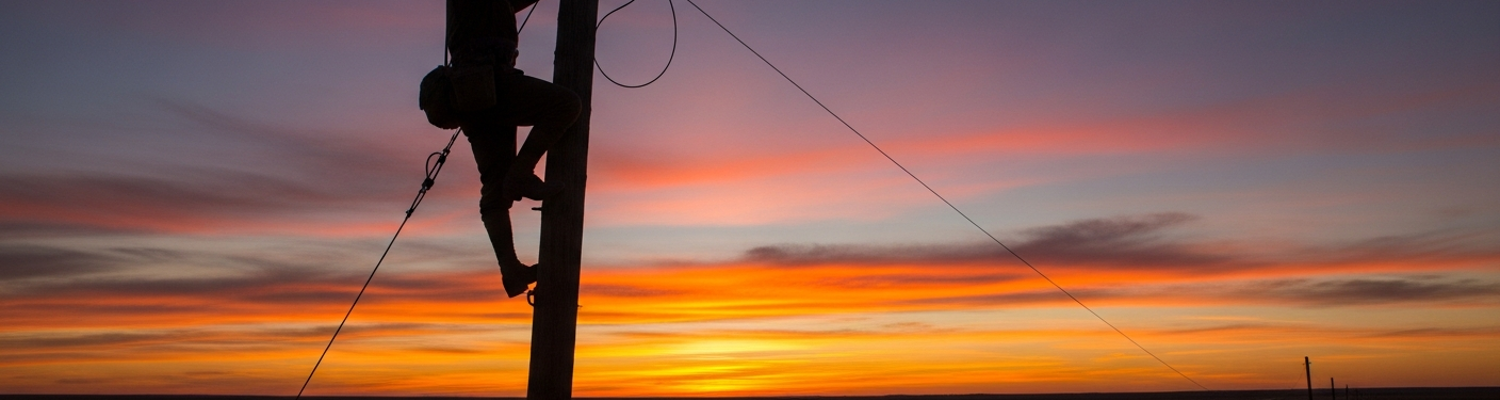
The mission was monumental. Construction crews, composed of soldiers and civilian contractors, pushed into territories where the primary infrastructure was horse trails and the primary authority was tactical reality. Their task was to erect a permanent communication grid connecting isolated forts, territorial capitals, and emerging railroad lines. The physical labor was immense. Teams cut and transported countless cedar or pine poles, often sourced locally in arduous logging operations. They affixed brittle, green-hued Brookfield glass insulators to the crossarms, then unspooled and tensioned the heavy, single-strand number 9 gauge iron wire. Iron, though a poorer conductor than copper, was chosen for its superior tensile strength and lower cost, making it better suited to withstand the strain of long spans and the harsh frontier environment. The work was performed under armed guard, a constant necessity against raids by Native American tribes who correctly identified the 'talking wire' as a direct threat to their autonomy and way of life. These construction details were not merely logistical footnotes, they were active combat engineering operations conducted by a technical branch of the Army.
The system’s architecture was a product of military necessity. Lines connected key posts from the Department of the Missouri to the remote garrisons of Arizona and Montana. These were not the relatively forgiving environments of the East. In the northern plains, winter blizzards buried lines under feet of snow and ice, the weight snapping wire and toppling poles. Repair crews on snowshoes faced frostbite and disorientation, their survival dependent on locating a single broken strand in a white wilderness. In the desert Southwest, summer temperatures exceeding 110 degrees Fahrenheit warped equipment and made daytime labor a life-threatening endeavor. Dust storms abraded components and flash floods washed away entire sections of line laid through arroyos. The environment itself was a relentless, neutral adversary that demanded constant maintenance and repair.
The Lonely Sentinels at World's Edge
At the terminus of each wire sat a lone Signal Corps operator, a man whose existence was defined by profound isolation and constant peril. Stationed in crude dugout shelters, sod huts, or fortified log blockhouses at places like Fort Abraham Lincoln in Dakota Territory or Camp Apache in Arizona, these telegraphers were the vital nodes in the network. Their days were a monotonous cycle of listening to the chatter of the sounder, logging weather data as part of the Corps’ burgeoning national meteorological duty, and maintaining their delicate equipment. This gear often included a simple Bunnell or Seth Thomas main line sounder and key, powered by jars of caustic Grove or Daniell wet-cell batteries that required careful mixing of acid and monitoring of zinc electrodes. The entire system relied on a simple ground-return circuit, meaning a secure connection to the earth itself was as critical as the wire overhead. Their world was the staccato rhythm of Morse code, a language that carried everything from mundane supply requests to the first alerts of an impending attack.
This isolation took a significant psychological toll. Men spent months with no companionship beyond the intermittent dispatches from the wire. Their memoirs and letters speak of a deep sense of detachment, of being a disembodied ear and voice connecting a world they could no longer see or touch. This mental strain was compounded by physical danger. Operators were high-value targets. A silenced telegraph station could blind an entire military district. During the Apache Wars, warriors became adept at crippling the network. They would cut lines and then, with sophisticated understanding of the technology, tie the severed ends together with a non-conductive strip of rawhide or leather. This created an open circuit that was maddeningly difficult for repair crews, known as 'line-walkers' or 'trouble-shooters', to locate with their primitive galvanometers. Operators were killed at their keys, their small stations burned, their presence erased in a sudden, violent assault. The casualty rate for these telegraphers was comparable to that of frontline infantrymen, a stark measure of the risks they faced.
Lightning on the Wire: Command in a New Era
Despite the costs, the telegraph network proved its worth in moments of high crisis, fundamentally reshaping command and control on the frontier. The defeat of Lieutenant Colonel George Armstrong Custer’s command at the Little Bighorn in June 1876 provides a stark example. News of the disaster, carried by the steamboat Far West, reached the nearest telegraph station in Bismarck, Dakota Territory, on July 5th. The operator, James W. Mac-A-Fee, transmitted General Alfred Terry’s initial 50,000-word report over the wire. The message flashed across the country, reaching Army headquarters and the War Department in Washington with a speed that was, for the time, breathtaking. While the news itself was grim, the ability to transmit it so rapidly allowed for the swift organization of reinforcing columns under Generals Terry and Crook and demonstrated to a shocked nation that the frontier was now tied directly to the industrial heartland.
The system’s most transformative impact was felt during the long, grinding campaigns of the Apache Wars. Commanders like General George Crook and his successor, General Nelson A. Miles, learned to wield the telegraph as a weapon. Miles, in particular, integrated communications into his operational doctrine. He established a vast network of 27 mountaintop heliograph stations across Arizona and New Mexico, covering hundreds of miles of rugged territory. These stations, manned by Signal Corps personnel using mirrored instruments to flash sunlight in coded signals, augmented the vulnerable telegraph lines. They provided line-of-sight communication that could not be easily cut. This 'sun telegraph' network allowed Miles to coordinate the movements of his numerous small, fast-moving pursuit columns. When a raiding party led by Geronimo was spotted, its location could be flashed from peak to peak, relayed to the nearest telegraph office, and sent to every garrison in the territory within hours. This system deprived the highly mobile Apache warriors of their traditional advantages of stealth and surprise, systematically boxing them in. Geronimo’s final surrender in September 1886 was, in large part, a surrender to the relentless efficiency of this information network.
Enduring Echoes in the Digital Domain
The ordeal of the Signal Corps telegrapher in the Gilded Age offers sober lessons for modern military development. The lone operator in his dugout, defending a critical information node with a carbine and a telegraph key, is the direct ancestor of today’s network warfare specialist defending a server from digital intrusion. The 19th-century physical line, vulnerable to being cut by a raiding party or grounded with a rawhide strip, finds its modern parallel in the submarine fiber optic cables and satellite links susceptible to physical sabotage, cyber-attack, and electronic jamming. The fundamental vulnerability of the communications conduit remains a central military problem.
The success of General Miles’s integrated system of telegraphs and heliographs underscores a timeless principle: the necessity of redundant and resilient communication pathways. His forces prevailed not just through firepower, but through information dominance. He built a multi-layered network that was difficult to completely disable. When one method of communication failed or was compromised, another was available. This concept remains the bedrock of modern C4ISR (Command, Control, Communications, Computers, Intelligence, Surveillance, and Reconnaissance) doctrine and is reflected in today's PACE (Primary, Alternate, Contingency, Emergency) communication plans. A cautiously optimistic forecast for the future draws from this past. The Signal Corps of the 1870s did not possess perfect technology. Their equipment was fragile, their environment hostile, and their personnel under constant threat. Yet, they adapted. They developed new tactics for line repair, integrated novel systems like the heliograph, and cultivated a culture of resilience and ingenuity. They learned that the network itself, its structure and its defense, was as important as the messages it carried. As the military moves deeper into the complexities of the cyber and space domains, the fundamental challenges remain the same: protect the line, ensure the message gets through, and dominate the information landscape. The ghostly echoes of the telegraph sounder from a lonely frontier outpost serve as a persistent reminder of the human cost and strategic imperative of that mission.