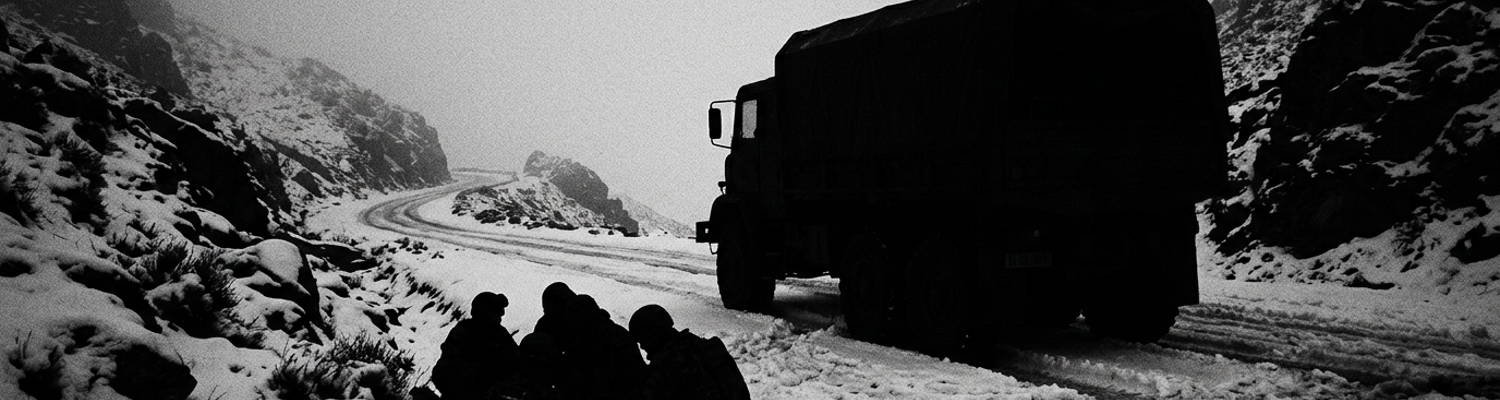

Chongchon River Motorized Reconnaissance Ambush
Archival evidence shows that by the final week of November 1950, over 300,000 infantrymen of the Chinese People's Volunteer Army Thirteenth Army Group infiltrated the terrain of northern Korea undetected. Aerial reconnaissance flights conducted by the Far East Air Forces reported empty snowfields across the Taebaek Mountains. Elements of the 38th, 39th, and 40th Corps maneuvered into blocking positions along the primary withdrawal routes of the United States Eighth Army. The numerical disparity was absolute.
For every mechanized reconnaissance element the US 2nd Infantry Division pushed forward along the frozen dirt roads of the Chongchon River valley, Chinese commanders positioned three full infantry battalions on the adjacent ridgelines.
The Thirteenth Army Group established a twenty-mile-long gauntlet of concealed firing pits and mortar base plates overlooking the unpaved supply route designated as Route 1.
The trap snapped shut on November 25.
A close review of operational logs (NARA Record Group 338) indicates that the initial contact systematically dismantled the motorized patrols of the 2nd Infantry Division. Advanced elements of the 9th Infantry Regiment and the 72nd Tank Battalion advanced north from Kunu-ri to probe for enemy positions along the eastern banks of the Chongchon River. Chinese forces did not initiate contact at maximum engagement range. They allowed the American columns of Willys MB jeeps, M3 half-tracks, and M24 Chaffee light tanks to penetrate deep into the narrow defiles where the river bent sharply against steep granite embankments near grid coordinates 39 degrees 45 minutes North 125 degrees 55 minutes East.
Once the lead M24 Chaffee hit a concealed anti-tank mine, PVA mortar teams unleashed concentrated fire on the stalled column.
Gunfire from Type 24 heavy machine guns raked the exposed American infantrymen attempting to dismount from their unarmored transport trucks. The Chinese 112th and 113th Divisions specifically targeted the vulnerable wheeled vehicles at the front and rear of the convoy to prevent any organized retreat back toward Sunchon. American drivers were shot through the windshields of their two-and-a-half-ton cargo trucks.
Heavy vehicles blocked the narrow dirt tracks.
Command and control networks disintegrated within fifteen minutes of the opening barrage.
A severe Siberian winter cold front descended across the Korean peninsula. Ambient temperatures dropped to thirty degrees below zero Fahrenheit. When examining the historical record, the rapid atmospheric freeze proved highly destructive to the tactical capabilities of the ambushed patrols. Standard military-issue petroleum lubricants inside M2 Browning .50 caliber machine guns congealed into a thick substance. Weapons jammed after firing a single round. The intense cold altered the metallurgical properties of M1 Garand firing pins. Frequent shattering occurred when soldiers attempted to clear malfunctions by striking the bolt handle.
Inside the engine blocks of the motorized reconnaissance vehicles, the extreme temperature drop drained six-volt lead-acid batteries and froze water-based coolants that lacked sufficient ethylene glycol antifreeze mixtures.
Radios failed entirely as the SCR-300 backpack transceivers lost voltage capacity in the sub-zero air. Communication between the pinned-down forward elements and the division headquarters at Kunu-ri was severed. Infantrymen attempting to fire their M1 carbines found that the gas pistons had frozen shut. Semi-automatic rifles became completely inoperable against the advancing Chinese assault elements. Medical personnel from the 2nd Medical Battalion recorded that blood plasma supplies froze solid in their glass containers before they could be administered to shrapnel casualties.
Deconstructing the Myth of Organized Retreats
Archival evidence shows that post-war film and television productions heavily sanitized the withdrawal of the US 2nd Infantry Division from Kunu-ri. Popular narratives portray an orderly armored breakout. These accounts depict tightly formed columns of M4A3 Sherman medium tanks and M3 half-tracks suppressing enemy positions while safely escorting infantry convoys southward.
A close review of operational logs indicates a complete contradiction of this orderly retreat.
Immediate and catastrophic unit fragmentation occurred across the entire division front. On November 30, Major General Laurence B. Keiser ordered the 38th Infantry Regiment and the 2nd Engineer Combat Battalion to lead a coordinated drive down the six-mile mountain pass toward Sunchon. The operational order required a strict fifty-yard interval between vehicles to maintain overlapping defensive fire sectors and prevent traffic bottlenecks. Within forty-five minutes of crossing the line of departure near grid coordinates 39 degrees 41 minutes North 125 degrees 56 minutes East, this spacing completely collapsed.
Drivers of the lead M24 Chaffee light tanks accelerated in a state of panic under heavy enfilading fire from the ridges.
Slower unarmored transport trucks were left far behind.
The vehicular convoy stretched into a disjointed ten-mile string of isolated targets. Platoon leaders inside the trailing Willys MB jeeps found their SCR-508 radio receivers saturated with overlapping distress calls from fragmented squads. It became impossible to coordinate return fire or direct forward movement. Infantrymen from the 9th Infantry Regiment were originally assigned to ride in the canvas-covered cargo beds of M35 two-and-a-half-ton trucks. They began leaping from the moving vehicles to seek cover in the frozen drainage ditches flanking the unpaved road.
Command structures dissolved as staff sergeants lost visual contact with their lieutenants in the dense smoke generated by burning rubber tires and ignited diesel fuel.
Without armored escorts to suppress the ridgelines, individual truck drivers made independent decisions to halt, reverse, or ram the vehicles ahead of them. Motorized infantry units rapidly lost cohesion when primary supply routes were severed by enemy road blocks. The Chinese 113th Division exploited this vehicular chaos by constructing physical barriers directly across the Sunchon road. PVA assault teams dragged the twisted chassis of destroyed American cargo trucks laterally across the narrow defile.
Impassable steel barricades formed at choke points where the steep granite cliffs met the road edge.
Elements of the 2nd Engineer Combat Battalion attempted to clear these obstacles using the front-mounted dozer blades of M4 Sherman engineering variants. Chinese anti-tank teams hidden on the adjacent slopes fired captured 2.36-inch M9A1 bazookas at the exposed suspension bogies of the tanks. Engineering vehicles were disabled. Their burning thirty-ton bulk added to the blockades. The severed primary supply route paralyzed the 15th Field Artillery Battalion.
Artillerymen towing 105mm M2A1 howitzers behind M5 high-speed tractors found themselves trapped behind the flaming roadblocks with less than ten rounds of high-explosive ammunition remaining per gun.
Forward observers could not call in defensive barrages because the supply trucks carrying replacement artillery shells were physically blocked three miles north of the firing batteries. Trapped between the barricades and the advancing Chinese infantry, American motorized units abandoned their primary heavy weapons and vehicles. Soldiers unbolted M1919A4 .30 caliber machine guns from the skate mounts of their stalled trucks. Heavy M2 tripod assemblies and spare ammunition cans were left in the cargo beds.
Weapons became nearly impossible to fire accurately on the move.
Without a coordinated supply line, infantry squads scrounged loose eight-round en-bloc clips for their M1 Garands from the frozen pockets of casualties lying on the road. Company commanders ordered their men to destroy the remaining vehicle engines by firing incendiary rounds directly into the cast-iron cylinder blocks. The 2nd Quartermaster Company abandoned over three hundred tons of Class I and Class III supplies right on the dirt track. Thousands of C-ration crates and fifty-five-gallon drums of aviation gas were left behind.
SCR-300 Battery Failures and Communication Loss
A close review of operational logs indicates that the complete disintegration of the 2nd Infantry Division forward screen began inside the chemical cells of their communication equipment. The US Army relied entirely on the SCR-300 backpack transceiver to coordinate company-level maneuvers across the rugged Korean topography. This thirty-five-pound frequency modulation radio utilized an eighteen-tube circuit design requiring large BA-70 dry cell batteries to transmit signals over a three-mile radius.
Archival evidence shows that signal officers attached to the 9th Infantry Regiment issued fresh battery packs to front-line radiomen at 0400 hours on November 26.
The ambient temperature concurrently plummeted to thirty degrees below zero Fahrenheit. Cold weather testing conducted prior to the Korean deployment did not account for the rapid freezing of the zinc-carbon electrochemical paste inside these specific power units. The severe subzero conditions halted the internal chemical reactions necessary to generate standard electrical current. Voltage output across the forward elements dropped from a required 4.5 volts to less than 1.5 volts in under three hours.
Radiomen walking alongside the Willys MB jeeps near grid coordinates 39 degrees 43 minutes North 125 degrees 57 minutes East noticed their transmission range shrinking rapidly before failing entirely.
Static replaced voice communications as the receiver tubes failed to draw adequate filament power from the freezing batteries. Operators in the field attempted to unclip the heavy battery blocks and stuff them inside their M-1943 field jackets to warm the cells using their own body heat. The sheer fifteen-pound bulk of the rectangular BA-70 units made this field modification physically impossible for infantrymen attempting to maneuver through heavy snow while carrying their M1 Garand rifles. Squad leaders resorted to striking the external metal casings of the radios with their rifle butts out of frustration.
By 0730 hours, every company-level radio in the forward reconnaissance column was entirely dead.
This sudden loss of electronic contact completely severed command and control between the motorized patrols and their battalion commanders situated to the south. The 2nd Reconnaissance Company was operating three miles ahead of the main body. They were navigating the twisting dirt tracks of the Chongchon River valley. Without functioning SCR-300 units, forward observers had no method to transmit the grid coordinates of the Chinese machine gun nests to the 15th Field Artillery Battalion.
Infantry platoons pinned down under heavy mortar fire found themselves cut off from all heavy fire support.
When examining the historical record, battalion commanders inside the Kunu-ri command post assumed the forward elements were advancing unopposed simply because the radio network fell completely silent. They continued ordering trailing supply trucks filled with ammunition and rations to drive directly into the established kill zone. Commanders lost all telemetry regarding enemy troop concentrations. Officers in the ambushed column attempted to re-establish the broken command link by reverting to primitive communication methods.
Platoon leaders pulled infantrymen from the defensive perimeter and ordered them to sprint back down the unpaved Route 1 as physical runners.
Chinese marksmen positioned on the high granite ridges overlooking the road systematically shot these isolated messengers before they could traverse the three miles back to the battalion lines. Visual signaling proved equally ineffective in the dense winter fog. Forward patrols fired M9A1 rifle grenades equipped with red star cluster flares to signal their distress. The thick gray overcast completely obscured the pyrotechnics from the command post at Kunu-ri. The motorized patrols were entirely isolated in the frozen defiles.
Lieutenants commanding the lead M3 half-tracks had no way to warn the division headquarters that three full Chinese infantry divisions were actively enveloping their flanks.
A staff sergeant from Baker Company was found frozen in a drainage ditch clutching a handwritten situation report that never reached his captain.
Depletion of Heavy Machine Gun Ammunition
A close review of operational logs indicates that the survival of the 2nd Infantry Division motorized screen depended entirely on the M2HB Browning heavy machine gun. Mounted on the reinforced steel ring pedestals of M3 half-tracks and Willys MB jeeps, these recoil-operated weapons provided the only firepower capable of penetrating the earth-and-log barricades erected by the Chinese 113th Division along Route 1.
Gun crews from the 2nd Reconnaissance Company encountered their first major enemy roadblock near grid coordinates 39 degrees 42 minutes North 125 degrees 56 minutes East at 0915 hours on November 29.
The physical obstacle consisted of felled pine trees, granite boulders, and overturned quarter-ton cargo trailers covered by interlocking fire from concealed Type 92 machine gun pits on the eastern ridges. Suppressing these fortified positions required continuous bursts of 12.7x99mm armor-piercing incendiary ammunition. This was needed to shatter the frozen timber, neutralize the entrenched marksmen, and prevent the enemy from enveloping the stalled vehicles. The M2HB fired five hundred rounds per minute.
Gunners attempting to keep the Chinese assault elements pinned down burned through standard one-hundred-round M9 metallic link belts in less than fifteen seconds of sustained operation.
The heavy steel barrels quickly overheated. They melted the snow that fell on them while the gunners aggressively suppressed the ridge lines to protect the exposed infantrymen dismounting from the trucks. The ready-racks inside the lead vehicles completely emptied before 1000 hours. Archival evidence shows that the division ammunition resupply plan rapidly disintegrated under coordinated enemy mortar fire.
Division commanders at Kunu-ri ordered the 2nd Quartermaster Company to dispatch an emergency convoy of M35 two-and-a-half-ton cargo trucks loaded with wooden crates containing thousands of linked .50 caliber cartridges.
These unarmored transport vehicles received strict instructions to follow the mechanized reconnaissance column at a two-mile interval to avoid direct engagement. Chinese forward observers tracked the slow-moving convoy as the drivers struggled to shift their non-synchronized manual transmissions through the heavy snow drifts along the narrow mountain passes. The sheer weight of the ammunition crates caused the dual rear wheels of the M35 trucks to sink deep into the frozen mud. Their advance slowed to less than five miles per hour.
At 1130 hours, PVA mortar teams dropped sixty-millimeter high-explosive shells directly onto the canvas roofs of the lead and trail trucks in the defile.
The explosions shattered cast-iron engine blocks and ignited the primary gasoline fuel tanks. This instantly transformed the large vehicles into immovable, burning obstacles. Secondary detonations rapidly occurred as the extreme heat cooked off the volatile cargo of armor-piercing incendiary belts packed inside the wooden truck beds. Shrapnel from exploding ammunition crates shredded the pneumatic rubber tires of the trailing supply vehicles.
When examining the historical record, the destruction of the supply train left the forward reconnaissance elements entirely without heavy suppressive fire.
The trapped cargo trucks burned out precisely three miles north of the pinned-down patrols. Front-line gunners frantically searched the frozen steel floorboards of their M3 half-tracks for loose cartridges to manually feed into the receivers of their M2 Brownings. Platoon leaders inside the command jeeps radioed the rear echelons for emergency airdrops. The dense winter overcast ceiling prevented Far East Air Forces C-47 transport planes from visually identifying the designated drop zones marked by the ground units.
Without the heavy .50 caliber rounds needed to punch through the enemy barricades, the American column could not advance south toward the safety of Sunchon.
Chinese infantrymen recognized the sudden cessation of heavy machine gun fire and immediately initiated close-quarters flanking maneuvers armed with Type 67 stick grenades and PPSh-41 submachine guns. American soldiers abandoned their mounted weapons directly on the dirt road to seek cover in the adjacent drainage ditches. An inspection of a captured Willys MB jeep abandoned near the primary roadblock revealed an M2 Browning with its feed tray cover locked open and a single brass casing jammed tightly inside the extraction chamber.
Subzero Temperatures and Mechanical Vehicle Stalls
Archival evidence shows that the mechanical failure of the 2nd Infantry Division motorized columns began deep inside the cast-iron engine blocks of their primary transport vehicles. On the night of November 27, temperatures along the Chongchon River valley at grid coordinates 39 degrees 44 minutes North 125 degrees 56 minutes East plummeted to minus thirty-five degrees Fahrenheit. Motor pool mechanics attached to the 9th Infantry Regiment had previously serviced the GMC CCKW two-and-a-half-ton cargo trucks with standard summer-weight SAE 30 motor oil.
The extreme atmospheric freeze caused this petroleum-based lubricant to rapidly congeal into a dense sludge inside the crankcases.
Oil pumps failed to push this thickened mass through the narrow galleries of the engine block. Piston rings scraped against completely unlubricated cylinder walls. This generated intense friction that warped the metal components and snapped forged steel connecting rods. Starter motors drew massive amperage from the six-volt lead-acid batteries in vain attempts to turn over the immobilized crankshafts. Electrical systems shorted out entirely within ten seconds of continuous cranking.
A close review of operational logs indicates that fuel delivery systems suffered equally catastrophic failures as the cold front intensified.
Condensation had built up inside the fifty-gallon stamped steel fuel tanks of the M3 half-tracks during the humid autumn months. The sudden drop in temperature caused this trapped water vapor to crystallize into solid ice blocks directly inside the narrow copper fuel lines. Gasoline flow to the Zenith downdraft carburetors choked off completely. This starved the White 160AX six-cylinder engines of combustible vapor.
Drivers attempting to manually clear the blockages crawled into the frozen mud and used open-flame Zippo lighters to heat the exposed fuel lines beneath the chassis.
The resulting open flame frequently caused localized fires that melted the exterior rubber hosing but failed to thaw the deep internal ice plugs. Mechanics from the 72nd Tank Battalion tried pouring raw alcohol into the fuel tanks to lower the freezing point. The chemical reaction occurred too slowly in the subzero air. These localized mechanical stalls trapped the 9th Infantry Regiment motorized column along a two-mile stretch of the narrow mountain pass.
Entire motorized columns ceased forward movement along Route 1 by 0200 hours.
When examining the historical record, the combination of complete engine failure and deteriorating weather forced a large-scale abandonment of fully functional military hardware. A heavy subzero sleet began falling across the Taebaek Mountains just before dawn on November 28. It accumulated rapidly on the exposed metal chassis of the vehicles. The freezing rain coated the flat glass windshields of the stalled transport trucks in a half-inch layer of opaque ice.
Pneumatic wiper motors powered by engine vacuum systems ceased operating the exact moment the primary engines died.
Infantrymen assigned to drive the Willys MB jeeps found themselves entirely blind in the driver seats while fully exposed to Chinese small arms fire from the adjacent ridgelines. Soldiers resorted to kicking out the glass windshields with their combat boots just to escape the freezing vehicle interiors. Company commanders issued direct orders for their remaining drivers to abandon the intact trucks and half-tracks directly on the dirt tracks.
Officers from the 2nd Engineer Combat Battalion instructed their men to drain the remaining ethylene glycol coolant from the radiators to prevent the advancing Chinese infantry from easily repairing the captured equipment.
Personnel from the 2nd Quartermaster Company left hundreds of tons of heavy rolling stock sitting in the snowdrifts near Sunchon. The White Motor Company half-tracks were abandoned with their heavy steel transmission casings completely frozen in gear. This made them impossible to tow even if recovery vehicles had been available. Drivers fleeing the kill zone dropped the brass ignition keys into the snow and joined the retreating infantry squads on foot. They left their assigned vehicles completely operational except for the frozen fluids.
An inspection of an abandoned convoy three days later near grid coordinates 39 degrees 41 minutes North 125 degrees 55 minutes East revealed forty-two consecutive GMC cargo trucks sitting perfectly aligned on the road shoulder with their driver-side doors hanging open.
Systematic Breakdown of Field Medical Evacuation
A close review of operational logs indicates that the physical extraction of casualties from the Chongchon River valley collapsed completely under the combined weight of severe weather and impassable terrain. Elements of the 2nd Medical Battalion mobilized a convoy of Dodge M43 three-quarter-ton ambulances north from Sunchon at 0630 hours on November 29 to reach the pinned-down 9th Infantry Regiment. A heavy subzero sleet began falling across the Taebaek Mountains just as the medical convoy entered the narrow defile near grid coordinates 39 degrees 41 minutes North 125 degrees 55 minutes East.
Freezing rain coated the unpaved dirt track of Route 1 in a solid sheet of opaque ice.
Medical transport drivers engaged the four-wheel-drive transfer cases on their ambulances to traverse the steep granite inclines. Aggressive tread patterns of the pneumatic tires failed to grip the frozen surface. Steel tire chains snapped under the mechanical stress of spinning uselessly against the ice. They wrapped around the solid rear axles and severed the hydraulic brake lines. Forward movement became physically impossible when the medical convoy encountered the burning chassis of destroyed M35 cargo trucks and M4 Sherman tanks blocking the choke points ahead.
Chinese mortar teams positioned on the adjacent ridgelines bracketed the stalled ambulances with sixty-millimeter high-explosive shells.
The 2nd Medical Battalion abandoned twenty-two fully equipped Dodge M43 ambulances along a single two-mile stretch of the frozen mountain pass. Archival evidence shows that combat corpsmen trapped with the forward elements lacked the specialized equipment required to treat severe trauma in extreme atmospheric conditions. Medical personnel crawling through the drainage ditches near grid coordinates 39 degrees 43 minutes North 125 degrees 57 minutes East attempted to administer emergency blood volume replacements to shrapnel casualties.
Thermometers attached to the field radios registered minus thirty-five degrees Fahrenheit.
Glass bottles containing whole blood and plasma froze completely solid inside the canvas medical bags. High water content inside the intravenous fluids expanded rapidly as it crystallized. Internal pressure from the ice shattered the glass containers from the inside out. Useless chunks of frozen plasma spilled directly into the snow. Corpsmen reaching for standard half-grain morphine syrettes found the tartrate solution turned into immovable ice blocks.
Medics desperately tried to thaw the small metal tubes by holding them inside their own mouths while applying tourniquets with their bare hands.
Freezing air instantly solidified the liquid the moment it entered the hollow steel needles. Medics documented that standard metal syringe needles snapped off cleanly inside the rigid skin of hypothermic casualties. When examining the historical record, the absence of functional ambulances and freeze-resistant supplies forced front-line units to improvise highly destructive evacuation methods. Infantrymen from the 9th Infantry Regiment strapped wounded soldiers to the hood-mounted litter brackets of surviving Willys MB jeeps.
These unarmored transports lacked canvas tops or side enclosures to deflect the freezing wind.
Moving at speeds of fifteen miles per hour through the sleet storm generated a localized wind chill factor approaching minus sixty degrees Fahrenheit. Casualties secured to the engine hoods died from rapid core temperature loss long before the jeeps could bypass the flaming roadblocks. Triage officers stationed at the forward aid post in Kunu-ri stopped logging incoming patients entirely at 1400 hours. Plaster of Paris required to set compound fractures failed to cure. Exposed water in the mixture crystallized upon contact with the frigid air.
This left the plaster as a useless, crumbling powder.
Triage personnel resorted to binding shattered femurs with frozen strips of canvas torn directly from the cargo covers of destroyed transport trucks. Complete destruction of the evacuation chain left hundreds of non-ambulatory wounded lying directly on the ice without any medical support. Chinese assault teams armed with PPSh-41 submachine guns systematically overran the makeshift casualty collection points along Route 1.
Unarmed corpsmen destroyed their remaining medical kits by smashing the surviving glass penicillin vials with their folding M-1943 entrenching tools to prevent the enemy from capturing the antibiotics.
Officers ordered all able-bodied personnel to retreat south on foot through the adjacent mountain trails. Steep inclines along the granite ridges made it physically impossible for the retreating infantrymen to carry the heavy canvas field litters through the deep snowdrifts. Graves registration teams returning to the defile three months later found the bodies of seventy-four American casualties still strapped tightly to their stretchers.
Tactical Triage Collapse at Kunu-ri
A close review of operational logs indicates that the primary clearing station operated by the 2nd Medical Battalion inside the Kunu-ri schoolhouse compound collapsed under a massive influx of trauma patients on the evening of November 29. Standard evacuation protocols dictated that forward aid posts stabilize shrapnel and gunshot victims before transferring them via Dodge M43 ambulances to this centralized facility near grid coordinates 39 degrees 42 minutes North 125 degrees 55 minutes East. Chinese infantry assaults along the eastern ridges severed these organized transit routes.
Unescorted GMC CCKW two-and-a-half-ton cargo trucks began arriving at the schoolhouse courtyard carrying dozens of wounded men stacked directly on top of each other in unheated canvas cargo beds.
Medical officers originally designed the triage system to process thirty patients per hour using four distinct surgical bays equipped with portable M-1941 Yukon heating units. By 1800 hours, over four hundred bleeding infantrymen from the 9th and 38th Infantry Regiments had flooded the muddy courtyard. Triage procedures dissolved in minutes. Archival evidence shows that overwhelmed surgeons abandoned systematic patient sorting and resorted to uncoordinated emergency interventions directly on the frozen ground.
Corpsmen bypassed the designated preoperative tents because Chinese sixty-millimeter mortar shells had shredded the canvas roofs and destroyed the gasoline-powered heaters.
Orderlies dragged incoming casualties into the dark schoolhouse hallways without filling out standard Form 52b Emergency Medical Tags. Medical supply clerks lost track of inventory as panicked infantrymen raided the wooden supply crates looking for Carlisle model first aid packets to apply to their own wounds. Without a functional command hierarchy, junior medics made independent decisions to amputate shattered limbs using unsterilized crosscut saws pulled from engineer tool kits.
Litters carrying men with severe chest wounds were pushed into empty classrooms and abandoned as the medical staff rushed back outside to unload the continuously arriving cargo trucks.
Blood loss accelerated as unligated arteries contracted poorly in the subzero air. When examining the historical record, the rapid onset of severe cold injuries physically incapacitated the surviving personnel attempting to manage this crisis. Ambient temperatures plummeted to minus thirty degrees Fahrenheit overnight. This initiated deep tissue freezing in the extremities of the exposed medical staff. Dodge M43 ambulance drivers operating the heavy non-synchronized manual transmissions lost all tactile sensation in their feet.
Standard-issue M-1944 shoepacs provided zero insulation against the freezing steel floorboards of the uninsulated vehicle cabs.
Drivers suffering from third-degree frostbite could no longer generate the sixty pounds of physical force required to depress the heavy clutch pedals or modulate the hydraulic brakes. This mechanical inability to operate the transport vehicles resulted in multiple low-speed collisions within the Kunu-ri compound. The main exit gates were permanently blocked. Steering columns locked up as drivers with completely frozen fingers could not grip the thin bakelite steering wheels.
Field medical operations halted entirely by dawn.
Combat medics assigned to the remaining triage areas experienced catastrophic loss of manual dexterity. Treating traumatic injuries requires fine motor skills to manipulate Kelly hemostatic forceps, thread curved surgical needles, and apply pressure bandages to arterial bleeds. Frostbite crystallized the intracellular fluids in the corpsmen's unprotected hands. Their fingers turned into rigid, blackened appendages. Medics attempting to tear open waterproof adhesive tape packages found their thumbs completely unresponsive.
A battalion surgeon from the 38th Infantry Regiment documented his inability to press the plunger of a glass syringe because his index finger had frozen solid at the middle joint.
Lacking the physical capacity to handle basic trauma equipment, medical personnel simply stopped treating the wounded and sat against the brick walls of the schoolhouse with their hands shoved deep inside their armpits. An inspection report filed the following week noted seventy unopened crates of sterile bandages sitting untouched next to a pile of frozen bodies.
Disorganized Foot Retreats Through the Gauntlet
A close review of operational logs indicates that the physical withdrawal from Route 1 required the total abandonment of the 2nd Infantry Division mechanized advantage. On the afternoon of November 30, elements of the 9th Infantry Regiment and 2nd Engineer Combat Battalion found their M35 cargo trucks and M4A3 Sherman tanks physically blocked by burning debris near grid coordinates 39 degrees 40 minutes North 125 degrees 54 minutes East. Chinese mortar teams from the 113th Division registered their sixty-millimeter base plates directly on the stalled convoy.
Company commanders issued immediate orders to disable the heavy hardware and proceed into the Taebaek Mountains on foot.
Mechanics from the 72nd Tank Battalion dropped thermite grenades down the open hatches of their M24 Chaffee light tanks to melt the sliding-wedge breech blocks of the 75mm M6 main guns. Artillerymen assigned to the 15th Field Artillery Battalion uncoupled their 105mm M2A1 howitzers from the pintle hooks of M5 high-speed tractors. They removed the firing lanyards and panoramic telescopes before throwing the optical sights into the frozen Chongchon River.
Over three hundred functional vehicles were left idling on the dirt road until their gas tanks ran dry.
Archival evidence shows that this mandatory transition to foot movement instantly destroyed the structural cohesion of the retreating battalions. Soldiers heavily burdened by M-1943 field jackets, extra bandoleers of .30-06 ammunition, and SCR-536 hand-held transceivers attempted to scale the fifty-degree granite inclines flanking the eastern edge of the kill zone. The steep topography forced infantrymen to crawl on their hands and knees through knee-deep snowdrifts. Platoon leaders quickly lost visual contact with their squads as the men dispersed to avoid concentrated Type 24 heavy machine gun fire sweeping the lower ridges.
The intense physical exertion of climbing the frozen embankments caused soldiers to sweat profusely inside their layered cotton field uniforms.
When they paused for cover, the subzero ambient air rapidly froze this trapped moisture directly against their skin. Troops began discarding their heavy steel M1 helmets, folding entrenching tools, and even their M1 Garand rifles to reduce weight during the grueling ascent. Command hierarchies vanished completely by nightfall. When examining the historical record, the retreat fragmented into dozens of isolated micro-engagements fought by leaderless clusters of mixed personnel.
A mixed element comprising motor pool mechanics, field cooks, and a handful of riflemen from Baker Company wandered blindly through the forested ravines east of Route 1.
They lacked compasses, topographic maps, and functioning radio equipment. Chinese assault teams tracked these disorganized bands by following their deep footprints in the snow. Without centralized tactical command at the battalion or company level, these fragmented groups could not coordinate flanking maneuvers or establish interlocking fields of fire when ambushed. A lieutenant from the 38th Infantry Regiment attempted to organize a defensive perimeter near grid coordinates 39 degrees 39 minutes North 125 degrees 53 minutes East using stragglers from four different fragmented units.
The men did not recognize his authority or know each other's standard operating procedures.
Chinese infantrymen armed with PPSh-41 submachine guns easily overran these uncoordinated positions by initiating close-quarters assaults through the dense pine timber. Small groups of survivors walked southward in total silence to avoid detection. Officers in the division headquarters at Sunchon had no method of tracking these scattered remnants. The 2nd Military Police Company established a straggler collection point five miles south of the gauntlet to process the men emerging from the tree line.
Men arrived individually or in pairs, suffering from severe hypothermia and acute combat fatigue.
A close review of operational logs indicates that many of these soldiers had walked continuously for thirty-six hours without rations or water. Medical clerks attempting to document the returning personnel found that entire platoons had simply ceased to exist. Soldiers reported leaving their wounded comrades behind in the snow because they lacked the physical strength to carry canvas field litters up the steep mountain passes. Search and recovery teams sweeping the ravines the following spring discovered the frozen bodies of an ad hoc squad from the 2nd Engineer Combat Battalion huddled together inside a shallow cave.
Seven men were found dead with their empty M1 carbines stacked neatly by the entrance.