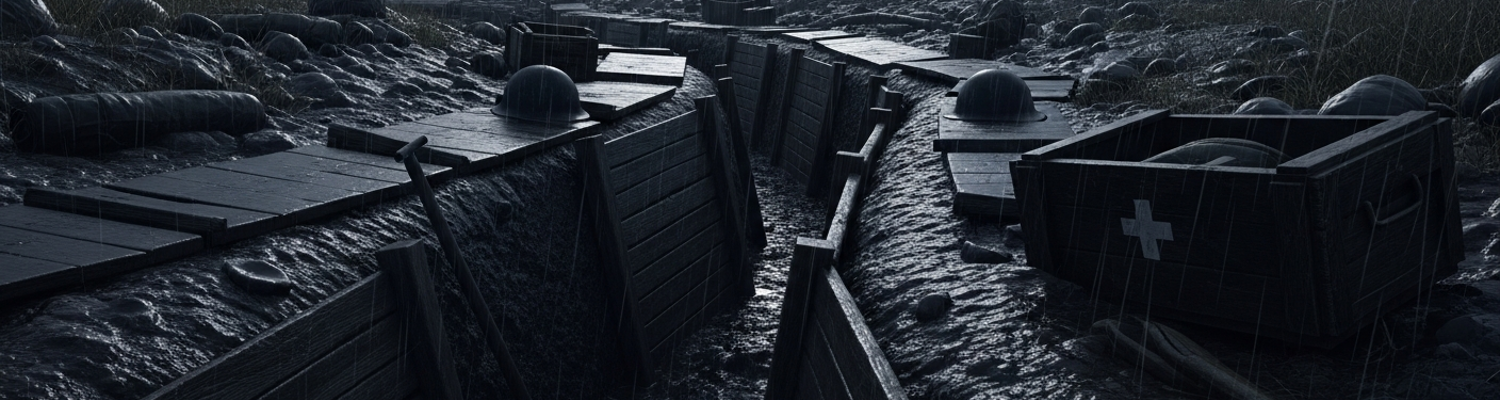

By September 1918, German armies on the Western Front were depleted, some divisions operating at less than half their designated strength. The true obstacle was the Hindenburg Line, a defensive system perfected over four years of industrial war. This was not a simple trench. It was a multi-layered fortress of machine-gun nests, concrete pillboxes, and pre-ranged artillery zones integrated into the terrain of the Argonne Forest and the heights east of the Meuse River. German engineers had woven every ravine and hill into a cohesive web designed to bleed any attacker dry. The American Expeditionary Force (AEF) was tasked with breaking this line in what would become the largest battle in its history.
Operational logs (NARA Record Group 120) reveal the scale of the undertaking. The AEF committed over 1.2 million soldiers under General John J. Pershing. In the eleven days before the attack, more than half a million troops and thousands of artillery pieces were shifted into position, mostly at night. The paper strength of these divisions was deceptive. Units like the 79th Division had been in France for only seven weeks before the assault. Five of the nine divisions in the initial wave had no prior combat experience. This mass of inexperienced manpower was now expected to succeed where veteran Allied armies had failed for years. The density of men and equipment jammed the few available roads, turning rear areas into a morass of traffic that would severely hamper logistics once the battle began.
AEF command doctrine was misaligned with the battlefield. Pershing and his staff believed in open warfare, trusting the American rifleman's spirit to overwhelm the enemy. This philosophy produced optimistic operational plans. Planners expected to advance eight miles and capture the critical high ground of Montfaucon on the first day. Allied commanders, including French General Philippe Pétain, were skeptical, privately believing the Americans would be lucky to reach Montfaucon before winter. AEF pre-battle casualty estimates reflected this overconfidence, failing to account for the lethality of a German defense-in-depth. The plan for a swift breakthrough devolved immediately into a series of costly frontal assaults. The attack became a yard-by-yard fight for which the AEF was neither tactically nor logistically prepared.
Over 47 days of combat, the AEF suffered between 117,000 and 122,000 casualties, including 26,277 killed. This averages over 2,500 casualties per day. The period from late September to mid-October was the bloodiest in American expeditionary history. These numbers represent bodies shattered by machine-gun fire, artillery, and poison gas, compounded by the Spanish Flu. The 35th Division, made of Kansas and Missouri National Guardsmen, was effectively broken in the first days. Other units, like the 1st and 32nd Divisions, were fed into the line to replace them, only to be ground down in attacks on the heights of Romagne and Cunel. The volume of wounded overwhelmed the AEF’s medical corps, leading to a breakdown in casualty evacuation and care.
AEF medical doctrine was built for a different conflict. American military planning was predicated on a war of movement. Its medical support structure, including field hospitals and forward clearing stations, was designed to be small, mobile, and agile. Tables of organization provided for minimal bed capacity, often just a few hundred folding cots, with equipment light enough for a few trucks or wagons. The system had been tested on a smaller scale at St. Mihiel and deemed adequate. That success created a dangerous overconfidence.
When the offensive began at 05:30 on September 26, 1918, the medical system collapsed. The first waves from inexperienced divisions like the 35th, 79th, and 91st were torn apart by pre-ranged German fire. The trickle of wounded became a flood. Archival records show clearing stations designed for a few hundred patients a day were inundated with thousands. Evacuation Hospital No. 8 at Petite-Maujouy received a torrent of casualties far exceeding its official capacity. Roads designated for ambulance traffic became impassable, clogged with supply wagons and artillery, turning a short evacuation into a multi-day ordeal. Many wounded lay for days on the battlefield. For those who reached a clearing station, the situation was little better. A tally from the initial phase shows American ambulance sections transported over 40,000 casualties, overwhelming the evacuation chain.
The system was not strained. It was broken.
With no beds left, medical personnel laid the wounded outside. Thousands of injured men were stacked in rows in open fields and muddy courtyards, often with only a blanket against the autumn rain. Surgeons, working with exhaustion and dwindling supplies, performed triage under the open sky, using flashlights as shells fell nearby. At clearing stations near Cheppy and Varennes, lines of stretchers snaked hundreds of yards into the woods. The volume of bodies, living and dead, created logistical paralysis. There was not enough staff, food, or space. Many men who survived their initial wounds succumbed to exposure and shock while waiting for care.
With the evacuation chain shattered, clearing stations became sites of desperation. AEF medical officers adopted the French method of triage, a term derived from the word for "to sort." It was a measure to impose order on chaos and apply finite resources. Arriving casualties were assessed and sorted into one of three categories, marked by a colored tag. The first, "delayed," were the walking wounded with minor injuries who could wait. The second, "urgent," were men with serious but survivable injuries requiring immediate surgery, like controlled hemorrhage or stabilizable fractures. These patients had the highest chance of survival with prompt attention.
A third tag designated a man as "expectant." This was for those with wounds deemed so catastrophic that survival was minimal. This category included soldiers with penetrating abdominal wounds, which were almost universally fatal before advanced antibiotics. It also included those with severe chest trauma from machine-gun fire or shrapnel and soldiers with devastating head injuries. Medical logs from Evacuation Hospital No. 8 reveal the reality of this process. These expectant casualties were not rushed to an operating table. They were moved to a separate "moribund ward," often a tent or a corner of a field, to make way for those deemed salvageable. The only care they received was palliative. A dose of morphine, a blanket, water. A surgeon attempting a lengthy, likely futile surgery on one expectant patient would expend time and resources that could have saved multiple urgent cases.
As the AEF advanced, it liberated French towns. The civilians who emerged became another stream of casualties. These non-combatants, suffering from malnutrition, disease, and the trauma of the final battles, were funneled to the same clearing stations. Red Cross reports and AEF medical unit logs show the intake of French and Belgian civilians wounded by artillery, burned, or gassed. Once inside the medical chain, they were subjected to the same dispassionate triage. A French child with a severe shrapnel wound to the abdomen was assessed by the same criteria as an American soldier. If the injury was deemed unsurvivable, they too were tagged as expectant and moved aside. There was no separate system for civilians.
The collapse of the AEF’s medical supply chain began with the ground. The Meuse-Argonne region possessed a primitive road network pulverized by four years of war. Heavy autumn rains turned the few arteries into channels of mud. Each American corps had only one main road. These thoroughfares became scenes of gridlock, as wagons, trucks, artillery, and ambulances vied for passage. AEF engineers worked constantly to repair roads, but it was a losing effort. For forward medical units, this paralysis was a disaster. Trucks with essential supplies could take days to travel a few miles. The result was a shortage of anesthetics like ether, antiseptics like Carrel-Dakin solution, and basic supplies like bandages and splints. Surgeons were forced to pass instruments between operating tables and operate without gloves.
Beyond the quagmire at the front, a collapse was occurring within the AEF’s command structure. Friction existed between the First Army, consuming supplies at a ferocious rate, and the Services of Supply (SOS), the logistical organization at Tours. The SOS controlled depots and railheads, but its allocation system was rigid, based on pre-battle estimates that failed to anticipate the attritional nature of the fight. The requisition process was ponderous. As surgeons ran out of chloroform, warehouses in the rear could be full. The earlier decision to prioritize combat troops over medical personnel and logisticians created a deficit that now proved impossible to overcome. The system was designed for movement, but it was paralyzed by a stationary battle.
This was compounded by a severe personnel crisis. An acute shortage of experienced surgeons and nurses meant the capacity to treat the flood of casualties was insufficient. Many physicians mobilized into the AEF were civilian doctors with little experience in military trauma surgery. They were unprepared for the wounds inflicted by high-explosive shells. The demand for nurses was equally desperate. The pre-war formula of one nurse for every ten beds was an impossible standard. At one hospital, 70 nurses cared for 5,000 patients. Many worked 14-to-18-hour shifts for weeks. This shortage was not for a lack of volunteers. Transport priority was given to combat troops. In mid-1918, hundreds of nurses were detained at mobilization stations in New York for months, awaiting passage. This deficit of skilled hands magnified the lethality of the battlefield.
The soil of the Meuse-Argonne was a bacteriological hazard. Four years of war had churned the region’s farmland, long cultivated with animal manure, into a soil rife with anaerobic bacteria. A report from the laboratory of U.S. Army Base Hospital No. 28 cited the warfare over cultivated fields as a direct cause for the high prevalence of gas gangrene. Artillery shells and bullets created deep, penetrating injuries that drove fragments of wool uniforms and contaminated soil into muscle tissue. This created the perfect oxygen-deprived environment for Clostridium perfringens to flourish. As the bacteria multiplied, they produced toxins causing rapid tissue death, or myonecrosis, and a gaseous swelling. A foul-smelling discharge would seep from the wound, the skin would turn dark purple, and a crackling sensation could be felt under the skin. For the thousands of soldiers left in No Man’s Land for hours or days, a survivable wound often became a death sentence from infection.
In the absence of penicillin, AEF surgeons relied on irrigation and excision. The most advanced method was the Carrel-Dakin technique. It involved continuous flushing of a wound with Dakin’s solution, a diluted sodium hypochlorite solution, to kill bacteria without severely damaging healthy tissue. Medical teams placed a network of small rubber tubes deep into the wound, connected to a container that fed the antiseptic fluid into the flesh. Nurses, who often managed the process, had to prepare each batch precisely. For deep-seated infections like gas gangrene, irrigation alone was insufficient. The only remaining option was radical amputation, performed high above the site of infection to get ahead of the spreading necrosis.
Surgical intervention was a gamble. The number of casualties forced surgeons to operate for up to 16 hours a day in tents or damaged buildings with poor lighting. Aseptic procedure frequently broke down. With supplies bottlenecked, instruments were often just rinsed between operations. The core surgical strategy against infection was débridement, a ruthless excision of all dead, damaged, and contaminated tissue. Surgeons cut away flesh until they exposed healthy, bleeding muscle, leaving massive open wounds packed with antiseptic-soaked gauze. This disfiguring procedure was the only known way to stop gangrene. The combination of surgical shock, limited anesthesia, and high probability of secondary infection meant even a successful operation was no guarantee of survival.
AEF operational planning contained a glaring omission: the French civilians who had endured four years of German occupation. Thousands remained trapped in the villages of the Meuse-Argonne. The German military administration had turned the area into an exploitative resource zone. When the American offensive began, these civilians were not evacuated. They were overrun. As American divisions pushed north, they liberated towns like Montfaucon and Grandpré, finding them occupied by French non-combatants, malnourished and caught in the crossfire.
The sudden flight of these civilians introduced a disastrous variable into a failing logistical equation. First Army traffic control reports indicate the few main supply routes were already paralyzed. Autumn rains turned the unpaved routes into thick mud, stalling military convoys for days. Into this gridlock stumbled thousands of French refugees, carrying belongings on their backs. Their unplanned exodus intersected directly with the MSRs, creating bottlenecks that brought all movement to a standstill. A V Corps staff officer reported that senior officers were dispatched simply to act as traffic police. A military struggling to supply its assaults collided with a civilian population fleeing those same assaults.
For these displaced French civilians, there was no formal AEF medical aid system. The American Medical Corps was overwhelmed by its own army's casualties. AEF medical doctrine contained no specific provisions or allocated resources for treating non-combatants on this scale. Private organizations like the American Red Cross operated hospitals for civilians, but these were in rear areas, far from the battle zone. Any care a French civilian received at an AEF clearing station was ad hoc, dependent on the compassion of individual surgeons already buried under an avalanche of wounded soldiers. These civilians, suffering from malnutrition, exposure, and battle wounds, were subjected to the same triage as the troops.
The AEF’s official post-war medical history, particularly the volumes titled The Medical Department of the United States Army in the World War, attempted to frame the breakdown as an unavoidable consequence of the battle's scale. The documentation, however, points to a failure of doctrine. The medical support structure was built for a war of movement that never happened, leaving it unprepared for the static, attritional slaughter it encountered. The system was conceptually broken. This doctrinal rigidity is a central legacy of the campaign. The AEF had seen the results of four years of trench warfare yet fielded a medical corps whose organization was better suited for 19th-century campaigns.
Post-war analysis of hospital records (found in NARA collections) shows a significant number of deaths attributed not to the initial wound, but to secondary causes like shock, exposure, and post-operative infection. These were deaths caused by the system’s collapse. The popular narrative of the Meuse-Argonne focuses on the valor of the soldier and the skill of the surgeon. It omits the thousands who died waiting for an ambulance stuck in mud, or who succumbed to gangrene because their wounds were not debrided in time. The heroic image of the tireless doctor eclipses the triage officer forced to tag a man with a survivable wound as expectant because there were no resources.
The experience of the French population was absorbed into the impersonal category of collateral damage. Their liberation was incidental to the military objective of seizing terrain, and their survival was not an AEF responsibility. Post-war reports focused on military lessons learned. AEF Surgeon General Merritte W. Ireland's final report led to significant changes in U.S. Army medical doctrine, including the permanent establishment of mobile surgical hospitals and a vastly expanded motor ambulance service. The documented failure in 1918 directly informed the structure of medical support for the next world war, a system designed never to repeat the chaos of the Argonne.