
Initial Squadron Deployment and Mandate
The West Gulf Blockading Squadron’s formation in February 1862 was not for passive patrol. A review of its operational directives (NARA Record Group 45) reveals an aggressive, offensive mandate. The primary objective was the capture of New Orleans, the Confederacy’s largest city and most significant economic hub. This was a direct order to project force deep into enemy territory. To achieve this, the squadron was tasked with forcing a passage past the masonry guardians of the lower Mississippi, Forts Jackson and St. Philip. After that, it was to destroy any Confederate naval assets it encountered. A secondary goal was to use New Orleans as a base to assert control over the entire lower Mississippi River. This action would sever the Confederacy along its most important internal artery, cutting off the flow of troops, food, and horses from Texas and Arkansas to the eastern theaters. Other key Confederate ports fell under the squadron’s purview for eventual neutralization, including the heavily defended Mobile in Alabama and the Texas outlets at Galveston and Sabine Pass. The strategy was to choke, and then to dismember.
A frantic, large-scale expansion was necessary to create this fleet. The Union Navy Department purchased or chartered a vast array of civilian ships, from passenger ferries and merchant steamers to sluggish whaling ships, and gave them a hurried conversion for military duty. These vessels were fundamentally unsuited for the demands of a sustained blockade. Their engines, designed for predictable coastal runs, frequently failed under the strain of continuous at-sea operations. Their hulls, built for speed or cargo capacity rather than durability, were vulnerable to the open Gulf. The subtropical climate compounded mechanical issues. The Gulf’s intense heat and oppressive humidity warped wooden decks and accelerated the corrosion of iron hulls and fittings. For the crews, it was a constant battle against sickness. Yellow fever and malaria were endemic. The pathogens spread rapidly through men packed into poorly ventilated ships without effective medical intervention. The very water itself was an enemy; shipworms bored into the wooden hulls of the older vessels with such speed that ships had to be periodically beached for careening, a dangerous and labor-intensive process, just to remain afloat.
This far-flung operation was tethered to the industrial North by a long and fragile logistical chain. Every action consumed coal. The squadron’s steam-powered ships were voracious. Initially, the main supply depot was in Key West, hundreds of miles from the primary operational area off the Mississippi Delta. The subsequent seizure of Ship Island, Mississippi, provided a forward staging area, but it was little more than a barren sandbar that had to be built into a base from nothing. Every ton of coal, every barrel of hardtack, every crate of ammunition, and every engine spare part had to be transported over 1,500 miles from Northern depots in Philadelphia or New York. The process of coaling ships at sea was a slow, difficult evolution, leaving the warships stationary and vulnerable for hours. Fresh water, essential for both boilers and crew, was another scarce commodity. A cracked cylinder or a failed boiler tube could render a warship useless, forcing it off its station for weeks while it awaited a replacement part that might never arrive from the over-burdened supply system.
The Unseen Enemy of Tropical Disease
The most destructive adversary faced by the West Gulf Blockading Squadron was not Confederate cannon. It was microscopic. The operational theater, the semi-tropical coastline of the Gulf of Mexico, was a perfect incubator for pathogens. Medical science of the era lacked a comprehensive understanding of bacteriology or vector-borne illnesses, attributing sickness to miasmas rising from the swamps and bayous. For the sailors packed into poorly ventilated warships on long blockade duty, this environment proved exceptionally lethal. The three most prevalent diseases were dysentery, malaria, and yellow fever. Dysentery, an intestinal infection often called the bloody flux, was a constant presence, spread through contaminated water casks and subpar food sanitation. It left men severely weakened and dehydrated. Malaria, with its recurring cycles of fever and chills, was endemic to the region and spread by the ubiquitous mosquito population. Yellow fever, also mosquito-borne, was the most feared; it struck suddenly and with high mortality, capable of incapacitating an entire ship’s company in a matter of days.
The operational readiness of the squadron was systematically degraded by what the sailors called shivering fevers. A close review of ships' logs and surgeons' reports from the period reveals a constant struggle to keep vessels on station. Malaria’s debilitating cycle was particularly disruptive. A sailor in the grips of its high fever and violent chills was useless for duty, unable to haul coal, climb the rigging, or serve a gun crew. These fevers could prostrate a man for days, followed by a period of apparent recovery, only to return weeks later. This unpredictability made it nearly impossible for a ship’s officers to maintain a reliable watch bill or be certain of having enough men to fight the ship if an enemy was sighted. The loss of even a few key hands in the engine room or at a gun battery could render a warship ineffective. On some vessels, a significant percentage of the crew would be on the sick list at any given time, forcing the healthy to perform double duties to the point of exhaustion, making them more susceptible to illness in turn. Ships were frequently forced to abandon their blockading station and make for the naval hospital at Pensacola or even Key West, leaving dangerous gaps in the Union cordon.
The Navy Department in Washington failed to grasp the scale of non-combat casualties. The strategic planning of Secretary Gideon Welles and his staff focused primarily on ship-to-ship combat, fortress assaults, and the number of hulls required to patrol the vast coastline. Manpower calculations were based on projected battle losses, not the relentless attrition from an unseen biological enemy that killed and incapacitated far more sailors than Confederate action. For every two soldiers who died in battle during the war, three died of disease, a ratio that was often even more skewed in the disease-ridden operational area of the Gulf. Admiral Farragut’s dispatches, while focused on operational movements, contain repeated mentions of sickness hampering his fleet. Official records show that two soldiers died from disease for every one killed in combat, and the problem was especially acute in the South. The department’s directives for manpower replacement did not adequately account for the constant drain of sailors whose constitutions were broken by recurring bouts of malaria or the long-term effects of dysentery. Many ships in the squadron operated in a perpetually undermanned state, a fact that senior commanders understood but which was never fully factored into strategic resource allocation from the capital.
Forcing the Passage of Forts Jackson and St. Philip
The entire Union strategy for the lower Mississippi hinged on overcoming two specific masonry-and-earthwork positions. Located approximately 75 miles south of New Orleans, Fort Jackson and Fort St. Philip sat on opposite banks at a sharp bend in the river, creating a natural chokepoint. Any vessel attempting to pass was forced to slow and navigate directly into the interlocking fields of fire from the forts’ combined armament of over 120 cannons. Fort Jackson, a more modern star-shaped brick fort on the west bank, was supported by the older, irregular earth-and-brick Fort St. Philip on the east bank. Confederate engineers amplified this geographic advantage by stretching a defensive boom across the river, a raft of cypress logs and chains anchored to schooner hulks, designed to halt ships directly under the guns. Confederate naval assets, including the unfinished ironclad CSS Louisiana and the ram CSS Manassas, were positioned upriver to attack any Union ships that survived the gauntlet.
The initial Union approach began on April 18, 1862. It was a massive, sustained bombardment. Commander David Dixon Porter’s flotilla of twenty-one mortar schooners, partially concealed by the riverbank trees, began lobbing thousands of 200-pound shells, concentrating their fire primarily on Fort Jackson. A review of Confederate damage reports from Brigadier General Johnson K. Duncan shows that while the six-day bombardment set fire to the soldiers' quarters and the fort's central citadel, it failed in its primary objective. The fort’s hardened brick casemates protected the majority of its gun crews and artillery pieces. Only seven of the fort's cannons were disabled. With mortar ammunition dwindling and Flag Officer David Farragut growing impatient, a new plan was adopted. Concluding that the forts could not be destroyed by shelling, Farragut issued orders to bypass them entirely under cover of darkness. The assault was set for 2:00 AM on April 24, a high-risk gamble to push seventeen warships through the prepared kill zone.
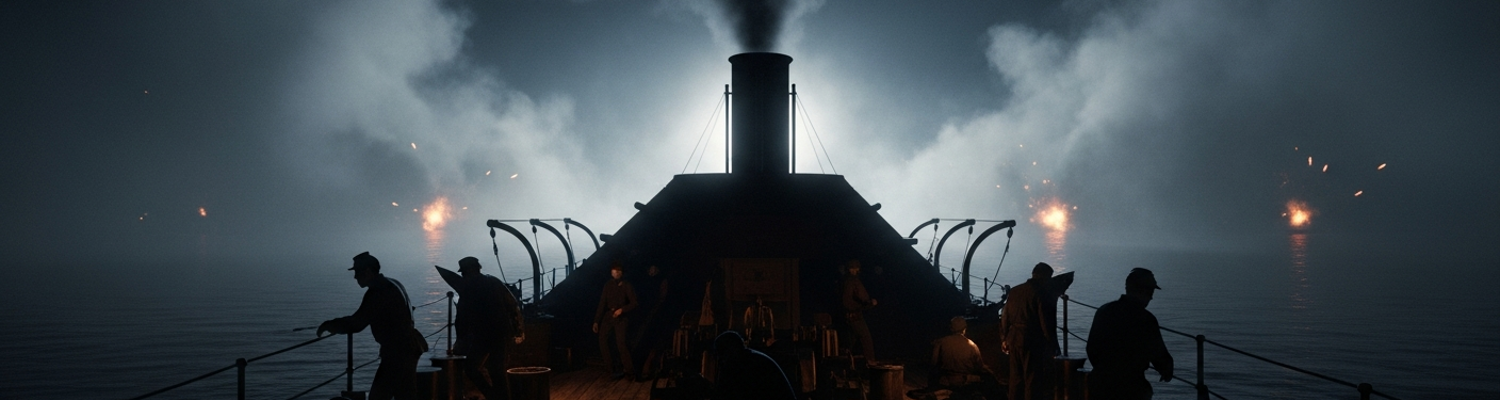
The assault began in near-total darkness. As Farragut’s fleet advanced in two columns toward the gap previously broken in the river chain, the forts spotted them at approximately 3:30 AM and opened fire. The night was instantly filled with the deafening roar of hundreds of guns firing simultaneously. Visibility, already low, was almost completely eliminated by the immense volume of dense, acrid gunsmoke from the fleet’s own broadsides and the forts’ batteries. Farragut himself noted that they had nothing to aim at but the flash of enemy guns. The Confederates compounded the blinding effect by sending massive fire rafts, barges piled high with burning pine knots and cotton, drifting down the current. This tactic created a hellish, flickering light that cast disorienting shadows and ruined the sailors’ night vision. Command and control dissolved. Each ship became an isolated unit fighting for its own survival in the dark. The USS Hartford, Farragut’s own flagship, ran aground while avoiding a fire raft and was briefly set ablaze before its crew extinguished the flames. Other ships collided in the smoke. Gunners in the forts and on the ships fired indiscriminately at any vessel they could see, frequently targeting their own side. The Confederate ram CSS Manassas was fired on by both Union ships and the Confederate gunners in Fort Jackson. Distinguishing friend from foe became nearly impossible.
The Reality of Accidental Engagements
The passage of Forts Jackson and St. Philip devolved into a blind fight where the greatest immediate threat to a Union vessel was often another Union vessel. A review of after-action reports reveals multiple instances of fratricide born from chaos. The experience of the gunboat USS Kineo provides a specific case study. As the fleet plunged into a dense bank of gunsmoke that reduced visibility to near zero, the larger sloop-of-war USS Brooklyn became disoriented. Drifting off course, it suddenly appeared out of the smoke and slammed into the smaller Kineo. Before the crews could process the collision, the Brooklyn’s gunners, acting on the standing order to fire at anything that appeared in the dark, discharged a full broadside directly into the friendly vessel. The point-blank cannonade tore through the Kineo, inflicting serious damage and casualties upon a crew that was part of the same attacking column.
Mistakes were inevitable.
This lethal confusion was a direct consequence of the technological and environmental realities of naval combat in the era. There was no reliable method for identifying friend from foe in the heat of a night engagement. Signal lanterns were useless, their light swallowed by the thick, sulfurous clouds of black powder smoke that hung heavy and motionless in the humid river air. Gunners were trained to service their pieces with maximum speed. In the deafening, blinding environment of a close-range battle, any dark shape that loomed out of the smoke was treated as a target. The Confederate ram CSS Manassas became a phantom enemy to both sides; its low, turtleback profile made it difficult to identify even in clear conditions. During the battle, it was fired upon indiscriminately by Union ships and the Confederate gunners in Fort Jackson, each side believing it was engaging a hostile vessel.
This lethal confusion was not confined to the river. The challenge of coordinating naval firepower with army movements on the ground created another vector for friendly fire casualties. During the Siege of Port Hudson in 1963, Admiral Farragut’s warships were tasked with providing fire support for Major General Nathaniel P. Banks’s ground assaults. The squadron’s powerful guns were essential for suppressing Confederate artillery batteries. However, a close examination of the operational mechanics reveals an exceptionally high-risk endeavor. The lack of real-time communication between the ships and the troops ashore meant that fire missions were based on pre-arranged plans and visual signals that were often obscured by terrain or battle smoke. From the river, it was exceedingly difficult for naval gunners to distinguish the maneuvering Union regiments from the entrenched Confederate defenders along the bluffs. A minor miscalculation in gun elevation, a slight shift in the ship’s anchored position due to river current, or a misread signal could send hundreds of pounds of ordnance into the wrong location. Union ground troops endured the constant threat of their own naval support accidentally raining destruction upon their positions.
The Grind of Mississippi Riverine Operations
The capture of New Orleans in late April 1862 did not conclude the squadron’s offensive duties. It initiated a new, more grueling phase of the war. The strategic objective pivoted from a concentrated assault on a single urban center to the systematic domination of hundreds of miles of the Mississippi River. This forced an operational transition from saltwater siege tactics to a grinding inland patrol, a type of warfare for which many of Farragut’s deep-draft vessels were poorly suited. Ships designed for open-ocean blockading were now tasked with navigating a treacherous, winding waterway defined by shifting sandbars and submerged obstacles. An examination of the squadron’s order of battle shows an immediate need to push assets north to subdue Confederate holdouts at Baton Rouge, Natchez, and the fortress of Vicksburg. This new mission stretched Union naval power thin, transforming a concentrated fleet into a series of small, detached flotillas operating deep inside hostile territory.
It was a war against the river itself. The mechanical and environmental challenges of sustained river patrol were relentless. Ship engines designed for intermittent cruising in the open Gulf were now forced to run for extended periods, fighting the Mississippi’s constant 3-to-4 knot current. This placed enormous strain on pistons, boilers, and drive shafts, leading to frequent mechanical failures far from any friendly repair facility. Fuel consumption became a severe vulnerability. The constant work required to simply hold a position in the river, let alone advance, devoured coal at an alarming rate. When coal ran out, landing parties had to be sent ashore to forage for wood, an action that exposed them to attack from Confederate partisans. A review of operational logs from this period details a persistent, low-intensity war fought against an unseen enemy. Confederate sympathizers and irregular cavalry units used the dense vegetation along the riverbanks for concealment, taking potshots at helmsmen, officers on deck, and any sailor exposed during wood-gathering or repair operations. These were not formal battles but a constant, nerve-shredding harassment that inflicted a steady stream of casualties and degraded crew morale.
This was a campaign of isolation. The further a Union gunboat pushed north from the support base at New Orleans, the more isolated it became. A single disabled steam engine or a damaged rudder could leave a vessel stranded for weeks, hundreds of miles from aid. Communication was nonexistent except by dispatch boat. The most dramatic illustration of this vulnerability occurred on July 15, 1862, when the Confederate ironclad CSS Arkansas steamed out of the Yazoo River and directly into the combined, unprepared Union fleets of Farragut and Charles H. Davis anchored above Vicksburg. The powerful Confederate ram, a single vessel, passed directly through the entire Union flotilla, disabling the ironclad Carondelet and the ram Queen of the West before reaching the safety of the Vicksburg batteries. The event was a tactical embarrassment. Despite dozens of ships present, the dispersed and uncoordinated Union flotilla was unable to stop one determined attacker. The Arkansas had single-handedly broken the Union’s naval siege, forcing Farragut to withdraw his deep-draft ships soon after due to falling river levels and the inability to destroy the Confederate vessel.
Partisan Attacks and the Dangers of Shore Duty
A shift from open-water naval engagements to coastal and riverine dominance exposed sailors of the West Gulf Blockading Squadron to an entirely new class of threat. Control of the sea did not equate to control of the shore. Every landing for water, intelligence, or foraging brought Union personnel into direct contact with a hostile environment where the population itself was a combatant. Confederate authorities actively encouraged the formation of irregular units to counter this threat. A review of Confederate military records shows the authorization of units like the 13th Battalion Louisiana Partisan Rangers, specifically tasked with harassing Union forces with guerrilla tactics. These were not armies that would meet in formal battle, but bands of fighters who used their intimate knowledge of the local swamps and bayous to lethal effect. For the Union sailor, the threat was no longer just from a cannon at a fixed range, but from a sniper’s rifle fired from a concealed position at any moment.
Shore expeditions became exercises in extreme physical duress. They transformed sailors into overburdened infantrymen. A typical sailor assigned to a landing party was loaded with equipment unsuited for extended overland movement in the subtropical Gulf climate. The standard-issue weapon, often a heavy rifled musket, was supplemented by a leather cartridge box holding dozens of rounds, a bayonet in its scabbard, a heavy cutlass, a haversack for rations, and a canteen. The cumulative weight was substantial, turning any movement across soft sand or through dense, humid vegetation into a grueling ordeal. The oppressive heat and humidity of the Louisiana and Texas coasts caused rapid exhaustion and heat-related illnesses among men accustomed to the slightly cooler conditions at sea. This physical burden was a tactical vulnerability. Men struggling under the weight of their packs were slower to react and more likely to become separated from their units, making them prime targets for partisan attack.
The transition from boat to land was the moment of maximum vulnerability. Landing operations, by their nature, exposed organized military units to piecemeal destruction. The planning for the disastrous Second Battle of Sabine Pass on September 8, 1863, reveals this inherent risk. The Union plan called for gunboats to silence Fort Griffin, allowing some 4,000 troops on transports to land and invade Texas. But the initial assault by the gunboats was repulsed with shocking efficiency by a small Confederate force of fewer than 50 men firing from well-prepared positions. The Confederate gunners had previously placed stakes in the channel to use as range markers, allowing them to fire with devastating accuracy. The Union gunboats USS Sachem and USS Clifton were disabled and captured. The entire invasion force withdrew, having suffered hundreds of casualties without a single infantryman getting ashore. This incident provides a stark case study: even before facing partisans, landing forces were exceptionally exposed during the approach. Any concealed enemy with accurate artillery could turn a packed landing craft into a slaughter pen.
The True Human Cost of the Blockade
An objective examination of Union naval records reveals that for every sailor in the West Gulf Blockading Squadron killed by a Confederate cannonball, at least two died from disease. This disproportionate lethality was a direct consequence of the operational environment. The squadron’s wooden steamships, packed with men and machinery, were perfect incubators for pathogens in the semi-tropical climate of the Gulf Coast. A review of ships’ surgeons’ logs indicates that dysentery, spread through contaminated food and water stores, was a constant, debilitating presence. Malaria and yellow fever, both transmitted by mosquitoes from the coastal swamps, could incapacitate a vessel with stunning speed. A warship with a significant portion of its crew sick was a liability; it could not effectively give chase, man its guns in a sudden fight, or even weigh anchor in an emergency. The constant attrition from sickness was a greater threat to the blockade’s integrity than all the Confederate ironclads and privateers combined.
This was a war defined by profound boredom, punctuated by moments of extreme terror. A sailor’s life was one of crushing monotony, confined to the cramped, foul-smelling confines of a rolling ship for months on end. The diet consisted largely of salted meat and hardtack. The water was often brackish. The only respite from the oppressive heat was on an open deck, exposed to enemy observation. This grinding existence was layered with constant, low-level anxiety. The threat was not just a blockade runner appearing out of a squall, but the ship itself failing. Steam boilers, operated under high pressure by men working in extreme heat, could explode with catastrophic force. A sudden storm could snap a mast or drive the ship onto an uncharted sandbar hundreds of miles from friendly territory. Medical logs and asylum records from the period document cases of severe depression and listlessness, a condition that we would now recognize as a response to trauma and isolation. Instances of what doctors called irritable heart, characterized by panic attacks and anxiety, were common among men subjected to the long-term strain of this isolated duty.
A steam sloop was a machine, and much of a sailor’s life was dedicated to feeding and maintaining it. The single task of coaling ship was a filthy, exhausting evolution that covered every surface and every man in a thick layer of black dust. An analysis of enlistment records shows that the crews of Union warships were a diverse collection of professional mariners, recent immigrants, and landsmen with no sea experience, many motivated more by enlistment bounties than ideology. The rigid hierarchy of a naval vessel, with officers enjoying comparatively spacious quarters while the crew was packed into hammocks on the gun decks, created a stark social divide.