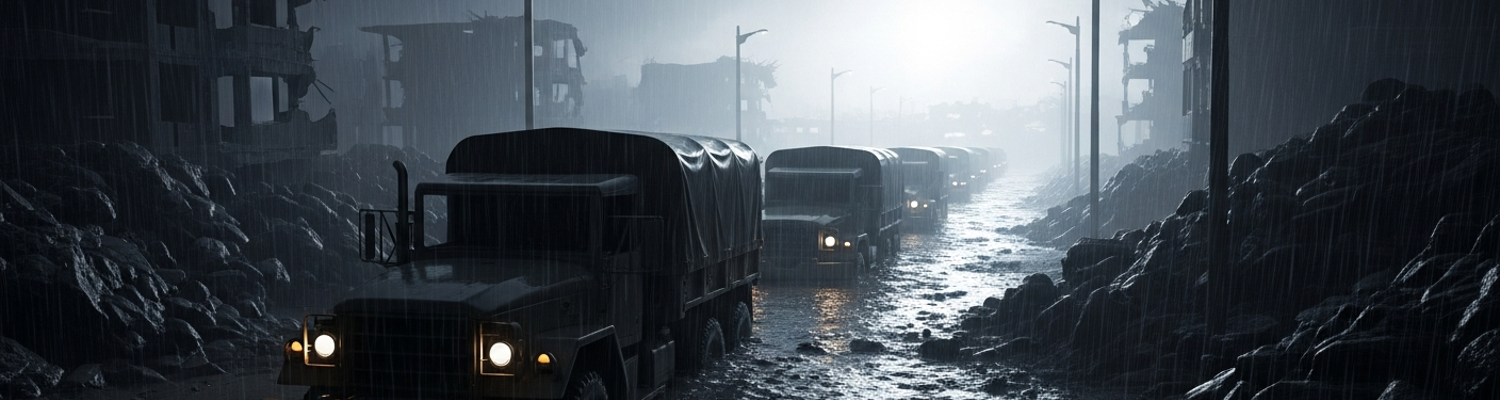

The M35 2.5-ton cargo truck was conceived for a conflict that never occurred, on a continent half a world away from Vietnam. Archival evidence (NARA Record Group 127) shows the vehicle, initially designed by the REO Motor Car Company in 1949, was a direct product of post-World War II logistical doctrine. The specifications called for a 6x6 truck rated to carry 5,000 pounds off-road or 10,000 pounds on the paved highways of Europe. Its development was a lesson from the advance across Germany, where supply lines stretched to their breaking point. The M35 was built as a reliable, mass-produced workhorse for moving immense quantities of materiel across an established road network in a conventional war against the Soviet Union. Initial models, powered by a Continental OA-331 gasoline engine, were engineered for a world of predictable infrastructure.
They were not designed for the punishing, roadless expanse of rural South Vietnam.
Operational logs from I Corps reveal the immediate and crippling effect of the region’s climate on the M35. The standard M35A1 and A2 models lacked any comprehensive, deep-water fording capabilities. The January 1968 monsoons preceding the Tet Offensive turned the lowlands around Hue into a landscape of churning water. Roads became shallow rivers. Every stream crossing posed a threat to the truck’s electrical system. The ignition, distributors, and spark plugs were not adequately shielded from moisture. A crossing through water just a few feet deep could saturate these components, stalling the engine and rendering the 13,000-pound vehicle an immobile obstruction. Maintenance crews from the 1st Marine Division and the Army's 1st Cavalry Division recorded a constant struggle against this design flaw. Field-expedient measures became standard procedure. Plastic bags, grease, and any available sealant were applied to protect vital electrical parts. These efforts were often futile against the pervasive, engine-stalling dampness.
The vehicle's cab configuration was a deliberate design choice from an earlier era of manufacturing that prioritized visibility and simple construction. In Vietnam, it was a catastrophic flaw. The canvas top and open sides offered the driver and co-driver no protection from the elements, forcing them to endure the same relentless rain that threatened their engine. Far worse, it left them completely exposed to enemy fire. Convoys moving supplies along Route 1, the main artery to Hue, were constant targets for ambushes. Viet Cong and NVA forces could direct rifle and machine gun fire directly into the cab with impunity. This vulnerability threatened the entire logistical chain. A single burst of fire could neutralize a truck’s drivers, causing the vehicle to crash and block the narrow road, creating a kill zone for the vehicles trapped behind it. The response was born of necessity. Units began improvising armor by welding salvaged steel plates to the doors and floorboards, initiating a cycle of field modification that would define the M35’s service.
The northeast monsoon that struck Thừa Thiên-Huế Province in early 1968 was a physical force of attrition. A review of maintenance records from the 1st Marine Division indicates the M35’s problems extended beyond its exposed ignition system. The constant, driving water worked its way into every mechanical tolerance. A significant issue arose with the truck’s braking system. After-action reports show that the hydraulic brakes, which relied on rubber seals and flexible lines, were highly susceptible to failure. The pervasive moisture, combined with grit and mud, accelerated the degradation of these components, causing leaks in brake cylinders and a loss of hydraulic pressure. Drivers would press the brake pedal only to find it unresponsive, a system failure when navigating a congested street under fire. The water also contaminated lubricants, particularly in the wheel hubs and differentials. This emulsified the grease, washing it away from bearings and leading to overheating and seizure. An M35 did not have to be hit by an RPG to be knocked out of action; the environment itself was a saboteur.
Hue was a city of masonry. French colonial facades, ancient pagodas, and brick-and-stucco homes did not just collapse under artillery fire. They shattered into a landscape of weaponized debris. The avenues of advance for M35 resupply convoys were choked with piles of broken brick, twisted rebar, and razor-sharp shards of blasted-out walls. This terrain destroyed tires. The standard 9.00x20 non-directional military tires of the M35, designed for the dirt roads of Europe, were completely outmatched. Their sidewalls were easily gashed and punctured. A single flat tire could cripple a 13,000-pound truck, turning it into a stationary target and a roadblock for the entire column behind it. The strain on the vehicle’s frame was immense. Navigating these rubble fields subjected the truck’s leaf spring suspension and ungalvanized steel frame to constant, violent shocks, leading to cracked springs and stressed frame rails.
The combination of monsoon mud and urban rubble created an impassable obstacle. The M35’s 6x6 drive system was frequently rendered useless. The truck's considerable weight became its primary enemy. As drivers attempted to push through water-filled craters or across rubble-strewn lots, the vehicle would sink. The ten heavy tires would spin uselessly in the viscous slurry of mud, brick dust, and filth, digging themselves deeper with every rotation. The dual rear tires, a design feature for on-road load carrying, became a liability in deep mud by packing with sludge and losing all traction. A shallow puddle could conceal a meter-deep hole. An entire convoy could be halted by a single bogged-down Deuce. This immobilization was a tactical disaster. A stuck M35 was a primary target for NVA mortar teams and B-40 rocket gunners, who could engage the stationary vehicle and its crew at their leisure.
The response to the M35’s inherent vulnerabilities was not a top-down directive. It was a reaction from the men who drove and maintained the trucks. A review of operational logs shows that mechanics and drivers, particularly those of the 11th Motor Transport Battalion, became the primary agents of innovation. Working in makeshift motor pools at bases like Phu Bai, often under the threat of rocket and mortar attack, they transformed the standard-issue Deuce and a Half into a machine hardened for the realities of the war. This was not organized research and development. It was battlefield engineering, executed with scavenged parts and welding torches.
The most immediate modification addressed the truck’s exposed cab. Drivers running supplies down Highway 1 toward Hue were vulnerable. The solution was sandbags. Crews began lining the floorboards, doors, and the thin metal firewall of their cabs with layers of sand-filled sacks. This was intended to create a layer of armor capable of stopping or slowing small arms fire and fragmentation. The application was a science born of experience. A single layer was often useless. Stacking them too high made the truck top-heavy and unstable. Drivers learned the precise placement needed to protect their torsos while still being able to operate the vehicle. This ad-hoc armoring came at a cost. The added weight put a severe strain on the truck’s suspension and engine. During the monsoon, the sandbags would become water-logged, drastically increasing the load, cracking leaf springs, and causing engines to overheat.
To combat the monsoon-swollen rivers and flooded streets that defeated the truck’s low-slung chassis, mechanics devised snorkel systems. The standard M35’s exhaust pipe terminated beneath the vehicle, and the air intake was similarly vulnerable. Driving into deep water would flood the exhaust, creating backpressure that could stall the engine. Once stalled, the truck was an anchor. Mechanics from units like the 11th Motor Transport Battalion began scrounging for any available pipe or tubing. They would cut off the original exhaust and weld on vertical extensions, often running them up the back of the cab to a height of seven or eight feet. A similar modification was often made to the air intake. These improvised snorkels, cobbled together from salvaged culvert sections or scrap metal, allowed the engine to continue breathing even when the rest of the truck was submerged almost to the top of its hood. It was an unofficial fix that gave the M35s the deep-wading capability they needed to navigate the aquatic battlefield of Hue.
The besieged Marine firebases inside Hue required a constant flow of materiel. A detailed analysis of dispatch logs from the 11th Motor Transport Battalion, the logistical element for the 1st Marine Division, reveals the intensity of their mission. Convoys were assembled at logistical hubs like the Red Beach Base Area in Da Nang or the closer Phu Bai Combat Base. Each truck was a mobile warehouse, its bed packed with a specific cargo. Drivers hauled pallets of 7.62mm ammunition for M60 machine guns, crates of 81mm mortar rounds, cases of C-4 explosives for breaching structures, and thousands of gallons of water. The convoys were targets. Command-detonated mines and ambushes were a constant threat along Highway 1. The loss of a single truck could halt an entire column, creating a static and indefensible target for NVA forces. The decision to keep these convoys rolling was a necessity; without them, the Marines in Hue would cease to be an effective fighting force.
When the call for casualty evacuation, or CASEVAC, went out over the radio, it was often an M35 that answered. This mission is distinct from a formal medical evacuation because it uses any available vehicle, not a dedicated ambulance. For the Marines fighting block by block through the rubble of Hue, the nearest available vehicle was almost always a Deuce and a Half that had just delivered its cargo. After-action reports describe a grim process. Wounded men were lifted onto the cold steel bed of the cargo truck. There were no medics on board and no sterile environment, only the shuddering floor slick with a mixture of diesel, rainwater, and blood. The drivers, often the same young Marines who had just run the gauntlet into the city, would then have to drive back out, their ears filled with the sounds of the wounded sliding in the back with every lurch and turn. The M35, designed to haul pallets of gear, became an improvised ambulance, its previous cargo of bullets replaced by the bodies of the men who needed them.
Operational capability was maintained through relentless labor. The drivers and mechanics of the 11th Motor Transport Battalion worked in open-air motor pools, engaged in a constant war against the degradation of their machines. A review of maintenance logs from the period shows a litany of recurring failures. Tires were shredded by debris. Leaf springs cracked from the weight of sandbags and the shock of shell craters. Brake lines were severed by shrapnel. Cannibalization became standard procedure. A truck disabled by a blown engine would be stripped of its tires, axles, and suspension components to keep another M35 in the fight. The mechanics became experts at triage, deciding which trucks could be repaired and which would become donors. This cycle of breakdown, repair, and cannibalization, performed by exhausted men under extreme duress, was the hidden mechanism that kept the supply lines to Hue open.
The Battle of Hue proved the M35 was the wrong tool for that specific job. Archival evidence from the 1st and 5th Marine Regiments shows that once inside the city’s confines, the truck’s design flaws became fatal liabilities. Its long wheelbase and poor turning radius, engineered for open roads, made it difficult to maneuver in the narrow, debris-choked streets south of the Perfume River. A simple ninety-degree turn could become a multi-point maneuver under intense enemy fire. The open, unarmored cab, a holdover from post-WWII design, turned the driver's compartment into a kill box for NVA snipers and machine gunners firing from the dense warren of two- and three-story buildings. The truck’s high profile made it an easy target for B-40 rockets. Its non-directional tires were shredded by the endless fields of shattered brick and glass, while the dual rear tire configuration frequently became packed with mud, losing all traction.
The M35's performance signaled a need for future logistical platforms to be built with the expectation of a contested, asymmetric battlefield. The failures at Hue provided a clear set of requirements for the next generation of military vehicles. The ad-hoc efforts of Marines to sandbag their floors and weld on steel plates demonstrated a requirement for factory-installed, integrated armor. A close examination of post-Vietnam vehicle development, such as the program that led to the Medium Tactical Vehicle Replacement (MTVR), reveals a direct lineage from these lessons. Future designs would prioritize crew survivability from the outset, incorporating armored cabs and blast-resistant hulls. The constant struggle with the terrain underscored the need for superior off-road mobility, leading to innovations like central tire inflation systems and more advanced independent suspensions. The M35 was a product of an era that assumed control of supply lines; Hue demonstrated that logistics itself would be a primary battlespace.
This experience altered Marine Corps logistical doctrine. Before Hue, planning was built around the concept of large convoys operating on secure main supply routes. The battle laid bare the fragility of that model. The concentrated, high-value target presented by a column of M35s was too easy for enemy forces to attack. Post-action analyses and subsequent doctrinal updates show a shift in thinking. There was a new emphasis on distributed logistics, moving away from a total reliance on ground convoys toward a more flexible approach. The importance of heavy-lift helicopter assets like the CH-53 Sea Stallion for bypassing contested ground routes and delivering supplies directly to frontline units was heavily reinforced.