
Rangefinder Failure in Monsoon Fog
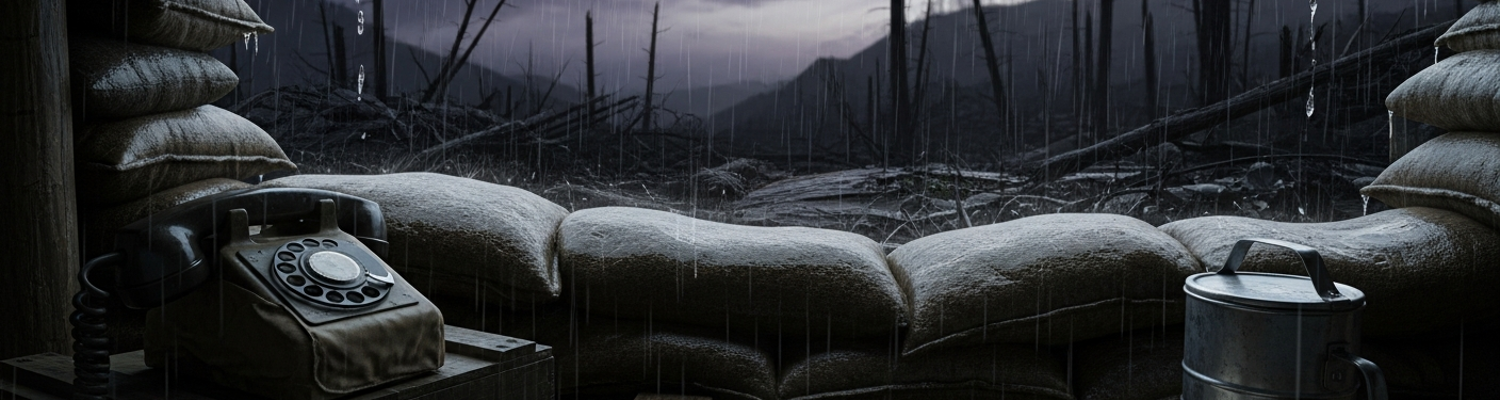
The rain over Maehwa Ridge was a physical presence. It was a liquid curtain that absorbed sound and erased light. For Private First Class Jensen, a forward observer with the U.S. 2nd Infantry Division, the world had contracted to the muddy confines of his trench. His function was direct: serve as the eyes for the 155mm howitzer batteries located miles to the rear. He was tasked to locate Chinese positions and provide the Fire Direction Center with coordinates for their destruction. This man was a single, vital link in a chain of violence stretching across the central Korean peninsula. The operational plan depended on him establishing precise target data before an infantry assault. That plan was gone. It was washed away by a monsoon that rendered the landscape an impenetrable gray void.
The nexus of the failure was in Jensen's hands. It was a metal tube, just over a meter in length: the M1 coincidence rangefinder. A product of Second World War optics, the M1 was a robust but environmentally sensitive instrument. Its operation required a clear line of sight and the user's ability to resolve two separate images of a target into a single, cohesive picture. By turning a dial, the operator manipulated a set of internal prisms and wedges. When the split images perfectly overlapped, the range in meters could be read from an internal scale. Calibrating, or zeroing, this optical system was a challenge even in ideal weather. It required the operator to focus on an object at a known, fixed distance to ensure the scale's accuracy.
In the thick monsoon fog, there were no objects at a known distance.
There were no objects at all.
The core principle of the device, the triangulation of a visible target, was rendered useless. Water droplets suspended in the air scattered and diffused any available light, preventing a sharp image from ever forming in the eyepiece. The internal lenses would fog over from the ambient humidity. Any attempt at recalibration would only introduce greater error into an already compromised system.
The outcome was a severe miscalculation. Lacking any reliable data from the M1, Jensen and his radio operator reverted to cruder methods. They relied on map estimation and sound-ranging. Archival after-action reports (NARA Record Group 407, Entry 279) indicate the team believed they heard the distinct report of Chinese mortars from a forward slope of a neighboring hill, designated Hill 395 on their maps. The incessant drumming of rain on rock and canvas, however, warped the sound. This made directional pinpointing an exercise in pure guesswork. A fire mission was called in based on this auditory phantom. The coordinates transmitted to the artillery were for a position hundreds of meters away from any actual Chinese entrenchments. The subsequent barrage of high-explosive shells from IX Corps artillery impacted an empty, mud-soaked hillside. It was a furious but entirely pointless expenditure of ammunition. The real Chinese mortar pits, dug into a reverse slope specifically to protect against this kind of line-of-sight observation, remained untouched and fully operational.
Signal Collapse on Hill 247
The assault on October 14, 1952, part of the wider Operation Showdown, was directed at Chinese positions on Triangle Hill. For the men of the U.S. 7th Infantry Division, the objective was a specific piece of contested earth designated Hill 247. This ground was a tactical problem. Steep, rocky, and churned into a near-liquid state by the unrelenting autumn monsoon, it offered little cover and less stable footing. The entire operational plan depended on small units, platoons and squads, seizing footholds and then coordinating their subsequent movements. That coordination relied entirely on a fragile technological chain. A chain that was about to be broken by weather and violence. The primary means of communication were the SCR-300 backpack radios and sound-powered field telephones connected by spools of W110-B field wire. In the driving rain and chaos, these systems began to fail almost immediately.
A close review of operational logs from the battle highlights a catastrophic dependence on a fallback system: pyrotechnic signals. With radios rendered useless by water ingress and telephone lines shredded by artillery, platoon leaders reverted to their AN-M8 flare pistols. The established protocol was simple. A green flare indicated an objective was taken and to consolidate. A red flare was a desperate call for fire support or a signal of being overrun. In the thick, foggy air of the monsoon, these colors lost all distinction. The driving rain and mist acted as a distorting filter. Archival accounts describe how green stars, fired to signal success, appeared as a sickly, washed-out yellow or white, easily mistaken for a standard illumination flare. More dangerously, red flares, meant to signal extreme danger, lost their intensity. They appeared as faint orange embers that were often entirely invisible to adjacent units. On the slopes of Hill 247, one platoon from the 31st Infantry Regiment believed they had secured a forward trench line and fired a green flare. A supporting platoon, positioned lower on the hill and peering through the storm, saw only a brief, ambiguous flicker. Interpreting this as a sign that the lead element had been wiped out or had failed to launch its assault, they held their position instead of moving up to support. This single, misinterpreted signal caused the entire right flank of the American assault to stall, leaving the lead platoon dangerously isolated.
Command was blind.
The reversion to 19th-century signaling methods was a direct result of 20th-century technology failing under extreme stress. The SCR-300 radio, a heavy backpack unit weighing over 35 pounds, was notoriously vulnerable to moisture. Rain would seep past rubber gaskets and into battery compartments, shorting out the BA-70 cells and rendering the unit dead weight. Even if the radio itself survived, the downpour and atmospheric conditions created immense static, turning voice transmissions into an unintelligible hash of noise across the 40.0 to 48.0 MHz band. Field telephones offered no better solution. The standard W110-B wire, though tough, was laid directly on the ground. Constant mortar and artillery bombardment from Chinese positions tore the lines to shreds faster than linemen could perform splices. A single piece of shrapnel could sever contact. The rain created another problem: water would work its way into any splice, no matter how well-taped, creating shorts in the circuit. Repairing these lines required linemen to expose themselves to fire, tracing breaks in a sea of mud while the battle raged around them. For the commanders situated in bunkers to the rear, the effect was a terrifying void. Their maps showed the planned progression of their units, but the battlefield offered only silence. After-action reports from the 7th Infantry Division repeatedly note periods of 30 to 45 minutes where all contact with forward assault elements was completely lost. During these windows of silence, commanders could not know if their men were winning, losing, or being annihilated.
Analysis of Fratricide Coordinates
The breakdown of command and control on Maehwa Ridge culminated in a disastrous friendly fire incident involving elements of the 7th Infantry Division. Archival evidence shows that late in the night, a platoon from the 31st Infantry Regiment, having been displaced from its planned axis of advance by a Chinese counter-attack, found itself pinned down in an unfamiliar gully. Their SCR-300 radio was dead, drowned by the monsoon. Believing they were observing enemy movement on what they thought was the adjacent ridgeline, the platoon leader fired a red star cluster. This was the pre-arranged signal for emergency fire support on a pre-planned target. The signal was seen by a rear-area mortar section. The coordinates for the fire mission, designated Target Package Baker-7, had been logged hours earlier. It was a point on the map meant to interdict a key trail junction. Due to the chaos and the complete loss of contact with the forward platoon, the Fire Direction Center had no way of knowing that the platoon was now occupying that exact position. The 81mm mortar crews executed the fire mission flawlessly.
The rounds were perfectly on target.
A close review of operational logs shows that the first high-explosive shells landed directly in the center of the beleaguered platoon’s position, resulting in multiple casualties. The rugged terrain of the Korean peninsula was a direct contributor to this tragedy. The landscape around Maehwa Ridge was not a series of clean, rolling hills but a chaotic jumble of steep, knife-edged ridges and deep, narrow valleys that all looked maddeningly similar in the dark and rain. An infantry company advancing along one valley floor was completely invisible to a unit on a parallel ridge just a few hundred meters away. This terrain created significant dead zones for both line-of-sight observation and radio signals. The platoon leader who called for fire was operating under the conviction that his unit was in one location, while the map in the Fire Direction Center showed his last reported position miles away. The terrain itself fostered this disorientation. From the ground, in the driving rain, one muddy slope looked identical to the next. The topographical maps, while accurate in a two-dimensional sense, could not convey the vertical confusion and sheer difficulty of movement that defined the battlefield. Target verification became a lethal exercise in guesswork.
Confirmation was impossible.
Standard operating procedure for low-visibility engagements demanded a multi-layered verification process that utterly failed that night. Any request for artillery or mortar fire, especially a danger close mission near friendly lines, required positive confirmation from the requesting unit’s higher command. The Fire Direction Center of the supporting artillery or mortar battalion was responsible for plotting the requested coordinates and ensuring they did not overlap with known friendly positions. This entire system hinged on a steady flow of communication. With the SCR-300 radios out and field telephone wires shredded, that flow ceased. The FDC was working from old information. Their maps showed the platoon in its planned location, not its actual, desperate position. The use of pyrotechnic signals was a last-ditch fallback, and a poor one, as it provided no way for the FDC to question the fire mission or confirm the requesting unit’s true location. The red flare simply signaled 'fire,' and the mortar crews, following procedure for a pre-planned target, obliged. There was no 'check fire' or 'cancel mission' call because the very people in danger were the ones who had initiated the request, and they had no way to stop what they had started.
Report Number 1 From the Dugout
The scene inside the company command post, a hastily excavated dugout shored up with ammunition crates and sandbags, was one of controlled chaos. Rainwater, thick with red Korean mud, dripped steadily from the corrugated tin roof, pooling in greasy puddles on the floor. The air, heavy with the smell of wet wool, sweat, and ozone from the radio batteries, was barely breathable. In the center of this squalor, hunched over a field desk made from a discarded ration crate, sat Lieutenant Davies. He was illuminated by the flickering, yellow light of a single gas lantern, its hiss a constant counterpoint to the drumming of the monsoon outside. Davies was fighting a losing battle with the elements to create the first formal record of the night’s disaster. This was Report 'Number 1', the initial after-action summary for battalion headquarters. Its purpose was not polished analysis but the urgent, raw documentation of facts before they could be forgotten or misremembered in the exhaustion of the aftermath. His pen scratched across the waterproof paper of a message pad, the ink bleeding slightly in the dampness. Every few minutes, a runner would slosh into the dugout, handing over a scrawled note from a platoon sergeant or shouting a verbal update before disappearing back into the maelstrom.
A review of archival after-action templates (per Field Manual FM 101-5) shows the severe pressure Davies was under. He had to quantify the unquantifiable, to impose military order on a night of pure bedlam. The primary focus was a grim accounting of personnel and equipment status. The equipment section of the report told a story of technological collapse. The SCR-300 radios, the backbone of platoon-level command, were a near-total loss. Davies’s report noted that of the seven sets carried into the assault by the lead companies, five were confirmed inoperable. Three of these failures were attributed to water seeping past the seals of the BA-70 battery compartments, a known vulnerability of the system. Another two were simply gone, lost with the men who carried them. This left field telephones as the only fallback, but the report detailed how continuous Chinese mortar fire had shredded the W110-B wire lines almost as soon as they were laid. The friendly fire incident alone was blamed for severing the last intact line to the forward platoons.
The initial assessment of personnel was a chaotic and heartbreaking exercise. The numbers changed with every new report from the exhausted platoon sergeants. Davies’s initial draft, cross-referenced with radio logs, listed eight confirmed killed in action, twenty-seven wounded, and twelve missing. The report specifically annotated that the friendly fire incident in the gully accounted for at least four of the confirmed KIA and six of the wounded, a fact Davies underlined twice. These were not just numbers on a page; they represented a failure of command and control, a direct result of the communication and observation breakdowns earlier in the night. The report had to capture this link. He methodically listed the sequence of events: the loss of contact with the forward platoon, the misinterpretation of the red star cluster, and the execution of a pre-planned fire mission on what had become a friendly position. There was no blame assigned, only a cold, chronological recitation of the facts as they were understood in that muddy dugout.
The final section of Report 'Number 1' was a stark inventory of lost or destroyed ordnance. Beyond the radios, the list was grim. One M1 coincidence rangefinder was reported destroyed by shrapnel. Multiple M1 Garand rifles were listed as missing. More critically, the report had to estimate the ammunition expended for no tactical gain. Based on reports from the IX Corps liaison, Davies noted the firing of over thirty rounds of 155mm high-explosive artillery on erroneous coordinates supplied by the sound-ranging team. He also had to log the twelve 81mm mortar rounds fired in the friendly fire incident. Each entry was a data point in a larger analysis of what had gone so terribly wrong on Maehwa Ridge. His hand cramped as he finished the final line itemizing the loss of pyrotechnic signals, a detail that seemed almost trivial but spoke directly to the desperation of the signaling failure.
The Sensory Void of the Aftermath
The end of the firefight was not marked by a signal or an order. It was defined by an absence. A profound, enveloping silence descended upon Maehwa Ridge, a quiet so absolute it felt louder than the preceding hours of ordnance. For the men still alive in the mud, this cessation of noise was a new form of psychological pressure. The constant, familiar cracks of M1 rifles, the rhythmic chugging of Browning machine guns, and the deafening crump of mortar shells had been a violent but known environment. Its sudden disappearance left a vacuum filled with dreadful uncertainty.
Archival debriefings with survivors from the 7th Infantry Division reveal a consistent sensory memory of this moment. The dominant sound was now the monsoon itself, a heavy, unceasing drumming that had previously been background noise but now took center stage. It was an isolating sound, turning every shell crater into a private world of water and mud, cutting men off from the sounds of their comrades just yards away. This auditory isolation was tactically dangerous. A soldier could no longer discern the direction of a threat, the cries of the wounded, or the whispered orders of a squad leader. The silence was not peaceful. It was the sound of a battlefield reset to zero, holding its breath before the next unknown event.
From this sonic void, a new cacophony emerged. This noise came not from the battlefield but from the technology meant to command it. In the command posts and with every radio operator still possessing a functioning battery, the airwaves screamed with static. This was the sound of total communication breakdown. A close review of signal corps reports from October 1952 details how the atmospheric conditions created by the monsoon played havoc with the SCR-300’s frequency modulation, turning the 40 to 48 MHz band into a wasteland of white noise. Operators would strain to hear a human voice, turning the dials, only to be met with a sharp hiss punctuated by electrical pops and the unintelligible fragments of distant, unrelated transmissions. On the command nets, multiple officers were attempting to broadcast simultaneously, creating a layered hash of noise where no single voice could be deciphered. This electronic roar was the sound of blindness, a confirmation that battalion and regimental commanders had no clear picture of their units' disposition, status, or even their continued existence.
The airwaves were a dead frontier.
Then, a new sound began to slice through the rain and static. At first, it was an almost imperceptible, low-frequency hum, more felt in the chest than heard. It grew slowly, resolving into the distinct, mechanical signature of approaching vehicles. For the men on Maehwa Ridge, this was the sound of the rear echelon beginning its grim work. It was the strained, high-pitched whine of a Dodge M37’s transmission fighting for purchase on a muddy track and the rhythmic, metallic clatter of an M39 Armored Utility Vehicle’s tracks churning through the mire. The unique geography of the valleys acted as a natural amphitheater, carrying and distorting these sounds. A jeep engine might echo off a rock face and sound as if it were coming from two directions at once. The grinding groan of a 2-and-a-half-ton truck climbing a grade a mile away could sound deceptively close, its engine noise rising and falling as the driver shifted gears. This was not the sound of reinforcement. It was the sound of retrieval, the first machines arriving to pick over the battlefield, bringing with them the litters, medics, and body bags that signaled the final, terrible accounting of the night’s work.
Doctrinal Response to Signal Failure
The lessons from the monsoon-drenched slopes of Maehwa Ridge were written first in mud and blood, then translated into the cold, bureaucratic language of after-action reports. For the officers in the command tents, the immediate task was to codify the night’s failures into directives that could prevent a recurrence. A close examination of initial IX Corps reports reveals that the most urgent revisions centered on the near-total collapse of battlefield communications. The doctrinal reliance on World War II-era technology had proven inadequate. The SCR-300 backpack radio, while an effective FM system in clear weather, was highly susceptible to water damage. Reports methodically documented how the rubber gaskets on battery compartments failed, allowing rainwater to short out the BA-70 power sources. The fallback system, sound-powered field telephones, proved equally fragile. Spools of W110-B field wire laid across the cratered ground were shredded by Chinese artillery faster than linemen could splice them. The immediate doctrinal recommendation was clear: a mandate for the Signal Corps to develop and field truly waterproof radio systems and to explore more resilient, quickly deployable wire alternatives. The very concept of a primary and a single backup was discarded in favor of a multi-layered, redundant communications doctrine for all-weather, high-intensity combat.
With radios silent and wires cut, platoon leaders fell back to their 37mm AN-M8 flare pistols. This created a second, equally critical point of doctrinal review: the standardization and interpretation of pyrotechnic signals under adverse conditions. The events on Hill 247 provided a brutal case study. The thick fog and driving rain distorted the chemical combustion of the flares, leaching the color from the burning magnesium. A green star cluster, intended to signal 'objective secured,' was perceived by supporting units as a washed-out white or yellow. This caused them to halt their advance under the assumption that the lead element was in disarray. Red flares, a call for emergency fire support, lost their intensity and appeared as faint, orange flickers that often went entirely unseen. The doctrinal post-mortem focused on two areas. First was a technical requirement for ordnance developers to create pyrotechnics with higher candlepower and more chemically stable color compounds, less prone to atmospheric distortion. Second, and more important, was a change in tactical procedure. New training manuals would stress that in low-visibility conditions, any action based on a lone pyrotechnic signal was forbidden. A flare had to be confirmed by a secondary source or a different signal type before a commander could commit troops or, more critically, artillery fire.
The breakdowns in communication and signaling fed into the night’s greatest tactical disaster. The friendly fire incident that decimated a platoon of the 31st Infantry was a direct consequence of commanders being blind. A detailed analysis of Fire Direction Center (FDC) logs from that night shows they were operating on hours-old positional data. The platoon leader, disoriented in the chaotic terrain and believing he was calling fire onto an enemy-held ridge, was in fact calling it upon his own coordinates. The FDC, with no way to communicate with the platoon, had no means to verify the request or check the platoon’s actual location against the pre-planned Target Package Baker-7. The doctrinal shift that arose from this was foundational. It created a new emphasis on proactive and continuous battlefield assessment under duress. Instead of waiting for units to report in, command elements were now expected to constantly seek out positional data. This put a new burden on junior leaders, who would be trained extensively in rapid terrain association and dead reckoning to provide constant updates, even if only by runner. It also spurred a long-term requirement for technological solutions that could provide commanders with a common operational picture, a map that showed friendly unit locations in near real-time, independent of voice communications. The request for what would eventually become the Tactical Operations System (TOS) can be traced back to the ink-smeared pages of reports like the one written by Lieutenant Davies in a muddy dugout on Maehwa Ridge.