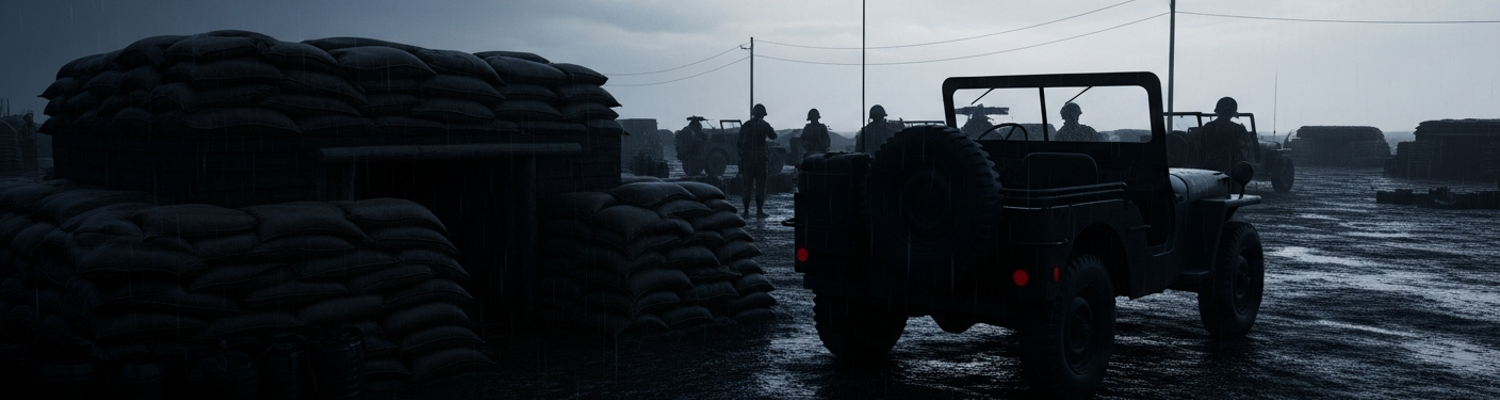

The arsenal assembled in the I Corps Tactical Zone was apocalyptic. Naval gunfire from cruisers and destroyers could pulverize one-third of the entire landmass. B-52 payloads erased suspected enemy concentrations from the map. On the ground, the firepower of 105mm and 155mm howitzers, the immediate violence of helicopter gunships, and the individual M16 rifles, M60 machine guns, and M79 grenade launchers carried by thousands of infantrymen saturated the battlespace. This destructive power was focused on the northernmost region of South Vietnam, a territory stretching from the Demilitarized Zone (DMZ) south through five provinces: Quang Tri, Thua Thien, Quang Nam, Quang Tin, and Quang Ngai. It was the most hostile operational area in the country.
Operational logs show a geography that dictated every engagement. The I Corps Tactical Zone was a layered battlefield. A narrow coastal plain of rice paddies and fishing villages offered concealment for local Viet Cong forces. To the west, the terrain erupted into the Annamite Cordillera, a 700-mile-long mountain range forming the border with Laos. This rugged, triple-canopy jungle was threaded with enemy infiltration routes, primarily the Ho Chi Minh Trail. The climate itself was an adversary. Monsoon seasons brought torrential rains and dense fog, grounding air support for days and turning the red clay into a viscous, impassable slurry. During Operation Dewey Canyon in the A Shau Valley in 1969, a sweep by the 9th Marine Regiment found its progress measured not just by enemy contact but by the exhausting slog through intermittent downpours and slick terrain that made casualty evacuation a near impossibility. The steep, jungle-covered mountains funneled both U.S. and North Vietnamese Army (NVA) movement onto predictable footpaths, making them ideal ambush sites.
American power projection into this wilderness depended on a network of remote and isolated bases. The U.S. presence was not a continuous front line but a constellation of platoon-sized combat outposts and larger company- or battalion-level Fire Support Bases (FSBs). These bases, with names like Khe Sanh, Con Thien, Camp Carroll, and Ripcord, were often just circular perimeters scraped from hilltops. Their main purpose was to serve as artillery platforms, positioning howitzers within range of infantry patrols operating deep in enemy territory. A standard FSB might contain a battery of six 105mm or 155mm howitzers, a tactical operations center, a communications bunker, and an aid station, defended by a single infantry company. These installations were islands, wholly dependent on helicopter resupply for food, ammunition, and mail.
Their isolation made them targets.
A 1967 siege of Con Thien saw the Marine base relentlessly pounded by NVA rockets, mortars, and artillery from across the DMZ. On February 2, 1969, during Operation Dewey Canyon, FSB Cunningham was hit by NVA 122mm artillery fire originating from Laos, killing five Marines. The psychological weight on the soldiers manning these outposts was unceasing. They were fixed targets in a 360-degree war.
The ground war in I Corps was defined by the constant, pervasive threat of irregular tactics. Archival evidence (NARA Record Group 472) shows that between 1963 and 1964, terrorist attacks in the ICTZ increased by 525 percent. For the individual soldier, the threat was personal. Patrols navigated a landscape seeded with booby traps designed to maim. These were not just simple punji pits. Viet Cong and NVA sappers used tripwires to trigger grenades, rigged M16A1 bounding mines that sprang into the air before detonating, and fashioned explosive devices from unexploded American artillery shells. Casualty statistics from 1965 show that booby traps and mines accounted for as high as 70% of all USMC casualties. Ambushes were a daily risk on any trail. This created an environment of extreme psychological stress, where a single misplaced step could result in catastrophic injury.
The U.S. Army Chaplain Corps' doctrinal mission was to provide spiritual support, counseling, and morale-building activities. In I Corps, executing this mission became an exercise in grim adaptation. The function of nurturing the living was not conducted in quiet chapels but in sandbagged bunkers or in muddy clearings moments before a patrol departed. Operational logs show chaplains conducted services wherever soldiers could be gathered. A Catholic priest might offer Mass from a portable field kit on a blood-stained poncho. A Protestant minister could lead a prayer for the 23rd Psalm in a mess hall that might be struck by rockets at any moment. The counseling they provided was immediate psychological first aid. Chaplains dealt with the raw grief of a soldier whose friend had just been killed by a bounding mine, the shock of a Marine reading a letter from home detailing infidelity, and the gnawing fear that settled on units preparing for sweeps through enemy territory like the A Shau Valley. They were a tangible link to a world beyond the war, distributing mail and writing letters for the wounded.
Reaching the scattered infantry units was a life-threatening challenge. The primary mode of transport was the helicopter, but chaplains had no dedicated aircraft. They were forced to hitchhike on resupply or medical evacuation flights on a space-available basis. A chaplain hoping to visit a remote firebase might wait for hours at a dusty airstrip for a Huey, knowing the flight itself was a high-risk gamble against enemy ground fire. For some troops, this meant seeing a chaplain only once every four to six weeks. Ground travel offered no safer alternative. A journey in a jeep along key arteries like Route 1 or Highway 9 was an invitation for an ambush or a command-detonated mine. To mitigate this, chaplains were sometimes provided a vehicle armed with a .50-caliber machine gun for protection. Arriving at a destination like Fire Support Base Cunningham often meant landing in an active combat zone, with the timing of a visit dictated by lulls in enemy artillery. The chaplain’s ability to perform his duties was entirely contingent on the availability of a helicopter and the nerve of its pilot. Several chaplains were killed in air crashes while attempting to reach their men.
Compounding the physical dangers were severe limitations in personnel and logistical resources. The military’s supply chain prioritized beans and bullets, leaving support services like the Chaplain Corps undersupplied. A close examination of the Table of Organization and Equipment (TO&E) for an infantry division reveals a structure ill-suited for the dispersed reality of I Corps. A division of over 15,000 men, scattered across dozens of firebases, might only be authorized a handful of chaplains, making comprehensive coverage a mathematical impossibility. Each chaplain was supported by an enlisted Chaplain Assistant, a soldier who served as a driver, bodyguard, and administrative clerk, often setting up makeshift altars under fire. This assistant was an armed non-combatant who shared the same risks. Religious supplies like Bibles, prayer books, and sacramental elements were low-priority cargo and frequently scarce. A chaplain might arrive at an isolated outpost only to find he lacked the basic materials to conduct a communion service, with no resupply for weeks.
Psychiatric after-action reports from I Corps reveal the progressive stages of psychological decay. The initial state of hypervigilance, a necessary survival tool, slowly curdled into chronic anxiety. Soldiers on patrol in the dense jungles west of Da Nang developed a pervasive paranoia. Every vine could be a tripwire. Every patch of disturbed earth could conceal a mine. This constant, high-stakes threat assessment led to a state of mental exhaustion where apathy became a defense mechanism. Men exhibited the thousand-yard stare, a vacant gaze indicating a disconnection from their surroundings. This was a symptom of a mind overloaded by trauma. In some units, apathy manifested as a reckless disregard for personal safety. In others, it appeared as extreme emotional withdrawal. Full psychological breakdowns, though officially recorded at a lower rate than in previous wars, were not uncommon. These episodes could range from sudden, uncontrollable anger to catatonic states. For many, the damage was a slow erosion of their pre-war identity.
The relentless pace of combat operations was a primary driver of this psychological erosion. Sustained operations, such as the 77-day siege of Khe Sanh in 1968 or the multi-week sweeps by the 1st Cavalry Division in the A Shau Valley, left no room for mental recovery. Units were in a constant cycle of patrol, ambush, and defense. Soldiers operated on minimal sleep, their bodies and minds worn down by physical strain and the physiological stress of potential enemy contact. An infantryman in a forward area could expect to be on patrol or ambush duty for weeks at a time, followed by a brief period manning the perimeter of a fire support base, which was itself a frequent target. The sheer frequency of combat exposure magnified the risk of psychological injury. The grinding schedule was designed to maintain pressure on NVA and Viet Cong forces, but it systematically broke down the American units tasked with executing it.
Systemic policies actively contributed to the burden. The 365-day individual rotation policy proved to be a psychological catastrophe. Unlike the unit cohesion of World War II, this system meant a soldier was dropped alone into a veteran unit and, if he survived, was pulled out alone a year later. This policy fostered a survivalist mentality focused entirely on an individual’s Date of Estimated Return from Overseas (DEROS). A soldier’s primary motivation shifted from unit victory to personal survival. Opportunities for psychological decompression were woefully inadequate. A soldier might get a week of Rest and Recuperation in Bangkok or Sydney, but this was a temporary escape. In-country rest centers offered little relief, as they were still within the war zone. A soldier could be helicoptered from a firefight to a rear base and find himself back on patrol within 48 hours, with no time to process the trauma. This rapid cycling between intense combat and a brief, artificial peace created a severe psychological whiplash.
Chaplain after-action reports (filed under DA Form 461-R) reveal a systematic effort to document the psychological decay. These were not generalized complaints. Chaplains, by virtue of their unique role, were repositories of the most desperate concerns of enlisted men. Their reports detailed the specific drivers of collapsing morale: the nihilistic fixation on DEROS, a sharp rise in racial animosity, and, particularly after 1969, the widespread use of heroin and marijuana. One Marine chaplain with the 3rd Battalion, 5th Marines after the Tet Offensive noted that any morale that existed was purchased at the price of air support and good food, not from a sense of dedication to the mission. Chaplains attempted to communicate these observations through official channels, filing periodic reports intended to provide commanders with a qualitative assessment of their unit’s spiritual and mental health. The content was stark, describing soldiers who had become convinced of the war’s futility. Patrols were becoming search and evade missions, with units deliberately avoiding enemy contact. These were patterns of behavior that chaplains saw repeating across firebases, a clear signal of a force hollowing out from within.
The military bureaucracy, from Military Assistance Command, Vietnam (MACV) down to the battalion level, was built on quantitative metrics. An officer’s career and his potential for promotion were linked to a narrow set of operational statistics. These included body counts, weapons captured, and pacification progress measured by the Hamlet Evaluation System. A commander of a battalion in the Americal Division was judged by his unit’s tangible success. A chaplain’s report detailing drug abuse or combat refusals offered no positive metrics. It was unquantifiable data that directly contradicted the official narrative of progress that commanders were required to project up the chain of command. Admitting to serious morale problems was tantamount to admitting failure, an act that could terminate a career. The system created a powerful institutional incentive to ensure that such negative information never reached higher headquarters.
The command’s response to these inconvenient truths was consistently one of suppression. Chaplains who filed detailed reports on morale issues often found their observations dismissed as anecdotal or exaggerated. A battalion commander, facing pressure from his brigade commander for results, had every reason to bury a chaplain’s report that highlighted endemic drug use on his primary firebase. The chaplain, typically a captain or major, held little institutional power compared to the lieutenant colonel he was reporting to. His concerns could be easily downplayed as being soft or out of touch with combat demands. In some cases, chaplains’ reports went up the chain of command only to be sanitized or stopped at the division level. This bureaucratic filtering ensured that the leadership in Saigon and Washington received a skewed and overly optimistic picture of the army’s condition. The consequences of this willful blindness were severe, contributing to operational failures and morale collapse within units of the 23rd Infantry Division, where underlying issues of discipline were allowed to fester unreported until they erupted into atrocities.
The mechanical backbone of command and control for infantry platoons was the AN/PRC-25 radio transceiver. Its operational history reveals a piece of equipment that was both revolutionary and critically flawed in the specific environment where it was most needed. Weighing over 23 pounds with its BA-386/PRC-25 battery, the Prick-25 was a heavy burden for the radio telephone operator (RTO). It operated in the VHF spectrum (30.00 to 75.95 MHz), making it dependent on a direct line of sight between antennas. This was a catastrophic limitation in the steep, jungle-covered mountains. A patrol dropping into a ravine could lose contact with its supporting firebase just a few hundred meters away. The radio’s nominal range of 5 to 8 kilometers was a fiction in places like the A Shau Valley. The monsoonal humidity would seep into the handset, causing frequent shorts, a problem so common that RTOs developed a standard field improvisation of stretching the battery’s plastic wrapper over the handset to keep it dry. The dry-cell batteries had an average life of around 20 hours, forcing units on extended patrols to ration communication to conserve power.
The unreliability of field communications had a direct, crippling effect on a chaplain’s ability to perform his most urgent duties. A chaplain stationed at a firebase like Khe Sanh might hear the initial, garbled radio traffic of a unit making contact. He knew that in those first violent moments, men were being killed and wounded, and his presence was needed for psychological support and for last rites. Yet, he was helpless. The same terrain and weather that degraded the signal for the infantryman prevented the chaplain from knowing the precise nature of the emergency. He could not simply call the unit for a situation report. He had to wait for a stable communication link to be established, for a request for a medevac to be formally processed, or for the patrol to return. Chaplain after-action reports show a recurring theme of profound frustration at this inability to provide timely emergency counseling. By the time the chaplain could reach the men, often meeting the dustoff helicopter as it brought back the wounded and the dead, the critical window for immediate spiritual intervention had closed.
For the individual soldier, the silence of a dead radio was a profound psychological blow. A patrol that lost communication was an island. The radio was the sole link to the firepower of the artillery batteries and the life-saving promise of a medevac helicopter. Combat memoirs and oral histories indicate that the fear of being wounded and unable to call for help was a constant source of anxiety. When a patrol’s PRC-25 failed, the men were truly on their own. This technological failure intensified the feelings of isolation inherent in a counter-insurgency war. The sense of abandonment was immediate. A squad leader, watching his RTO struggle in vain to raise the company command post, was keenly aware that his unit had effectively ceased to exist in the eyes of his superiors. This breakdown in the command-and-control net fueled a deep-seated mistrust in the system.
Upon arrival at a forward base, formal religious services were a luxury. The real work of the chaplaincy took place on ammo crates, in muddy fighting positions, or leaning against sandbags. Archival evidence shows this was a deliberate strategy of rapport-building. Chaplains understood that in an environment of extreme cynicism, trust was the only currency that mattered. They established informal counseling networks not by holding office hours, but by sharing a soldier’s immediate experience. They helped fill sandbags, drank canteen-cup coffee, and learned to read the vacant stare of a man reaching his breaking point. A chaplain might spend an entire week living with a platoon on its firebase after a friendly-fire incident, doing nothing more than being available to listen as the men processed their grief and guilt. This act of simply being present, of sharing the same risk and discomfort without being part of the direct chain of command, created a unique safe space. A soldier could vent his fear or his anger to the Padre without fear of official repercussion. This made the chaplain an essential psychological relief valve.
Spiritual support had to be fundamentally non-denominational. In a foxhole, doctrinal differences were secondary to shared humanity. A Catholic priest might find himself in a deep conversation with a Jewish soldier, and a Protestant minister could be the last comfort for an atheist. The chaplain became a universal symbol of a moral framework that existed beyond the immediate brutality of combat. Their presence was a reassurance that things were stable, and their willingness to listen provided a connection to a world where killing was not the primary measure of a day’s work.
The hard-learned lessons of Vietnam directly reshaped the American military’s approach to psychological health. The scale of psychological erosion witnessed by chaplains and commanders forced an institutional reckoning. This led directly to the formal recognition of Post-Traumatic Stress Disorder (PTSD) by the American Psychiatric Association in 1980, a clinical acknowledgment of a condition that chaplains had been treating in its raw form for years. The Department of Veterans Affairs, acknowledging that a significant number of Vietnam veterans were not accessing traditional services, established the Vet Center program in 1979. These were community-based, less formal counseling outposts designed to provide readjustment support, often staffed by veterans themselves. Within the armed forces, the concept of Combat and Operational Stress Control (COSC) evolved from a nascent idea into a core doctrine. Forward-deployed psychiatric teams and new preventative programs were designed to address the exact problem that plagued chaplains in Vietnam: the inability to provide immediate psychological first aid at or near the point of trauma.
The ministry of presence that chaplains had improvised under fire was subsequently codified into doctrine. The image of the hitchhiking chaplain became a powerful symbol of a systemic failure. In the war’s aftermath, there was an increased recognition that chaplains required dedicated support. This understanding solidified the central importance of the Unit Ministry Team (UMT), a dedicated pairing of a chaplain and a religious affairs specialist designed to function as a self-sufficient support element. The UMT was doctrinally recognized not just as a provider of religious services, but as a key advisor to the commander on unit morale and the human dimension of operations. The chaplain’s unique status as a confidential, non-combatant officer outside the formal rating chain, a status proven essential in Vietnam, was reinforced.
Despite these advancements, operations in subsequent conflicts demonstrate that many of the core challenges faced by chaplains in Vietnam have proven remarkably persistent. The counter-insurgency campaigns in Iraq and Afghanistan, with their geographically dispersed forces occupying remote Forward Operating Bases, replicated the problem of isolation. Chaplains once again found themselves reliant on high-risk helicopter flights. The constant threat of Improvised Explosive Devices (IEDs) created a psychological landscape of pervasive stress that mirrored the booby-trapped jungles of I Corps. In this environment, chaplains confronted not only PTSD but also the complex phenomenon of moral injury, the deep spiritual wounds that result from witnessing or participating in events that transgress deeply held moral beliefs. This concept, with its roots in the ethical ambiguities of the Vietnam War, placed chaplains on the front line of dealing with the most profound questions of guilt and shame. The constant exposure to trauma and the emotional weight of counseling created a high risk of burnout and secondary trauma for the chaplains themselves, a familiar echo of the burdens carried by their predecessors decades earlier.