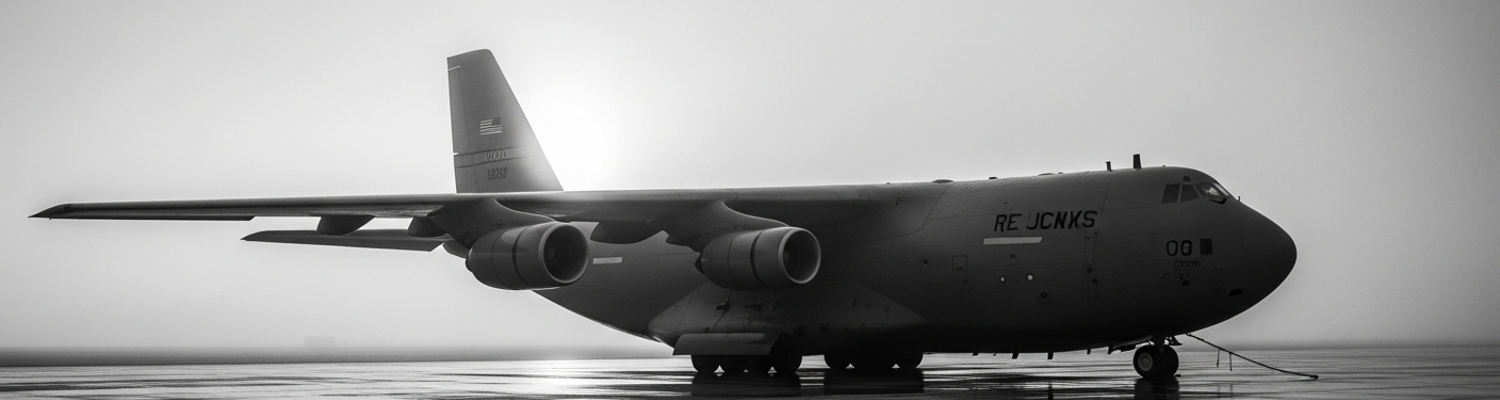

The strategic demands that birthed the C-124 Globemaster II were a direct response to the operational lessons of World War II and the anxieties of a new global standoff. A close review of logistical records reveals that existing transports like the C-47 Skytrain were inadequate for the coming conflict. They were difficult to load, could not carry heavy vehicles, and possessed slanted cargo floors. Planners at the Douglas Aircraft Company, drawing from the Berlin Airlift's showcase of air power, envisioned a transport that could move entire divisions. The design specifications called for an aircraft capable of carrying a payload up to 74,000 pounds. It had to be the only aircraft of its time able to transport fully assembled, outsized equipment like tanks, bulldozers, and heavy artillery. To achieve this, the C-124 was designed with a 77-foot-long cargo compartment, a reinforced floor, and its iconic, hydraulically-operated clamshell doors in the nose. These allowed vehicles to be driven directly up a ramp into the fuselage. The aircraft was also specified to carry 200 fully-equipped troops or 123 litter patients, a significant increase in capacity that defined its intended role.
This was not a clean-sheet design.
The airframe was an evolution of the earlier C-74 Globemaster, inheriting its wings and tail but featuring a new, deeper fuselage for the double-deck and heavy cargo requirements. The prototype, YC-124, first flew on November 27, 1949. It was powered by four enormous Pratt & Whitney R-4360 Wasp Major engines. Each engine was a mechanical marvel, a 28-cylinder, four-row radial piston engine intended to produce 3,800 horsepower. Almost immediately, these powerplants became the program’s most persistent source of trouble. The four-row configuration created a thermal nightmare. Cooling air struggled to reach the rear cylinders, causing them to run dangerously hot and leading to frequent failures. Archival maintenance logs (NARA Record Group 342) detail a litany of issues. Engines consumed gallons of oil per hour. Exhaust systems were prone to cracks that could leak carbon monoxide into the cockpit. In-flight fires were a constant threat. The complexity was a maintenance officer’s burden; with 28 cylinders, 56 spark plugs, and four magnetos per engine, the potential points of failure were multiplied across four powerplants. The nickname Old Shaky was earned not just from airframe vibration, but from the crew’s unease about whether all four engines would complete a mission.
Structural integrity was the next ordeal. During initial static and flight testing, engineers discovered that scaling up the C-74 design had introduced significant stress points. The aircraft's weight, with an empty weight over 101,000 pounds and a maximum takeoff weight approaching 195,000 pounds, placed unprecedented loads on the wing roots and landing gear assemblies. Test reports from Edwards Air Force Base indicated that hard landings or operations from semi-prepared runways risked structural damage. The clamshell nose doors and their hydraulic ramp system, while operationally necessary, created a complex structural interface that required repeated reinforcement to prevent fuselage cracking under load. Douglas engineers were forced to implement a series of strengthening modifications. These added weight that measurably reduced the aircraft’s performance and range. Deliveries of the first C-124A models began to the Military Air Transport Service (MATS) in May 1950, thrusting the troubled but uniquely capable airlifter directly into the Korean War.
The deployment of the C-124 Globemaster II across the Pacific was a function of America’s expanding Cold War containment strategy. Squadrons from MATS began operating the heavy lifter out of a network of island and coastal airfields. Operational logs show C-124s from units like the 374th Troop Carrier Wing establishing a presence at hubs like Tachikawa Air Base in Japan and Clark Air Force Base in the Philippines. These bases were not merely transit points; they were logistical anchors for projecting power from the Korean Peninsula to the Taiwan Straits. The Globemaster was the only aircraft capable of delivering fully assembled tanks, engineering equipment, and outsized ordnance to these forward positions. Its presence was non-negotiable for military planners. Aircraft were tasked with everything from supply runs and troop rotations to classified missions for the Strategic Air Command, transporting nuclear weapons and their support equipment. The entire strategic framework depended on the C-124’s ability to move materiel that no other transport could.
A machine designed in California. Now facing the relentless heat and humidity of the tropics.
The Pacific environment proved to be a destructive adversary. The combination of intense heat, high humidity, and salt-laden air created a perfect storm for mechanical failure. The Pratt & Whitney R-4360 Wasp Major engines, already known for their thermal problems, were pushed past their limits. The four-row, 28-cylinder configuration struggled to dissipate heat, with rear cylinders frequently overheating. This led to rapid oil breakdown and accelerated wear on components. Maintenance crews at Clark and Wake Island reported that engines remained dangerously hot for hours after shutdown. Flight engineers developed field-expedient techniques, like engaging primer switches during takeoff runs, just to get extra cooling and a marginal increase in climb performance. The airframe itself suffered. The corrosive mixture of salt and moisture attacked aluminum skin panels and structural members, particularly around joints and fittings. This led to intergranular corrosion, a hidden decay that could weaken primary structures from the inside, creating conditions for fatigue failure. Avionics and electrical systems were equally vulnerable. Moisture intrusion caused short circuits in propeller control systems, instrument panels, and generators, creating constant and unpredictable hazards.
The result of operating a mechanically temperamental aircraft in a hostile environment was a fleet crippled by maintenance. Old Shaky spent an alarming amount of time on the ground. Entire squadrons were sometimes grounded for emergency inspections. In late 1952, every C-124 in the 22nd Troop Carrier Squadron was grounded due to systemic fuel tank leaks. In July 1953, a rash of in-flight engine fires forced another fleet-wide grounding for engine inspections. A review of maintenance dockets from Tachikawa showed that nearly half of all C-124s were returning to the ramp after engine run-ups failed pre-flight checks for magneto drops or generator faults. These groundings created disruptions in the supply chain to Korea. The most dramatic consequence of these failures occurred on June 18, 1953. A C-124A from the 374th Troop Carrier Group, substituted for another aircraft scratched for engine trouble, lost power in its port engine just after takeoff from Tachikawa. The aircraft crashed. All 129 service members aboard were killed. At the time, it was the deadliest air disaster in history. Another crash at Iwo Jima in November 1955 was traced to a suspected electrical short in a propeller system that forced the blades into reverse pitch immediately after liftoff. Each flight was a gamble against metal fatigue, engine fires, and the corrosive Pacific air.
Operational logs from the Military Air Transport Service reveal a little-examined mission set for the C-124: direct support for the U.S. Navy’s Cold War apparatus. The C-124’s ability to swallow outsized cargo made it the only viable air bridge for time-sensitive naval components. This bypassed traditional naval logistics, which had for centuries relied on the slow cadence of surface shipping. The atomic age, with its high-stakes submarine patrols and global surveillance networks, demanded speed that ships could not provide.
The C-124 became the primary transport for the Navy's advanced underwater acoustic surveillance equipment. The Sound Surveillance System (SOSUS) was a classified network of underwater hydrophone arrays laid on the seabed to track Soviet submarine movements. These arrays, often over a thousand feet long, were extraordinarily difficult to transport. Archival evidence shows missions where C-124s were tasked with flying new or replacement arrays to remote Naval Facilities (NAVFACs). A typical mission profile involved a Globemaster from a MATS squadron flying a massive, crated sonar array from a stateside manufacturer directly to an airfield near a new SOSUS site, such as Naval Station Argentia in Newfoundland or Keflavik in Iceland. These locations were selected to monitor the Greenland-Iceland-United Kingdom (GIUK) gap, the primary route for Soviet submarines entering the Atlantic. The C-124’s clamshell nose doors and internal hoists were the only method for loading the bulky crates without risking damage. Surface shipment would take weeks and expose the sensitive technology to the sea environment and potential observation.
The Globemaster also functioned as an emergency lifeline for the submarine force. A nuclear-powered ballistic missile submarine (SSBN) was a primary strategic deterrent. A component failure at a forward base like Holy Loch, Scotland, or Apra Harbor, Guam, could neutralize that asset completely. When a part failed, a high-pressure coolant pump, a large diesel generator, or a section of a propeller shaft, sea transport from the United States could take up to a month. A C-124 could cut that time to less than 48 hours. Operational records detail flights where a Globemaster would be loaded at a depot like Norfolk Naval Station with a single, multi-ton component secured to a specialized pallet in its cargo bay. These flights were executed with the highest priority, bypassing surface supply chains to get a single submarine back on patrol. The ability to project industrial-scale repair capability across oceans by air changed the calculus of naval forward deployment. The Navy no longer needed to maintain vast, expensive inventories of every large spare part at dozens of remote bases. It could rely on a just-in-time system centered on CONUS depots and the C-124’s global reach. A damaged radar antenna for a carrier air group in the Mediterranean, a replacement jet engine for an anti-submarine patrol aircraft in Japan, or a torpedo fire-control console for a fast-attack submarine could be requested, pulled from a warehouse, loaded onto a Globemaster, and flown directly to the point of need. One MATS mission in 1961 saw a C-124 deliver two complete Thor missile systems from California to Royal Air Force bases in England, a journey that took three days instead of the estimated five weeks by sea.
The demands placed upon the C-124 Globemaster II exposed the chasm between its design specifications and the conditions of its employment. At the heart of its performance limitations were the four Pratt & Whitney R-4360 Wasp Major engines. A close examination of maintenance logs from MATS squadrons reveals a direct correlation between ambient temperature and mission capability. The engines, prone to overheating, suffered acutely in the hot, humid air of the Pacific and Southeast Asia. Air density decreases in hot conditions, reducing both propeller thrust and engine power output. C-124s operating from bases like Clark in the Philippines or Tainan in Taiwan during the afternoon heat often faced payload restrictions. Flight engineers had to make difficult calculations, trading thousands of pounds of cargo for the ability to achieve a safe takeoff climb rate. A 0.5% decrease from maximum takeoff weight could equate to losing the capacity for three passengers or their equivalent in cargo. For an aircraft whose purpose was heavy lift, this limitation was a constant impediment.
The machine was broken by its missions.
One of the most significant structural challenges emerged from a mission profile the aircraft was not initially optimized for: transporting heavy naval components. While the C-124 could carry items like tanks, the point-loading characteristics of certain naval machinery proved destructive to the standard cargo floor. A review of depot maintenance records from the mid-1950s indicates a recurring problem with floor panel deformation and damage to the underlying support structure when transporting items like submarine diesel generators or multi-ton sections of propeller shafts. Unlike a tank, which distributes its weight across long tracks, this equipment concentrated its mass onto a few small contact points. The original magnesium and spruce plywood floor construction could not withstand such focused stress. In response, maintenance depots, including those at Hill Air Force Base, began implementing a field modification. Large sections of the cargo floor in select aircraft were reinforced with heavy-gauge steel plates to better distribute the load. This added hundreds of pounds of permanent weight to the airframe, further taxing the engines, but it was a necessary trade-off to prevent cargo shifts or structural failure.
Beyond structural stresses, the tropical environment attacked the aircraft’s internal systems. The C-124C variant introduced new electronic systems, including the APS-42 weather radar, which added a new layer of sensitivity. These systems, along with mission-specific electronic countermeasures (ECM) pods or specialized communications gear, relied on vacuum-tube technology that generated substantial heat. In the climate of Southeast Asia, where C-124s were a logistical support element for operations in Vietnam, this internal heat combined with ambient temperatures led to frequent electronic failures. Archival accounts from flight crews describe navigation computers drifting and radio sets failing mid-flight. Ground crews at forward airfields devised improvised cooling solutions. These were often rudimentary, consisting of jury-rigged ventilation hoses that redirected airflow from the main cabin or locally procured electric fans placed directly in front of avionics racks. These ad-hoc fixes were essential to maintaining some reliability for the delicate electronics.
The arrival of the Douglas C-133 Cargomaster in 1957 signaled the beginning of the end for the C-124. A review of MATS operational planning from this period shows an immediate shift in doctrine. The C-133 was a transitional machine, bridging the gap between the piston-engine era and the pure-jet age with four Pratt & Whitney T34 turboprop engines. Each one produced nearly double the horsepower of the C-124’s R-4360 radials. This gave the Cargomaster a significant performance advantage. It could cruise faster and fly higher. Its most important feature was its uncompromised cargo hold. Unlike the C-124, the C-133 featured a high-mounted wing and a forward flight deck, allowing for a 90-foot-long pressurized and heated cargo compartment with unobstructed access through large rear doors. This design allowed it to carry the new generation of ballistic missiles, like the Atlas and Titan, fully assembled, a task the Globemaster could not perform. MATS planners began assigning these high-priority missions to the new C-133 squadrons, relegating the C-124 to general bulk cargo and troop transport. While the C-133 fleet was small and suffered from its own airframe fatigue issues, it proved that future strategic airlift depended on turbine power.
The future was jet-powered.
The death knell for the Globemaster II sounded with the introduction of the Lockheed C-141 Starlifter. The first C-141A became operational with MATS in April 1965. Its capabilities made the C-124 instantly obsolete. Powered by four Pratt & Whitney TF33 turbofan engines, the Starlifter could cruise at over 500 mph, more than twice the C-124’s 230 mph pace. This speed differential altered strategic calculations. A supply mission from Travis Air Force Base to Southeast Asia that took a C-124 multiple days could be completed by a C-141 in a fraction of the time. The C-141 was designed for global reach and efficiency, featuring a fully pressurized cargo bay and an integral rear loading ramp. As units like the 63rd Military Airlift Wing transitioned from the C-124 to the new C-141 in 1967, the operational contrast became stark. The Starlifter was a more reliable and vastly more capable platform, forming the new backbone of what was now the Military Airlift Command (MAC).
This technological shift was compounded by an economic equation. By the mid-1960s, keeping the aging C-124 fleet airborne had become a maintenance burden. A historical review of maintenance logs shows the effort required to service the four R-4360 Wasp Major engines, each with 28 cylinders and 56 spark plugs. The man-hours required, combined with the scarcity of spare parts and qualified mechanics, sent the C-124’s cost-per-flight-hour soaring beyond that of the new jet transports. Airframes were old and suffering from structural issues stemming from years of hard use. Cannibalization of retired aircraft for parts became standard procedure. For the Department of Defense, facing the logistical demands of the war in Vietnam, continuing to invest in the slow, unreliable, and expensive C-124 fleet was no longer feasible. The C-141 provided a faster, more dependable, and more cost-effective solution for the majority of airlift missions.
By 1970, the active-duty force had transferred its remaining Globemasters to Air Force Reserve and Air National Guard (ANG) units. These units continued to fly Old Shaky for several more years, primarily in tactical support roles and for domestic cargo movement. A review of ANG unit histories shows C-124s flying their final missions throughout the early 1970s. The 165th Tactical Airlift Group of the Georgia Air National Guard was the first ANG unit to receive the C-124C and also the last to officially retire it. In September 1974, the last two C-124s in U.S. Air Force service, serial numbers 52-1066 and 53-0044, were officially retired, bringing the aircraft’s 24-year operational history to a close.