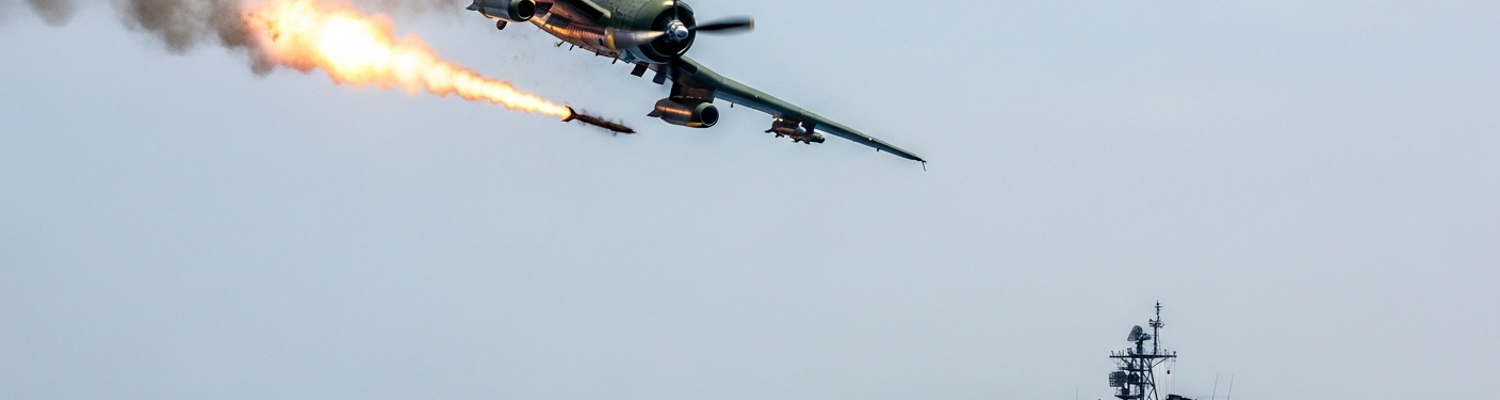

The Plunging Spear Point
The battleship, a steel behemoth bristling with heavy guns, reigned supreme for centuries. Yet its dominance rested on a singular assumption, that its foes would meet it on the surface of the sea. The advent of military aviation presented a new axis of attack. Early attempts to sink warships from the air with level bombing proved the concept’s difficulty. Hitting a maneuvering, defending vessel from high altitude was a matter of statistical probability, not precision. The physics of gravity and wind rendered unguided bombs wildly inaccurate. Navies required a weapon that could deliver ordnance with surgical accuracy, a spear point to strike the vulnerable heart of an enemy fleet. The answer arrived not as a single piece of technology, but as a complex, integrated system. A purpose-built aircraft, a radical attack profile, and a new naval doctrine converged to create the dive bomber, the machine that would architect modern carrier warfare.
Perfecting the Vertical Assault
The concept of dive bombing emerged from the ad hoc tactics of the Great War, but the United States Marine Corps began its formalization in the 1920s. During expeditionary actions in Haiti and Nicaragua, Marine pilots flying Curtiss F6C fighters and Vought O2U Corsairs discovered that steep dives directly at their targets dramatically improved accuracy for close air support. Pioneers like Lieutenant Lawson H. M. Sanderson refined the technique. They found that dives of 70 degrees or more kept the target visible over the engine cowling and presented a difficult, high-speed target for ground fire. This was more than just aiming, it was a fundamental shift in aerial attack geometry.
The U.S. Navy, whose leadership was dominated by the battleship-centric “gun club,” watched with initial skepticism. The potential was too great to ignore. On December 13, 1926, the Navy conducted its first formal dive bombing exercises off the coast of San Diego. Pilots from Navy and Marine squadrons, flying Boeing FB-5 and Curtiss F6C fighters, attacked a towed target sled. The results were startling. They achieved 19 hits with 45 bombs, a level of precision unheard of in naval aviation. These tests, often conducted from 2,500 feet with bomb release at a dangerously low 400 feet, confirmed the technique’s lethality. Figures like Lieutenant Commander F. D. Wagner of VF-2 pushed the envelope, developing tactics for surprise attacks from 12,000 feet. The physics were brutal but effective. By diving at a steep angle, the aircraft's trajectory and the bomb's subsequent path were nearly identical. This simplified aiming to a matter of pointing the aircraft's nose at the target and accounting for a much shorter time of flight, minimizing the effects of wind and target movement.
Engineering for Extreme Stress
This new tactic demanded a new type of aircraft. A standard airframe could not withstand the immense structural stress of a high-speed, near-vertical dive followed by a high-G pullout. Designers began engineering machines specifically for the plunge. The Douglas SBD Dauntless, the most important naval strike aircraft of the war, exemplified this new design philosophy. Developed by Ed Heinemann’s team from the earlier Northrop BT-1, the Dauntless was built for punishment. Its most recognizable features were the perforated, split dive brakes. These “Swiss cheese” flaps, extending from the wing’s top and bottom surfaces, created drag to govern the aircraft's speed in a dive. They kept the Dauntless stable around 240 knots, preventing control surface compression that could lock the plane into its dive. Structural reinforcement was paramount. Wing spars, engine mounts, and the fuselage were all strengthened to endure repeated 6-G pullouts. A critical innovation was the bomb displacement gear. This trapeze-like crutch swung the centerline bomb down and forward upon release, ensuring it cleared the propeller arc during the steep dive. This single mechanism was essential for the vertical attacks that defined naval dive bombing.
The Curtiss SB2C Helldiver represented a more ambitious, and ultimately troubled, second generation. Designed for higher speeds and a larger bomb load, including an internal bomb bay, it was a more complex machine. The Helldiver, known to its crews as “The Beast,” suffered a protracted and difficult development. The Navy demanded over two thousand design changes before it was deemed combat ready. Its intricate Curtiss electric propeller and complex hydraulic systems were sources of constant maintenance headaches. On the confined space of a carrier deck, this complexity presented significant logistical challenges that often negated its performance advantages over the simpler, more reliable Dauntless.
The Logistical Realities of Carrier Operations
The dive bomber was only the tip of the spear. The shaft was a massive logistical and organizational structure built around it. A carrier’s ability to project power was measured by its “sortie rate,” the speed at which it could launch and recover aircraft. This depended entirely on the flight deck crew, a team executing a dangerous, high-speed ballet. The deck cycle involved moving aircraft from the hangar bay via massive elevators, spotting them on the flight deck for launch, and then recovering, rearming, and refueling them for the next mission. This choreography was a marvel of human organization. Men in colored jerseys performed specialized tasks under immense pressure. Yellow shirts directed aircraft movement. Red shirts handled ordnance, manhandling 500-pound and 1,000-pound bombs from magazines deep within the ship. Purple shirts managed fueling lines, a hazardous job on a deck crowded with running engines and hot metal. A single mistake could cause a catastrophic fire. The entire process of spotting and launching a full strike wave of fifty aircraft had to be completed in less than thirty minutes. Success in battle depended directly on the efficiency of this logistical chain. The specialized parts for dive bombers, from dive brake actuators to bomb crutches and arresting hooks, required their own spare parts inventories and skilled mechanics. The constant fight against saltwater corrosion was a battle in itself. An unreliable aircraft like the early SB2C did not just risk its pilot, it threatened to disrupt the entire carrier’s combat tempo.
Doctrine Forged in the Fleet Problems
The development of dive bombing aircraft and their support systems occurred in tandem with their integration into fleet-wide doctrine. The U.S. Navy’s annual Fleet Problems, a series of large-scale war games conducted between 1923 and 1940, served as the laboratory for carrier warfare. These exercises tested new technologies and refined tactics, moving naval aviation from a scouting role to the fleet’s primary offensive arm. Fleet Problem IX in 1929 saw the USS Saratoga execute a daring mock raid on the Panama Canal, proving a carrier could project power over vast distances. Fleet Problem XIII in 1932 simulated a surprise carrier attack on Pearl Harbor, a chilling dress rehearsal for a future conflict. These games consistently underscored the importance of striking first and the devastating effectiveness of a well-coordinated air attack. From these exercises, a clear doctrine emerged. Carrier air groups were organized into fighter (VF), bombing (VB), and torpedo (VT) squadrons. The dive bomber was the centerpiece of the main attack. Grumman F4F Wildcat fighters provided escort and strafed ship defenses. Slower Douglas TBD Devastator torpedo bombers attacked from a different axis, forcing the target ship to turn to avoid the torpedoes. This turn, however, exposed the ship’s full length, its vulnerable deck, to the SBD Dauntless dive bombers plunging from above. It was a coordinated system of destruction, designed to overwhelm a ship’s defenses from multiple angles simultaneously. The lessons learned in the Fleet Problems, paid for with training and analysis, prepared the Navy for the moment its theories would be put to the ultimate test.
Climax at Midway
That test came in June 1942. At the Battle of Midway, the full potential of the dive bomber system was unleashed. After initial torpedo attacks by land-based and carrier aircraft failed with devastating losses, the battle’s outcome hung in the balance. By a combination of dogged determination and sheer luck, two separate groups of SBD Dauntlesses, led by Wade McClusky from USS Enterprise and Max Leslie from USS Yorktown, located the Japanese carrier fleet. The Japanese carriers were in their most vulnerable state, decks crowded with aircraft preparing for a second strike. In the span of five minutes, the Dauntlesses plunged down. They were the culmination of two decades of innovation, training, and logistical preparation. The pilots executed the attack profile perfected in peacetime exercises. The dive brakes bit into the air, the pilots aligned their targets, and the bomb crutches swung their payloads clear. Bombs struck the Japanese carriers Akagi, Kaga, and Soryu, turning their flight decks into infernos of burning fuel and exploding ordnance. The heart of the Japanese Navy’s carrier force was ripped out. The battle was a stunning victory, made possible not by a single weapon, but by a fully matured system of war. The dive bomber, the pilot who flew it, and the complex doctrine that deployed it had proven to be the decisive element in the war for the Pacific.