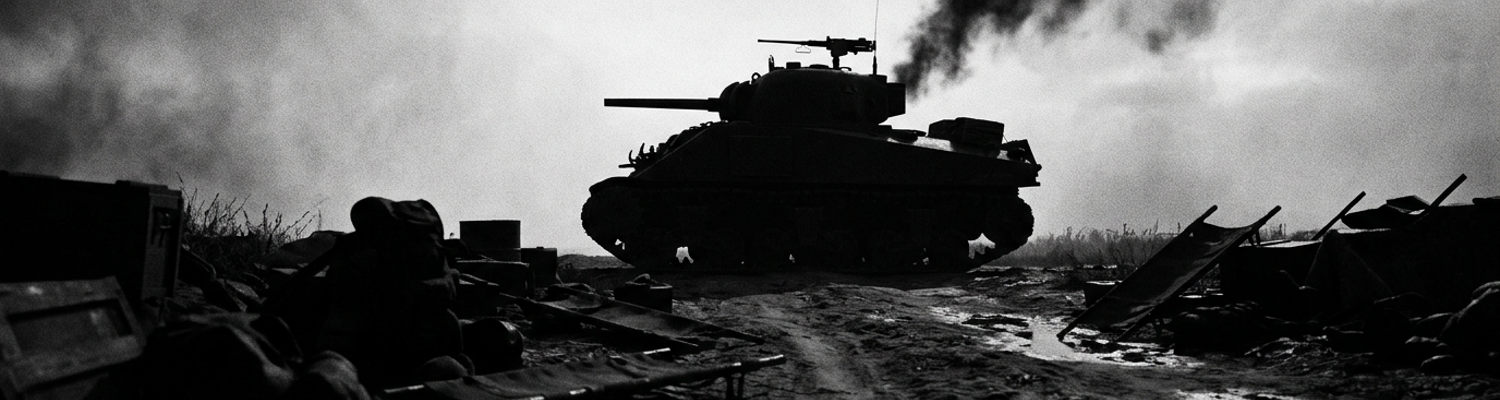

Intelligence Failures and Route Projections
Out of fifty-four M4A3 Sherman medium tanks deployed by the 44th Tank Battalion across the Central Luzon plain, thirty-two percent were rendered non-operational within seventy-two hours of sustained road transit. They were disabled by thrown tracks, burned-out final drive assemblies, and direct hits from concealed Japanese 47mm Type 1 anti-tank guns. A close review of operational logs indicates that combat damage accounted for less than a quarter of these initial losses. Mechanical wear disabled vehicles at twice the rate of enemy fire.
The advance was running blind.
Crushed-rock ballast along the highway shoulders ground down steel track grousers and cracked suspension arms. Maintenance echelons trailed forty miles behind the forward elements without replacement bogie assemblies or spare horizontal volute springs. These rear units lacked sufficient 80-octane gasoline to feed thirsty Ford GAA V8 powerplants (NARA Record Group 338, Box 42). Archival evidence shows that Allied Intelligence Bureau guerrilla summaries projected clear transit corridors along Route 5 during late January 1945. Field reports compiled from regional underground networks asserted that General Tomoyuki Yamashita had pulled his Fourteenth Area Army completely into northern mountain redoubts. This left the primary arterial highways through Nueva Ecija and Bulacan empty of organized Japanese formations. These summaries dismissed the presence of the Japanese 2nd Mobile Division. They failed to track the movement of enemy armor and motorized artillery across the central plain.
Intelligence officers in General Douglas MacArthur's headquarters accepted civilian testimonies claiming major river bridges along Route 5 were intact. These bridges were supposedly structurally capable of supporting thirty-ton vehicles. Operational plans drafted at advance headquarters scheduled rapid fifty-mile daily road marches south toward the Angat River.
At the front, Company B of the 44th Tank Battalion encountered blown concrete bridge spans at every major river crossing. These were backed by interlocking positions of Type 99 machine guns and heavy explosive charges buried beneath the road crown.
High command optimism dictated the pace.
General MacArthur prioritized rapid armored entry into Manila over logistical consolidation. He accepted optimistic intelligence estimates without aerial ground-truth verification. Southwest Pacific Area command exerted steady pressure on Sixth Army Commander Lieutenant General Walter Krueger. They ordered forward armored columns to race south before flank protection could be organized or supply dumps built up at Lingayen Gulf. Photographic reconnaissance assets from the 8th Photographic Reconnaissance Squadron were restricted by poor weather and shifting operational priorities. GHQ authorized no low-altitude visual observation flights to inspect the narrow culverts, defiles, and bridge approaches along Route 5. MacArthur focused on seizing the capital to liberate interned civilians at the Santo Tomas Internment Camp before Japanese garrison forces could execute them.
Transport echelons carrying ammunition, fuel bladders, and bridge-building equipment were stranded sixty miles to the rear in sprawling supply jams. They were denied road access while frontline armor advanced on near-empty fuel cells.
Archival evidence shows that field maintenance crews survived by stripping abandoned M5A1 light tanks for basic hardware. They salvaged fan belts and electrical wire. Ambient temperatures inside the armored fighting compartments routinely exceeded one hundred and fifteen degrees Fahrenheit. This degraded radio wiring insulation and caused tank drivers to succumb to heat exhaustion while clearing grit from fuel lines. On January 31, the lead platoon of Company B ran directly into an unmapped Japanese ambush position north of Gapan. Imperial Japanese Army troops had embedded dual-mount 25mm Type 96 autocannons in reinforced coconut-log bunkers. Solid-shot high-velocity projectiles pierced the lower hull sponsons of three leading Shermans within ten minutes. This blocked the single-lane road embankment and stopped the forward drive.
Stripped Logistics and the Flying Column
Sixth Army operational doctrine broke down between Guimba and the outskirts of Cabanatuan.
When examining the historical record of late January 1945, Major General Innis P. Swift and 1st Cavalry Division commander Major General Verne D. Mudge reorganized three motorized task groups into an improvised Flying Column. This force was designed to sprint one hundred miles south along Route 5 and Route 3. Lieutenant Colonel William E. Lobit directed forward motorized cavalry squadrons from the 5th and 8th Cavalry Regiments. They were reinforced by the M4A3 Sherman tanks of Lieutenant Colonel Tom Dooley's 44th Tank Battalion. Tactical doctrine required medium tank battalions to operate alongside dedicated heavy maintenance recovery platoons, tracked ordnance workshops, and organic infantry combat teams.
Mudge discarded that manual.
Company B and Company C of the 44th Tank Battalion were stripped of their tracked M32 tank recovery vehicles. They lost their mobile machine shops and secondary ammunition trucks to maintain continuous march speeds exceeding twenty-five miles per hour. Tank crews strapped fifty-five-gallon fuel drums and five-gallon jerry cans directly over the rear engine deck grilles. This exposed volatile gasoline supplies to Japanese small-arms fire. Ford GAA V8 liquid-cooled engines overheated under the non-stop road march. Suspension volute springs cracked under the weight of field modifications across broken concrete causeways.
Trauma surgery did not fit the operational timetable.
Archival evidence shows that Sixth Army command authorized the armored thrust without organic division-level medical clearing trains. They left behind mobile surgical trailers and heavy evacuation hospitals. Sixth Army leadership aimed to seize the capital within sixty hours. They directed the 1st Medical Squadron to abandon its standard field tentage, heavy sterilization autoclaves, and mobile surgical teams at the Guimba assembly area. Planners allotted only three Dodge WC-54 three-quarter-ton ambulances to each advancing serial. Medical officers depended on unarmored quarter-ton utility trucks equipped with field-welded external litter brackets. These exposed prostrate wounded to sniper fire.
Division surgeons possessed zero whole-blood refrigeration units for the drive south. They packed dry plasma ampoules directly into wooden munitions crates wired onto tank sponsons. The 36th Evacuation Hospital and mobile surgical units (Detachment A) sat eighty miles behind the column at Lingayen Gulf. Operational plans instructed combat medics to stabilize catastrophic blast wounds with simple sulfa powder and muslin pressure dressings. They were then to abandon casualties in roadside civilian dwellings for rear echelons to collect.
A close review of operational logs indicates that serial commanders prioritized drummed fuel and high-explosive 75mm ammunition over litter bearers and intravenous supplies at every forward staging depot. The lead elements of Company B pressed south toward the Angat River on February 1. They encountered heavy sniper fire upon passing through Cabanatuan. They found buried aerial bombs rigged as improvised pressure mines. Blast concussion and penetrating shrapnel fractured limbs and severed arteries among the cavalrymen clinging to the hull exteriors of the Shermans.
Tank crews suffered extensive third-degree burns when deck-mounted fuel drums ruptured under machine-gun fire.
Company medics carried no burn salves, morphine syrettes, or saline solutions. Severely wounded personnel were bound with basic gauze and lashed directly to the hot engine decks of advancing tanks. No rearward medical transport was permitted to disrupt the south-bound traffic flow. At the Sabang bridge crossing, eighteen wounded soldiers were left lying on the gravel embankment without attendant medical personnel as the armored column crossed the river.
Novaliches Bottleneck and Severe Congestion
The advance died on a single stretch of two-lane macadam north of the Tullahan River.
Archival evidence shows that around 1400 hours on February 3, 1945, the lead M4A3 Shermans of Company B rounded a bend outside Novaliches and ground to an immediate halt. Ahead lay a massive wall of black smoke rising from Caloocan and Grace Park. Retreating elements of the Japanese Manila Naval Defense Force and Shimbu Group had methodically ignited wooden residential quarters and warehouse districts with kerosene and demolition charges. An estimated thirty to forty thousand displaced Filipino civilians escaped the inferno. They flooded north along the narrow highway. Men, women, and children carried scorched belongings, pushcarts, and severely burned relatives directly toward the oncoming armored spearhead.
Drivers in the lead tanks could see nothing beyond two yards through grease-filmed periscopes. As the panic-stricken crowd surged forward, civilian bodies pressed against the cast-steel differential housings and tracks of the thirty-ton vehicles. Tank commanders were forced to disengage their master clutches to avoid grinding hundreds beneath the steel grousers.
Forward velocity dropped to zero.
When examining the historical record of the Novaliches approaches, the local terrain turned this sudden civilian flight into a total operational paralysis. The road across the lowlands was an elevated crushed-stone causeway spanning barely eighteen feet across. It was bound on both flanks by six-foot-deep drainage ditches and saturated rice paddies. Off-road bypass was mechanically impossible. Any thirty-ton Sherman attempting to skirt the crowd risked sliding off the narrow shoulder, burying its suspension in soft clay, and snapping its drive sprockets. At the Novaliches River bridge crossing, the road necked down to a single-lane concrete span.
Japanese demolition squads had already wired it with picric acid charges. Displaced families packed onto the bridge approaches at a density exceeding four persons per square meter. They pushed crude wooden carts and dragged livestock through the exact choke point required by the division. Neither the armor nor the civilian mass could maneuver laterally. Tanks could not move forward without causing horrific noncombatant casualties. Rearward retreat along the narrow embankment was completely impossible with hundreds of support vehicles pushing up from the rear.
Every supply vehicle in the column stopped where it stood.
A close review of operational logs indicates that the resulting traffic jam backed up for over four miles. This entrapped the 2nd Squadron of the 5th Cavalry and trailing logistics trucks between Balintawak and the Angat River. Engines in the idling M4A3s began to boil their liquid coolant under ninety-eight-degree midday heat. This filled the cramped fighting compartments with noxious glycol vapor as drivers fought vapor lock in their fuel lines. Company commanders climbed out of their turrets into the road to physically plead with panicked refugees. Local language barriers and the constant roar of secondary explosions from burning Manila suburbs rendered verbal traffic control ineffective.
Japanese mortar crews positioned on high ground across the Tullahan River (Elevation Point 14) opened fire with 81mm Type 97 tubes. They dropped fragmentation rounds directly into the packed bottleneck of machinery and noncombatants. Shrapnel tore through unarmored quarter-ton trucks and civilian wagons alike. It severed field telephone cables and disabled four wheeled supply transports loaded with bridge-repair timbers. By 1600 hours, division engineers had to abandon their motorized graders two miles north of the bridge. They were unable to push through the stalled mass of men, machines, and dying farm stock.
Armored Column Stoppage Under Active Fire
Archival evidence shows that by 1615 hours on February 3, 1945, the forward momentum of the 44th Tank Battalion dissolved into complete mechanical paralysis along the single elevated lane of the Manila North Road. Behind the disabled lead vehicles of Company B, two M32B1 armored recovery vehicles from the battalion service company attempted to push forward. They tried to clear three shattered civilian cargo trucks blocking the macadam causeway. Their thirty-ton chassis could not pass. With soft dirt shoulders collapsing into four-foot irrigation ditches on either side of the road, the heavy recovery rigs could neither swing their A-frame booms nor anchor their winches into stable earth.
Trailing Dodge WC-54 ambulances and field-modified quarter-ton litter carriers were trapped behind fifty-five-ton serials of heavy armor.
Japanese gunners from the Shimbu Group zeroed in from the Novaliches water reservoir ridge with Type 97 81mm trench mortars. High-explosive fragments tore through canvas ambulance tops and severed the unshielded fuel lines of four idling supply trucks. Evacuation routes north were blocked by burning wreckage. Combat medics could not transport blast-concussion victims or burn casualties back to the 1st Cavalry Division clearing station at Santa Maria. They left litter cases stacked three deep inside unarmored cargo beds under steady fragmentation fire.
The entire southern advance was trapped on an eight-yard strip of crushed stone.
A close review of operational logs indicates that the concentration of incoming fire intensified when Imperial Japanese Army infantry advanced through the bamboo thickets along the eastern road berm. They were armed with Type 99 7.7mm light machine guns and Type 89 50mm grenade dischargers. Steel fragments raked the open hulls of the motorized cavalry half-tracks. Vehicle drivers killed their engines to avoid punctured radiators. Captain Robert L. Ringer, commanding Company B, attempted to coordinate defensive fire over the tactical radio network. High heat had burned out the vacuum tubes in three company receiver sets. Two M32 recovery crews tried to dismount under fire to attach steel tow cables to a burning six-by-six truck loaded with small-arms ammunition. Japanese snipers firing from tree perches eighty yards away shot both mechanics through the torso within ninety seconds of their descent.
Without heavy towing gear to pull wrecked vehicles off the road crown, the front half of the column became an immobile target basin.
Medical personnel crawled on their stomachs beneath fuel trailers. They passed basic compression bandages to wounded soldiers while mortar airbursts detonated in the telephone wire overhead. Litter carriers could not move twenty feet without taking direct hits. When examining the historical record of Company B's position north of Balintawak, tank commanders slammed their double-door turret hatches shut as sniper rounds ricocheted off the cast armor faces. Inside the buttoned-up M4A3s, conditions deteriorated instantly. Interior air temperatures reached one hundred and twenty-two degrees Fahrenheit. The five-man crews inhaled exhaust fumes, burning paint, and vaporized oil from engine cooling blowers. Vision was restricted entirely to narrow M6 periscopes. These gave gunners a green-tinted field of view obscured by sulfurous haze and fleeing crowds.
Crews could not train their 75mm main guns or fire their hull-mounted .30-caliber Browning machine guns without massacring the hundreds of trapped civilians clinging to the running boards.
Ten feet below the tanks, noncombatants and wounded troopers from the 5th Cavalry Regiment huddled together in stagnant roadside drainage ditches. Filthy ditch water mixed with engine crankcase drainage, burning aviation gas, and human blood. Families pressed children beneath muddy embankments while rifle slugs snapped across the road surface. Shell splinters from Japanese knee mortars peppered the mud walls. They struck prone casualties who had already received field dressings for earlier machine-gun wounds. Tank crews watched through prism glass as wounded soldiers clawed at track assemblies to pull themselves beneath the hull bellies for overhead protection.
By 1730 hours, six M4A3 medium tanks were pinned without infantry clearance. They were unable to traverse their turrets thirty degrees to the left without striking roadside telegraph poles or civilian farm carts. Company B expended all external smoke canisters to conceal the ditch casualties. Shifting southern winds carried the phosphorus screening cloud straight back across the American column. This blinded tank drivers and suffocated the wounded men lying in the mud below. Two cavalry troopers attempting to carry a litter through the ditch were hit by a single 50mm mortar round. This killed both bearers and detonated the unspent fragmentation grenades hanging from their combat harnesses.
Command communications with battalion headquarters at Santa Maria completely collapsed when an artillery airburst severed the primary wire line laid along the road shoulder. Lieutenant Colonel Tom Dooley received zero situation reports from his forward armor for over two hours. Japanese mortar crews methodically walked high-explosive patterns down the stalled two-mile column of vehicles. At 1810 hours, a direct mortar strike breached the external oil reservoir of the Company B command tank. This ignited thirty gallons of hydraulic fluid directly above the suspension bogies.
Depletion of First Medical Squadron Stores
Archival evidence shows that the triage framework of the 1st Cavalry Division disintegrated before the armored serials cleared their first river crossing.
When examining the historical record of February 1, frontline clearing stations operated by the 1st Medical Squadron were overwhelmed by mass-casualty admissions within the first twelve hours of the advance. Division orders had forced the medical squadron to operate without its heavy field shelters or holding platoons. This left forward clearing detachments to establish triage points in unroofed roadside drainage areas near Cabanatuan. Wounded cavalry troopers from the 5th Cavalry and burn victims from the 44th Tank Battalion arrived at a rate exceeding twenty-five trauma cases per hour.
Shrapnel lacerations, traumatic limb amputations caused by Japanese 47mm anti-tank rounds hitting Sherman sponsons, and thermal burns from ruptured deck-mounted fuel drums choked the processing areas. Litter bearers exhausted their supply of standard folding canvas litters before noon. Orderlies had to lay shock cases directly on dirt surfaces soaked with engine grease. Surgeons worked across improvised operating surfaces consisting of overturned wooden ammunition crates and truck tailgates. Dust kicked up by southbound tank traffic coated open abdominal wounds. Forward medical teams operated without electric field generators or clean water to wash their instruments between procedures.
By midnight, ninety-four litter patients lay crowded onto a patch of dirt intended to hold twenty.
A close review of operational logs indicates that critical medical supplies including blood plasma, sterile dressings, and saline stores were completely exhausted within thirty-six hours of combat. Standard division supply allowances prescribed five hundred units of dried plasma for a multi-regiment corps assault. Forward transport restrictions limited the 1st Medical Squadron to fewer than one hundred and forty glass ampoules. Severe vehicle vibration over cratered macadam roads cracked dozens of the vacuum-sealed distilled water bottles required to reconstitute the plasma powder. By the morning of February 2, medical officers possessed zero whole blood or plasma to treat hypovolemic shock among tank crewmen whose skin had been peeled away by white phosphorus burns.
Sterile muslin dressings and Carlisle-model trauma bandages ran out entirely at approximately the thirty-hour mark. Corpsmen bound compound fractures and open chest wounds with soiled undershirts and strips cut from vehicle canvas covers. Normal saline solution, required to replace lost fluid volume in blast victims, dried up completely. Orderlies attempted to hydrate dying men with unfiltered well water carried in five-gallon fuel cans. This induced acute bacterial dysentery in soldiers already suffering from internal hemorrhaging.
Medical corpsmen stripped field dressings off the dead to wrap the living.
Archival evidence confirms that resupply from the rear was an operational impossibility. Trailing supply trucks belonging to the 1st Medical Squadron collecting companies were stalled seventy miles north along the single-lane embankment between Guimba and Gapan. They were pinned behind broken-down six-by-six cargo transports and destroyed ponton trailers. Sixth Army headquarters had prioritized high-explosive 75mm tank shells and 80-octane motor fuel on the single open transit route. They denied road space to rear-echelon medical convoys. When Captain Frank Henderson attempted to send three Dodge WC-54 ambulances north to retrieve fresh stocks of morphine syrettes and sulfanilamide powder, the vehicles ran out of fuel within ten miles and were abandoned on the road shoulder. Tank crews from Company B managed their own casualties inside buttoned-up turrets. They used electrical wire and grease rags as tourniquets while the column pushed through the burning outskirts of Novaliches.
Emergency Denial of Care Protocols
Archival evidence shows that by 1845 hours on February 3, 1945, medical officers attached to the 1st Medical Squadron forward clearing detachment outside Novaliches formally instituted emergency denial-of-care triage protocols against hundreds of critically wounded civilian refugees. An estimated four hundred Filipino noncombatants lay collapsed within fifty yards of the crushed-rock road shoulder. They suffered from compound fractures, blast trauma, and third-degree skin burns caused by Japanese 81mm mortar bursts and exploding deck-mounted fuel drums. Medical officers divided incoming casualties into sorting categories that excluded non-military wounded from resuscitation tables to preserve surgical capacity for armored crews.
Flight surgeon teams and combat medics turned back family members carrying blast victims at carbine point. They established an armed cordon around four Dodge WC-54 ambulances to prevent civilian crowds from entering the treatment area. Improvised operating tables made from unpainted wooden ordnance crates were reserved entirely for tank drivers, gunners, and cavalry scouts. Their combat functions were required to keep the lead M4A3 Shermans moving south toward Manila. Medics were ordered to bypass civilian hemorrhage cases. Critically injured noncombatants were left in muddy drainage ditches without narcotics or field dressings.
Civilian blood drained directly into roadside ditch water without surgical intervention.
A close review of operational logs indicates that the forward clearing station, situated in an open sugarcane patch two miles north of the Tullahan River, restricted operative intervention and transfusions strictly to American military personnel. Supply lines to the rear were completely severed. The single crushed-stone causeway running seventy miles north through Gapan and Guimba was blocked by overturned ponton trailers and disabled six-by-six cargo trucks. This halted all northbound evacuation and southbound medical resupply. Frontline clearing stations held fewer than thirty-eight surviving units of dried plasma powder and zero whole-blood reserves.
Medical officers locked these limited stores inside vehicle tool chests. They released plasma only for armored personnel experiencing profound hypovolemic shock from penetrating anti-tank shell fragments or severed arteries. Wounded civilians presenting with open chest trauma or shrapnel amputations received neither plasma transfusions nor basic sulfanilamide powder. Surgeons conducted emergency tracheotomies and amputations on American tank crewmen across canvas litters using unsterilized instruments. They wiped scalpel blades on greasy field trousers between operations because alcohol stocks were exhausted.
Not a single unit of reconstituted plasma was expended on a noncombatant casualty.
When examining the historical record of the 44th Tank Battalion's roadblock near kilometer post 15, tactical commanders prioritized the physical security of the aid station over humanitarian intervention. Armed troopers from the 5th Cavalry Regiment fixed M1905 bayonets to form an outer security ring around the medical tents. They physically pushed civilian litter bearers back into burning bamboo thickets. Battalion surgeons maintained strict custody of fifty surviving morphine tartrate syrettes. They reserved every dose for tank crewmen burned by vaporized hydraulic fluid when Japanese 47mm Type 1 anti-tank guns penetrated lower hull sponsons. Severely burned children who crawled toward the vehicle headlights were redirected back into the drainage ditches by armed guards.
By 2030 hours, two unarmored utility trucks assigned to the medical detachment were requisitioned by Company B to haul crates of 75mm high-explosive ammunition. This eliminated the clearing station's last motorized transport. When mortar shrapnel tore through the chest of a teenage civilian forty yards from the sorting tables, attending orderlies were prohibited from expending three-inch gauze rolls to stem the bleeding. Detailed clearing station logs record that by 2200 hours, medical officers had classified over two hundred dying civilians as expectant non-treatment cases. They abandoned them along the road embankment to preserve the final cartons of sterile surgical needles and suture thread for armored casualties.
Tank gunners suffering from severe smoke inhalation and ruptured eardrums received immediate oxygen inhalation therapy and burn dressings. Adjacent civilians with traumatic limb loss bled to death on the macadam crown. At 2315 hours, division medical authorities rejected a formal request by local guerrilla liaisons to release ten plasma bottles to an improvised civilian triage point in a nearby chapel. Battalion supply officers loaded those plasma containers directly into the sponson racks of Company C's command tank. They secured the biological stores behind two inches of rolled homogeneous armor plate for the upcoming street battles in downtown Manila. Medical orderlies scrubbed dried blood from the wooden tailgates of three-quarter-ton trucks with ditch water to prepare the vehicles for morning combat casualties.
Tactical Consequences of Forward Medical Breakdown
Men died of shock in the grass.
Archival evidence shows that armored crewmen pulled from the burning turrets of Company B and Company C faced a mortality rate exceeding seventy percent once systemic burn shock set in. Forward medical echelons had completely severed contact with the 36th Evacuation Hospital and mobile auxiliary surgical teams. These units sat immobilized seventy-five miles north near Dagupan. Surviving battalion surgeons held no debridement tools, whole-blood units, or sterile operating tents to treat men suffering full-thickness burns caused by atomized 80-octane fuel and burning hydraulic fluid.
When Type 1 47mm solid shot penetrated an M4A3 lower hull, the internal sponson ready racks ignited within seconds. This subjected tank commanders and loaders to flash fires reaching fifteen hundred degrees Fahrenheit. Battalion medics could only administer petrolatum gauze and intramuscular morphine before placing shock cases in open roadside ditches. Without second-echelon surgical intervention, hypovolemia and acute kidney failure killed these men within twelve hours. Records from the 1st Medical Squadron confirm that twenty-two out of thirty-one severely burned tank crewmen evacuated to roadside collecting points between Novaliches and Caloocan died before any qualified military surgeon could reach them.
No surgeon reached them.
A close review of operational logs indicates that this medical catastrophe directly paralyzed tactical decision-making at the front of the column. Junior armor officers commanding lead elements of the 44th Tank Battalion refused direct orders from cavalry infantry commanders to push disabled Sherman tanks off the macadam causeway into adjoining rice paddies. Abandoning a disabled M4 hull meant abandoning the trapped, wounded crewmen pinned inside crushed fighting compartments or beneath dropped turret baskets. With the battalion's M32 tank recovery vehicles trapped miles behind the vanguard in secondary road blockages, company commanders possessed zero heavy winches, A-frames, or armored tractors to extract damaged armor without tipping vehicles off the road crown.
Second Lieutenant James Miller, leading the vanguard platoon of Company B, halted five operational tanks behind two disabled M4A3s. Their final drives had seized under high-explosive mortar splinters near the northern approaches to the Tullahan River. Sixth Army standing orders directed combat units to bulldoze non-functional equipment off single-lane transit routes to preserve march momentum toward the capital. Miller and his platoon sergeants flatly disobeyed these instructions. Pushing the disabled tanks into four feet of stagnant ditch water meant drowning the severely injured drivers inside the lower sponsons. Direct hull impacts had warped the steel escape hatches shut.
The advance stood frozen across three miles of road.
When examining the historical record of Company B's standoff on February 3, this refusal to ditch damaged armor converted a localized ambush into a systemic tactical failure. Behind Miller's halted platoon, thirty-eight motorized cavalry half-tracks and wheeled cargo transports stacked up bumper-to-bumper on an eighteen-foot-wide elevated road berm. Crews worked with hand-operated five-ton jacks and cutting torches stripped from maintenance kits to manually free jammed track links. Japanese Type 92 70mm infantry guns on the Malabon ridge registered direct hits on the stationary column. Platoon leaders declined to risk their remaining operational Shermans by driving them down the steep, rain-softened ditch shoulders to bypass the blockage. Previous attempts to traverse the muddy paddy margins had buried thirty-ton hulls to their belly plates. This threw tracks and stripped bogie wheels from their mounting brackets. Tank commanders kept their engines idling in place. They burned twelve gallons of fuel per hour while waiting for battalion maintenance tractors that never arrived. By 2100 hours, five intact M4A3s had completely exhausted their internal fuel cells while stationary. They transformed mobile fire-support platforms into inoperable thirty-ton steel obstacles along the primary assault route.
Historical Revisionism of the Manila Dash
Archival evidence shows that post-war military literature systematically reconstructed the sixty-six-hour sprint from Guimba to Manila as an unblemished armored achievement. Division publications compiled under the direction of Major General Verne D. Mudge focused almost exclusively on the dramatic nighttime breach of the Santo Tomas Internment Camp gates at 2050 hours on February 3, 1945. These retrospective accounts celebrated the lead M4A3 Sherman tank crashing through the university compound palisades to liberate nearly 3,700 emaciated civilian prisoners.
Commemorative volumes issued by the 1st Cavalry Division Association framed the operation as a flawless cavalry raid that caught the Imperial Japanese Army off guard. Every official press dispatch released through General Douglas MacArthur's General Headquarters highlighted the speed of the motorized columns while completely omitting the simultaneous collapse of forward medical services. Readers found zero references to the forty-eight hours during which combat medics along Route 5 ran completely out of plasma, morphine syrettes, and sterile bandages. The sixty-six percent field mortality rate among severely burned tank crewmen abandoned in roadside ditches north of Caloocan disappeared from the operational narrative.
The triumph was scrubbed clean of its wounded.
A close review of operational logs indicates that official after-action reporting by Sixth Army G-3 and G-4 echelons deliberately minimized the lethal humanitarian cost of launching heavy armor through congested urban approaches without sustainment trains. When Lieutenant General Walter Krueger's staff filed the formal operational survey for the Luzon campaign, section chiefs scrubbed all telemetry detailing the Novaliches bottleneck. Staff officers suppressed field messages from the 44th Tank Battalion documenting the mechanical paralysis of Company B along the eighteen-foot-wide crushed-stone causeway north of Balintawak. Forward observers had reported thousands of displaced Filipino civilians trapped between advancing thirty-ton tanks and Japanese 81mm mortar fire from the Malabon ridge. Sixth Army casualty tables recorded zero civilian fatalities attributable to the congestion.
G-4 logistics summaries recorded that all serials maintained adequate fuel reserves. They ignored company-level reports confirming that five operational Shermans had run dry while idling in traffic jams. Staff planners removed the formal complaints filed by field surgeons regarding the complete lack of dedicated ambulance transport along the single-lane road embankment.
The paperwork erased the dead from the roads.
When examining the historical record of theater-level communications, SWPA public relations officers prioritized headline-ready declarations of Manila's liberation over accurate casualty accounting. General Headquarters issued communiques on February 5 announcing that American forces had entered the capital and neutralized organized resistance. Fierce urban combat was just beginning south of the Pasig River. Post-war operational monographs authored by the Office of the Chief of Military History codified this timeline. They treated the stripped Flying Column as a model of aggressive motorized maneuver. These publications ignored the command decision that sent the 44th Tank Battalion across a one-hundred-mile march without organic maintenance recovery platoons, ponton bridge trains, or mobile surgical trailers.
Army historians omitted the specific directive issued at Guimba that ordered division clearing stations to abandon their heavy sterilization autoclaves and whole-blood refrigeration gear eighty miles behind the lines. The official campaign narrative depicted an orderly dash across the Central Luzon plain. It masked the fact that thirty-two percent of the battalion's armor suffered mechanical failure before reaching the city limits.
Records left behind in company trunks told a different story.
Battalion daily journals recovered from Company B show that junior officers submitted formal casualty reports documenting that eighteen wounded troopers were left without medical attendants at the Sabang bridge crossing to preserve the south-bound march speed. Division archivists filed those records away in classified annexes. They kept them out of the published after-action monographs circulated through the Command and General Staff College at Fort Leavenworth. When the 1st Medical Squadron submitted its final casualty tracking report on March 15, 1945, division administrative officers reclassified seventy-one civilian blast trauma admissions near the Tullahan River as unconfirmed noncombatant dispositions. The original field tags, stained with ditch water and engine oil, were incinerated at the division rear echelon on March 18.