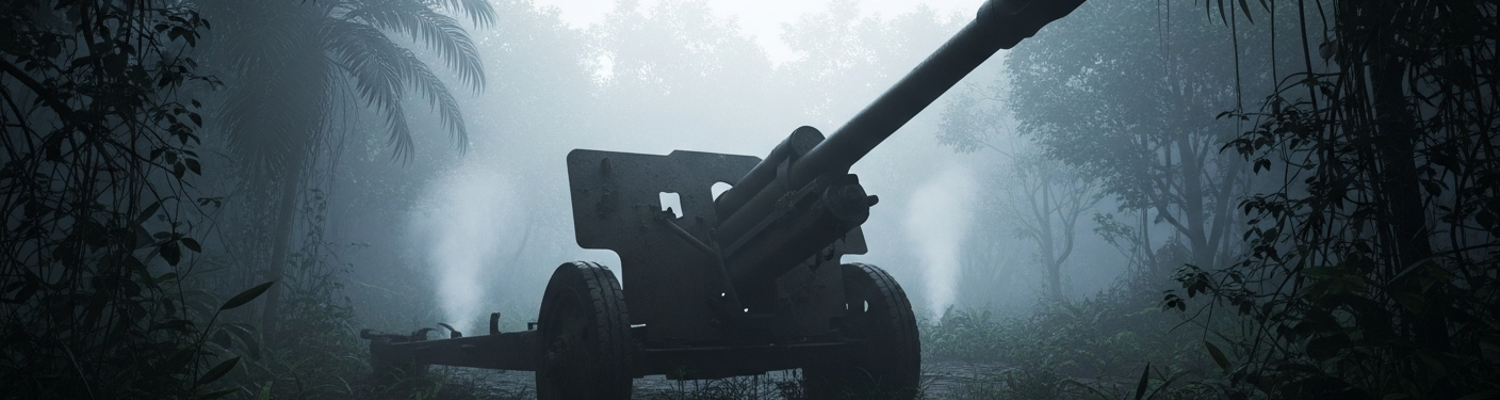

French 75mm Artillery Deployment
The weapon was a ghost of another war. The primary artillery piece for American and Filipino forces defending Bataan was the Canon de 75 modèle 1897, a French design that had defined the battlefields of World War I. American variants, designated 75mm Gun M1917 and M1918, were mechanically almost identical to the original. Their defining feature, the hydro-pneumatic recoil system, had been revolutionary in 1897, allowing for a high rate of fire without resetting the gun's aim. By 1941, after decades of service and storage, it was a liability. Spare parts for the complex mechanism were nonexistent on the Bataan Peninsula. The gun's entire design was predicated on the open fields of Europe, not the dense, suffocating jungle of the Philippines. A critical design flaw for this new environment was its limited traverse. The carriage allowed for a mere six degrees of sideways aiming. To engage a target outside that narrow arc required the entire 1.5-ton carriage to be physically manhandled through mud and thick vegetation, an exhausting and often impossible task.
This was a weapon system out of time.
The principal unit armed with these vintage guns was the 88th Field Artillery Regiment of the Philippine Scouts. As a provisional unit hastily formed in April 1941, its existence was a testament to the unpreparedness of the U.S. Army Forces in the Far East (USAFFE). The enlisted men were elite Filipino soldiers, known for their discipline and professionalism, led by a mix of American and Filipino officers. Archival evidence shows these men had minimal time to train on the old guns before being thrown into combat, first seeing action during the withdrawal from Lingayen Gulf. Their equipment was a mix of towed M1917 guns and a small number of self-propelled mounts, which were simply the same 75mm gun bolted onto an M3 half-track. The bravery of these men was never in question. On January 6, 1942, Sergeant Jose Calugas of the 88th ran 1,000 yards under continuous fire to put an abandoned gun position back into action, an act for which he would later receive the Medal of Honor.
The battlefield itself was an opponent. Bataan is a rugged spine of mountains cloaked in a triple-canopy jungle, with few roads running along its coasts. This terrain made direct observation of enemy positions nearly impossible for ground forces. Any time a USAFFE 75mm battery fired, the smoke from its discharge provided a clear signal to Japanese spotter planes circling overhead. The terrain also forced the guns into predictable firing positions along the few existing roads and clearings, making them easy for Japanese artillery to target. Once a battery was sited, its lack of mobility meant it was effectively a static target, awaiting its destruction.
Antiquated Observation Doctrine
Fire control was a classroom theory from Fort Sill, built for a different continent and a different war. American artillery doctrine in 1941, heavily influenced by the French experience in World War I, was a slow, deliberate process centered on observed, indirect fire. It began with a forward observer, or FO, a small team positioned to see the target. Using an aiming circle and binoculars, the FO would determine the target's map coordinates. This data was then transmitted to a battalion-level Fire Direction Center, or FDC. The transmission link was almost entirely the EE-8 field telephone, a hand-cranked device connected by miles of vulnerable copper wire. In the FDC, staff officers performed complex trigonometric calculations to determine firing data, which was then relayed back down the wire to the gun batteries.
This entire system was built on one fragile assumption: the observer could see the target.
On Bataan, that assumption disintegrated. The peninsula’s dense jungle, steep ravines, and volcanic peaks rendered line-of-sight observation useless. Forward observers crawling through the undergrowth found their vision reduced from thousands of yards to mere feet. The physical link in this system, the telephone wire, became a fatal vulnerability. Strung through the jungle, the wires were constantly severed by Japanese infiltration patrols, artillery bombardments, and even falling trees. Records from NARA Record Group 407 detail the heavy casualties suffered by repair crews attempting to find and fix breaks under fire. The leather cases of the EE-8 telephones rotted in the constant humidity, and the lines themselves performed poorly when saturated with moisture. Radio technology was no solution. Early portable sets like the SCR-194 were heavy, and their weak signals were easily absorbed and scattered by the wet foliage and mountainous terrain.
The Americans and Filipinos were effectively blind. This doctrinal failure was magnified by the tactics of the Japanese 14th Army. The American system was designed for a static front, not for the fluid infiltration tactics and massed assaults employed by the Japanese. More decisively, the Japanese held absolute control of the air. Their spotter planes circled with impunity, acting as the all-seeing eyes that USAFFE forces lacked. For their final offensive in April 1942, the Japanese massed nearly 200 artillery pieces, including heavy 150mm guns and monstrous 240mm howitzers. An observation balloon, lofted north of Balanga, provided Japanese observers with a stable, elevated platform to direct this destruction with pinpoint accuracy, a capability USAFFE could not counter.
Battlefield Intelligence Failure
The operational logs of USAFFE command reveal a catastrophic intelligence deficit from the first day. Bataan's geography was an impenetrable shield for Japanese forces, making conventional reconnaissance impossible. The 26th Cavalry (Philippine Scouts), the primary reconnaissance element, had performed a textbook horse-mounted delaying action during the retreat into Bataan. Once on the peninsula, their horses were a liability in the thick jungle. The unit was soon dismounted, and the last of its horses were butchered for food. They became infantrymen, not a reconnaissance force.
They could not see the enemy.
This systemic failure of reconnaissance translated directly into the paralysis of the artillery. The guns were deaf and blind. The triple-canopy jungle made it impossible to spot enemy assembly areas or advancing infantry until they were nearly on top of friendly lines. With observation and communication thoroughly compromised, the artillery was forced to fall silent or fire unobserved, a wasteful and dangerous guessing game. The Japanese, however, faced no such handicap. Any USAFFE battery that opened fire had its position instantly revealed by smoke, inviting swift and devastatingly accurate counter-battery fire from Japanese guns or strikes from bombers.
Desperate attempts were made to overcome this blindness. By early 1942, the Far East Air Force had been all but annihilated. A handful of battered P-40 Warhawks and a few other stray aircraft were all that remained, operating from hastily constructed gravel strips. In a few missions, these planes were sent aloft to act as artillery spotters, a task for which neither the pilots nor the artillerymen were trained. Communication was primitive. Lacking effective air-to-ground radios, pilots scribbled notes about enemy positions, placed them in weighted bags, and tried to drop them near friendly command posts. By the time the information was retrieved and relayed, it was often hours old and tactically useless. In one recorded instance, a P-40 pilot, Lieutenant Jack Donaldson, was ordered to drop small bombs on approaching Japanese forces and then fly to Cebu, as the Bataan airfields were about to be overrun. These sporadic efforts were courageous but utterly insufficient.
Overwhelming Enemy Superiority
The sky over Bataan belonged to the Japanese. Complete Japanese air superiority was the single most decisive factor in neutralizing USAFFE artillery. Japanese observation and light bombing aircraft, primarily Mitsubishi Ki-30s and Ki-51s, circled over the peninsula with near impunity. This created an impossible tactical dilemma. The very act of firing a 75mm gun was a potential death sentence. Every discharge produced a plume of smoke that served as an immediate beacon, betraying the battery’s location. The response was terrifyingly swift. Japanese observers would radio the coordinates to their own artillery units, and counter-battery fire could begin falling within minutes. Lacking any significant anti-aircraft capability, the USAFFE gunners had no way to challenge this aerial dominance. Their guns were forced into silence.
This aerial dominance was compounded by a massive disparity in ground firepower. For the final offensive in early April 1942, the Japanese 14th Army was reinforced with a powerful collection of artillery designed to systematically smash the Bataan defensive lines. The Japanese order of battle shows an assembly of approximately 190 guns. These included modern Type 92 105mm cannons and Type 96 150mm howitzers. The most formidable were the colossal Type 45 240mm howitzers. These siege guns, positioned well out of range of the USAFFE’s own limited number of 155mm pieces, could lob enormous high-explosive shells onto the main line of resistance with impunity. The bombardment preceding the final assault was methodical, focusing on the sector around Mount Samat. It was not a duel; it was a one-sided demolition that destroyed fortifications and shattered the morale of the starving, disease-weakened troops.
The defenders were out-sighted and outgunned.
Even if USAFFE artillery could have fired without fear of immediate retribution, it was largely incapable of countering the primary Japanese infantry tactic of infiltration. American and Filipino commanders were consistently baffled by the Japanese method of advancing in small, dispersed parties through gaps in the line, often at night. The slow, wire-dependent American fire control system was completely unable to cope with such fluid threats. By the time a forward observer could identify a target and relay a request for fire, the infiltrating Japanese soldiers were long gone. The shells would fall on empty jungle, a futile exercise that allowed the Japanese to repeatedly get behind the main defensive positions and force withdrawals without costly frontal assaults.
Artillery's Final Obsolescence
The order came on April 9, 1942. It was the command every artilleryman dreads: destroy the guns. For the crews of the French 75s, including the Philippine Scouts of the 88th Field Artillery, this was the final admission of defeat. Survivor accounts detail the grim, methodical process. With the main line of resistance broken, the primary objective shifted to denying the enemy their equipment. Gunners turned on their own weapons. They used sledgehammers to smash the panoramic sights and shatter the delicate traversing gears. They jammed the breechblocks with thermite grenades, the intense heat melting the precision-milled steel into a useless mass. The most critical target was the hydro-pneumatic recoil mechanism. Destroying it rendered the gun incapable of rapid fire. Some crews buried the muzzle in the earth and fired a final shell, causing the barrel to rupture. The weapons that had been their primary tool of defiance were systematically unmade by the men who served them.
Survival became a lottery. In the final hours, unit cohesion evaporated. Some gun crews fought to the last, firing over open sights at advancing Japanese infantry until their positions were physically overrun. Others were ordered to abandon their pieces and fall back, fighting as disorganized infantrymen. An artilleryman’s fate depended not on skill, but on the chaotic whims of a battlefield in its death throes. Whether he was on a section of the line that broke first, whether his position was on a Japanese map, or whether he was simply in the wrong place when a shell landed.
This was a war of chance.
The end of the fighting was the beginning of a new ordeal. The gunners, now disarmed and defeated, were herded into columns with the rest of the 75,000 American and Filipino prisoners for the Bataan Death March. These soldiers, who had spent months hauling heavy ammunition and manhandling 1.5-ton guns, were now subjected to a brutal march of over 60 miles with almost no food or water. Those who fell behind were killed. The march terminated at Camp O’Donnell, a former Philippine Army training base converted into a concentration camp. Here, an artilleryman's specialized skills were worthless. The camp was a nightmare of disease and starvation. Dysentery and malaria were rampant. In the first few months of the camp's operation in 1942, approximately 20,000 Filipinos and 1,500 Americans died. The men who had once commanded the power of modern artillery were now reduced to skeletons, their final obsolescence a grim testament to the comprehensive nature of their defeat.