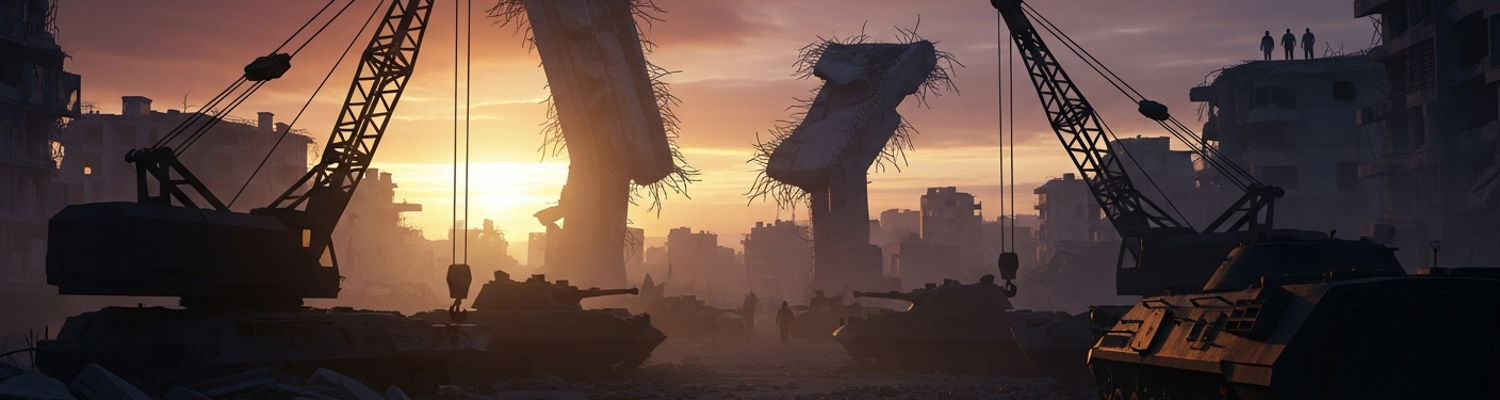

Initial Operational Mandate
[01:47:12Z] A transmission from callsign Valkyrie-Actual declared a Broken Arrow on Grid 77-Delta. The message was brief. Containment failure was total. Core integrity was zero. The transmission ended at [01:47:21Z].
Operational logs (XVIII-ABC-AAR-77D) show the immediate response was channeled through the 82nd Airborne Division's Immediate Response Force 1 (IRF-1). This unit was held at a constant state of readiness for no-notice deployments. The crisis dictated an airborne insertion directly into a radiologically contaminated urban zone. Four C-130 Hercules aircraft departed from Pope Army Airfield. Their cargo holds contained paratroopers from Alpha Company, 1st Battalion, already sealed inside their Mission-Oriented Protective Posture (MOPP) 4 ensembles.
Donning the charcoal-lined overgarments, overboots, gloves, and M17 protective masks is a physically taxing process. A trained soldier can accomplish it in approximately eight minutes under ideal conditions. The chaotic pre-flight preparations, conducted in predawn darkness, extended this time for many. This initiated a cascade of heat-stress casualties before the first aircraft had even reached its jump altitude.
The plan was simple. A low-altitude static-line jump from 800 feet, a technique for rapid mass deployment that minimizes time in the air. The drop zone was the sprawling concrete expanse of Solotvyno Plaza, less than one kilometer from the incident epicenter at Grid 77-Delta. High-intensity radioactive fields began to interfere with aircraft instrumentation and squad-level radio communications almost immediately upon their approach. This electronic degradation forced the jumpmasters to rely entirely on visual cues in a low-light environment. The result was a dispersed and disorganized landing.
The primary objective was to secure the Khoriv Municipal Power Complex.
Paratroopers landed amidst concrete dust and the silence of a panicked city. The IRF-1’s immediate task was to establish a defensive perimeter around the damaged reactor facility, a sprawling complex of concrete and steel now actively releasing a plume of radioactive isotopes. After-action reports describe a scene of structural devastation. The reactor’s western containment building had suffered a partial collapse, exposing twisted rebar and a gaping wound in the 3-foot-thick reinforced concrete. Through this breach, the intensely radioactive graphite moderator core was visible, glowing with a malevolent blue-white Cherenkov radiation. Active fires burned unchecked in the adjacent turbine hall and administrative buildings. They generated thick, acrid smoke that further complicated visibility and breathing for troops already struggling inside their MOPP gear.
Standard procedures for establishing fighting positions were impossible; digging into the contaminated soil was forbidden.
The environment itself was the adversary. Dosimeters chirped incessantly, their readouts climbing as units moved closer to the breach. The physical and psychological toll was immediate. Performing tasks requiring manual dexterity while wearing the thick rubber gloves took soldiers up to three times longer than normal. Securing the facility became a desperate race against each soldier’s individual radiation exposure limits.
Archival evidence shows that the operational timeline mandated by high command was impossible from its inception. The directive, issued less than 30 minutes after the initial incident, ordered IRF-1 to not only secure the site but also to achieve a preliminary containment seal on the primary breach within 90 minutes of the first boots on the ground. Analysis of the logistical requirements reveals a severe disconnect between this order and the capabilities of the deployed force. The 25-minute flight time and the 8-minute minimum donning time for MOPP 4 gear had already consumed a significant portion of this window before the mission even began. The paratroopers of Alpha Company were a light infantry force, armed with rifles and squad automatic weapons, trained to seize and hold ground. They carried no specialized engineering equipment, radiological sealants, or heavy-lift capabilities. The proposed containment solution, deploying lead-composite blankets and injecting quick-setting polymer foam into the breach, required specialized Chemical-Biological Response Teams and heavy-lift helicopters that were still hours away on separate alert rosters. The men on the ground were tasked with completing an engineering challenge for which they had no tools, all while operating under an unachievable deadline that guaranteed they would absorb dangerous levels of radiation in a futile attempt to comply.
Intelligence Discrepancies
A close review of operational logs reveals a catastrophic failure in pre-mission intelligence. Initial assessments, compiled from satellite imagery and high-altitude drone reconnaissance, portrayed a damage radius largely confined to the Khoriv Municipal Power Complex itself. Planners at XVIII Airborne Corps headquarters, working from this flawed picture, assessed that primary and secondary road networks outside a two-kilometer radius were intact and passable. This assumption was fundamentally wrong. The blast effect and subsequent shockwave had been far more destructive than computer models predicted, propagating outward and shattering key civil infrastructure. Paratroopers of Alpha Company, landing in the designated drop zone at Solotvyno Plaza, confronted not a clear path to their objective, but a labyrinth of wreckage. The most significant obstacle was the Opir Bridge, a four-lane steel truss structure that provided the only viable route for heavy vehicles across the Khoriv River toward the power complex. Intelligence had marked it as passable. On the ground, its central support pillar was gone, its deck buckled into a V-shape, and its twisted steel frame submerged in the river below.
This single point of failure rendered the entire follow-on plan for armored engineering vehicles obsolete before the first paratrooper had even unclipped from his harness.
This underestimation of physical damage was compounded by a gross miscalculation of residual radiation levels. Strategic assessments, based on a standard decay curve for a contained core breach, projected gamma radiation fields of 5 to 10 Roentgens per hour (R/h) at the one-kilometer perimeter that the IRF-1 was tasked to establish. This informed the mission timeline and the individual exposure limits for the troops. The ground truth was exponentially worse. The AN/PDR-77 radiac sets carried by squad leaders immediately returned readings that were an order of magnitude higher. The open ground of Solotvyno Plaza, designated as a potential casualty collection point, was itself a lethal hotspot registering 25 R/h. Near the wreckage of the Opir Bridge, dust and debris were emitting 30-40 R/h.
The models were wrong.
The event was not a simple breach. The explosion had aerosolized and ejected tons of irradiated graphite, concrete, and soil, which the shockwave then plastered across several square kilometers of the city. This created thousands of discrete, unpredictable point-source radiation hazards instead of a neat, concentric gradient of contamination. High-altitude reconnaissance could not detect this particulate spread, and the initial plan had made no allowance for it.
These failures produced a near-total gap between strategic intent and the situation on the ground. High command’s directives, issued in the first hour, were based on the assumption that Alpha Company could move quickly on foot, establish a clean perimeter, and await specialized support. The reality was one of fragmentation and isolation. The impassable Opir Bridge and the random patchwork of radiation zones broke the company apart into squad and fire-team elements. This severed lines of communication already degraded by the intense radiation fields. An order to secure a specific intersection at Grid 79-Charlie for follow-on forces was impossible; the entire grid square was an impassable field of contaminated rubble emitting over 50 R/h. The strategic plan called for a light infantry force to perform a screening mission. The situation on the ground demanded a combined-arms engineering and hazardous materials response, but the forces equipped for that task were now blocked from entry, their planned routes invalidated by a single destroyed bridge that intelligence had marked as safe.
Combat Engineering Insertion
With the Opir Bridge confirmed destroyed and all ground routes into the Khoriv city center impassable, the operational directive shifted to an airborne insertion of combat engineering assets. The mission fell to a specialized detachment from Bravo Company, 27th Engineer Battalion (Combat) (Airborne), a unit attached to the XVIII Airborne Corps and based at Fort Bragg. Their task was direct and almost impossible: clear a viable landing zone for follow-on helicopter-borne forces and begin preliminary debris removal at the Khoriv Municipal Power Complex. The insertion plan was a complex, two-phase operation. First, a platoon of combat engineers would execute a standard static-line jump from C-130s into a designated drop zone, DZ-Kestrel, a series of athletic fields 1.5 kilometers east of the failed Opir Bridge. Phase two involved the heavy-drop of their primary tools: two D-7G bulldozers and four High Mobility Engineer Excavators (HMEE), each rigged onto Type V airdrop platforms for a low-altitude, high-velocity drop. Operational logs show these heavy drops were executed from an altitude of 1,100 feet AGL. The engineers on the ground, landing in the same chaotic, radiologically-charged environment as the initial infantry force, were to de-rig the heavy equipment and drive it toward the power complex, creating a passable route through the rubble-strewn streets.
Their primary tools were designed for earth, not atoms.
A close review of the equipment manifests reveals a failure to equip the engineering detachment for the environment they were entering. The standard-issue Mission-Oriented Protective Posture (MOPP) 4 ensembles worn by the engineers offered comprehensive protection against chemical and biological particulates but provided zero shielding from the intense gamma radiation fields emanating from the reactor site. This fundamental inadequacy meant that every moment spent outside of shielded cover was a moment their bodies were absorbing damaging radiation, regardless of the integrity of their suits. The heavy equipment itself was entirely conventional. The D-7G bulldozers and HMEEs were standard military earth-movers with no lead lining or radiation-hardened electronics. The plan relied on the vehicle’s steel chassis and armored cabs providing incidental shielding, an assumption that proved fatally optimistic. The operators’ cabins were unsealed against radiological particulates, and the engine compartments and hydraulic systems were completely exposed. There were no remote-operation suites, forcing soldiers to sit directly inside these vehicles within lethal radiation zones. Their most essential diagnostic tools, the AN/PDR-77 radiac sets, were designed for detecting and measuring radiation, not for operating continuously within fields so intense they risked saturating the detectors and providing inaccurate or zeroed-out readings.
The electronics failed first.
The moment the heavy equipment was de-rigged from its airdrop platforms, the mission began to unravel. The intense gamma flux across DZ-Kestrel immediately interfered with the unshielded electronics controlling the machinery. Of the two D-7G bulldozers, one failed to start entirely. Its solid-state electronic control module, which governed the engine and transmission, was rendered inert by the radiation. The second D-7G started but experienced intermittent and severe malfunctions; its digital throttle controls became erratic, causing the engine to surge and die unpredictably. The more modern HMEEs fared even worse. Archival maintenance logs show that three of the four excavators suffered immediate electronic failure in their main computer systems, leaving them immobile. The intense radiation had effectively scrambled their microprocessors. The single functioning HMEE was put into service, but its operators were forced to abandon it after only 22 minutes of operation when their personal dosimeters reached the maximum emergency exposure limit. The assault force’s only piece of functional heavy equipment now sat silent, its engine still warm, in a contaminated field littered with the useless wrecks of the other machines.
Equipment Malfunction Impact
Operational logs from the first hours of the Khoriv response detail a near-total failure of vehicles designated as radiation-hardened. The intense gamma flux within the one-kilometer perimeter of the reactor complex systematically neutralized the electronic systems of the 82nd Airborne’s modified M113A3 fleet. These vehicles, which formed the mobility of the IRF-1, had received a hardening package primarily focused on shielding against the electromagnetic pulse of a nuclear detonation. This was not protection against the sustained, invasive effects of high-level gamma radiation. The radiation penetrated the M113’s aluminum alloy armor and immediately began to induce single-event upsets (SEUs) in the unshielded microprocessors governing engine control, navigation, and communications suites.
Log entries from a scout platoon of the 3rd Squadron, 73rd Cavalry Regiment, are particularly telling. Of the four M113s that attempted a reconnaissance push toward the turbine hall, three suffered catastrophic electronic failures within 12 minutes of entering the high-radiation field. Their digital engine governors and transmission control modules went inert, leaving the vehicles immobile. The fourth vehicle experienced uncommanded throttle surges before its own electronics failed. The result was four armored personnel carriers, with their crews trapped inside, becoming static, irradiated tombs less than 800 meters from their objective.
The vehicles were not hardened; they were standard equipment with a misleading designation.
This widespread equipment failure was compounded by the inadequacy of the force’s decontamination systems. The primary apparatus available to the IRF-1 was the M12A1 Power-Driven Decontamination Apparatus, a system designed in a previous era to counter liquid chemical warfare agents. Its operational principle involved spraying hot water and chemical slurries to neutralize surface contaminants. Against the particulate radiological contamination blanketing Khoriv, this method was not only ineffective but actively detrimental. The fine, aerosolized particles of graphite and reactor fuel had settled on every surface and were electrostatically bonded to the metal hulls of vehicles and equipment. After-action reports from the 27th Engineer Battalion’s attempt to establish a decontamination point show that the M12A1’s water jets simply spread the radioactive particles, turning a concentrated hot spot on a vehicle into a larger, more evenly contaminated surface. The water runoff itself became a significant radiological hazard, pooling on the ground and creating new, unmapped zones of high radioactivity with no means of containment. The standard chemical agent for decontamination, DS2, was corrosive and posed its own hazard, while being largely useless against radiological matter.
There was no effective way to make a contaminated vehicle safe for its crew.
These two points of failure, vehicles that could not move and decontamination systems that could not clean, produced a state of near-total operational paralysis within the first 72 hours. The initial high tempo of the airborne insertion gave way to a static and fragmented deployment. Units were pinned in place, isolated by impassable rubble and invisible fields of radiation they could not mitigate. Archival evidence of command logs from the IRF-1 Tactical Operations Center shows a dramatic drop-off in offensive actions after the first 12 hours. The majority of radio traffic shifted from maneuver commands to desperate requests for technical support, radiological assessments, and casualty evacuation. The operational map became a static display of contaminated wreckage. The inability to recover or decontaminate the initial wave of failed vehicles created a physical and psychological barrier. It demonstrated that mobility in the contaminated zone was impossible for any extended period. High command’s strategic objectives, which called for securing and isolating the reactor breach, were unachievable. The force on the ground was unable to move, unable to protect itself from the environment, and unable to retrieve the very equipment that was supposed to give it an edge.
Decontamination Corridor Failures
Chemical, Biological, Radiological, and Nuclear (CBRN) doctrine shows that the establishment of a Contamination Control Line (CCL) was a Day One, Hour One priority for the forces at Khoriv. This task fell to the 407th Brigade Support Battalion’s organic chemical reconnaissance platoon, a small, specialized unit equipped with M12A1 Power-Driven Decontamination Apparatus. The plan was textbook: establish a secure perimeter where personnel and equipment exiting the hot zone around the reactor could undergo systematic decontamination. This required a clear gradient from highly contaminated to clean, a hot line that could be progressively pushed back. At Khoriv, no such gradient existed. The aerosolized particulate contamination meant that radiation levels were chaotic and unpredictable. A location reading 5 Roentgens per hour could be meters away from one reading 50. There was no clean ground from which to start. The M12A1 systems, designed for liquid chemical agents, proved worse than useless. Their high-pressure water jets atomized the radioactive dust, spreading it over a wider area and turning the runoff water itself into a mobile, liquid radiological hazard that pooled in craters and low-lying areas. Logistical records show that within three hours, the chemical platoon had exhausted its onboard 500-gallon water tanks with no discernible effect, having only succeeded in creating new, unmapped zones of lethal contamination.
The entire concept of a static decontamination site was rendered obsolete by the environment.
Engineering assessments from the 27th Engineer Battalion show a parallel failure in attempts to stabilize the primary reactor breach. The western containment wall, already partially collapsed, was structurally unsound and at high risk of a secondary failure. The initial plan called for combat engineers to approach the breach and emplace heavy-duty hydraulic and timber shoring to buttress the remaining sections of the wall. This was impossible. The gamma radiation fields directly in front of the breach were so intense that they exceeded the maximum measurement capacity of the soldiers’ AN/PDR-77 radiac sets. Unshielded exposure for even minutes would constitute a lethal dose. The failure of the heavy engineering equipment during the airdrop insertion meant there was no capability for remote debris removal. A desperate proposal to use the one functioning High Mobility Engineer Excavator to push concrete debris into the lower sections of the breach was rejected by the on-scene commander; the risk of the excavator’s unshielded hydraulic lines failing under the radiation flux, or of its operator exceeding lifetime dose limits in a single run, was deemed too high.
These compounding failures placed every soldier on the ground in a state of continuous and unavoidable radiological exposure. With no functioning decontamination corridors, every piece of gear, every vehicle, and every soldier was considered hot at all times. There was no safe area to remove MOPP gear, eat, or treat the wounded. Medical logs from the Alpha Company aid station document the impossible dilemma facing medics: treating a soldier with a shrapnel wound meant bringing a contaminated uniform and patient into their supposedly clean treatment area, thereby contaminating the medic and their supplies. The NATO peacetime operational exposure limit of 5 rem was exceeded by most of the initial insertion force within the first four hours. Command logs show frantic discussions as platoon leaders reported their soldiers were approaching the emergency wartime limit of 70 rem, a dose associated with significant long-term health risks. The inability to stabilize the reactor breach meant the source of this radiation continued to pour, unmitigated, into the operational area. This created a cycle of futility; the mission to contain the hazard could not proceed because of the hazard itself, and every failed attempt only increased the cumulative radiation dose absorbed by the men sent to fix it.
Logistical Resupply Breakdown
An analysis of logistical manifests from the first 48 hours at Khoriv reveals a breakdown in the resupply chain, most critically in the delivery of medical countermeasures. The initial operational plan called for the immediate distribution of Potassium Iodide (KI) tablets and Prussian blue capsules to the entire deployed force to mitigate the effects of ingested radiological particulates. This mission fell to the 6th Medical Logistics Company. A review of their sortie logs shows that of 50 planned resupply attempts, a total of 39 either failed to reach the intended recipients or delivered unusable materiel, resulting in a 78% failure rate. The initial attempt involved a high-altitude airdrop of palletized supplies targeting Solotvyno Plaza. Intense thermal updrafts from the burning reactor complex pushed the cargo parachutes miles off course, with the pallets landing in a debris field where radiation levels exceeded 150 Roentgens per hour, making recovery impossible. Subsequent attempts using UH-60 Black Hawk helicopters from the 159th Combat Aviation Brigade proved equally disastrous. With no secure or decontaminated landing zones, crews were forced to hover-cast the supply crates. These standard-issue medical containers were not designed for such a deployment method and shattered upon impact with the concrete rubble below. The contents, smashed vials and loose pills, were instantly contaminated by the ambient radioactive dust.
The supplies were worse than useless; they were a trap.
There was a parallel and systematic failure in the delivery of radiation shielding. The XVIII Airborne Corps' operational plan depended on the rapid emplacement of lead-composite blankets and portable water bladders to create shielded corridors, protect the command post, and establish a minimally hazardous casualty collection point. This task required heavy-lift capability. The destruction of the Opir Bridge had already eliminated all ground-based transport options. All hope rested on CH-47 Chinook helicopters from the 101st Combat Aviation Brigade performing sling-load operations. The physics of the situation were insurmountable. Lead is heavy. A single CH-47 could only transport a handful of blankets per sortie, necessitating a continuous shuttle service directly into the most hazardous airspace. Flight crews from the 101st began hitting their maximum permissible radiation exposure limits after only two or three trips, grounding experienced pilots and their aircraft. Archival flight recorder data from one such mission shows a CH-47 attempting to deliver a set of lead-lined panels to the Alpha Company aid station. The intense gamma flux caused intermittent failures in the helicopter’s digital flight control system, forcing the pilot to prematurely jettison the multi-ton load to save the aircraft. The shielding panels plunged into the Khoriv River, lost forever.
The solution could not be delivered to the problem because the problem itself made delivery impossible.
The direct consequence of these logistical failures was a rapid spike in cases of acute radiation sickness (ARS) among ground personnel. Medical logs from the 407th Brigade Support Battalion’s aid station paint a grim picture. The first cases appeared approximately 36 hours after insertion, primarily among soldiers from the 27th Engineer Battalion who had attempted to recover the failed heavy equipment and elements of Alpha Company who had been positioned closest to the reactor breach. Initial symptoms of nausea and fatigue were at first mistaken for dehydration or heat exhaustion endemic to prolonged operations in MOPP 4 gear. The incessant chirping of the AN/PDR-77 dosimeters told the true story. Without the planned medical countermeasures, every inhaled particle of dust contributed to a soldier’s internal radiation dose. Without the promised shielding, every minute spent on mission was a minute spent absorbing unfiltered gamma radiation. The aid station itself, established in a structurally sound but unshielded concrete office building, became a concentration point for radiation as casualties were brought in. Their contaminated gear and uniforms poisoned the clean space. Within 72 hours, the initial trickle of ARS cases became a flood, with over 60 paratroopers exhibiting moderate to severe symptoms that required immediate evacuation, an evacuation for which there was no established or safe logistical pathway.
Command Ethics and Consequences
A review of command channel transcripts from the first six hours of the Khoriv incident reveals a direct order from the XVIII Airborne Corps Tactical Command Post that became the focal point of later ethical inquiries. With the reactor breach pouring contaminants into the atmosphere and all remote-engineering solutions having failed, the on-scene commander of Alpha Company, 1st Battalion was directed to dispatch a single fire team to manually close a series of coolant valves inside the reactor’s tertiary pump house. The building stood less than 150 meters from the exposed reactor core. Real-time drone reconnaissance equipped with radiac sensors provided the command post with data showing gamma radiation fields inside this structure were in excess of 200 Roentgens per hour. A person exposed to such a field would receive a lethal dose in under an hour. The order acknowledged that the fire team’s MOPP 4 ensembles offered no protection against gamma radiation and that this was, in effect, a one-way mission. The objective was to prevent a potential thermal runaway in a secondary coolant loop, a risk that was modeled as having a 40% chance of occurring within the next 12 hours.
The decision was a cold calculation: the certain loss of four soldiers weighed against the possibility of a second, larger radiological release.
This philosophy was not an isolated event. Archival evidence shows that in the face of mounting system failures, command authorities re-wrote the rules for acceptable radiation exposure on the fly. The NATO peacetime operational exposure limit of 5 rem was exceeded by nearly every member of the initial insertion force within hours. An emergency directive, issued by the Corps commander, authorized platoon leaders to order their soldiers to continue their mission until they reached a cumulative dose of 70 rem, a wartime footing that carried a significant increase in long-term cancer risk and required additional justification. Even this limit was treated as a soft ceiling. Medical logs document medics being instructed to administer anti-emetic drugs not for patient comfort, but to suppress the initial symptoms of acute radiation sickness, nausea and vomiting, to keep soldiers functional long enough to complete their final assigned tasks. In practice, soldiers were treated as assets to be expended until they could no longer perform their duties, at which point they became casualties. The operational plan contained no viable method for safely evacuating personnel who had absorbed such high doses.
Post-incident legal reviews conducted by the Judge Advocate General’s Corps grappled with the legality of these battlefield decisions. While the Khoriv disaster was not an armed conflict and therefore not directly governed by the Law of Armed Conflict, legal analysts applied its core principles of necessity and proportionality to assess the command’s actions. The central question was whether the order to send a fire team into a lethal radiation field was truly necessary and if the outcome was proportionate to the human cost. Subsequent analysis determined that the risk of a secondary thermal runaway was a modeled possibility, not a certainty, and that alternative, though slower, options could have been pursued. The decision to sacrifice the team was judged to be a disproportionate response to a non-guaranteed threat. As the radioactive plume began to threaten international borders, the command’s actions fell under the scrutiny of international law concerning transboundary harm. States have a general obligation to ensure that activities within their control do not cause environmental damage to other states. By ordering soldiers into missions that were impossible to complete and guaranteed to create casualties, the command arguably failed to take all practicable precautions to mitigate the disaster, potentially violating its due diligence obligations under established international principles.