
Operation Pipestone Canyon and the Go Noi Enclave
Mud sucked at the company radio operator's canvas jungle boots with every stride across the suffocating flats of the Ky Lam delta. Standing swamp water rose above his waist in the irrigation ditches, soaking the spare dry cell batteries packed inside his nylon rucksack and adding dead weight to his harness. Dense stands of razor edged elephant grass blocked any cooling breeze, trapping humid air that pushed daily temperatures past one hundred degrees. Sweat dripped directly into the radio handset casing as the operator checked his frequencies, struggling to maintain clear contact through the dense vegetation and rolling heat distortion. Every step forward through the thick silt threatened to tear loose the whip antenna snagging against low branches, while the surrounding marsh smelled of rotting vegetation and stagnant runoff.
Runoff water from three converging channels formed the natural boundary around Go Noi Island, locking the terrain between the Ky Lam, the Ba Ren, and the Thu Bon rivers. North Vietnamese Army regulars and local Viet Cong battalions used this fertile triangle as a fortified staging area and sanctuary, stockpiling munitions and food less than twenty miles south of the sprawling allied airfield at Da Nang. Underground bunker complexes, deep tunnel networks, and reinforced trench lines honeycombed the tree lines along the riverbanks, allowing hidden fighters to slip past air patrols and launch rocket strikes against coastal bases. Thick hedgerows bordered every abandoned village, concealing tripwires, pressure release mines, and sharpened bamboo stakes placed specifically to shatter infantry foot columns. Riflemen stepped cautiously behind the point element, scanning the brown water and tangled bamboo roots for signs of freshly disturbed dirt or hidden sniper positions.
Sniper fire and buried ordnance had harassed American patrols across the river basin for months, prompting the 1st Marines to launch Operation Pipestone Canyon in late May 1969 to systematically clear North Vietnamese and Viet Cong forces south of Da Nang. Combat sweeps dragged on through the brutal summer months and into September 1969, grinding men and equipment down under constant exposure to moisture and grit. Fine river sand jammed charging handles, while moisture corroded rifle components into rust pitted receivers with seized M16 bolts that failed to extract spent cartridges during sudden firefights. Machine gunners poured river water over their weapons when continuous cyclic fire produced overheating machine gun barrels that threatened to warp the steel and freeze the firing pins. Radio operators carried the extra weight of spare oil bottles alongside their battery packs, constantly stripping and scraping gun parts between calls for artillery coordinates.
Artillery coordinates crackled through the radio operator's headset as the 1st Battalion, 1st Marines and assigned reinforcing units moved into position to establish a tight perimeter around the island. Infantry companies conducted sweeping cordon operations across the river bends, methodically closing escape routes along the dikes to trap and isolate local insurgent cadres. Engineers cleared landing zones with explosives and bulldozers, while rifle platoons advanced abreast through the dense hedgerows to flush out enemy supply caches and hospital bunkers. Marine units maintained twenty four hour blocking positions along the waterways, checking every wooden boat and searching every reed bed for fighters attempting to break the ring under cover of night. The radio operator relayed fresh grid locations to battalion command as company point men cut through the final tree line, bracing for contact along the interior riverbank.
Ky Lam River Delta Terrain and Tactical Communications
Riverbank silt pulled riflemen down to their knees as the lead squad cleared the last canopy of bamboo and entered the open marsh. Alluvial mud, standing swamp water, and dense elephant grass along the Ky Lam delta severely restricted foot mobility and squad dispersion. Thick silt forced platoons into narrow single file columns instead of broad tactical formations. Squad leaders struggled to push their flanks outward through ten foot grass stalks that tore through combat utilities and blinded scouts to nearby wood lines. Every attempted step off the main path sank patrols into hidden creek beds, bunching frightened men tightly together against company standing orders. The radio operator fought through the same suction behind the company commander, steadying the heavy harness and metal transceiver housing digging into his collarbones.
Collarbones bruised under the straps of PRC-25 and PRC-77 tactical radio sets that experienced accelerated battery depletion from continuous transmission schedules and extreme tropical heat. Internal dry cell components inside the metal receiver housings degraded rapidly under temperatures exceeding one hundred degrees, cutting operational life to mere fractions of normal duty cycles. Constant coordinate calls to battalion artillery batteries and medical evacuation channels drained the remaining voltage before midday, forcing the operator to swap heavy power packs with mud slicked hands. Spare batteries packed inside damp canvas pouches frequently failed right out of their waterproof wrappings because trapped heat broke down their chemical seals. Company officers demanded constant updates from platoon commanders, keeping the microphones keyed and accelerating the power loss across every active squad net. The operator unbuckled his radio pack during a brief halt near a drainage dike, checking the reserve voltage meter as static crackled through his rubber handset.
Handset cords tangled around the threaded base of the flexible steel mast as high humidity and immersion caused frequent corrosion and signal loss in manpack radio whip antennas. Green verdigris and rust coated the brass screw threads, breaking electrical grounding every time an operator stumbled into a canal or brushed against dripping elephant grass. Scrubbing the contact points with wire brushes or combat knives provided only temporary relief before tropical air oxidized the bare metal again. Broken transmissions forced the company commander to repeat grid coordinates multiple times, exposing their positions to enemy direction finding gear while delaying crucial mortar support. Platoons advancing on the far side of the riverbend dropped out of the net entirely, unable to report bunker sightings or call for immediate suppressive fire. The radio operator unscrewed the ten foot whip section to attach a short steel tape antenna, hoping the reduced profile would prevent further water damage while restoring contact with the lead elements.
Scouts from the lead elements signaled from the crest of an irrigation dike as the modified antenna picked up broken calls from the forward platoon. Squad leaders relied on physical runners when the crackling receiver failed to punch through the thick treeline, sending young riflemen across exposed rice paddies to coordinate fields of fire by hand. These messengers risked tripwires and concealed punji pits with every dash between scattered dikes, trading radio security for basic tactical survival. Company officers gathered their remaining radio teams in the center of the perimeter, consolidating functioning batteries and swapping dry parts between degraded PRC-25 sets to keep at least one reliable line open to battalion headquarters. The radio operator tightened the rubber gasket on his spare handset, slung the twenty five pound transceiver back onto his soaked shoulders, and stepped forward into the murky ditch behind the company commander.
Bunkers Across the Dodge City Complex
Commanders led their riflemen out of the murky ditch and advanced across the open paddies into the Dodge City operational area. This operational area contained multi tiered tunnel systems fortified with timber reinforced overhead cover and interlocking fields of fire. Heavy mahogany logs, woven bamboo matting, and packed alluvial clay formed thick bunker ceilings capable of deflecting mortar rounds and direct small arms fire. Subterranean chambers reached depths of up to fifteen feet beneath the surface, sheltering command posts, ammunition stores, and sleeping quarters from aerial observation. The company radio operator tracked the lead squad through the tall weeds as the point element stepped across an open clearing toward a line of overgrown earthworks, where scouts probed the dry soil with bayonets to find hidden trapdoors.
Trapdoors swung open as soldiers from the entrenched NVA 36th Regiment and local Viet Cong cadres utilized concealed spider holes to ambush advancing Marine point elements. Automatic fire from Soviet made RPD machine guns cut through the low grass at knee level, pinning the lead squad against the bare dirt. Point men scrambled for cover behind shallow depressions while enemy riflemen fired quick bursts, dropped back down into their vertical shafts, and slid wooden lids shut to escape return fire. The company radio operator pressed his chest into the silt as bullets snapped inches over his transceiver antenna, keying the microphone to shout grid coordinates to company mortars. Squad leaders returned fire with their M16 rifles, but the light bullets merely chipped the reinforced logs without penetrating the subterranean firing bays. Platoon sergeants yelled through the noise of battle, ordering combat engineers and assault teams to bring demolition bags and gas canisters up to the front line.
Infantrymen on the front line deployed satchel charges, CS gas canisters, and hand grenades to systematically neutralize subterranean bunker complexes pinning down the platoon. Riflemen crawled up to the earthen firing slits under covering fire from M60 machine guns, pulling the safety pins on tear gas canisters and shoving the smoking cylinders directly into the air vents. Thick chemical gas poured into the underground chambers, forcing enemy gunners away from their loopholes and masking the approach of the demolition teams. Assault teams followed the gas with fragmentation grenades, tossing them through firing apertures before pushing heavy canvas satchel charges against the primary support pillars. Detonation cords burned down to blasting caps, triggering massive concussions that cracked the overhead timber framework and collapsed the upper tunnel shafts inward.
Shafts collapsed and dirt erupted into the sky along the hedgerow as the blast waves sealed the escape routes and blew the camouflaged lids off nearby spider holes. Secondary explosions shook the ground beneath the operator's boots as stockpiled enemy mortar rounds detonated within the crushed lower galleries. Surviving NVA riflemen scrambled out of secondary exit shafts along the riverbank, coughing from the lingering gas and firing their weapons blindly into the haze. Riflemen waiting on the perimeter cut down the fleeing soldiers with disciplined rifle fire, securing the immediate trench network before clearing the remaining entrances. The radio operator gripped his handset to confirm that the first bunker cluster was neutralized, watching engineers drag fresh spools of detonating cord toward the next fortified mound.
Engineers and Rome Plow Land Clearing Operations
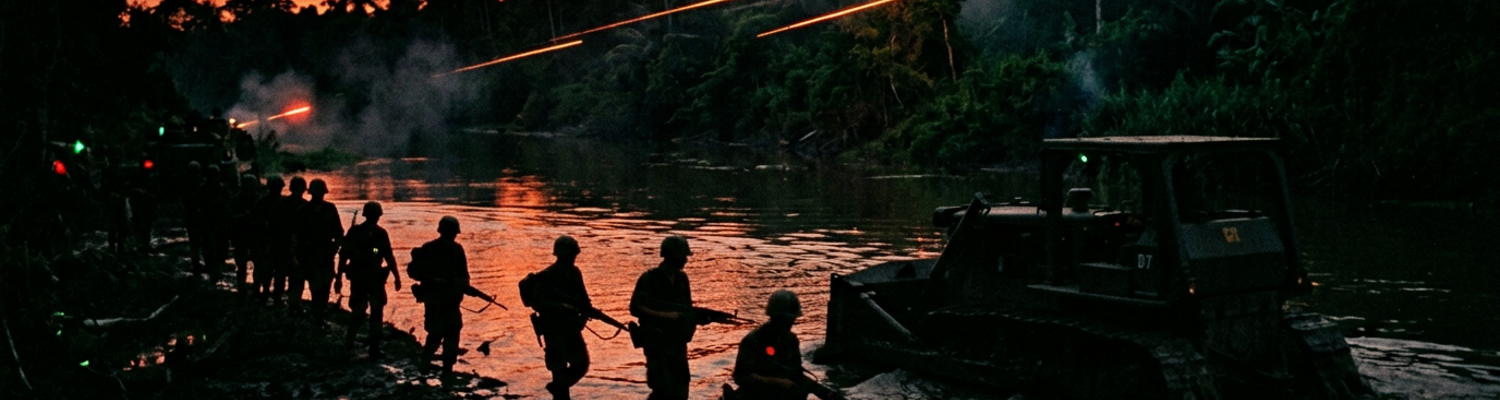
Mounds crumbled as military combat engineers operated armored Rome Plow tractor detachments to shear away hundreds of acres of bamboo hedgerows and defensive earthworks. Massive Caterpillar D7 bulldozers fitted with heavy steel roll cages and specialized cutting blades shifted into gear, cutting into root systems that had anchored the enemy fortifications for years. The company radio operator felt diesel vibrations thrumming through the wet clay, vibrating the metal transceiver frame against his bruised ribs as he monitored command traffic over his rubber handset. Drivers engaged low gears to push the heavy blades straight through the thickest growth, splitting mature trees and collapsing dirt ramparts that had shielded enemy gunners from naval gunfire and air strikes. Extended steel stinger points sliced through dense clusters of thorn and bamboo at ground level, toppling thick vegetation that had previously deflected artillery fragments and resisted manual clearing by infantry machetes. Felled bamboo trunks, shattered logs, and displaced soil tumbled into the stagnant drainage canals as the tractors pushed steadily across the fortified tree line.
Tree line clearing operations frequently detonated buried ordnance and breached concealed trench networks while Rome Plow blades operated under sniper fire. Buried artillery shells, command detonated mines, and booby trapped mortar rounds erupted against the reinforced curved steel, throwing mud and burning propellant into the air while shaking the armored cabs. Enemy snipers took aim from surviving tree lines across the riverbend, cracking high velocity rounds against the tractors protective steel plates and forcing equipment operators to steer with their heads ducked below the sightlines. Deep cutting edges ripped open camouflaged firing trenches, peeling back heavy timber roofs to expose subterranean living quarters, weapons caches, and escape crawlways hollowed out of the clay. Marine assault squads rushed the exposed openings under covering fire, hurling fragmentation grenades and smoke into the collapsed shafts while the tractors backed up on their churning tracks to widen the breach. Machine gunners laid down suppressive fire toward the distant wood line, shielding the exposed engineer crews as mechanics leaped down to replace damaged hydraulic hoses cut by shrapnel.
Shrapnel hazards forced Marines to establish defensive lines along the newly flattened ground as mechanical deforestation stripped natural enemy concealment but left Marine rifle platoons in exposed perimeter security positions. Stripping away the towering hedgerows and thick elephant grass denied North Vietnamese soldiers their traditional ambush corridors, leaving riflemen lying in open dirt fields without shade or overhead cover. The radio operator pressed his chest into a shallow scrape behind an idling tractor tread, wiping gritty dust from his transmitter knobs while calling in updated boundary coordinates to the battalion operations center. Heat radiating from the bare soil warmed his rifle receiver until the metal was hot to the touch, and distant spotters easily tracked any troop movements across the open terrain. Squad leaders ordered their men to build low earthen parapets with their entrenching tools, anchoring their machine guns on the bare field to protect the bulldozers while the engineers prepared another run along the riverbank. Rifle platoons braced in these shallow fighting positions under the midday sun, watching the tractor blades churn up another stretch of riverbank as company commanders called for fresh water supplies over the radio net.
Mines and Asymmetric Attrition
Radio nets crackled with supply confirmations as water cans dropped from a resupply helicopter onto the flattened riverbank, giving the thirsty riflemen a brief pause before officers ordered them back onto their feet. Marines stepped past the churned dirt into untouched brush, immediately confronting areas where Viet Cong sappers extensively seeded tree lines and trail junctures with command detonated 105mm and 155mm artillery shells. Insurgent demolition teams salvaged unexploded American ordnance from past bombardments and buried the massive steel cylinders beneath exposed tree roots along the major footpaths. Insurgents connected these salvaged munitions to long strands of electrical wiring, running the lines through shallow trenches to camouflaged spider holes hidden hundreds of yards away in the thick brush. The company radio operator tracked the lead squad through the dust, watching the point man halt at an overgrown cart crossing where loose earth revealed a buried firing cord. Enemy observers pressed dry cell batteries against the exposed wire ends the moment Marine files drew level with the trap, detonating the buried high explosives with devastating force.
Force from the earthen blast ripped through the canopy, showering the surrounding scrub with pulverized soil, shattered branches, and jagged metal casing fragments. Metal fragments sliced into nearby tree trunks as surviving Marines crawled away from the smoking blast crater and scattered into the undergrowth on either side of the trail. Concealed punji stake pits, wooden box mines, and grenade tripwires inflicted traumatic blast injuries and puncture wounds on advancing patrols throughout the flanking brush. Sharpened bamboo stakes smeared with mud and fecal matter rested at the bottom of camouflaged pit traps, puncturing the canvas sides and soles of jungle boots when soldiers stepped off the main path. Scrap wood box mines filled with cast explosives and improvised pressure switches escaped detection by portable metal detectors, blowing off feet and lower legs when stepped upon. Grenade tripwires made of green military tripcord and thin fishing line ran across the footpaths at ankle and knee height, ready to jerk the safety pins off rusted fragmentation grenades fastened to low bamboo stems.
Bamboo stems concealed the traps as Navy corpsmen crawled through the thorn bushes under heavy sniper fire to apply tourniquets and pressure dressings to wounded scouts. The radio operator keyed his sweat slicked handset to request urgent medical evacuation helicopters while stretcher teams carried the screaming casualties back toward the tractor lines. Hedgerows laced with hidden explosives forced company commanders to abandon wide search formations and halt all rapid movement across the terrain. Asymmetric mine warfare forced Marine formations into slow, single file movements, severely limiting operational momentum across the island. Point men knelt in the dirt and crawled forward on their stomachs, using bayonets and pocket knives to gently probe every square foot of soil before shifting their weight. Every rifleman behind the lead scout had to place his boots directly into the footprints of the man ahead of him, turning standard company advances into agonizingly slow stalks that covered barely fifty yards an hour.
Hours of delay gave enemy guerrilla squads ample time to relocate their mortars, displace across the waterways, and set up fresh defensive lines further inland. The radio operator stood completely still in the tracks of his platoon commander under the afternoon heat, balancing his heavy pack frame while perspiration pooled inside his eyes and rusted the steel safety catch on his rifle. Squad leaders marked newly detected tripwires and suspicious depressions with strips of red survey tape, calling up combat engineers with demolition blocks to blow each obstacle in place before the column took another step forward. Demolition charges detonated along the taped trail, showering the waiting infantrymen with muddy canal water and fine riverbank clay as the squad pushed deeper into the flooded terrain.
Weapons Corrosion and Mechanical Failures
Terrain flooding caused steel magazine feed lips and weapon receivers to develop severe surface corrosion following continuous immersion in brackish delta waterways. Salty river runoff ate through the protective dark finishes on the weapons, producing thick patches of orange rust that seized selector switches and pinned internal springs. Riflemen found that warped, oxidized magazine lips failed to guide cartridges into the chambers smoothly, causing rounds to tilt upward and crush against the barrel extensions. The radio operator repeatedly wiped brackish grime off his rifle receiver with an oily cleaning patch, watching the metal flake away around the trigger housing after hours spent submerged in tidal irrigation cuts. Patrol leaders ordered their men to strip and clean their ammunition magazines during every brief halt, but salt deposits welded thin steel parts together before the metal could dry in the humid air.
Humidity carried the sound of concealed North Vietnamese automatic fire that suddenly tore through the tall grass from across an open paddy. Riflemen scrambled to reassemble their corroded weapons as M16A1 rifles suffered extraction failures and jammed bolt carrier assemblies due to pervasive alluvial silt and inadequate lubricant in wet field conditions. Fine river silt drifted into open ejection ports and coated the internal receiver rails, mixing with sweat to form a gritty paste that stopped moving parts in their tracks. Wet conditions washed away the thin coats of standard rifle oil, leaving dry aluminum carriers to grind against fouled steel until bolts seized halfway inside the receiver tubes. Spent brass cartridge cases stuck tightly inside fouled firing chambers, forcing riflemen to drop into stagnant water behind dirt dikes and run cleaning rods down their muzzles to pound out stubborn casings. Squad leaders kicked stubborn charging handles with their combat boots to dislodge frozen bolts, shouting for immediate machine gun fire as half the rifles in the company stopped shooting.
Shooting from M60 general purpose machine gun teams faced rapid barrel overheating and torn cartridge rims during extended suppression fires across open paddies. Gun crews dropped their bipods into the muddy soil of the dikes and fired long bursts at the distant wood line to buy time for the riflemen. Sustained firing cycles drove temperatures past structural limits, turning the heavy steel barrels dangerously hot and softening the brass casings inside the chambers. Powerful extraction claws ripped through the weakened metal rims of jammed rounds, leaving split cartridge cases firmly wedged in the chambers while the guns locked up solid. Assistant gunners used insulated asbestos mittens to twist off the ruined, smoking barrels, working through heavy return fire to clear shredded brass with pocket knives and chamber cleaning tools. Gun teams locked spare barrels into place and reloaded fresh belts of belted ammunition, pouring direct fire into the enemy tree line to let the pinned company maneuver toward solid ground.
Fatigue and Tactical Evacuation Networks
Ground along an overgrown railway embankment offered a brief reprieve until the sharp blast of a buried explosive detonated under the lead scout's boot. Persistent casualties from unseen explosive devices caused pervasive psychological strain and combat fatigue among Marine rifle companies. Infantrymen advanced with agonizing hesitation and hollow expressions, knowing that a single misplaced step onto a hidden box mine, tripwire, or command detonated shell would shred their limbs without offering an enemy to shoot back at. Point scouts experienced severe mental breakdowns after hours of crawling forward on their bellies to probe the topsoil with bayonets, paralyzed by the realization that survival across the river flats felt entirely arbitrary. Men sat trembling in the mud during brief pauses, unable to stomach cold rations while the shock of unpredictable explosions eroded their will to advance. Squad leaders struggled to maintain forward momentum because frightened riflemen dropped flat and froze at every snapping reed or metallic click, overwhelmed by the constant dread of sudden mutilation.
Mutilation and trauma forced Navy corpsmen to crawl through the thorny brambles between smoking blast craters to apply pressure dressings and tourniquets to the latest wounded scouts. Company radio operators managed congested tactical nets coordinating continuous emergency casualty evacuations and armed helicopter escorts. Static and frantic voices jammed the PRC-25 frequencies as multiple platoons made simultaneous calls for emergency litter pickups, fresh plasma units, and defensive artillery fires. The radio operator balanced his grease pencil and plastic coated map board on his knees, shouting into the rubber handset to relay landing zone coordinates to circling CH-46 Sea Knight transports while tracking incoming mortar bursts along the riverbank. Battery levels dropped dangerously low during the endless transmissions, forcing the operator to swap fragile power packs in the rain while coordinating arrival routes for incoming flight sections. Bell UH-1E gunships swept low over the hedgerows, raking suspected spider holes and concealed trench lines with heavy machine gun fire and folding fin rockets to suppress the perimeter around the extraction site.
Stretcher teams at the extraction site dashed through blinding clouds of kicked up rotor wash to hoist the wounded Marines onto open cargo ramps under intermittent sniper rounds that ricocheted off the fuselage armor. Crew chiefs pulled the litters inside the vibrating fuselages and door gunners laid down continuous automatic fire into the tree lines as the transport helicopters lifted rapidly out of the dust. Marines watched the evacuation aircraft disappear over the Ky Lam river, turning back to their flooded perimeter scrapes where their physical endurance was rapidly collapsing. Relentless physical degradation from tropical infections, sleep deprivation, and sustained heat exhaustion depleted frontline rifle strength by late September 1969. Immersion foot, weeping jungle ulcers, and widespread fungal rot covered the lower bodies of riflemen who waded through stagnant delta marshes for weeks without dry socks or clean utilities, leaving raw skin vulnerable to crippling bacterial infections. Severe sleep deprivation eroded basic mental alertness after weeks of round the clock perimeter security, unpredictable mortar barrages, and mandatory night ambushes that prevented any continuous rest.
Rest became impossible as sustained heat exhaustion pushed field medical capabilities to their absolute limit. Daily temperatures exceeding one hundred degrees broke down soldiers carrying heavy combat gear, machine gun ammunition belts, and radio batteries across the unshaded mud. Corpsmen treated dozens of dehydrated infantrymen alongside the wounded, pouring canteen water over feverish skin while rifle companies lost more men to sickness than to direct enemy fire. Platoon sergeants consolidated their surviving men into understrength squads of barely four or five riflemen each, redistributing remaining bandoliers and water canteens. The battered files pushed back into the dense elephant grass, stepping carefully along the muddy dikes as the radio operator tightened his shoulder straps and followed the company commander deeper into the island.