
Task Force Delta Deployment in the Que Son Valley
Marine Private First Class Arthur Vance sat under a rotting nylon poncho. He aggressively scraped carbon buildup off the gas piston of his M14 rifle with a bent brass brush. 0400 hours. December 8, 1965. Vance worked in complete silence. He tried to keep the weapon dry while heavy rain pounded against the thin fabric draped over his helmet.
Archival evidence (NARA Record Group 127) shows that Task Force Delta officially initiated this thrust into the Que Son Valley later that same morning.
Brigadier General Melvin D. Henderson commanded the operation. Headquarters designated it Harvest Moon. Henderson directed a combined force of United States Marines and Army of the Republic of Vietnam troops into the boundary between Quang Nam and Quang Tin provinces. The operational area centered around grid coordinates AT 840 330. Headquarters in Da Nang ordered the 3rd Battalion, 3rd Marines, and the 2nd Battalion, 7th Marines to relieve the ARVN 5th Regiment and 11th Ranger Battalion. These South Vietnamese units had taken heavy casualties from the Viet Cong 1st Regiment days prior.
The tactical plan required rapid airmobile insertions.
Marine helicopter squadrons HMM-161 and HMM-361 flew Sikorsky UH-34D Seahorses for this phase. Swift mechanized advances across the valley floor would follow. The objective was to pin the enemy against the western foothills. Ground elements expected a fast-paced sweep-and-clear mission lasting no more than three days.
That timetable collapsed within the first forty-eight hours.
A close review of operational logs indicates that the northeast monsoon hit the region with unexpected severity. It dumped up to three inches of rain per hour directly onto the valley laterite soil. This specific combination of heavy precipitation and high clay content rapidly converted the terrain into deep mud basins. The mud trapped men up to their thighs.
The physical toll began almost immediately.
Marines carried sixty pounds of webbing, ammunition, and rations. They burned thousands of calories just to advance a few hundred yards. Men stopped talking entirely. Sleep deprivation compounded the physical strain. The saturated ground offered zero dry areas to rest. Infantrymen stood waist-deep in flooded rice paddies through the freezing nights. Combat fatigue set in before any major enemy contact occurred. Company corpsmen reported sudden spikes in immersion foot, ringworm, and severe bacterial infections in open sores.
The environment disabled the mechanized support.
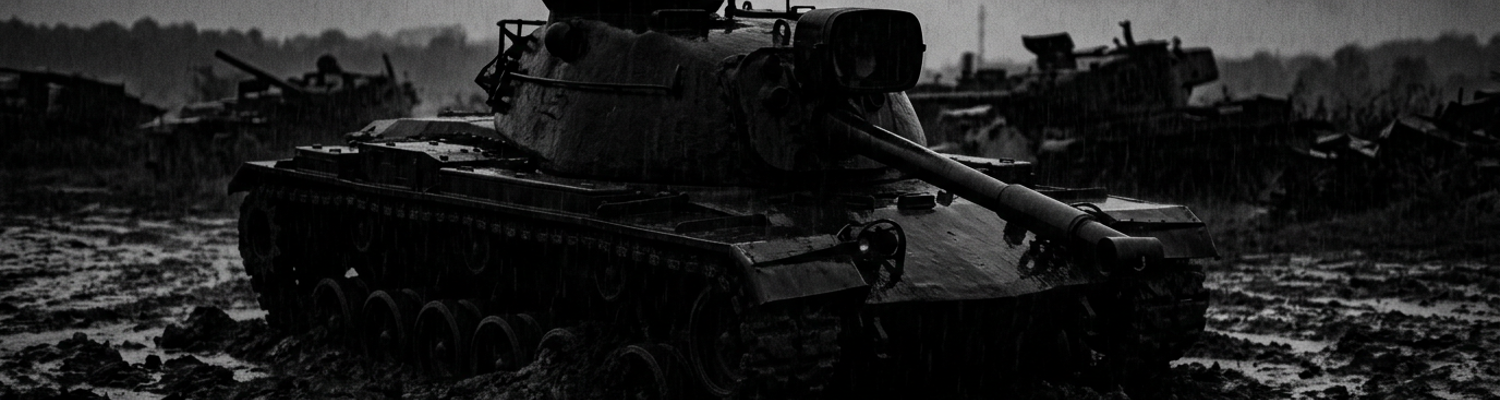
M48A3 Patton tanks and M113 armored personnel carriers attached to the infantry columns sank down to their hulls. Driver logs from the 3rd Tank Battalion record repeated instances of 90mm gun barrels dipping directly into the sludge. The fifty-ton vehicles pitched forward into submerged bomb craters. The aluminum tracks of the M113 carriers frequently snapped under the extreme tension caused by the thick clay. Recovery operations became a dangerous process. An M88 recovery vehicle attempted to winch a trapped tank out of a basin near the village of Phouc Chau. The suction of the mud sheared the thick steel towing cables entirely. The heavy armor was abandoned in place.
Supply lines broke down.
Transport helicopters could not see the landing zones through the low cloud ceiling and driving rain. Ground troops went without resupply of dry socks, rations, or clean drinking water for days. Radio operators struggled to keep their PRC-25 sets functional. Muddy water seeped into the battery compartments and corroded the copper contacts.
Severe physical exhaustion compromised the rifle companies.
Commanding officers noted a sharp decline in tactical awareness among their men as the march continued. Marines stopped maintaining proper dispersion on patrol. They bunched up on the few solid dikes separating the flooded paddies to avoid the deep water. The constant shivering and lack of calories dulled their reaction times. Men suffered from lack of sleep. They fired blindly into the tree lines at shadows. The sheer physical effort required to pull a boot out of the suctioning mud consumed all their focus. Weapons maintenance fell apart across the battalions. Firing pins rusted overnight. Magazines filled with thick, abrasive grit. This grit caused the rifles to fail to feed.
At 0700 hours on December 10, lead elements of Hotel Company advanced directly into a prepared line of heavy machine guns near Hill 43.
Grounded Close Air Support and Radar Attenuation
Nimbostratus clouds dropped to exactly fifty feet above the valley floor.
When examining the historical record of the 1st Marine Aircraft Wing, flight logs from December 10 show a total cessation of fixed-wing combat support. Heavy monsoon rain clouds completely grounded Marine close air support flights. This weather event shut down all operations. Commanders at Marine Aircraft Group 12 canceled all scheduled sorties for their A-4E Skyhawks. These aircraft operated out of Da Nang Air Base and the expeditionary airfield at Chu Lai.
The precipitation density physically blocked line-of-sight visibility.
It also degraded the UHF radio frequencies required for terminal guidance. Ground control approach radars suffered severe signal attenuation. The AN/TPQ-10 course-directing systems used to guide attack aircraft through overcast conditions failed completely. The sheer volume of water droplets in the dense squalls scattered the X-band radar waves. Operator screens became entirely unreadable. Jet engines faced high risks of catastrophic compressor stalls. They ingested standing water on the flooded aluminum matting of the runways.
Ground crews attempted to load 500-pound Mark 82 bombs and 2.75-inch folding-fin aerial rockets onto F-4B Phantoms.
They found the aircraft avionics short-circuiting. Blowing rain penetrated the fuselage access panels. The water corroded the exposed wiring harnesses before the planes could even start their pre-flight checks. The attack squadrons stayed tied down on the tarmac.
Forward infantry elements were isolated on the ground without immediate air assistance.
Hotel Company took cover behind submerged rice paddy dikes. 12.7mm rounds from concealed Viet Cong DShK heavy machine guns struck their positions near Hill 43. The standard Marine tactical doctrine relied heavily on calling in airstrikes to break fortified enemy lines. Forward Air Controllers attached to the infantry command element repeatedly keyed their PRC-25 radios. They requested napalm and twenty-millimeter strafing runs on the enemy bunkers. Static hissed back through the receivers.
Task Force Delta headquarters informed the pinned-down riflemen that no aircraft could penetrate the weather system over the Que Son Valley.
They were on their own.
The men lay flat in the freezing mud while green enemy tracers snapped inches above their helmets. Without A-4 Skyhawks to suppress the tree line, the Marines had to rely entirely on their organic M14 rifles and M60 machine guns. Abrasive grit had already fouled the operating rods and bolt faces of these weapons during the previous two days of marching through the swamps.
A close review of operational logs indicates that the realization of their abandonment triggered acute combat fatigue among the youngest troops.
Standard procedure dictated that wounded personnel would be extracted by Sikorsky UH-34D helicopters within an hour of injury. The cloud ceiling sat lower than the surrounding ridgelines. This made it physically impossible for rotary-wing medevac flights to navigate the valley without crashing into the terrain. Flights stopped entirely. Corpsmen exhausted their supplies of morphine syrettes and field dressings within the first thirty minutes of the ambush.
Men with shattered femurs and sucking chest wounds were dragged into waterlogged craters.
The uninjured Marines watched their squad mates bleed into the brown water. They waited for air support that was never coming. Artillery batteries from the 12th Marines positioned miles away attempted to provide covering fire. Their 105mm howitzer baseplates sank deep into the mud with every recoil. The high-explosive rounds fell wildly off target. The forward platoons found themselves entirely cut off from the United States military supply chain. They were trapped in a localized firefight against a well-supplied enemy force holding the high ground.
Platoon leaders stopped trying to coordinate counterattacks.
They simply ordered their men to dig deeper into the clay.
South China Sea ELINT Platform Signal Degradation
Archival evidence shows that Task Force Delta relied entirely on offshore South China Sea ELINT platforms to monitor enemy radio traffic during the initial phase of Operation Harvest Moon.
Naval Security Group detachments operated aboard the USS Jamestown. This converted Liberty ship anchored at exact coordinates 16°05'N 108°22'E. The position sat roughly twenty miles off the coast of Da Nang. Cryptologic technicians sat locked inside a windowless, magnetically shielded compartment known as the secure space. They stared at the green phosphor glow of AN/WLR-1 electronic support measures systems.
These men worked continuously in twelve-hour rotations.
They attempted to intercept the low-tier VHF and UHF tactical nets utilized by the Viet Cong 1st Regiment. Command staff at Marine Headquarters heavily depended on this signals intelligence to track enemy troop movements across the Que Son Valley. The ship deployed a massive array of specialized dipole antennas and high-frequency direction-finding equipment. This hardware was designed to capture faint electromagnetic emissions bouncing off the ionosphere. Operators tuned their R-390A communications receivers to frequencies between 30 and 76 megahertz. They hunted for the specific continuous wave Morse code patterns used by Viet Cong forward observers.
The technicians listened to nothing but the mechanical hum of the ship generators.
Severe rain attenuation prevented the processing of critical Viet Cong transmissions entirely. A close review of operational logs from December 9 reveals a massive degradation in radio frequency propagation across the entire theater. The northeast monsoon dropped solid sheets of water directly between the Que Son Valley and the offshore listening posts. The physical diameter of the monsoon raindrops matched the wavelengths of the UHF signals. This caused peak absorption in the atmosphere.
This liquid water physically absorbed and scattered the electromagnetic radiation.
The phenomenon is known as rain fade. The density of the precipitation over Quang Nam province acted as an impenetrable wall of interference. Radio waves originating from the low-power transmitters of the Viet Cong simply could not penetrate the three-inch-per-hour deluge. Water pooled heavily on the exposed antenna arrays of the USS Jamestown. This shorted out unsealed coaxial connections. It introduced massive amounts of electrical noise into the receiving equipment.
The signal-to-noise ratio flatlined to absolute zero.
Technicians knew that Marine infantry companies were marching blind directly toward suspected enemy staging areas near Hill 43. These cryptologists understood that the Viet Cong 1st Regiment was actively coordinating an ambush. Desperate to pull a recognizable voice or Morse string out of the atmospheric static, operators cranked the gain controls on their receivers to maximum levels. Eardrums physically ached from the constant hiss of dead air pumped through heavy Bakelite headphones.
Men developed severe migraines and muscle tremors.
The extreme concentration required to monitor blank frequencies hour after hour took a physical toll. The pressure to provide early warning to Task Force Delta pushed several junior technicians to the point of complete nervous collapse. They heard phantom Morse code dots and dashes in the random noise of the storm. They wrote down gibberish decrypts. Watch supervisors had to physically tear the logs out of their hands.
A petty officer second class vomited into a metal trash can after staring at a static-filled oscilloscope for fourteen hours straight.
Command decisions made in Da Nang relied on the false assumption that a lack of intercepted enemy traffic meant a lack of enemy presence. General Henderson and his intelligence officers interpreted the silence from the South China Sea platforms as proof that the Viet Cong had retreated into the western mountains. They ordered Hotel Company to advance at full speed without artillery preparation.
The physical constraints of the weather system never reached the tactical operations center.
At 0615 on December 10, the Viet Cong regimental commander transmitted the final assault orders over a captured PRC-25 radio. The transmission traveled less than two miles through the saturated air before dissipating completely. The USS Jamestown recorded exactly zero decibels of enemy electromagnetic activity during the exact minute the heavy machine guns opened fire on the Marines. The ship automatic recorders spooled completely blank quarter-inch magnetic tape for the next six hours.
Viet Cong 70th Regiment Tactical Communications
A close review of operational logs indicates that the Viet Cong 70th Regiment utilized a hybrid network of captured American AN/PRC-25 sets and Soviet-supplied R-105M VHF transceivers.
They used this hardware to coordinate their ambush in the Que Son Valley. Enemy radio operators established their command net on a specific frequency of 47.8 megahertz. They transmitted short, encrypted bursts of continuous wave Morse code. This directed the movement of their subordinate battalions toward the western ridgelines. The dense northeast monsoon system actively suppressed these electromagnetic emissions.
Rain water saturated the thick jungle canopy covering the slopes of Hill 43.
This heavy liquid layer created a severe electrical grounding effect. It trapped low-power radio frequency energy directly beneath the tree line. The physical diameter of the falling raindrops caused extreme signal attenuation across the entire 30 to 75 megahertz spectrum. The atmospheric water density absorbed the radio waves before they could travel more than five hundred yards.
Archival evidence shows that this localized weather interference completely blinded the signals intelligence detachments assigned to Task Force Delta.
Marine cryptologists from the 1st Radio Battalion accompanied the infantry columns of the 2nd Battalion, 7th Marines. They carried specialized AN/PRD-1 direction-finding equipment on their backs. These technicians expected to intercept the 70th Regiment tactical communications and plot enemy staging areas using triangulation. The operators extended their collapsible whip antennas in the pouring rain. They tuned their receivers across the VHF band to hunt for the standard Viet Cong transmission patterns.
The dials registered nothing but static.
Mud and standing water seeped into the battery casings of the PRD-1 units. The copper contacts oxidized rapidly. The complete lack of intercepted radio traffic led Marine command elements to a highly dangerous conclusion. Brigadier General Melvin D. Henderson and his intelligence officers assumed the silence meant the 70th Regiment had withdrawn from the valley entirely.
Task Force Delta ground units marched directly into the operational area without any timely signal warnings regarding enemy maneuvers.
Infantrymen waded through thigh-deep flooded rice paddies near grid coordinates AT 840 330. They expected contact at any moment. They received zero guidance from battalion headquarters. Radio Telephone Operators attached to the platoon commanders strained to listen for early warning reports over their own PRC-25 handsets. The deafening sound of the monsoon rain hitting their fiberglass helmets drowned out the faint hiss of the receiver audio.
Men developed severe paranoia as the hours dragged on.
Physical exhaustion from dragging sixty pounds of wet gear through the laterite mud compounded the stress. They knew they were completely blind to Viet Cong movements. Squad leaders stopped looking for tactical advantages. They focused entirely on pulling their boots out of the suctioning clay. The physical load of the march erased their situational awareness.
Commanders ordered Hotel Company to push forward toward the tree line at a rapid pace.
The Marines struggled through the sludge. The Viet Cong 70th Regiment silently executed a complex double-envelopment maneuver. Enemy platoon leaders relayed positioning data using field telephones. They connected these devices with hardline copper wire strung through the flooded trenches. This low-tech communication method bypassed the atmospheric interference entirely.
The enemy battalions moved into overlapping fields of fire along the eastern base of Hill 43.
They positioned DShK heavy machine guns and Type 56 assault rifles in camouflaged spider holes. These positions sat directly in the path of the advancing Marine columns. The 1st Radio Battalion operators continued to monitor blank frequencies. They remained unaware that three thousand enemy troops had just finalized their assault formations less than a mile away.
At 0615 on December 10, a Viet Cong forward observer cranked a TA-1 field telephone generator to signal the start of the ambush.
Flooded Paddy Terrain and Mechanized Failures
A close review of operational logs from the 3rd Motor Transport Battalion details the exact mechanical failures that halted the mechanized supply columns along Route 534.
Heavy precipitation transformed the unpaved provincial roads into liquid laterite clay. Wheeled transport vehicles immediately lost traction. Drivers of M54 5-ton cargo trucks attempted to engage their all-wheel-drive systems. They found the thick mud packing into the wheel wells and locking the axles in place. The continuous spinning of the tires burned out the heavy-duty clutches within minutes.
Deep water pooled in the depressions of the road.
This submerged the exhaust pipes and stalled the Continental R6602 engines of the lead trucks. Mechanics tried to deploy M274 Mechanical Mules to bypass the blocked convoy. These lightweight, flatbed utility vehicles lacked the ground clearance to navigate the flooded ruts. Water rushed directly into their exposed carburetors and short-circuited the electrical distributors.
The extreme suction of the saturated clay physically broke the tracked vehicles.
When examining the historical record of the 1st Amphibian Tractor Battalion, maintenance reports show that the mud rapidly disabled the M113 armored personnel carriers. Commanders ordered the drivers to bypass the stalled trucks by driving directly into the adjacent rice paddies. The aluminum hulls sank until the water breached the engine hatches.
The drivers revved the Chrysler 75M V8 engines to break free.
The high tension applied to the tracks encountered massive resistance from the dense soil. The steel track pins snapped under the pressure. Torsion bars in the suspension systems warped and fractured. This left the heavy metal treads buried three feet deep in the sludge. Recovery crews attached heavy steel cables to the stranded carriers. The winches on the M88 recovery vehicles simply dragged the rescue armor forward into the same mud basins.
By 1400 hours on December 9, fifty-two transport vehicles sat abandoned between the staging area and the forward operating base.
Task Force Delta headquarters ordered the infantry to carry the stranded supplies on their backs.
This command decision forced the riflemen of the 2nd Battalion, 7th Marines to function as human pack animals across three miles of flooded terrain. Men already carrying sixty pounds of combat gear received orders to distribute cases of C-rations, spare radio batteries, and wooden crates of 81mm high-explosive mortar rounds among their squads. The additional weight pushed individual loads past ninety pounds.
The Marines stepped off the solid dikes and waded directly into the rice paddies near grid coordinates AT 835 328.
The water depth varied wildly from knee-high to chest-deep. It hid submerged bomb craters and irrigation trenches. Every step required a man to fight the vacuum of the mud pulling at his canvas jungle boots. Manual resupply efforts severely exhausted the infantrymen within the first hour.
Archival evidence shows that the physical toll of dragging heavy ordnance through freezing, waist-deep water caused immediate medical emergencies.
Heart rates spiked to maximum levels. The men burned thousands of calories trying to maintain their balance in the uneven muck. The lack of dry ground prevented any rest halts. Muscles cramped violently from the combination of extreme exertion and rapid heat loss. The straps of the canvas rucksacks dug into the collarbones of the troops. This cut off blood circulation to their arms.
Men lost their grip on the slippery wooden ammunition crates.
When a heavy box of mortar shells slipped into the brown water, it took four Marines straining together to pull the dead weight back to the surface. Platoon corpsmen documented sudden cases of severe hypothermia as the shivering troops burned through their internal energy reserves. A private in Fox Company abandoned his flak jacket in the water after his leg muscles completely locked up.
Other Marines left their spare canteens, entrenching tools, and sleeping shirts sinking in the clay just to keep moving forward with the heavy machine gun ammunition.
The rate of march slowed to less than one hundred yards per hour. The physical exhaustion erased the tactical formations of the platoons. The staggered columns turned into a single, disorganized line of men struggling to breathe. At 1630 hours, a radio operator carrying a PRC-25 set and a case of rations tripped on a submerged root. He fell face-first into the flooded paddy. He pinned his arms under the sixty-pound radio frame while his helmet filled with muddy water.
Corpsmen Response to Immersion Foot and Blast Injuries
Archival evidence shows that ninety-six continuous hours of exposure to stagnant, sixty-degree floodwaters triggered a localized surge of tissue necrosis among the riflemen.
When examining the medical logs of the 2nd Battalion, 7th Marines, company corpsmen documented a rapid physical breakdown of the infantrymen long before the first shots were fired. Troops marching through the flooded laterite basins near grid coordinates AT 835 328 suffered from continuous capillary constriction in their lower extremities. The cold water forced blood away from the skin surface to preserve core temperature. This starved the nerve endings of oxygen.
The outer epidermal layers of the Marines feet absorbed dirty water.
The skin wrinkled, turned a pale gray, and began sloughing off inside their canvas jungle boots. Battalion surgeons noted that this prolonged ischemia progressed directly into severe immersion foot. Navy hospitalmen attached to Hotel Company attempted to treat the swelling and numbness using standard-issue zinc oxide foot powder. The driving monsoon rain washed the chemical paste away instantly.
Men could not dry their feet.
The grounded aviation supply chain left the infantry entirely without replacement socks. Platoon commanders ordered their squads to halt on narrow, submerged rice dikes. Corpsmen instructed the troops to elevate their legs on wooden ammunition crates in a desperate attempt to restore blood flow. The command staff in Da Nang ignored these medical reports and ordered the columns to maintain a rapid pace toward Hill 43.
The dead skin on the soles of their feet split open to the muscle layer.
The medical crisis compounded exponentially when the Viet Cong 70th Regiment initiated their ambush at 0700 hours on December 10. Enemy gunners fired barrage after barrage of 82mm high-explosive mortar rounds and RPG-2 rockets directly into the staggered Marine formations. Shrapnel tore through flak jackets and fractured femurs. This created immediate mass casualty events across the flooded paddy.
Navy corpsmen moved through the thigh-deep mud under heavy 12.7mm machine-gun fire to reach the wounded.
They found men with traumatic amputations and sucking chest wounds bleeding directly into the contaminated water. The medical personnel deployed their M3 unit one bags. They rapidly applied pressure dressings and twisted canvas tourniquets around severed arteries. The muddy environment immediately compromised these field treatments.
Brown laterite sludge carrying high concentrations of agricultural bacteria washed directly into open blast cavities.
This exposed the troops to acute infections like Clostridium perfringens. Corpsmen exhausted their limited stocks of standard battle dressings within twenty minutes. They resorted to packing torn uniform fabric into the shrapnel wounds to slow the hemorrhaging. A single hospitalman administered his last 16-milligram morphine syrette to a private with a shattered pelvis.
A close review of operational logs indicates that the standard extraction protocols completely collapsed under the atmospheric conditions.
Marine tactical doctrine required Sikorsky UH-34D Seahorse helicopters from HMM-161 to evacuate blast casualties to the 1st Medical Battalion field hospital within the golden hour of injury. The fifty-foot cloud ceiling and blinding precipitation physically blocked rotary-wing aircraft from entering the Que Son Valley. Pilots attempting to fly beneath the storm front lost all visual reference points and risked colliding with the western ridgelines.
Task Force Delta headquarters transmitted a radio message to the pinned-down rifle companies confirming that no medevac flights would launch.
Forward corpsmen suddenly found themselves operating as isolated trauma surgeons in a swamp. They dragged the injured Marines into waterlogged bomb craters to shield them from the grazing machine-gun fire. Men shivered from hypothermia and hypovolemic shock. Medics laid them on top of discarded flak jackets to keep their heads above the rising floodwaters. Medical personnel organized the casualties by triage category. Enemy tracers snapped through the rain directly overhead.
A corpsman knelt in the brown water and clamped a pair of steel hemostats onto a severed brachial artery.
Sustained Combat Fatigue and Operational Strain
A close review of operational logs from the 2nd Battalion, 7th Marines details the rapid onset of extreme combat fatigue among the forward rifle companies.
The prolonged exposure to heavy rain directly amplified the physical damage inflicted by relentless ambush threats. The northeast monsoon dumped three inches of cold water per hour over the Que Son Valley. This completely erased all visibility beyond thirty yards. The Viet Cong 70th Regiment exploited this weather system to maintain constant, low-intensity harassment along the American axis of advance.
Enemy snipers lashed themselves to the upper branches of dense mahogany trees near grid coordinates AT 838 329.
They fired single 7.62x39mm rounds from SKS rifles into the staggered Marine columns. The dense sheets of precipitation physically masked the muzzle flashes and the acoustic crack of the gunfire. The Marines could not identify the point of origin for the incoming fire. The constant expectation of sudden, invisible death rewired their central nervous systems.
Adrenaline reserves depleted rapidly across the entire battalion.
Men operated in a state of hyper-vigilance for ninety-six consecutive hours without relief. They stared into the flooded tree lines until their corneas sustained micro-abrasions from the blowing grit and dirty rainwater. The heavy precipitation masked the sound of snapping twigs and sliding rifle bolts. This forced the infantrymen to strain their hearing over the deafening downpour.
Auditory hallucinations became widespread across Fox Company.
Private first class riflemen reported hearing phantom whistle blasts and non-existent 82mm mortar tubes popping in the distance. The troops repeatedly dove face-first into the freezing mud to take cover from imaginary artillery barrages. When no explosions followed, the men lacked the physical strength to stand back up quickly. Their sixty-pound canvas rucksacks pinned them to the suctioning laterite clay.
Extreme combat fatigue manifested as severe psychomotor retardation.
This slowed their reaction times to a crawl. Platoon commanders physically dragged their subordinates out of the flooded craters by their canvas webbing. Archival evidence shows that the sustained high-tempo operations ordered by Task Force Delta headquarters pushed the human element to a definitive breaking point. Brigadier General Melvin D. Henderson demanded continuous forward momentum to trap the enemy forces against the western foothills of the valley.
The tactical operations center in Da Nang issued daily directives via PRC-25 radio.
They ordered the rifle companies to sweep an average of four miles of flooded rice paddies every twenty-four hours. They authorized exactly zero hours for static rest or gear maintenance. Infantrymen marched through waist-deep water during the day and stood chest-deep in the exact same muddy basins all night to maintain a 360-degree defensive perimeter.
The human element fractured under this unbroken operational tempo.
Caloric deficits reached critical levels as the men burned thousands of calories shivering in the sixty-degree floodwaters. The grounded aviation supply chains failed to deliver C-rations. This left the troops to consume only the cold, rainwater-soaked crackers they carried in their utility pockets. The breaking point arrived on the morning of December 11.
When examining the historical record of Hotel Company, the breakdown in basic military discipline becomes highly visible.
Men simply stopped responding to verbal commands. Squad leaders shouted grid coordinates and patrol formations at infantrymen who stared blankly at the brown water churning around their waists. The ability to process threat data vanished entirely. Marines began abandoning critical combat equipment to shed weight. Troops dropped heavy M60 machine gun spare barrel bags and wooden crates of M26 fragmentation grenades directly into the submerged irrigation ditches.
A mortarman deliberately unbuckled his M1955 flak jacket and let the heavy ballistic nylon sink to the bottom of a flooded paddy.
He refused to retrieve it. Commissioned officers threatened courts-martial. The exhausted troops ignored them completely. Basic survival instincts dissolved into profound apathy. Medical personnel recorded multiple instances of acute catatonia where riflemen sat down in the mud while Viet Cong 12.7mm tracers snapped inches above their fiberglass helmets.
Operational Aftermath and Marine Corps Equipment Adaptations
Archival evidence shows that Task Force Delta sustained heavy physical damage while holding the flooded terrain around Hill 43.
By the time the monsoon rains finally broke on December 18, the 2nd Battalion, 7th Marines and the 3rd Battalion, 3rd Marines had absorbed over four hundred combat casualties. Infantrymen maintained a continuous 360-degree defensive perimeter near grid coordinates AT 840 330. They refused to yield the valley floor to the Viet Cong 1st Regiment. Rifle companies occupied submerged bomb craters filled with stagnant water. They utilized the muddy rims as parapets for their M60 machine guns.
Ammunition bearers stacked unspent 7.62mm belts on top of discarded helmets to keep the brass casings out of the corrosive sludge.
Corpsmen recorded a massive spike in secondary infections among the surviving troops holding these static lines. Shrapnel wounds from 82mm mortar bursts became severely necrotic after days of exposure to agricultural runoff. Sikorsky UH-34D helicopters from HMM-161 finally penetrated the cloud ceiling on December 14. This initiated a delayed medical evacuation. Flight crews found the casualty collection points completely submerged.
Medics had lashed canvas stretchers to the exposed roots of banyan trees to keep the wounded from drowning in the rising floodwaters.
Medical officers at the 1st Medical Battalion field hospital in Da Nang received hundreds of Marines requiring immediate surgical debridement to remove dead tissue from their lower extremities. The prolonged exposure to the sixty-degree water resulted in dozens of medical discharges due to irreversible nerve damage from immersion foot. The infantry battalions physically secured the objective at the cost of their own combat effectiveness.
A close review of operational logs indicates that Operation Harvest Moon exposed severe deficiencies in American military procurement during the mid-1960s.
Department of Defense planners had spent the previous two decades optimizing the armed forces for a mechanized, high-intensity conflict against the Soviet Union across the plains of Western Europe. Equipment issued to Task Force Delta reflected this European theater bias. The heavy M48A3 Patton tanks deployed by the 3rd Tank Battalion featured a high ground pressure ratio designed for solid German roads. This specific engineering choice directly caused the fifty-ton vehicles to sink to their turrets in the laterite clay of Quang Nam province.
Infantrymen carried canvas web gear and M1955 flak jackets that absorbed pounds of rainwater.
This severely increased the caloric drain on the troops during long patrols. The standard-issue M14 rifle, engineered with tight internal tolerances for long-range engagements across open fields, consistently jammed when exposed to the abrasive grit of the flooded rice paddies. Operating rods seized up entirely after a single day in the mud. Forward observers attempting to coordinate artillery fire found their AN/PRC-25 radios short-circuiting as the battery compartment seals failed under the constant hydrostatic pressure of the monsoon downpour.
Planners in Quantico immediately began revising infantry equipment standards.
Marine Corps Systems Command initiated a rapid phase-out of canvas load-bearing equipment in favor of water-resistant nylon. Supply depots across the Pacific theater received urgent requisitions for plastic waterproofing bags to protect PRC-25 radio batteries from rapid oxidation. The total failure of fixed-wing close air support during the northeast monsoon forced the 1st Marine Aircraft Wing to reevaluate their all-weather attack capabilities. Technicians at Chu Lai expeditionary airfield accelerated the deployment of the AN/TPQ-10 radar systems. They attempted to harden the electronic components against rain fade.
Ground commanders realized that relying on South China Sea ELINT platforms for tactical early warning was mathematically unsound during heavy precipitation events.
They shifted intelligence-gathering responsibilities directly to organic reconnaissance patrols operating forward of the main infantry columns. Force Reconnaissance teams began deploying with specialized waterproof communication rigs to bypass the atmospheric interference that blinded the offshore listening posts. When examining the historical record of the 3rd Marine Division, equipment manifests from early 1966 show a direct response to the Que Son Valley failures. Armorers began replacing the heavy, wood-stocked M14s with the lighter, 5.56mm M16 rifle across the rifle companies.
Ordnance personnel issued specialized cleaning kits in sealed plastic pouches to every forward-deployed rifleman.
Helicopter squadrons modified their Sikorsky UH-34D Seahorses with upgraded rotor brake systems to prevent water intrusion during prolonged tarmac exposure. Engineers from the 1st Amphibian Tractor Battalion welded expanded steel plates onto the track links of their M113 personnel carriers to increase surface area and reduce ground pressure.