
Pre-War Doctrine and Flawed Assumptions
The United States Navy’s logistical doctrine of the interwar period was built on a core set of flawed assumptions. A review of training manuals and operational logs from the 1920s and 1930s reveals a clear strategic vision. Future naval conflicts were expected to be short, decisive fleet engagements. After a battle, ships would retire to secure, friendly ports for all repair and replenishment needs. The entire concept of the “Fleet Train,” the collection of auxiliary vessels supporting the battle line, was predicated on its operation in safe rear areas, far from any enemy threat.
Replenishment-at-sea was viewed as an occasional requirement, not the constant, grinding necessity it would become. The methods developed, including early broadside and astern fueling techniques, were mechanically designed for placid conditions. Manuals detailed the process of ships steaming in parallel, separated by a comfortable 40 to 80 feet. Crews manhandled heavy fuel hoses and used rudimentary winches to transfer cargo pallets. Every element of this doctrine presupposed daylight, reasonable sea states, and a non-hostile environment.
Combat operations in the Pacific Ocean rendered these assumptions dangerously inadequate.
The theoretical world of the training manual dissolved. Manuals depicting orderly transfers could not account for the violent, unpredictable swells of the open Pacific, which could snap tensioned lines or crush a smaller vessel against the hull of an oiler. The doctrine assumed a level of mechanical reliability impossible to maintain under combat duress. Salt spray and humidity corroded winch motors. The constant stress of operations wore out manila lines and heavy hoses at an accelerated rate.
Logistical planning for Operation Olympic, the invasion of Kyushu, presented a planner’s nightmare. It required a scale of sustained support that dwarfed all previous efforts. There were not enough specialized service troops or equipment to manage the immense flow of material needed for the invasion force. The fighting on Okinawa provided a grim preview. There, kamikaze attacks forced replenishment groups further out to sea, complicating and delaying the transfer of fuel and ammunition. The rigid, step-by-step procedures for alongside connected replenishment, known as CONREP, were difficult to execute even in moderate seas. Under the constant threat of attack, they became nearly impossible.
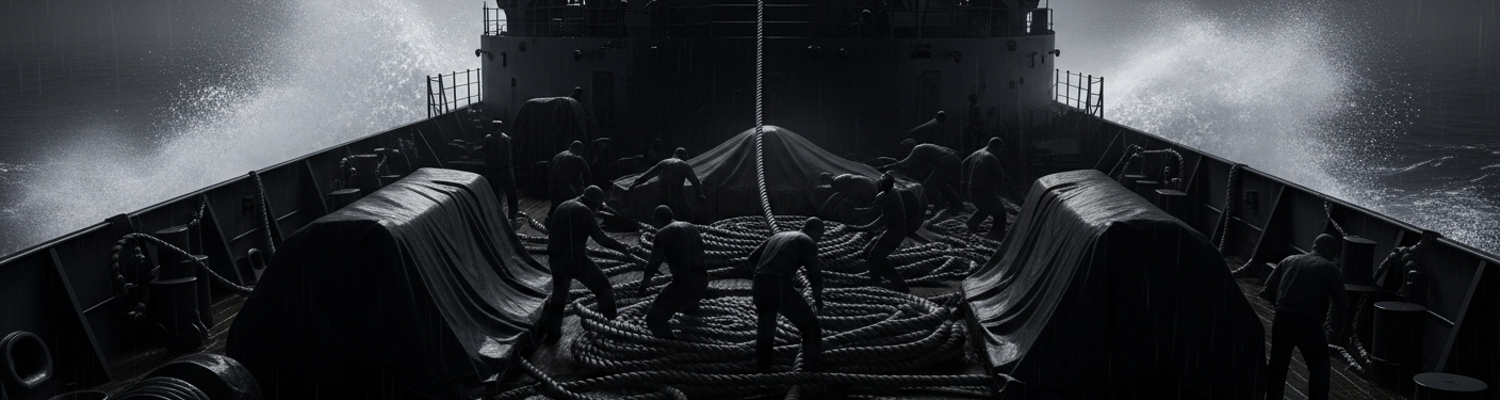
The most significant doctrinal disconnect was an institutional aversion to night operations. Pre-war thinking categorized night replenishment as an emergency procedure to be avoided at all costs. The risk of collision between two massive, blacked-out ships steaming in close formation was considered unacceptably high. The process was mechanically dependent on visibility. Riggers needed to see to connect highlines. Winch operators needed to observe the load’s status. Using floodlights was forbidden, as it would create a perfect, illuminated target for enemy submarines and aircraft. This left crews to work in near-total darkness, fumbling with heavy, grease-slicked equipment on pitching decks. The strategy for the final assault on Kyushu depended on carrier task forces remaining on station for weeks, striking targets continuously. This was only possible through constant underway replenishment. The tactical situation off the coast of Japan would dictate that much of this had to happen under the cover of darkness, a capability for which the Navy was doctrinally, mechanically, and psychologically unprepared.
Operational Conditions Off Kyushu
Archival evidence (NARA Record Group 38) shows that replenishment operations off Kyushu would have been defined by improvised, dangerous night transfers. The entire procedure was a frantic effort against physics and darkness. On decks slick with salt spray and leaking fuel, crews wrestled with heavy, six-inch fueling hoses and ammunition pallets weighing thousands of pounds. A Cimarron-class fleet oiler and an Essex-class carrier, both blacked out and running parallel, would attempt to hold a constant distance while pitching in the Pacific swell.
Floodlights were forbidden. This forced sailors to work by feel. A parted line could send a multi-ton pallet of bombs crashing onto the deck. A snapped fuel hose could whip across the transfer station with lethal force. The risk of collision was constant. Deck logs from the period are filled with entries detailing near-misses and damage sustained when ships were slammed together by unexpected waves.
These operations were a physically demanding necessity.
The sea itself was an impartial adversary. The planned invasion date for Operation Olympic, November 1, 1945, was set to avoid the peak of the Pacific typhoon season. Planners knew late-season storms remained a significant threat. The memory of Typhoon Cobra in December 1944, which sank three destroyers and killed 790 sailors, was fresh. That storm generated winds over 100 knots and waves that rolled smaller vessels under. A review of meteorological records from 1945 provides a grim forecast. Typhoon Louise, which struck the fleet anchorage at Okinawa in October 1945, battered ships with 80-knot winds and 35-foot waves. It sank 12 ships, grounded 222 others, and severely damaged 32 more. A similar storm hitting the invasion fleet off Kyushu would have forced the task force to scatter, burning fuel reserves just to ride out the weather and throwing the entire invasion timetable into chaos.
Every logistical calculation was distorted by the constant threat of attack. The waters off Kyushu were home to the remnants of the Imperial Japanese Navy, with an estimated 38 operational submarines tasked with intercepting the invasion force. Their primary targets were not heavily armed battleships, but vulnerable troop transports and the thin-skinned auxiliary ships. To counter this, replenishment areas were pushed further out to sea, increasing transit times and fuel consumption. The approach to Kyushu was also expected to be contested by hundreds of Shinyo suicide boats and Kaiten human-piloted torpedoes. The Kaiten, a modified Type 93 torpedo with a 3,420-pound warhead and a pilot locked inside, was a terrifying weapon, even if its operational success was limited.
The most significant threat came from the air. Japanese planning for the defense of Kyushu, Operation Ketsugo, called for an all-out aerial assault, sacrificing thousands of aircraft in kamikaze attacks targeting the amphibious forces. Based on the experience at Okinawa, where massed kikusui attacks inflicted devastating casualties, U.S. planners expected an even greater onslaught. The outer defense was a ring of radar picket stations, typically destroyers tasked with providing early warning. These picket ships were dangerously exposed and became priority targets. During the Okinawa campaign, 10 destroyers on picket duty were sunk and 32 were damaged by suicide attacks. A single kamikaze strike on a fleet oiler, like the one that sank the USS Mississinewa at Ulithi, could have a disproportionate impact, depriving an entire task group of fuel at a critical moment. The constant state of alert, with general quarters sounded multiple times a day, led to profound crew fatigue and a breakdown in combat readiness.
Catastrophic Failure During Night Replenishment
A review of operational logs from the Okinawa campaign details an incident that typifies the precarious nature of night logistics. On the moonless night of May 12, 1945, in a designated replenishment area approximately 150 nautical miles east of Kyushu, a Cimarron-class fleet oiler was refueling an Essex-class carrier from Task Group 58.3. The ships, blacked-out and steaming at twelve knots through a moderate swell, were connected by massive six-inch fuel hoses. Deep within the oiler’s hull, in the aft pump room, three Ingersoll-Rand centrifugal main cargo pumps (Model 4-GT) were generating the pressure needed to move thousands of gallons of Navy Special Fuel Oil per hour.
A high-frequency scream of tortured metal cut through the low thrum of the machinery. The drive shaft on pump number two, subjected to weeks of unrelenting operational stress, sheared. The failure sent vibrations through the deck plates and caused an immediate, dangerous drop in pressure across all connected fuel lines.
The loss of a single pump was a mechanical disaster with immediate tactical consequences. On the spray-slicked decks above, the sudden slackening of the heavy, fuel-gorged hose caused it to whip violently, threatening the rigging crew. Below, the engineering watch scrambled in the red-lit gloom. The failed pump, a multi-ton assembly of turbines and impellers, was now useless. A damage control party had to quickly isolate it from the main transfer manifold to prevent backflow and regain pressure with the two remaining pumps. This was not a simple task. It involved manually turning large, often frozen, valve wheels in a cramped, hot, and deafeningly loud compartment.
Every minute spent troubleshooting the crippled system was a minute the carrier, its screening destroyers, and the oiler itself remained locked in a predictable, vulnerable formation. A perfect target for any prowling Japanese submarine. The reduced flow rate from the two operational pumps extended the entire replenishment evolution by several hours.
This single mechanical breakdown had a cascading effect on the strategic timetable for Task Group 58.3. The carrier group was scheduled to detach at dawn to launch a full day of fighter sweeps and bomber strikes against air facilities on Kyushu. The delay meant the task group could not clear the replenishment area on time, forcing a difficult command decision. The admiral could postpone the initial strikes, giving Japanese forces more time to prepare, or launch later in the day with a compressed schedule, reducing the effectiveness of the sorties and forcing aircraft to recover in the difficult twilight hours. The incident also burned through the reserve fuel of the escorting destroyers, whose primary role was anti-submarine warfare. The failure of one pump, on one oiler, on one night, demonstrated the thin margin between operational success and failure.
Command Dilemmas and Crew Exhaustion
After-action reports from the Okinawa campaign reveal the impossible calculus forced upon commanders of the U.S. Fifth Fleet. For an admiral like Raymond Spruance, every decision regarding fleet readiness was a choice between bad and worse. The tempo of kamikaze attacks forced a dilemma: pull a carrier task group, such as Task Force 58, off the line to replenish in safer waters far to the east, or risk refueling closer to the fight. The first option opened a window in the combat air patrol screen protecting the hundreds of vulnerable amphibious ships. The second option, while maintaining continuous air cover, chained the fleet’s most valuable assets together in a predictable, slow-moving formation.
Operational logs from March and April 1945 show a grueling cycle where task groups were expected to strike targets for three days and then replenish on the fourth. A single delay, caused by weather or mechanical failure, could ripple through the entire schedule. This forced Spruance and his subordinate, Marc Mitscher, to either cancel strikes against Kyushu airfields or push their ships and crews past the breaking point. The decision to swap the entire command structure of the Fifth Fleet with Halsey’s Third Fleet in May 1945 was an unprecedented acknowledgment by CINCPAC Fleet Admiral Chester Nimitz that the command staff itself had become a depleted asset, worn down by three months of continuous, high-stakes combat decisions.
Continuous operations inflicted a severe and cumulative toll on the men of the fleet. Crew exhaustion went far beyond simple tiredness. It manifested as a measurable decay in combat effectiveness. Sailors on picket destroyers were often at General Quarters for hours on end, day and night. The psychological strain of enduring repeated suicide attacks was immense, leading to what was then termed “combat fatigue.” Historical accounts from enlisted men describe a state of heightened anxiety where any plane, friendly or enemy, triggered alarm.
This exhaustion was not limited to the picket line.
On the carriers, the cycle was just as punishing. Flight deck crews and armorers worked grueling hours to launch and recover strikes, only to be called away for an all-hands evolution to bring aboard thousands of pounds of bombs and aviation fuel during night replenishments. A close examination of deck logs and accident reports from this period indicates a spike in workplace injuries, ordnance handling errors, and ship-handling mistakes during these periods of intense pressure. The constant state of alert degraded the complex teamwork required to operate a warship, slowing damage control responses and increasing the risk of secondary explosions from mishandled ammunition. For the command staff, fatigue dulled analytical ability, creating an environment where a decision could be compromised by sheer mental and physical depletion.
Improvising At-Sea Casualty Evacuation
The system for moving wounded personnel between warships at sea was an ad-hoc affair born of necessity. No formal pre-war doctrine existed to guide it. A review of after-action reports from the Pacific campaigns details a hazardous process. The primary vehicle for this was the Stokes litter, a rigid wire-basket stretcher that could immobilize a patient. When a smaller vessel like a destroyer escort, which possessed only a small sick bay and a single medical officer, sustained heavy casualties, it had to transfer its most grievously wounded men to a larger ship with surgical facilities. This was accomplished via highline.
Sailors would rig a line between the two ships, which were steaming in close, dangerous formation. They would then haul the litter across the churning water below. The transfer was slow and perilous. An unexpected wave or a miscommunication in ship handling could cause the lines to slacken or snap, threatening to plunge the patient into the sea. The process was physically demanding on the rigging crews and psychologically taxing for the wounded man, strapped into the basket and pulled over the waves, often in full view of the damage on his own ship.
Providing medical care, let alone maintaining sterile conditions, on the deck of a warship in 1945 presented profound challenges. A ship’s deck was an inherently contaminated environment, coated in a film of salt spray, funnel soot, and lubricants. On a picket destroyer that had just survived a kamikaze attack, the deck could also be slick with firefighting foam, fuel, and hydraulic fluid. Establishing a clean field for even basic wound treatment in such conditions was nearly impossible. While larger vessels like Landing Ship, Tanks (Hospital), or LST(H)s, had dedicated operating rooms, a mass casualty event could quickly overwhelm these facilities, forcing medical personnel to convert mess halls into makeshift surgical wards. The constant, unpredictable motion of the ship presented another obstacle. Surgeons and corpsmen had to brace themselves against bulkheads to remain steady, timing their movements with the roll of the vessel.
Night operations amplified every existing problem. The requirement for absolute blackout conditions meant medical teams often worked by the dim, red glow of battle lanterns. This minimal lighting made delicate procedures exceedingly difficult. Equipment function became a persistent issue. A ship’s electrical grid, already strained by the demands of damage control, was notoriously unreliable. Power surges or outages could disable anesthesia machines or portable X-ray units without warning. The transfer of casualties was also far more dangerous in the dark. Rigging a highline between two blacked-out ships was a task of extreme difficulty, relying entirely on feel and shouted commands.
The kamikaze attack on the hospital ship USS Comfort off Okinawa on April 28, 1945, which plunged through multiple decks into a surgical ward, forced a tactical change. Afterward, even clearly marked hospital ships often extinguished their lights at night. They traded the theoretical protection of the Geneva Convention for the practical concealment of darkness. This decision eliminated them as navigational aids and plunged their own medical operations into the same hazardous gloom as the combat vessels they supported.