
Operation Pocket Money Execution
President Richard Nixon announced the decision to the American public on May 8, 1972. Haiphong Harbor would be mined. The port was the entry point for nearly 85 percent of all war material flowing into North Vietnam.
The order, codenamed Operation Pocket Money, went to Task Force 77.
Execution fell to aircraft from the carrier USS Coral Sea (CV-43). The mission was timed to the minute, launching as Nixon delivered his televised address. It was a blunt signal of American intent, a direct response to the ongoing Easter Offensive.
A close review of operational logs shows the mission’s spearhead was a specialized, multi-squadron force. The aircraft began launching from the Coral Sea at approximately 08:40 local time on May 9, 1972. The core of the mining element consisted of three A-6A Intruders from the 1st Marine Aircraft Wing’s Marine All-Weather Attack Squadron 224 (VMA(AW)-224). This was a notable deployment. It marked the first instance of a Marine squadron conducting combat operations from a carrier during the Vietnam War. These aircraft, known for their all-weather, low-level strike capabilities, were handed the most sensitive part of the mission: seeding the inner harbor channel. The lead Intruder’s bombardier-navigator, Marine Captain Charlie Carr, was responsible for establishing the precise attack azimuth and timing the release. The Intruders were supported by six U.S. Navy A-7E Corsair IIs from Attack Squadrons VA-22 and VA-94, which were assigned to mine the outer channel. An EKA-3B Skywarrior provided electronic countermeasures, jamming enemy radar to shield the strike package. The entire launch sequence of ten aircraft was completed with urgency. The mission was held under tight secrecy until the final moments before takeoff.
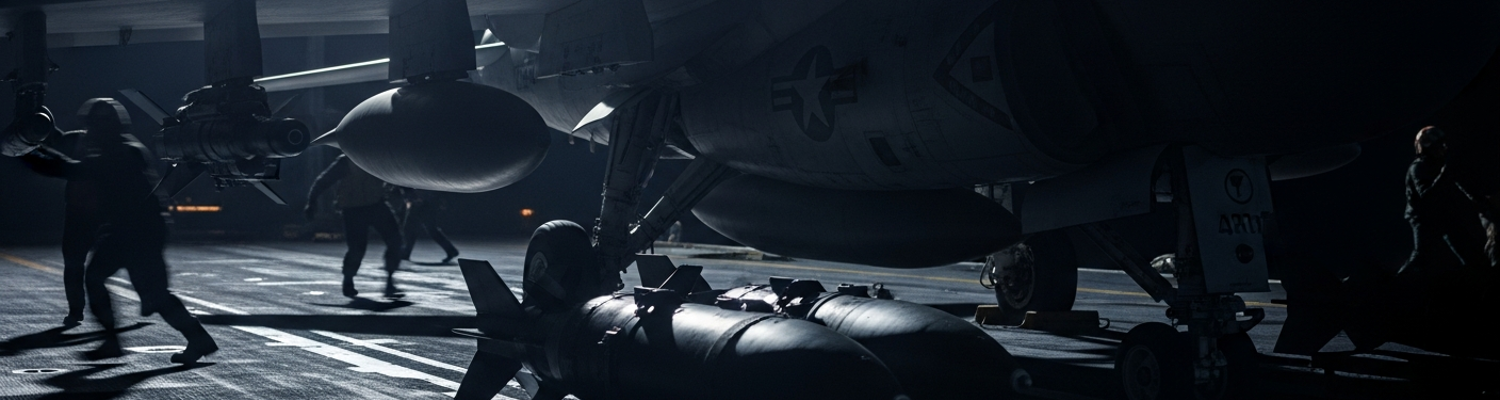
The ordnance was as important as the aircraft delivering it. The mission depended on new weapons technology to guarantee the harbor’s closure. The A-6A Intruders carried 1,000-pound Mk 52 magnetic mines for the deep-water inner channel. These were parachute-retarded bottom mines, designed to be triggered by the magnetic signature of a passing ship. A supply shortfall on the Coral Sea meant only six aerodynamic nose caps were available for the twelve mines carried by the Intruders. Each aircraft was forced to fly with two uncapped mines, creating a significant drag penalty. The A-7E Corsairs dropped Mk 36 Destructor mines in the shallower, outer approaches. The Mk 36 was an ingenious and cost-effective weapon. It was a standard 500-pound Mk 82 general-purpose bomb modified with a modular kit containing an arming device and a magnetic-influence firing mechanism. This conversion of conventional bombs into shallow-water mines permitted widespread use by any aircraft capable of carrying the original bomb body. Some records also refer to the use of modified AN-M66 2,000-pound bombs in the broader mining campaign, though the initial Haiphong strike concentrated on the Mk 52 and Mk 36.
The aerial minelaying run was a display of tactical precision under extreme pressure. At 08:59 local time, the Coral Sea bombers began their low-altitude approach over Haiphong’s inner channels. To divert North Vietnamese attention, seventeen aircraft from the USS Kitty Hawk had launched diversionary strikes against railroad sidings. Poor weather forced them to attack secondary targets. At the same time, a force of U.S. destroyers began a 30-minute bombardment of air defense batteries on the Do Son Peninsula. The guided-missile cruiser USS Chicago engaged and destroyed a MiG that was awaiting vectors to intercept the bombers. Flying at altitudes under 200 feet to ensure the mines settled correctly on the seabed in the 30 to 50-foot deep channels, the strike force delivered its payload in a breathtakingly short window. Commander Roger Sheets, leading the flight, radioed the first “mines away” signal at 08:59. By 09:01, all 36 mines were in the water. Twelve from the Intruders in the inner channel and 24 from the Corsairs in the outer channel. The message was relayed from the Coral Sea to the White House, arriving as President Nixon was still delivering his speech. All mines were set with a 72-hour arming delay, a deliberate measure to allow the 37 neutral vessels then in the harbor time to depart. The port of Haiphong was effectively sealed for 327 days.
Mk 36 Mine Malfunction Analysis
Post-mission analysis of Operation Pocket Money uncovered serious and unexpected technical failures with the Mk 36 Destructor mine. While the overall objective of sealing Haiphong harbor was met, a troubling percentage of the air-dropped ordnance malfunctioned. A close review of operational logs and subsequent naval reports (NARA Record Group 38) highlights a spectrum of failures. These ranged from mines that were complete duds, failing to arm and remaining inert on the seabed, to others that detonated prematurely. In one widely documented incident on August 4, 1972, a massive solar storm triggered the sympathetic, premature detonation of dozens of magnetic mines. This event, caused by a coronal mass ejection that disturbed the Earth’s magnetic field, exposed a vulnerability in the mine’s magnetic influence-firing mechanism. Beyond such extraordinary space-weather events, a consistent pattern of more mundane failures emerged. Analysis pointed to a combination of factors that compromised the weapon system. What was intended as a reliable, cost-effective area-denial weapon became a source of operational uncertainty. The destroyer USS Warrington (DD-843) experienced this firsthand in July 1972 when it struck two jettisoned, but still armed, Mk 36 Destructors. The damage was so severe that the destroyer was later decommissioned.
The failures were not random.
After-action technical assessments pointed to a single cause. A resonant frequency interaction. The problem originated with the non-standardized ordnance loading hoists on the carriers of Task Force 77. These powerful hydraulic and electric lifts generated distinct vibrational frequencies. The investigation revealed that the specific operational frequencies of certain hoists, particularly older or field-modified units, happened to align almost perfectly with the natural resonant frequencies of sensitive electronic components within the Mk 36’s fuzing mechanism. This phenomenon, known as Hazards of Electromagnetic Radiation to Ordnance (HERO), involves the potential for electromagnetic fields to inadvertently affect ordnance. During the minutes-long process of being lifted and maneuvered, the mines were subjected to a sustained, high-amplitude vibration. This harmonic resonance was capable of inducing micro-fractures in solder joints and jarring delicate relays. It caused a sympathetic vibration in the tuning-fork-like components of the arming clock. The effects were binary. Some units sustained enough damage to break the arming circuit, turning the mine into an inert dud. In other cases, the vibrations physically advanced the timer mechanism. This action shortened the pre-set 72-hour arming delay and caused premature detonations, a direct threat to the delivery aircraft.
The mechanical stresses of ordnance handling were made worse by pervasive humidity. The operational theater in the Gulf of Tonkin presented one of the most challenging maritime environments on Earth, with near-constant high temperatures and moisture. Archival evidence shows that the Mk 36 Destructor, a standard Mk 82 bomb case fitted with a modular fuze kit, suffered from inadequate sealing of the fuze cavities against moisture ingress. Over time, especially during storage in the non-air-conditioned magazines of the carriers, humid air would penetrate the assemblies. This moisture condensed on the interior surfaces of the fuze mechanism as temperatures fluctuated. The presence of water vapor and condensation within these tight spaces had a disastrous effect on the mine’s reliability. It led to accelerated corrosion on contact points and battery terminals, creating intermittent electrical connections or complete circuit failures. The moisture also altered the dielectric properties of the circuit boards, causing electrical tracking or short circuits that could either disable the mine or bypass the arming timer. High humidity is known to affect the sensitivity and stability of explosive compounds and their electronic triggers. This environmental sabotage from within meant that a percentage of the mines loaded onto the A-6 and A-7 strike aircraft were likely already compromised before they ever left the flight deck.
Global Broadcast of Mining Failure
The American narrative of a perfectly sealed harbor was short-lived. The story unraveled within days, not in the White House, but in the muddy tidal flats and coastal villages of North Vietnam. The immediate detection of the minefield’s extensive flaws was not the result of high-technology intelligence. It was the product of simple, direct observation by the very population the blockade was meant to isolate. North Vietnamese coastal defense units, fishermen in sampans, and local farmers became the first analysts of the American failure. They saw mines detonating prematurely, hours or days before their intended 72-hour arming sequence was complete. They found others washed ashore, inert and useless, their parachutes tangled in the mangroves. Archival evidence points to a rapid, low-tech, and highly effective survey of the minefield by North Vietnamese assets. Small, non-metallic boats could traverse the channels with relative impunity, visually identifying the location of duds and mapping the gaps in the expensive American barrier. This direct, ground-truth intelligence demonstrated that the Mk 36 Destructors and Mk 52 magnetic influence mines were not performing as designed. This information was gathered, collated, and passed up the command chain with speed.
Hanoi’s propaganda apparatus did not miss the opportunity.
This tactical blunder was almost immediately broadcast to the world. The Voice of Vietnam and the Vietnam News Agency began a coordinated information campaign. They transformed a U.S. combat engineering problem into a potent symbol of American fallibility. Instead of simply denying the blockade’s effectiveness, North Vietnamese media took a more sophisticated approach. They presented the malfunctioning mines as proof that the technological superiority of the United States was a hollow threat. Reports detailed the premature detonations, like the sympathetic explosions triggered by a solar storm on August 4, 1972, as evidence of unstable and poorly designed weaponry. More powerfully, they circulated information about the recovery of inert mines. By showcasing the dud ordnance, Hanoi crafted a narrative of desperation and incompetence. It suggested that President Nixon’s escalation was not only aggressive but also reliant on failing technology. This message was tailored for multiple audiences. It boosted morale domestically, sowed doubt among international observers about the blockade’s viability, and served as a direct psychological counter to the American show of force. The global broadcast framed the mining not as a successful military maneuver, but as a costly technical embarrassment.
The glaring issues with the minefield forced an internal reckoning within the U.S. military. It was designated as a direct combat engineering and infrastructure failure. The problem was not the aircrews or the delivery, but the weapon system itself. Post-mission analysis confirmed what North Vietnamese intelligence had already discovered: a high percentage of the ordnance was defective. The Mk 36 Destructor, a weapon born of a desire for a cheap and rapidly deployable mine converted from a standard Mk 82 bomb, was the primary source of the problem. Its development and testing cycle had been rushed. It failed to account for the extreme humidity of the Tonkin Gulf or the specific vibrational frequencies generated by carrier ordnance lifts. This was a systemic issue. The failure to properly seal the fuze kits against moisture and the unforeseen harmonic resonance from shipboard equipment pointed to a breakdown in the procurement and pre-deployment process. It revealed a disconnect between the engineers designing the weapons and the operational environment where they would be used. The result was a weapon system compromised before it ever reached its target, turning a key element of a major operation into a case study of infrastructural weakness.
Soviet Condemnation and Intervention Threat
The global broadcast of the minefield’s technical failures opened a new front in the diplomatic war between the superpowers. A diplomatic crisis began to form, centered not just on the act of mining Haiphong, but on its flawed execution. Within the Kremlin, the American operation was seen as a direct physical threat to Soviet assets and a challenge to its prestige as North Vietnam’s primary patron. At the time of the mining, sixteen Soviet-flagged merchant vessels were in Haiphong harbor, along with ships from China, Poland, and Cuba. The initial 72-hour arming delay for the mines was a deliberate window for these neutral ships to depart. The widespread malfunctions, premature detonations and a high dud rate, transformed this calculated risk into a diplomatic firestorm. Moscow perceived the situation as one where its ships were trapped not by a functioning blockade, but by an unstable and unpredictable field of defective American munitions. This perception of incompetence fueled a narrative of American recklessness, providing the Soviet Union with a powerful justification for a harsh response. The crisis was no longer a straightforward test of wills over a blockade. It had become a dispute over the unprofessional and hazardous nature of the American military action, which endangered Soviet lives and property without achieving its intended effect.
Moscow’s public response was immediate and sharp.
The Kremlin launched a coordinated propaganda campaign through its state-controlled media. It condemned what it termed the reckless and incompetent US naval blockade. Official government statements and articles in newspapers like Pravda characterized the mining of Haiphong as an illegal and dangerous act of desperation. The narrative focused heavily on the technical failures, presenting the faulty mines as evidence of a decline in American technological prowess and a hazard to international shipping. This messaging was particularly effective because it aligned with the ground-truth intelligence being gathered by the North Vietnamese. The Soviets argued that President Nixon, in his haste to respond to the Easter Offensive, had unleashed a poorly designed and unstable weapon system in one of the world’s busy waterways. This was not just an act of war, they claimed, but a gross violation of maritime safety that threatened sailors of all nations. The condemnation was a calculated move. It was designed to isolate the United States internationally and rally support against the escalation, all while a U.S.-Soviet summit in Moscow, focused on the Strategic Arms Limitation Talks (SALT), hung in the balance.
The Kremlin’s response quickly escalated beyond public condemnation. It evolved into a direct threat of military intervention. Analysis of Soviet naval planning from the period shows contingency plans being weighed for a direct challenge to the American operation. The most alarming possibility for Pentagon war planners was the potential deployment of Soviet minesweepers, escorted by warships from the Soviet Pacific Fleet, into the Gulf of Tonkin. Such an action would have forced a direct, ship-to-ship confrontation between U.S. and Soviet naval forces, as American policy would have been to re-seed the minefields as quickly as they were cleared. Intelligence assessments also considered the possibility of covert attacks on U.S. ships by Soviet submarines armed with cruise missiles, a threat that required substantial anti-submarine warfare (ASW) capabilities to counter. While a full-scale military response was deemed a low probability, the threat itself was a powerful tool. It forced the Nixon administration into a difficult strategic calculation, weighing the success of the harbor closure against the very real risk of triggering a direct conflict with the other global superpower. The Soviets left several of their merchant ships in the harbor. A deliberate choice to use them as human shields and dare the U.S. to risk hitting them in any subsequent strikes on the port facilities.
Strategic Repercussions and Peace Talks
A review of White House records from May 1972 reveals the intense pressure cooker environment inhabited by President Nixon and his National Security Advisor, Henry Kissinger. The decision to mine Haiphong harbor was a monumental gamble. It was designed to project overwhelming American resolve and force Hanoi to the negotiating table just weeks before a arms-limitation summit in Moscow. Nixon’s intent was to create the impression of decisive, even unpredictable, action to break the stalemate. The widely broadcast technical failures of the mines and the furious Soviet diplomatic response threatened to shatter this strategy. Instead of appearing strong, the U.S. risked looking both reckless and incompetent. The urgent negotiations between Nixon and Kissinger were no longer about how to apply pressure, but how to control the rapidly escalating diplomatic damage. The primary concern was that the Soviets would cancel the Moscow Summit, a cornerstone of Nixon’s foreign policy. This would have been a humiliating setback. The Soviet Ambassador, Anatoly Dobrynin, communicated Moscow’s sharp condemnation but also left the door open, signaling that the summit could proceed if the crisis was managed carefully. This forced Nixon and Kissinger into a delicate balancing act. They had to maintain a credible military threat to North Vietnam while simultaneously placating the Soviets to save the summit and the Strategic Arms Limitation Talks (SALT I).
The operational fallout was immediate.
Within the Pentagon, the technical failures of the Mk 36 Destructor and Mk 52 magnetic mines forced a drastic alteration of the calculus for future interdiction efforts. The promise of converting thousands of general-purpose Mk 82 bombs into cheap, reliable sea mines had been a core assumption of the operation. That assumption was now invalid. The exposure of the mines' vulnerability to a host of environmental and handling factors, from the resonant frequencies of carrier ordnance hoists to the humidity of the Tonkin Gulf, was a systemic shock. It revealed a disconnect between weapons engineering and operational deployment. Future blockade strategies could no longer rely on airdropped, converted munitions as a simple, off-the-shelf solution. The incident involving the USS Warrington, which was irreparably damaged in July 1972 after striking supposedly friendly mines, provided a lethal exclamation point to the problem. A close study of naval weapons development in the aftermath shows a shift in focus. The Navy began to prioritize the development of more robust, purpose-built mine systems with improved resistance to environmental factors and electromagnetic interference. The Quickstrike family of mines, which began to replace the compromised Destructor models in the late 1970s, incorporated more sophisticated and better-sealed target detection devices, a direct lesson from the Haiphong debacle.
The exposure of this technological vulnerability directly influenced the pace and tenor of the Paris Peace Talks. North Vietnamese and Soviet intelligence did not need sophisticated technology to assess the minefield; they used small, non-metallic boats and visual observation to map the gaps left by duds and premature detonations. Armed with this ground-truth knowledge, Hanoi’s negotiators, led by Le Duc Tho, approached the secret talks with Henry Kissinger with renewed confidence. The primary American bargaining chip, the complete and total closure of Haiphong harbor, was revealed to be less than absolute. While the mining did cause significant logistical disruption, it was not the knockout blow Nixon had advertised to the world. The North Vietnamese knew that supplies, though reduced, could still get through. This knowledge allowed them to endure the bombing campaigns and resist concessions at the negotiating table for months. The failure undermined the theory Nixon and Kissinger tried to cultivate, where American action was meant to seem so bold and decisive that it would force the enemy’s hand. Instead, the malfunctioning mines provided Hanoi with a propaganda victory, portraying the American war machine as fallible. This emboldened their position, contributing to the delays in reaching a settlement, which was not finalized until January 1973 after further intense bombing campaigns. The era of assuming a conventional bomb case could be easily and reliably turned into a sophisticated naval weapon was over.