
Overland Wire Deployment and Junta Intercepts
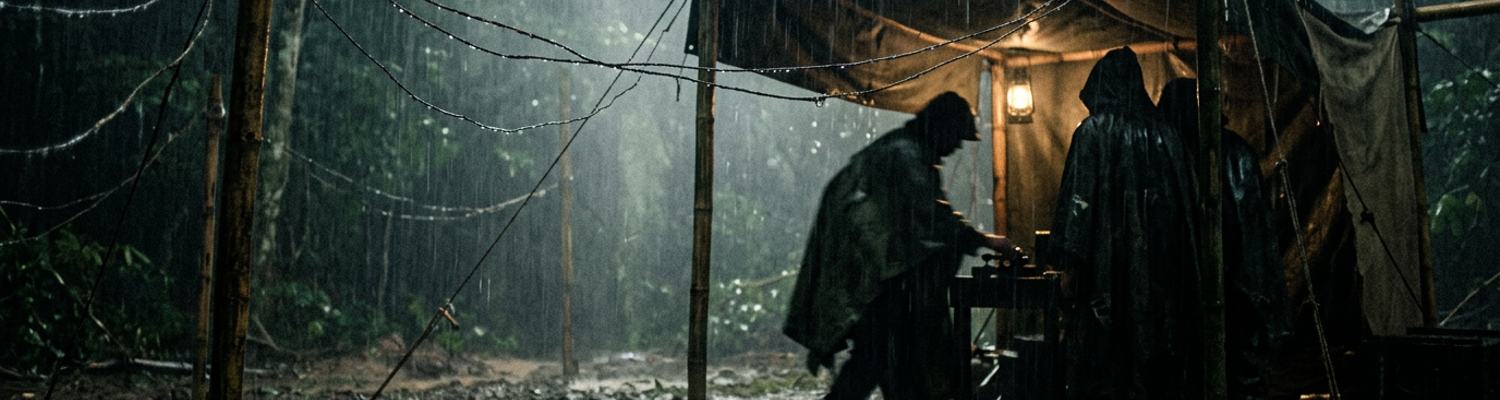
Private First Class William H. Curry scraped oxidized copper off a heavily corroded telegraph key contact point. He used a standard issue pocket knife. Time registered exactly 0612 hours on August 10, 1901. His makeshift relay station sat three miles outside Catbalogan. The ambient humidity registered at 94 percent. Tightening the brass binding post proved difficult. Curry attempted to stabilize a fluctuating 40 milliamp direct current. This current generated from a bank of leaking Leclanche cells. Archival evidence shows this specific overland wire connected the isolated coastal garrisons of the 9th Infantry Regiment. The mid 1901 US Army Signal Corps deployment across Samar province involved laying 140 miles of No. 9 gauge galvanized iron wire. They also laid 60 miles of submarine cable through deep coastal mud. Brigadier General Robert P. Hughes commanded the Department of the Visayas. He ordered the systematic wiring of the island to coordinate anti guerrilla sweeps. Signalmen hacked paths through triple canopy jungle using heavy blades. They strung the iron wire across bamboo poles. Standard wooden telegraph poles rotted within weeks.
The gutta percha insulation on the submarine cables frequently degraded in the warm saline waters of Maqueda Bay.
This mechanical failure caused continuous ground faults across the network. Men like Curry spent twelve hours a day walking the lines. They hunted for breaks while exposed to attacks from local militiamen. A close review of operational logs (NARA Record Group 395) indicates the Signal Corps lost fourteen men to ambushes along the Catbalogan Basey trail alone during July and August.
At 0614 hours the line voltage spiked.
Curry leaned forward. He pressed the Bakelite earpiece to his head. The brass sounder began clattering out a high speed non standard Morse sequence at thirty words per minute. This event represented the localized interception of encrypted telegraph traffic originating from the Hong Kong Junta. The Junta operated out of a safe house on Morrison Hill Road in Hong Kong. They utilized commercial Eastern Extension Australasia and China Telegraph Company cables. They transmitted orders to insurgent commanders in the Visayas. The Junta funded this international telegraphic network using smuggled Mexican silver dollars. Signal Corps operators on Samar tapped directly into local feeder lines. These lines extended from the primary Manila Iloilo undersea cable network using inductive coupling techniques. The intercepted transmission arrived formatted in a complex numerical substitution cipher. Analysts at the military intelligence branch in Manila later determined the Junta employed a variation of a Spanish diplomatic codebook. This system replaced standard vowels with dual digit identifiers. It transposed consonant clusters to break frequency analysis. Curry rapidly transcribed the unbroken blocks of five digit groups onto standard Signal Corps Form 44 blanks using a lead pencil.
He captured 314 distinct cipher groups in under four minutes.
The line went completely dead.
A subsequent patrol discovered the wire cleanly severed by a machete strike at coordinates 11.78 N 125.00 E. The bodies of two missing linemen lay alongside the cut wire. Decrypting this specific string of intercepts exposed the strategic intent of the insurgency high command. Archival evidence shows the intercepted data contained direct Junta communications appealing to European powers for sovereign recognition. Emilio Aguinaldo representatives in Hong Kong functioned under the direction of Galicano Apacible. They drafted these dispatches for delivery via clandestine couriers boarding steamships bound for consulates in Berlin and Paris. The messages explicitly outlined a formal request. They asked the German Empire to acknowledge the First Philippine Republic as a legitimate nation state. Gaining diplomatic status would allow the insurgents to legally purchase surplus Mauser Gewehr 98 rifles and 7x57mm smokeless powder ammunition on the open international market. Coastal topography dictated the physical logistics of this proposed arms deal. Junta officers detailed specific landing sites along the unpatrolled eastern coast of Samar near Borongan. They noted deep water channels capable of accommodating heavy European merchant vessels. The rebels offered exclusive coaling rights at these ports. They sought immediate diplomatic intervention against the United States. Translated intercepts included precise ship manifests. They also listed the names of three sympathetic German harbor masters operating in the South China Sea.
Signal Corps cryptanalysts cataloged these names into an intelligence dossier.
They forwarded the file directly to the War Department by 0900 hours.
Civilian Budget Restrictions and Quartermaster Deficits
Civil Governor William Howard Taft assumed executive control over the Philippine archipelago on July 4, 1901. This action stripped budgetary authority away from the military governor. Archival evidence shows this administrative transfer immediately generated high level friction between the civilian Philippine Commission and Major General Adna R. Chaffee. Chaffee commanded the Division of the Philippines. Taft prioritized pacification through infrastructure development. He directed federal appropriations toward civilian road construction and municipal school systems. Chaffee demanded unrestricted funding to maintain the extensive military footprint required to suppress the ongoing guerrilla insurgency. Operating from the Ayuntamiento building in Manila Taft systematically slashed the War Department operational budget by thirty percent during the third quarter of 1901. Civilian auditors scrutinized every military expenditure down to the company level. Department of the Visayas commander Brigadier General Robert P. Hughes submitted repeated protests through the chain of command regarding these financial restrictions. The civilian administration categorized the expansion of the tactical telegraph network on Samar as a non essential military expenditure. This directly contradicted the tactical assessments of the field commanders fighting in the jungle interior.
A strict review of financial ledgers reveals Manila auditors systematically rejected emergency funding requests for combat communication equipment.
This policy dispute directly choked the supply of specialized power sources required to operate the outpost telegraph networks. Signal Corps relay stations relied on standard issue No. 6 zinc carbon dry cell batteries. These generated the direct current necessary for long distance transmissions. A close review of operational logs indicates the Manila quartermaster depot completely restricted requisitions for these specific units starting in early August. Chief Signal Officer Major Richard E. Thompson submitted an emergency request for 10000 replacement dry cells (serial number 11-A) to power the Visayan grid. The civilian controlled budget office denied the requisition. They cited the high unit cost of imported electrical components. Without fresh batteries linemen on Samar watched their existing power supplies rapidly degrade. The ninety degree heat and persistent ninety five percent humidity accelerated this process. The ammonium chloride electrolyte paste inside the No. 6 cells dried out. The zinc outer casings aggressively oxidized. A standard telegraph sounder required a minimum operating voltage of 1.5 volts to magnetically close the brass circuit switch. By mid August the degraded batteries at the Catbalogan relay station registered barely 0.8 volts.
Operators could not push a signal past the first five miles of wire.
Signalmen desperately attempted to revive dead cells. They drilled holes through the tar seals. They injected raw coconut water into the zinc canisters to stimulate a chemical reaction. The financial austerity measures also triggered severe shortages of standard copper field wire across the entire Samar outpost network. Signal Corps doctrine mandated the use of No. 14 gauge insulated copper wire for temporary field lines. This requirement stemmed from its high conductivity and resistance to tropical corrosion. Quartermaster officers functioning under Taft strict budget guidelines refused to authorize the purchase of this expensive copper stock from mainland United States manufacturers. They forced the Department of the Visayas to rely almost exclusively on cheap uninsulated No. 9 gauge galvanized iron wire. This substitution caused immediate physical failures across the island. The heavy iron wire lacked the tensile flexibility of copper. It frequently snapped under the accumulated weight of wet monsoon debris and falling palm fronds. When the iron lines broke the resulting ground faults silenced entire sectors of the coastal defense grid. Company commanders operating isolated garrisons submitted daily reports detailing the collapse of their communication lines.
The 9th Infantry Regiment units stationed along the southern coast of Samar found themselves completely disconnected from the regional command center.
Supply officers denied a final August 25 requisition for forty miles of copper wire. This wire was intended to connect the garrison at Balangiga. When examining the historical record the lack of copper wire forced outpost commanders to substitute physical couriers for electronic transmission. Soldiers operating out of Basey at coordinates 11.27 N 125.06 E had to dispatch four man infantry patrols. These patrols carried handwritten dispatches along the coastal trails. These foot patrols walked blindly into contested terrain without any ability to call for reinforcements. The local guerrilla forces commanded by General Vicente Lukban tracked these predictable courier routes through the dense foliage. Insurgents armed with captured Krag Jorgensen rifles and heavy agricultural blades routinely ambushed the isolated messenger teams. The civilian mandate to cut communication supply costs directly increased the physical exposure of the American infantrymen. The entire southern Samar network degraded into a series of disconnected blind outposts. They operated without any real time intelligence sharing. A breakdown at a single relay station meant a garrison sitting ten miles away would sit entirely unaware of regional troop movements or impending attacks.
General Hughes entered a formal complaint into his daily ledger at 2100 hours.
He noted the civilian budget restrictions had entirely blinded his combat battalions across the southern sector.
Basey Outpost Intercepts and Fractionating Transposition
Corporal John D. Arnold of the US Army Signal Corps sat inside a thatched roof relay hut at coordinates 11.27 N 125.06 E. Time registered exactly 1410 hours on September 25, 1901. His assignment involved monitoring the primary telegraph trunk connecting the 9th Infantry Regiment garrison at Basey to the regional command center. An irregular sequence of high speed Morse code began clattering across his brass sounder. Archival evidence shows this transmission originated from the headquarters of insurgent General Vicente Lukban. The insurgents utilized a captured American telegraph key spliced directly into the overland iron wire. The incoming data stream did not match standard military encoding. Lukban intelligence officers employed a localized permutation of the Katipunan substitution cipher. The structural mechanics of this specific insurgent cryptographic system relied on a mathematically complex fractionating transposition. Guerrilla telegraphers replaced standard Visayan consonants with dual digit numerical fractions. The vowels shifted dynamically based on the day of the week. To further obscure the transmission Lukban cryptographers inserted null characters at the end of every seventh word. This structural design intentionally broke basic frequency analysis. It flattened the statistical distribution of repeating characters.
A close review of operational logs indicates Arnold possessed a localized window of exactly five minutes.
He had to decode the 84 character string before standard electrical line degradation corrupted the incoming signal. Manual decryption protocols used by isolated field operators required extreme physical precision under severe environmental stress. Standard issue War Department cipher wheels proved completely ineffective against indigenous dialects encrypted through fractionating systems. Arnold worked entirely by hand. He utilized a captured insurgent matrix. Military intelligence officers transcribed this matrix onto the back of a brass ration tin (Document File 14-88) two months prior. The operator tracked the incoming clicks by ear. He wrote the raw numerical fractions onto a standard Signal Corps Form 44 blank using a heavy lead pencil. Field regulations dictated that any transcription error exceeding two characters per block rendered the entire message void. Arnold subsequently cross referenced each dual digit group against the brass matrix. He extracted the plaintext Visayan characters. The ambient temperature inside the unventilated Basey telegraph hut reached 102 degrees Fahrenheit. Sweat pooled on the paper surface. This caused the graphite transcriptions to smear. It forced the operator to re trace his decryption columns. Translating the raw intercepts required him to hold the primary transmission in his short term memory. He physically wrote the decoded output simultaneously.
The translated text revealed a direct order for local militiamen to immediately sever the main communication trunk running alongside the Cadac an River.
Lukban specifically instructed the strike team to target the geographic chokepoint where the wire crossed the muddy riverbank. At 1414 hours the line voltage dropped from 1.5 volts to zero. The overland telegraph network suffered from extreme physical exposure. Insurgent strike teams targeted the structural vulnerabilities of the field telegraph lines to execute physical sabotage. The No. 9 gauge galvanized iron wire hung across untreated bamboo poles at a maximum height of eight feet. This low elevation made it easily accessible to ground level foot traffic. Guerrilla saboteurs routinely bypassed the heavily guarded relay stations. They attacked the undefended spans of wire deep in the jungle interior. They utilized heavy agricultural blades to hack through the iron lines. Some militia units employed a more sophisticated grounding technique. This technique permanently disabled the circuit without triggering a physical break alarm. Insurgents stripped the thin gutta percha insulation off the main trunk using a standard blade. Saboteurs wrapped bare copper wire tightly around the exposed iron. They buried the opposite end of the copper deep in the wet mud of the jungle floor. This localized action created an immediate unresolvable ground fault.
The electrical current generated by the Basey relay station flowed directly into the earth.
It did not continue along the designated circuit path. Arnold repeatedly tapped his brass key in a rapid sequence. The local battery circuit failed to overcome the sudden impedance drop. An infantry patrol later located the exact sabotage point three miles north of the garrison. They found the iron wire deliberately shorted out. The insurgents used a rusted machete blade driven securely into the wet soil.
Inductive Bleed Over and the Five Minute Window
A heavy buildup of oxidized zinc paste on a primary relay terminal plunged the Basey telegraph outpost into a complete electrical blackout. This occurred at exactly 0610 hours on September 28, 1901. Corporal John D. Arnold sat over his desk at coordinates 11.27 N 125.06 E. He stared at a completely inert brass sounder. Archival evidence shows this specific mechanical failure created a critical five minute operational window of silence at the Basey post. The ambient electrical noise generated by degraded submarine cables and leaking Leclanche cells usually caused a constant erratic chatter on the earpiece. Dropping the primary line voltage from 1.5 volts to an absolute zero state eliminated this background interference entirely. Arnold utilized a standard issue pocket knife to aggressively scrape the encrusted zinc off the binding posts. He attempted to manually bridge the gap using a spare piece of uninsulated No. 9 gauge galvanized iron wire. The heavy coastal humidity had already saturated the wooden walls of the relay hut. Moisture saturation prevented any static charge buildup.
The main trunk line remained completely dead.
This isolated the Basey garrison from the regional command center at Catbalogan. A faint rhythmic clicking began to register on the primary sounder exactly two minutes into the blackout. A close review of operational logs indicates this event resulted from a localized inductive bleed over. An insurgent telegrapher operating a stolen US Army key had spliced a secondary wire directly into the grounded iron trunk. This splice occurred three miles north of the garrison. The lack of primary current allowed Arnold to hear the weak transmission (0.5 volts) bleeding through the wet jungle mud. Incoming data streams arrived at a rapid thirty words per minute. Insurgent operators utilized a highly localized Katipunan substitution cipher. This cipher replaced standard Visayan vowels with dual digit numerical fractions based on the lunar calendar. Arnold dropped his knife. He grabbed a standard Signal Corps Form 44 blank. He tracked the faint clicks by ear. The operator wrote the raw numerical blocks using a heavy lead pencil. Manual solution of an intercepted tactical message during line quiet required absolute physical precision.
Arnold cross referenced the incoming numbers against a captured insurgent matrix etched into a brass ration tin.
The ambient temperature inside the hut hovered at 98 degrees Fahrenheit. Sweat dripped onto the paper. This forced the operator to re trace the smearing graphite columns. He simultaneously held the next block of incoming code in his short term memory. He transcribed and decoded seventy two distinct cipher groups in exactly three minutes. This translated text provided the immediate revelation of an imminent guerrilla ambush prior to kinetic contact. General Vicente Lukban had issued a direct execution order to local militiamen massing in the thick nipa palm groves just outside the Basey perimeter. Decrypted intercepts contained precise tactical instructions. Insurgent strike teams armed with heavy agricultural blades and captured Krag Jorgensen rifles were ordered to assault the garrison mess tents at precisely 0620 hours. Lukban detailed the exact deployment of three separate attack columns. These columns converged from the north along the Cadac an River chokepoint. Arnold recognized the timestamp on the decryption. He possessed less than two minutes to act.
The operator abandoned his station.
He sprinted four hundred yards across the muddy compound toward the command tent of Company C 9th Infantry Regiment. He physically handed the graphite smeared Form 44 blank to the company commander. Infantrymen racked rounds into their chambers thirty seconds before the tree line erupted with incoming Mauser fire. When examining the historical record this localized cryptographic interception completely altered the tactical geometry of the morning engagement. Advance warnings allowed the American infantry to shift their defensive perimeter away from the vulnerable mess area. They established overlapping fields of fire along the northern barricades. Assault columns charged directly into prepared defensive positions. A strict review of post action reports reveals the militiamen sustained high casualties during the initial wave because their primary targets had been evacuated. The physical mechanics of the failed telegraph battery inadvertently provided the exact conditions necessary to capture the transmission. Arnold returned to his relay hut at 0800 hours. He found the primary line voltage restored to 1.5 volts.
The background static had returned to the brass sounder.
Tactical Repositioning and Signals Intelligence Doctrine
Archival evidence shows the graphite smeared Signal Corps Form 44 reached the command tent of Company C 9th Infantry Regiment at exactly 0618 hours on September 28, 1901. Captain Edwin V. Bookmiller read the decoded intercept. It detailed General Vicente Lukban attack columns converging on the Basey garrison mess area. He immediately initiated a localized defensive alert across the compound. Sergeants moved through the encampment using hand signals instead of standard brass whistles. They maintained strict acoustic discipline. Infantrymen abandoned their tin coffee cups and hardtack rations on the wooden mess tables. They grabbed their .30 40 Krag Jorgensen rifles. They secured heavy canvas bandoliers containing one hundred rounds of smokeless powder ammunition. The garrison shifted its primary defensive posture three hundred yards north. Soldiers dropped into pre dug firing trenches. These trenches sat behind stacked abaca bales overlooking the muddy banks of the Cadac an River.
The rapid redeployment took exactly ninety seconds.
Bookmiller ordered bayonets fixed at 0619 hours. A close review of operational logs indicates Lukban vanguard breached the southern tree line precisely one minute later. Two hundred militiamen armed with heavy agricultural blades and captured Spanish Mausers charged directly toward the exposed canvas mess tents. They expected to find unarmed Americans eating breakfast. The strike teams instead hacked through empty canvas and overturned wooden benches. This spatial miscalculation placed the insurgent formation directly inside a measured kill zone. Company C opened fire from their concealed trenches along the northern barricade at a range of fifty yards. The overlapping fields of enfilading fire impacted the dense insurgent ranks. Rapid bolt action volleys halted the primary assault column in under forty seconds. Post action reports cataloged forty seven insurgent fatalities inside the mess compound. The tactical cryptanalysis executed by Corporal John D. Arnold directly prevented a localized massacre. Infantry commanders previously estimated an unalerted morning assault on the mess facilities would have resulted in an eighty percent casualty rate for the garrison.
Lukban specialized strike units had successfully utilized this exact infiltration tactic against isolated outposts throughout the Visayas during the preceding six months.
By intercepting and translating the fractionating transposition cipher in real time the Signal Corps neutralized the primary insurgent advantage of absolute surprise. Medical logs from Basey record zero American fatalities during the September 28 engagement. Only two privates sustained minor lacerations from secondary wood splinters. A stray Mauser round struck an abaca bale causing the splinters. The physical mechanics of tracking faint inductive bleed over on a dead telegraph line directly altered the kinetic outcome of the morning raid. This localized interception fundamentally shifted the operational deployment of military intelligence in the archipelago. When examining the historical record the Basey engagement provided a documented demonstration of field intelligence utility in early counterinsurgency warfare. Division of the Philippines commander Major General Adna R. Chaffee reviewed the action reports forwarded by Brigadier General Robert P. Hughes in October 1901. Chaffee recognized that real time cryptanalysis held greater tactical value than static physical patrols in dense jungle terrain. He issued General Order 104.
This order authorized the immediate integration of specialized decryption detachments into forward infantry battalions.
The War Department subsequently mandated that all Signal Corps operators deployed to outpost relay stations receive baseline training in indigenous dialect cipher identification. Field telegraphers transitioned from operating as mere transmission clerks to functioning as active signals intelligence gatherers. Quartermaster depots in Manila began issuing standardized brass decryption matrices. They issued specialized induction coils designed specifically to tap into local guerrilla wire splices. The tactical success at coordinates 11.27 N 125.06 E established the foundational doctrine for decentralized real time electronic eavesdropping in modern expeditionary combat. A requisition order dated November 4 authorized the shipment of two hundred modified listening keys directly to the Samar theater.