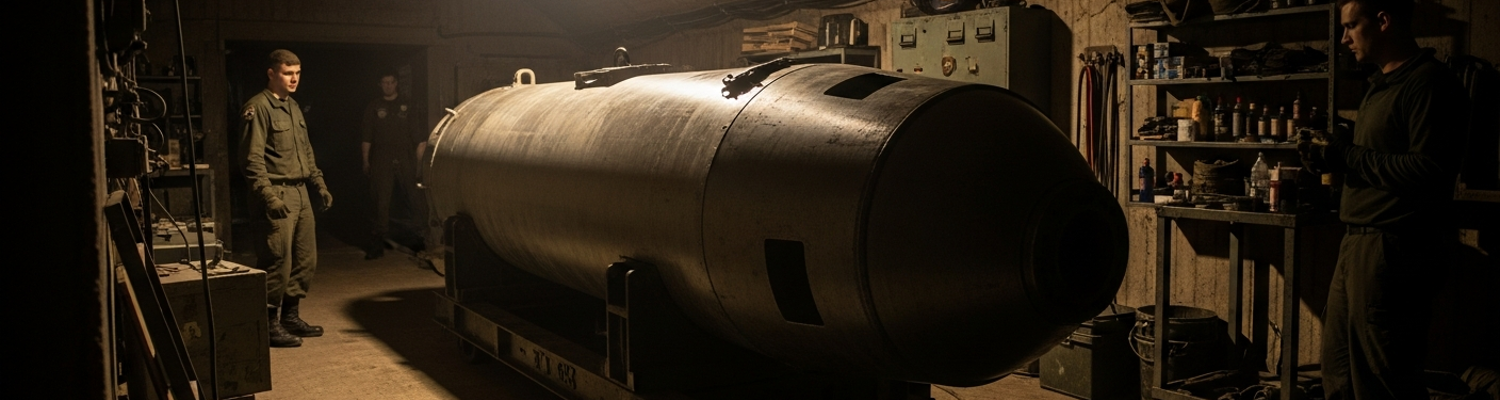

The Mark 12 mine was an idea born of ambition. It was conceived as a sophisticated, standoff area-denial weapon. Unlike contact mines that required a direct strike, the Mk 12 was a ground influence mine. It was designed to rest on the seabed and detonate when a target passed overhead, triggered by the ship’s magnetic and acoustic signatures. Design specifications called for a weapon deployable from submarine torpedo tubes or aircraft, capable of sealing enemy harbors. Weighing approximately 1,545 pounds with a 1,225-pound Torpex charge, the 94-inch-long casing was a formidable piece of ordnance. Bureau of Ordnance planners envisioned a weapon with a ship-counter, allowing it to ignore a preset number of vessels, and a delayed-arming clock. This complexity was a substantial leap from simpler mines.
Translating advanced specifications into a reliable weapon proved difficult for the Naval Ordnance Laboratory (NOL). Early production models were plagued by failures. A review of logs from the first five submarine patrols using the Mk 12 reveals 11 mine failures. A significant number were premature detonations that risked exposing the minelaying submarine. The problem was the intricate M-3 type firing mechanism. This exploder had to be painstakingly set before a patrol, calibrated to the magnetic latitude of the target area. Its network of hydrostatic switches, arming clocks, and magnetic needle sensors created numerous points of potential failure. The exploder's battery life was another constraint, initially around 90 days, after which the weapon became inert metal. These reliability issues demanded that a small cadre of ordnance technicians possess deep knowledge to arm and maintain the weapons. The high failure rate prompted a modification in August 1944, refitting the mines with the improved Mk 3 Mod 2 exploder, which doubled the firing mechanism's sensitivity.
The operational principle of the Mk 12 centered on its magnetic induction fuze. Every steel-hulled ship possesses a magnetic signature, a distortion in the Earth’s natural magnetic field. The mine’s sensitive magnetic-needle-type mechanism was designed to detect this fluctuation, closing a circuit and initiating detonation. This system was potent but susceptible to countermeasures like ship degaussing. To provide redundancy, later influence mines would incorporate acoustic sensors that listened for the sound profile of a ship’s propellers. The challenge for ordnance crews was calibration. Too sensitive, and a small patrol craft could trigger a mine intended for a capital ship. Not sensitive enough, and the target would sail by unharmed. This adjustment was not a simple dial turn but a complex procedure based on intelligence, target priority, and the specific environmental conditions of the planned minefield.
The journey of a single Mark 12 mine from a stateside factory to a forward-deployed submarine was a study in logistical friction. The sensitive M-3 type firing mechanisms were exceptionally vulnerable to the shocks of transport. Each exploder was crated and shipped under high security from the Naval Ordnance Laboratory, often by rail to West Coast ports like San Francisco, before being loaded onto cargo vessels bound for the Pacific. Supply lines stretched thousands of miles to bases like Guam, Ulithi, and Fremantle, Australia. These routes were under constant threat. The loss of a single transport ship could represent a catastrophic setback, erasing dozens of mines and the scarce ordnance specialists required to service them. Submarines themselves carried the mines, with two Mk 12s taking the space of a single torpedo. A Gato-class submarine departing from Pearl Harbor on a minelaying mission, such as the USS Thresher (SS-200) in October 1942, sacrificed significant anti-shipping firepower for the area-denial capability of the mines.
The destination was as hostile as the journey.
Upon arrival at forward depots, the mines entered an environment that was destructive to their design. Naval ordnance manuals from the period contain specific warnings about the corrosive effects of storing mine casings in crates with copper rivets, which could create electrolytic action against the aluminum mine body. In the humid, salt-saturated air of Pacific atolls, this process was dramatically accelerated. Ordnance crews in open-air workshops or sweltering Quonset huts fought a constant battle against rust and moisture intrusion. The problem went beyond blemishes on the 1,500-pound casings. Humidity would seep past rubber gaskets, fogging the delicate interiors of the exploder mechanisms. Condensation could form on battery contacts, leading to power degradation and shortening the mine’s 90-day armed lifespan. A post-mission report from the USS Trigger (SS-237) noted hearing premature detonations after a plant, a failure often attributed to internal electrical faults exacerbated by environmental contamination. The magnetic needle-type firing mechanism, so sensitive it had to be calibrated for the magnetic latitude of its target area, could be thrown off by the slightest internal corrosion.
These challenges were compounded by a persistent scarcity of spare parts and flaws in early production components. A single damaged hydrostatic switch could sideline an entire mine, and replacements were thousands of miles away. There were no local factories to machine new parts. Every screw, gasket, and battery had to traverse the same precarious supply chain. Archival evidence shows that ordnance teams on submarine tenders frequently resorted to cannibalization, stripping components from two or three damaged mines to make one weapon operational. This practice was an inefficient use of time and materiel. Of the 576 Mk 12 mines laid by U.S. submarines, 13 were recorded as immediate failures, with six exploding prematurely. This forced submarine commanders into difficult tactical decisions, sometimes delaying patrols for weeks while waiting for parts or proceeding with a loadout they knew had a high probability of failure.
The successful deployment of a Mark 12 mine depended entirely on a small cadre of naval ordnance technicians. The official rating of Mineman had been established in 1942, formalizing a specialty that demanded cross-disciplinary knowledge of mechanics, electronics, and explosives. These specialists were the sole practitioners of a difficult craft. A review of ordnance manuals, such as the restricted-issue OP 901, shows that preparing a Mk 12 was a multi-stage process. It began with the assembly of the 1,500-pound casing, but the true challenge was the M-3 type firing mechanism. Technicians had to test the hydrostatic switches, verify the clock-delay mechanism, and calibrate the magnetic-needle-type exploder. This was not a simple factory setting. The exploder’s sensitivity had to be manually adjusted based on the specific magnetic latitude of the target area. An incorrect setting meant the mine would either fail to detect a target or detonate on a non-military vessel. This work was performed in the cramped workshops of submarine tenders or in hastily erected Quonset huts on Guam and Fremantle.
This work was conducted under a blanket of operational security.
The submarine minelaying campaign was one of the most closely guarded secrets of the Pacific War. The secrecy extended to the ordnance specialists who assembled and armed the mines. Their work occurred in restricted-access areas on tenders and at shore depots, separated from other ordnance activities. Knowledge of the mine’s vulnerabilities, such as the 90-day battery life or the number of actuations set on the ship counter, was highly classified. A captured technician could have provided the Japanese with the information needed to sweep American minefields effectively. This operational security dictated the handling of the weapons; archival records show that movement of the mines from assembly areas to the submarine was a covert affair, often conducted at night. The existence of the minefields themselves was a secret, their locations known only to a handful of operational planners.
A critical brake on the Mk 12 program was the acute shortage of qualified personnel. The Navy struggled to produce enough Minemen with the requisite skills. Training was intensive. This small pool of experts was stretched thin across the Pacific. It was not uncommon for a submarine, otherwise ready for patrol, to be held in port for weeks, waiting for one of the few available Mobile Mine Assembly Teams to arrive. The loss of a single transport carrying these specialists could delay multiple submarine patrols. This personnel bottleneck created a situation where the number of available technicians, not the number of available mines, became the limiting factor on the offensive minelaying campaign. A post-war review noted that at the end of WWII, the Navy's ability to correctly assemble its mine stockpile was in poor condition, directly leading to the post-war creation of the Mobile Mine Assembly Group (MOMAG) to formalize the role of these technical experts.
Pre-war intelligence and ordnance planning for the Mark 12 mine suffered from a disconnect with the physical realities of the Pacific. A review of operational logs reveals that almost no meaningful reconnaissance was dedicated to the specific environmental conditions where the mines would be deployed. Planners in the United States treated the ocean as a uniform battlespace. They failed to account for the variables of the shallow coastal waters around the Japanese empire. Water salinity, temperature gradients, and unexpected seabed geology were not factored into the Mk 12’s design tolerances. The weapon was designed to be laid in depths between seven and twenty fathoms, but intelligence did not provide adequate data on bottom composition. Mines intended for hard, sandy bottoms were laid in deep silt off the coast of Indochina, where they could be buried, smothering their magnetic signature and rendering the 1,225-pound Torpex charge useless.
This was a weapon fighting the environment before it ever saw the enemy.
The most critical environmental failure was tied to the exploder’s 90-day battery life. This was a known design limitation, but intelligence assessments failed to grasp how the warm, corrosive waters of the South Pacific would accelerate battery degradation and moisture intrusion. A minefield that was theoretically active for three months might have a significantly shorter lifespan. Reports from submarine tenders consistently noted the battle against humidity and salt-air corrosion, problems that were exponentially worse once the mine was submerged. The complex M-3 exploder, with its delicate magnetic needles and hydrostatic switches, was the mine’s brain, and the Pacific environment was inducing a premature death.
Bureau of Ordnance assessments consistently failed to recognize that the Mark 12 program was dominated by logistics, not tactics. Intelligence focused on identifying key enemy shipping channels and harbor entrances. The theoretical capability of a single submarine covertly shutting down a major port like Haiphong was an alluring prospect. Yet, these plans were built on the flawed assumption that the mines would be available and functional. Archival evidence shows that tactical documents rarely addressed the strain placed on the supply chain. Two Mk 12 mines took up the torpedo-rack space of a single Mark 14 torpedo, a significant sacrifice of offensive firepower for a weapon with a high failure rate. Submarine commanders departing from Fremantle or Pearl Harbor were making a tactical gamble dictated by logistical availability, sometimes accepting mine-laying missions only because of a fleet-wide torpedo shortage. The intelligence failure was not in identifying targets, but in failing to report that the weapon system itself was its own greatest obstacle.
This created a chasm between the weapon on the drawing board and its performance in the field. The Mark 12 was designed to be a sophisticated weapon. It incorporated a ship-counter and its magnetic exploder was supposed to be calibrated for specific target classes. The battlefield results tell a story of malfunction. A detailed accounting of the 576 Mark 12 mines laid by submarines shows 13 were immediate, recorded failures. Six of these exploded prematurely, risking the position of the minelaying submarine. An analysis of the first five submarine minelaying patrols reveals 11 distinct mine failures. This poor performance forced a fleet-wide refit in August 1944 to install the improved Mk 3 Mod 2 exploder, a tacit admission by the Bureau of Ordnance that the original design was inadequate. While later analysis would credit submarine-laid minefields with sinking or damaging dozens of enemy vessels, these successes obscure the high rate of attrition and the sheer number of duds that became 1,500 pounds of inert metal on the seabeds of the Pacific. The ship counter was almost never set for more than a single actuation, turning the weapon into a simple device out of fear that the battery would expire before a second target appeared.
A review of naval ordnance records reveals a stark disparity between the intended and actual tactical impact of the Mark 12 mine, particularly concerning the defense of strategic islands. The weapon was conceived as a formidable barrier. In practice, its contribution to the defensive posture of locations like Midway or bases in the Aleutians was negligible. The same systemic flaws that plagued its offensive deployment made it an impractical choice for large-scale defensive fields. A review of after-action reports shows that the approximately 20,000 mines laid in defensive patterns in US waters resulted in no known enemy sinkings. The effort to transport, assemble, and maintain hundreds of temperamental Mk 12s was too great compared to the utility of more conventional defenses. A single faulty hydrostatic switch could render an entire section of a defensive minefield inert.
For island defense, commanders relied on more dependable ordnance. The Army Coast Artillery Corps managed extensive fields of electrically controlled mines in major harbors, a system that was cumbersome but far more reliable than the Mk 12. The failure of the Mk 12 in this role was not due to enemy countermeasures but to its own internal fragility. The complex M-3 exploder, with its 90-day battery life, was ill-suited for the long-term, passive nature of a defensive field. The weapon demanded constant attention it could not receive.
The Mark 12 mine was rendered obsolete not by enemy action, but by its own systemic failures and the emergence of a more effective doctrine. While U.S. submarines did lay 576 Mk 12s, which were credited with sinking or damaging several dozen ships, this figure belies the high rate of failure and the operational cost for each successful detonation. The weapon’s downfall was a combination of factors: a supply chain stretched to its limit, components failing in tropical humidity, a shortage of trained Minemen, and a design too complex for its own good. Japanese minesweeping efforts were not the primary reason for the Mk 12’s limited success; the weapon’s own unreliability did more to undermine the American mining campaign than enemy forces.
Its successor was not a more advanced submarine-launched mine, but a different delivery method.
Beginning in 1943, and culminating in the 1945 Operation Starvation, the focus of offensive mining shifted decisively to aircraft. B-29s based in the Marianas could deliver thousands of mines directly into Japan’s home waters, a feat logistically impossible for the submarine force. These air-dropped mines, like the Mark 25, were simpler, more robust, and could be deployed in overwhelming numbers. Operation Starvation laid over 12,000 mines in the final months of the war, using a mix of magnetic, acoustic, and pressure triggers that crippled Japanese maritime logistics. This campaign sank or damaged more shipping in five months than the entire submarine mining effort did during the whole war. The Mk 12, with its laborious submarine deployment of a few mines at a time, simply could not compete. It became a weapon of the past, superseded by a strategy of mass and aerial delivery.